Archives for November 10, 2018

This couple who retired in their 30s with over $1 million are living their best lives

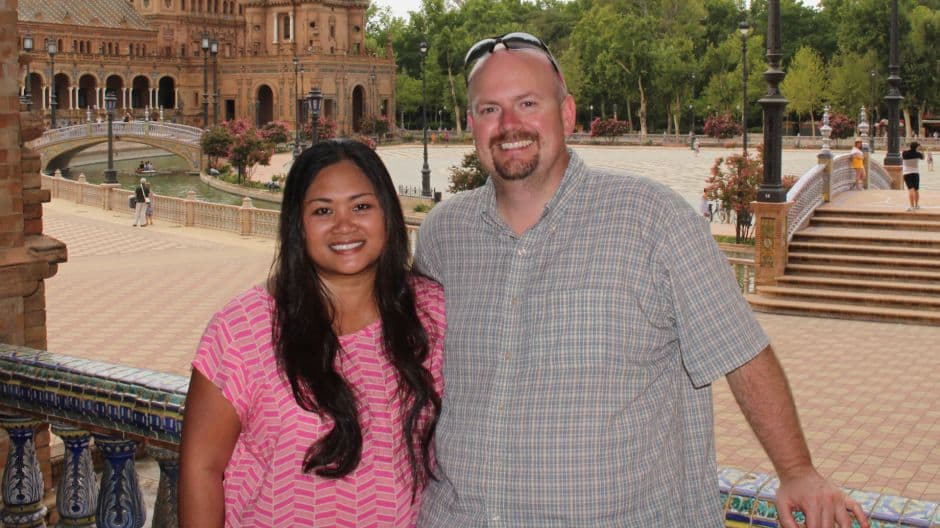
The typical American retires in their early 60s. Justin McCurry, a father of three based in Raleigh, North Carolina, quit his engineering job in 2013 and retired at age 33. His wife, Kaisorn, joined him in early retirement in 2016 at age 38.

“Neither of us ever reached a six figure salary, with my salary topping out at $69,000 and [Kaisorn’s] at $74,000,” Justin writes on his blog, Root of Good, which explains how he saved more than $1 million in 10 years to retire early.

“No winning lottery tickets or inheritances, either,” he says. “Just steady saving and investing in our low cost index fund portfolio year after year.”

Their journey to early retirement began in 2004, when Justin graduated from law school and landed a job at an engineering consulting firm. Kaisorn was still in law school, meaning their combined annual income was Justin’s $48,000 salary. They had a good bit in savings already: Between the two of them, they had accumulated $49,000 from investments during college and grad school.

Over the next decade, thanks to incremental raises and careful saving and investing, their portfolio grew to more than $1.3 million, enough to support their modest lifestyle in retirement.

By carefully tracking their expenses and living frugally in Raleigh, “every year we saved more than half of our income,” Justin tells CNBC Make It. At their peak earning period, they were making a combined $138,000 and saving up to 70 percent of it.

They didn’t just save a ton of money — they put their money to work. “We consistently pumped our savings into 401(k)’s, IRA’s, HSA’s, 529’s, and regular brokerage accounts,” Justin writes. “These investments grew enormously over roughly 10 years and made us financially independent today.”

You can see a detailed breakdown of how their money grew from 2004 to 2014 on their blog.

It’s been five years since Justin left the workforce and two years since Kaisorn followed suit. CNBC Make It, which profiled the couple in April 2017, checked back in with the McCurry family and asked about life in early retirement.

What is your budget in retirement?

Originally, the McCurry’s set their retirement budget at $32,000 a year, which they stuck to in 2014 and 2015. But the budget isn’t set in stone.

In 2016, for example, the McCurrys revisited their portfolio and realized they could increase their retirement budget to $40,000 a year. On the flip side, they can “always trim back on spending in some areas if our investment portfolio performed really poorly or we had an unexpected expense in one category,” Justin says.

They’re still aiming to spend $40,000 a year but, since their portfolio has gone up quite a bit in the past couple of years and they’ve earned money from their blog, “we’re giving ourselves permission to spend $5,000, $10,000 or $20,000 more than that if we find something worthwhile to spend it on,” says Justin.

Flexibility is key in early retirement, he adds: “You may have to spend less if the markets go down. Or, you may be able to spend more than what you originally budgeted for. … As long as you’re OK cutting back on some of the wants if your portfolio goes down, then you can still cover your needs without worrying about depleting your assets prematurely.”

How are you managing family expenses?

Even after the McCurry’s started having kids in 2005, they managed to maintain a high savings rate by taking advantage of the benefits offered by their companies, having family help out with child care and using hand-me-downs.

“We had good health insurance, so we weren’t paying a lot out-of-pocket for the child delivery,” says Justin. “We had Grandma watch the kids — we gave her some money, but it wasn’t $20,000 per year — so we lucked out just by staying close to where we grew up.”

“After childbirth, we didn’t spend a whole lot,” he continues. “We bought a mattress, crib and some child seats, so it was several hundred dollars, but not thousands and thousands. Having kids was kind of a blip on the radar in terms of spending.”

Today, their kids are six, 12 and 13, and they all attend public school. Plus, “we don’t go overboard when there’s the big study abroad, expensive field trips,” he says. “Instead of spending $2,000 or $3,000 to send one of the kids to Spain for a week, we would spend that same amount of money, or less, and to go to Spain for the entire family.”

The couple has already started planning for college costs by setting aside “several years of tuition for each one of them,” says Justin. It’s “not a full ride,” he notes, but “I don’t think it’s necessarily a foregone conclusion that we would pay 100 percent of the price. … So we’re having those discussions with our children about public schools versus private schools, looking into scholarships and getting them ready academically to compete for scholarships.”

Justin estimates that they spend “probably one-half or one-third of what most people report spending on kids.”

According to a report from the Department of Agriculture, families spend $233,610 per child — and that number doesn’t include college costs. Still, “they have phones and they have computers and games and bikes and we go on vacation with them,” he adds. “They have a pretty normal upbringing other than their parents are retired early.”

What does a day in the life of an early retiree look like?

“It’s pretty wide open in terms of day-to-day: Hiking or biking, volunteering at school, tennis, TV on Netflix, video games, board games, reading,” says Justin.

“We get out and about more during the day now,” he adds. “It’s a nice feeling to have that freedom of time. What a lot of people do on the weekends, we do that seven days a week, more or less, now.”

They also have more time to travel: “Every summer we take usually a month or two to go on vacation somewhere internationally, like the Bahamas, Mexico, Europe — this coming summer we’re going to Southeast Asia for eight weeks, so it’s a big shift from the normal vacation of one or two weeks for most working people.”

Their flexible schedule makes it easier to jump on good airline deals and keep travel costs low.

Do you ever miss working?

“No, I have to say definitely not,” says Justin. “There may be some small aspects of it, in terms of working on big projects that I would miss … but in terms of the constraints on lifestyle and requirements to show up every day at 8 a.m. and do things and be on a schedule and have deadlines, I definitely don’t miss at all.”

Kaisorn adds: “For me, the only thing I miss is the interaction with my colleagues. But outside of that, no, I don’t miss the waking up early in the morning and getting home late and hardly seeing my kids.”

Retiring early “was pretty great five years ago and it’s still really great now,” says Justin. “We’re sitting on the couch or outside walking around or going shopping in the middle of the day on a Tuesday. I still get a smile on my face when I sit back and think, Oh, this is our hard work — we put this together and now it’s really working out for us.”

Are there any unexpected challenges of retiring early?

“When you leave your full time job, you leave behind a lot of social interaction,” says Justin. Plus, “work keeps you busy, so you’re not sitting around at home thinking, how do I fill my days?”

“I think the social aspect is an area that people sort of overlook when they’re going into regular retirement or early retirement. How are they going to get out and meet people? How are they going to stay busy and stay active? And I think a lot of the answer to that is to do what interests you and find people who have similar interests in these activities that you do.”

How can other people do what you did?

“I think it’s really comes down to how much can you save and getting your savings rate as high as you can,” says Justin. “I’m not saying sacrifice your quality of life so that you’re suffering and not enjoying life, but be very intentional about your choices,” especially when it comes to “the big three,” housing, food and transportation.

The sooner you start putting your money to work, the more attainable early retirement becomes: “Start early. If you can start in your 20s, perfect. Even if you aren’t able to hit retirement in your 30s, if you start saving in your 20s, you have a much, much better chance of being able to retire in your 50s.”


Setting Up a Trust Fund

TRUST FUNDS ARE OFTEN associated with well-heeled individuals and affluent families looking to pass on their wealth to future heirs. But the reality is there are a variety of advantageous reasons to set up a trust, even if you aren’t especially rich. Still, establishing up a trust fund isn’t easy. Before you go through the process of opening a trust, consider the steps required, how a trust is structured and the ways in which a trust can help protect your assets and preserve your wealth for successors.

What Is a Trust Fund?

A trust fund refers to a fund made up of assets, such as stocks, cash, real estate, mutual bonds, paintings or antiques, or even a business, that are distributed after a death. The person setting up a trust fund is known as the grantor, while the person, people or organization receiving the assets are known as the beneficiaries. And the person the grantor designates to ensure his or her wishes are carried out is the trustee. While setting up a trust may seem similar to drawing up a will, they’re two different legal vehicles: A will details what you would like to happen to your assets after your death, while a trust fund ensures that it will happen.

Why You May Need a Trust Fund

You may be considering setting up a trust not only because you have a complicated financial situation and you want to preserve your heirs’ wealth through asset distribution, but also to seize upon other financial advantages.

Trust funds offer a variety of benefits, including tax advantages such as reducing estate and gift taxes and asset safekeeping. With a trust fund, you can establish rules on how your beneficiaries spend the money and assets you’ve allocated through provisions. For instance, you may want to set up a trust to guarantee that your money will only be used for a specific purpose, such as going to college or starting a business.

For families, there’s another compelling reason to set up a trust fund. “A trust fund can be set up for minor children, to distribute assets to adult children over time – for instance, at ages 25, 35 and 45 – in order to give them more than one chance to not blow an inheritance,” says Kathy Fish, a certified financial planner and president of Fish and Associates, a financial planning firm in Memphis, Tennessee. Plus, “it can be used for children with special needs, so that they are not disqualified from government benefits,” she explains. Because the assets in the trust aren’t actually owned by your kids (and aren’t considered part of their wealth), they wouldn’t lose out if those benefits are eliminated or reduced, such as Medicaid or Social Security income. In short, setting up a trust for a child with disabilities can help provide them with financial security once you’re no longer around.

“Some trust funds are set up to keep money in the family in a case of death or divorce. These are all high-level reasons, but they are indeed useful for middle class and wealthy families,” Fish says.

How to Set Up a Trust Fund – and When to Seek an Estate Planning Attorney

“First, determine the purpose the trust will serve,” advises Claire Steinman, an estate planning attorney and partner at Wingate, Kearney & Cullen, LLP in Brooklyn, New York. “There are many types of trusts, such as charitable trusts, life insurance trusts, revocable trusts and irrevocable trusts,” she says. A charitable trust is simply a trust that gives your assets to a charity. With a life insurance trust, instead of the money going to the beneficiary, the trustee would manage it and administer it to the beneficiary. A revocable trust means that you can make later tweaks to the trust, such as who the beneficiaries are; with an irrevocable trust, you can’t make changes.

“Whatever the individual’s needs are, the types of trusts should be discussed with an attorney to determine what is the best fit,” Steinman says. An estate planning attorney or financial planner is generally the ideal advisor to connect with when starting a trust fund. Whatever type of professional you use, he or she can help you understand the steps you’ll need to take, such as registering the trust with the IRS, transferring your assets to the trust fund and ensuring your paperwork is in order. Another hurdle a professional can help you navigate is familiarizing yourself with the nuances of trust law, which varies according to state.

After you find a qualified attorney or professional to work with, such as an investment advisor, they’ll draw up a legal document. You’ll also need to decide who your trustee will be. You could pick a friend or a relative, or it could be your spouse. But you want that person to be reliable and level-headed. Or you could pick a corporation, like a bank or trust company, to be your trust fund’s trustee. That can get costly, though; typically, a bank or corporate trustee will charge 1 percent of the trust’s assets a year to manage the funds.

Keep in mind, if you do pick a family member or friend, you should also select a successor, or allow your trustee to designate one, in the event something should happen to your trustee.

Pitfalls to Avoid When Setting Up a Trust Fund

There are a variety of mistakes to avoid when establishing a trust fund. You’ll want to carefully consider how you structure the trust. After all, you don’t want to put a lot of money into an irrevocable trust and then later decide you want to make changes. Additionally, “assets must be transferred into a trust to fund it,” Steinman says.

People make the effort to have a trust written and then neglect to add their assets to the fund, Fish explains. “Then, at death, the estate may still have to go through probate.”

It’s an understandable blunder, according to Steinman. Transferring those assets “can be an arduous process, requiring trips to the bank and lots of paperwork.”

Remember: A trust is essentially a record of assets for your beneficiaries after you’re no longer around. It isn’t enough to record in your will that you want all of your earthly possessions to be doled out to family and friends. For instance, if you have property that needs to go into the trust, the deed has to be transferred into the trust. And if you want to sell the property or other assets later on, you would likely have the trust sell it, but it’s best to consult an attorney. And keep in mind, if you want a beneficiary to have a certain amount of money, you need to put that money into the trust.

Another common misstep: Giving the trustee too many rules, says Adam Fleming, a partner and attorney who works in the estate planning group at WilliamsMcCarthy LLP, a law firm in Rockford, Illinois.

“While thinking through the guidelines to give your trustee for distribution of trust assets is a good thing, in our practice, we often try to dissuade clients from adopting detailed and rigid rules for asset distribution in their trusts,” Fleming says. “Life has a habit of developing in unpredictable ways, and no matter how many permutations of a possible situation a trust grantor has provided for, it is impossible to predict every possible circumstance. For this reason, setting forth general guidelines for use of trust assets is usually a better approach than laying down detailed rules.”

This is what Sarah Michelle Gellar did with her first ‘Buffy’ paycheck

Today Sarah Michelle Gellar is an actress, co-founder of organic-baking mix company Foodstirs, wife to Freddie Prinze Jr. and mom to two young kids. But In the 1990s, Gellar was a teen icon.

Even then though, she was refreshingly responsible with her finances.

Gellar, 41, has been acting since she was a kid — from a series of Burger King commercials in the early 1980s to a role on “All My Children” in the mid ’90s. But she may be most well-known and loved for starring in the WB’s hit show “Buffy the Vampire Slayer,” which debuted in 1996.

So what did a teenage Gellar do with her first “Buffy” paycheck?

“I saved it, ” Gellar tells CNBC Make It.

“I think I was very well aware already…you heard all those stories about actors that make money and people run off with it. And I remember thinking, ‘If I ever had money like that, I would know where it was at all times.'”

Still, Gellar did treat herself one thing: a new car. But even that she did responsibly.

“I remember I was the last one to get a new car,” Gellar says, referring to her “Buffy” co-stars. “I got a new car the second season of the show. I was the last one; everyone else had gotten it.

“Until I was totally sure, I was not ready to trade in my poor, sad first car…a green, Chrysler Lebaron. It was pretty awful,” she says.

When Gellar finally swapped her Chrysler for a Land Rover Discovery, even that purchase was far from impulsive.

“I was stressed,” Gellar remembers.

She grew up in New York City, she says, where many people never learn how to drive because of the convenient public transit. “I didn’t know much about cars. I remember going, ‘I’m going to get a Range Rover when I learn how to drive and get a license,’ not understanding how expensive Range Rovers were.

“So the first time I saw how much a Range Rover was, I said, ‘I am not getting Range Rover.’ Needless to say, I’ve still never had a Range Rover,” Gellar adds. (Land Rover makes both Land Rovers and Range Rovers, but that latter is more focused on luxury.)

Splurging was just not her spending style.

“I’m a saver…” Gellar says. “I know you can’t take it with you, so it’s not necessarily about saving it for a rainy day, but making sure I was in a place where I could always have a roof over my head.”

Retired and Loving It? The Differences Between Happy and Unhappy Retirees

SOME RETIREES ARE happy, while others are downright miserable. According to financial planners, what separates the happy retirees from the unhappy ones comes down to getting a few things right in pre-retirement planning. Financial advisors say happily retired clients are financially stable and have properly thought out and planned their retirement. Here’s what differentiates the happiest retirees.

The freedom of being debt-free. Retirees without any debt have more flexibility to spend money on their current lifestyle and less stress about making ends meet. “One of the biggest things that differentiates the people who are happy or unhappy is, ‘Did they pay off their mortgage?'” says Paul T. Murray, principal at Wealth & Advisory Associates in Chalfont, Pennsylvania. “Paying off your mortgage is critical.” The weight of the home mortgage and other debt weighs on people mentally, and forces some into part-time jobs they may not want.

Monitoring spending. Uncertainty about how you will pay your bills can cause problems in retirement. Developing a simple budgeting system can make it easier to track your finances and adapt to changes. “People who are doing well have a practical spending and budget system,” says Dan Prebish, director of life event services at Wells Fargo Advisors. “They are not necessarily people who do elaborate accounting and are always on the computer trying to keep track of every penny. Some people have a simple methodology, but they know what they’re spending.”

Clear communication with a spouse. Both members of retired couples should pay attention to the household budget. “For a couple, I think people are most happy who talk about financial issues regularly, even if the wife handles most of the finances and the husband is not interested,” Prebish says. “The fact that we sat down and had a little report seems to be a hallmark of successful, happy and thriving retirees.” Financial communication also helps couples to be better prepared if the spouse who handles the finances dies or is incapacitated.

Diverse income sources. The retirees who are most content have not only saved well, but they have saved the right way. That means they have income from multiple sources in retirement. For example, you probably don’t want all of your retirement income to come from a tax-deferred 401(k) plan or IRA. “A lot of retires save tons (of money), but they are facing taxes on income, and now they realize they are not in a lower tax bracket as they thought,” Murray says. “Some of the most successful (retirees) have converted their IRAs into Roth IRAs. The benefit is when they pull income out, it is free of taxes.”

An active social life. Retirees need to take action in order to maintain a social life. “People are happy who move to a community where they have friends or can make friends or have activities that reinforce what they like to do – arts, or being by the water or having an active network,” says Janet Taylor, a psychiatrist and certified life coach. “When people, especially couples, have a sense of purpose and have activities that support their values (they are happy). That includes volunteering, giving back to the community and living in a way that reinforces their sense of purpose and value.”

A lifestyle plan. The happiest retirees have a plan for how they will spend their time and carry it through. “I would say the one underlying theme with happy retirees, aside from the financial, is they are engaged, they have hobbies and things they want to do. Now, this extra time is letting them do it,” says Bill Van Sant, senior vice president and managing director at Univest Wealth Management in Souderton, Pennsylvania. “If I see retirees keeping busying, supporting causes or grandkids, I find overwhelmingly that those folks are more happy versus those who may be well off, but don’t have a hobby or have physical limitations. Those retirees are not that happy. They are getting bored and are not getting enjoyment.”

There are some people who don’t enjoy being retired. “Some folks don’t retire. They go back to work,” Van Sant says. “I find folks today delay retirement, not because they need money. They don’t have the desire to do anything but work. They will never be happy retired.”

Can this carbon capture technology save us from climate change?

The UK’s Drax power station is set to begin a pilot project testing Bioenergy Carbon Capture and Storage.

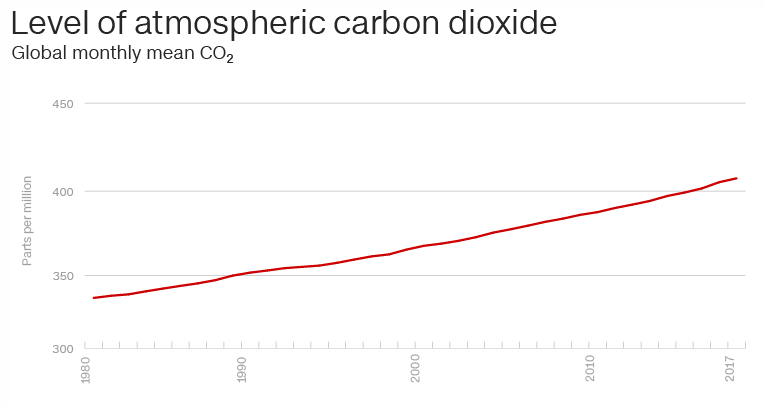
London – It’s a stark prognosis: To save the world from the worst effects of climate change, it’s likely not enough to cut carbon dioxide emissions; we need to start scrubbing carbon pollution from the atmosphere, too.

And not just a little bit of carbon. Vast amounts of it.

The problem is, the jury is still out on whether that’s even possible.

Last month, a report from the global authority on climate science, the Intergovernmental Panel on Climate Change (IPCC), warned of the catastrophic consequences likely to result if humans cause global temperatures to rise more than 1.5 degrees Celsius above pre-industrial levels. The group also said that if we want to stay below the 1.5 degree limit, we’ll need to use technologies that remove carbon dioxide (CO2) from the air.

But the report noted that carbon removal at the scale that’s likely required is “unproven and reliance on such technology is a major risk in the ability to limit warming to 1.5°C.” In other words, don’t solely bank on an unproven technology when your future is on the line.

Burning fuel to clean the air

Just how much CO2 we need to pull from the air depends on how much of that heat-trapping gas we keep pumping into the atmosphere.

If we fail to make dramatic cuts — which is how things stand with current global emissions pledges — by the end of the century we might need to remove a total of around 30 times the CO2 that the world currently emits each year, according to the IPCC report.

There are many methods we might use to remove CO2 from the air, from the low-tech — simply planting more trees — to the speculative — adding iron to the oceans to speed the uptake of atmospheric CO2 by microscopic plant life.

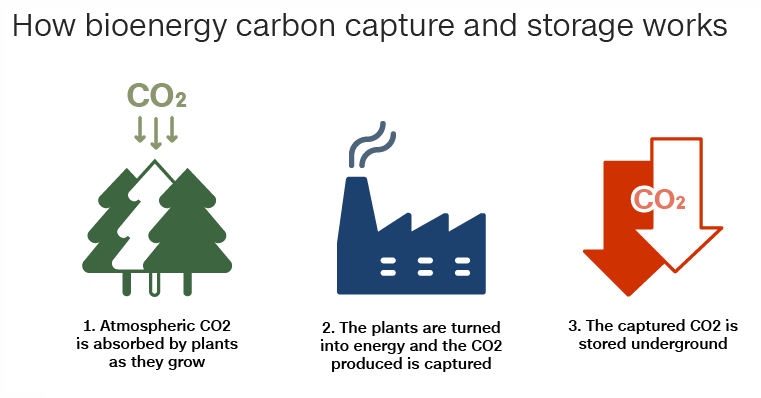
But one method that’s got a lot of attention from IPCC scientists is known as Bioenergy with Carbon Capture and Storage, or BECCS. Essentially, it means growing bioenergy crops and then burning them at power stations to create energy, while capturing the CO2 that’s emitted.

When the bioenergy crops grow, they absorb carbon dioxide from the atmosphere. As long as the CO2 captured when they are burned is safely stored, the process is considered carbon negative.

Of course, it’s not quite that simple. Growing, collecting, transporting and processing the crops will have a carbon footprint, but advocates believe that if the process is well managed, BECCS can be an important tool in removing atmospheric CO2.

Along with tree planting, BECCS is the CO2 removal method most used by the IPCC in its scenarios for limiting global warming.

Niall MacDowell, who leads the Clean Fossil and Bioenergy Research Group at Imperial College, London, says: “BECCS tends to come out as the preferred technology in many of the scenarios because in addition to removing CO2 from the atmosphere, it also generates power and is therefore a more cost-effective way to deliver these negative emissions.”

The problem with BECCS

Inevitably, BECCS has its drawbacks.

As well as the difficulties in ensuring the bioenergy is carbon neutral, there is the problem of carbon capture.

“There are very few examples of carbon capture and storage at large-scale power generating facilities that have come in on cost and work as expected,” says Glen Peters, research director at the Center for International Climate Research, in Norway.

“Large-scale” is the key adjective here for carbon capture, but even more so for bioenergy.

In some emission scenarios, a land area bigger than India would be needed to grow the required bioenergy crops.

That land might otherwise be used for forestry or to produce the food needed by a growing global population. Then there’s the question of how much water is needed, and how much carbon is released by converting land for growing bioenergy crops.

But MacDowell has studied the potential for BECCS to be rolled out at scale and believes it is possible, in theory at least.

“My research indicates it can work but you have to be very careful to do it the right way,” he says.

“If one were not careful to astutely manage and optimize the entire supply chain, starting from land that’s used for production of biomass right the way across the supply chain to harvesting and processing and final conversion to an energy product and effective sequestration of the CO2, then it might not work.”

But on top of the land needed to grow the crops, there is the land needed to store the CO2 indefinitely, and the infrastructure needed to move the CO2 there.

Power station pilot

So is BECCS a dead end? A dangerous distraction from the crucial business of cutting emissions? Some argue exactly that. Others see huge potential.

There are some small BECCS projects already running, but this month, a facility in the north of England is set to become the first power station in the world to start piloting the technology.

Drax power station provides about 6% of the UK power supply. When it opened in the 1970s it burned only coal but these days, four of its six generators are powered solely by biomass.

Biomass domes at Drax.

It claims that by using sustainably sourced biomass from managed forests in the United States, it saves at least 80% of the CO2 it would have emitted by burning coal (the missing 20% is down to supply chain emissions).

Remember, burning biomass still emits CO2 (actually, slightly more than coal, per unit of energy produced), but if Drax can capture that and either reuse or store it, then in theory, the process becomes carbon negative. Power generation that actually removes atmospheric CO2.

Drax is working with a local company called C-Capture, which has developed a chemical to trap the CO2 from its biomass flue gases. The technology has been tested in the lab and the plan is to trial it at the power station.

If Drax were to scale up the technology, Koss says a pipeline could be built to deliver the CO2 to disused North Sea oil or gas fields or aquifers, for long-term sequestration.

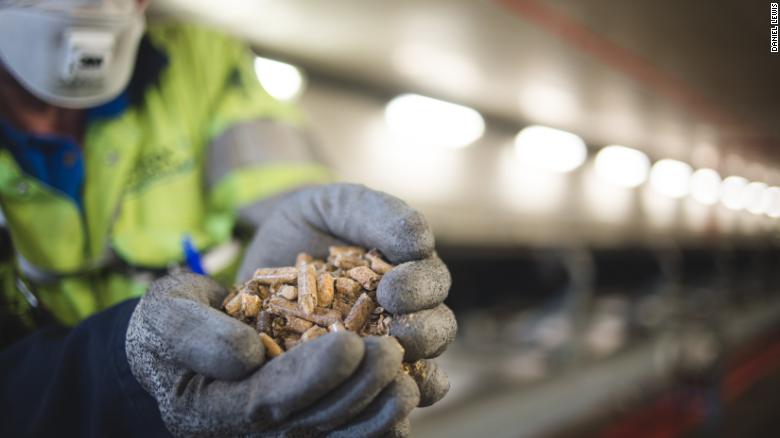
The biomass pellets used at Drax

If other power stations and heavy industries in the region were to also implement carbon capture, Koss says they could hook up to the same pipeline, driving down costs.

But experts say that at the moment there’s little economic incentive for large BECCS projects, and that governments should be providing more support.

The risk we’re taking

Koss sees scope for some large-scale BECCS deployment around the world, but acknowledges there are limits to the amount of sustainable biomass that can be produced.

If BECCS has a role to play in carbon removal, it will need to be alongside other methods.

“The least helpful thing we can do at the moment is get captured by some sort of hype cycle where we get overly excited by one technology,” says MacDowell.

When it comes to fighting climate change, experts say the priority must still be to reduce emissions immediately.

Peters warns of the dangers of us cutting emissions too slowly, in the hope that an unproven technology will one day make up for our inaction.

“The IPCC scenarios (for reducing emissions) are based on the assumption that we have large-scale negative emissions,” he says. “The risk there is that we’re choosing a pathway today that depends on us having this technology in the future — if we don’t have this technology, future generations will pay the consequences.”

Pressure BioSciences’ Ultra Shear Technology system may solve the cannabinoid delivery issue

Ultra Shear Technology can extend the shelf-life of milk and other liquids, such as CBD oil

The company’s technology creates nano-scale emulsion mixtures that allow fluids to mix that normally don’t mix, such as CBD oil and water

Pressure BioSciences Inc (OTCQB:PBIO) is advancing the development of its Ultra Shear Technology system, announcing Friday that it has completed its first working prototype.

The system applies high pressure to create intense, momentary liquid shearing forces at controlled temperatures that result in the scalable homogenization of liquids, creams and gels. The intense pressure reduces heat exposure in the preservation process.

In practice, the technology can extend the shelf life of milk and other liquids and also may be useful in the cannabinoid industry. The technology creates emulsion mixtures at a nano-scale that allows fluids to mix that normally don’t mix, such as oil and water.

“Since nanoemulsions are known to be well absorbed by the body, any method that could transform CBD Oil into a stable, water-soluble nanoemulsion would help solve one of the most critical problems in the cannabis industry today — the CBD delivery system,” said newly appointed Chief Commercial Officer Bradford Young in the company’s press release.

The company noted that the CBD market is expected to grow to $2.1 billion by 2020.

Young’s appointment was announced yesterday and CEO Richard Schumacher said the timing couldn’t be better as the company looks to expand the reach of its technology into other markets, including cosmetics and nutraceuticals.

Shares of the Massachusetts-based company were flat at $3.15 in Friday morning trading.