Archives for March 29, 2018

3 High-Growth Stocks That Could Soar

With the market near historic highs, investors might be wondering if there are any solid growth plays left. The answer is simple: There are always plenty of growth stocks with upside potential if you know where to look.

Today, three of our Motley Fool investors will highlight their favorite growth plays for this market: JD.com (NASDAQ: JD), Booking Holdings (NASDAQ: BKNG), and Mastercard (NYSE: MA).

A businessman watches a chart of rising returns.

China’s second-largest e-commerce company

Leo Sun (JD.com): JD.com is China’s second-largest e-commerce company after Alibaba (NYSE: BABA). Between 2014 and 2017, JD.com’s share of the Chinese e-commerce market grew from 18% to 33%, according to Analysys International Enfodesk. During the same period, Tmall’s shares slid from 55% to 51%.

Market share growth was fueled by four factors. First, JD gained new customers as many smaller business-to-consumer marketplaces collapsed. Second, its biggest investor is Tencent (NASDAQOTH: TCEHY), which owns WeChat, China’s most popular messaging app. Tencent’s integration of JD’s marketplace into WeChat significantly strengthened JD’s position against Alibaba.

Third, JD attracted partnerships from a growing list of companies, which want to counter Alibaba’s growth, and co-invested in other retailers with Tencent. These moves further widened its moat against Alibaba. Lastly, JD owns and operates its own warehouses and logistics network, while Alibaba mainly relies on third-party merchants and logistics providers. This makes it easier for JD to keep counterfeit products out of its marketplace.

Revenue rose 40% to $55.7 billion in 2017, while its non-GAAP net income jumped 140% to $0.8 billion. It also reported a GAAP profit of $18 million, compared to a net loss in 2016. Analysts expect JD’s revenue and non-GAAP earnings to rise 30% and 64% this year. The stock still trades at a reasonable 48 times forward earnings, indicating that it could still have room to run as it ramps up the pressure on Alibaba.

Let this stock take you higher

Dan Caplinger (Booking Holdings): The travel industry proved to be one of the easiest areas for the internet to disrupt, and Booking Holdings has been involved in that transformation from the beginning. Formerly known as Priceline Group, Booking Holdings changed its name to reflect the central role that its Booking.com hotel reservation website plays among its extensive group of websites. Yet you’ll also find other key players under its corporate umbrella, including the Priceline, Kayak, and Cheapflights travel sites and the OpenTable reservations specialist.

Even though the company has grown extensively in the past 20 years, Booking Holdings has still been able to sustain impressive growth rates. In its most recent quarter, the company sported revenue and adjusted earnings gains of nearly 20%, led largely by its core hotel booking activity across its platforms. Consolidation within the industry has put a huge portion of the overall online travel business in the hands of just a few different companies, and Booking Holdings hasn’t hesitated to make strategic moves where appropriate. With solid economic conditions across most of the globe and rising interest in travel, Booking Holdings has established itself as a key growth leader and is likely to hold on to that role for years to come.

A multibagger stock with solid growth potential

Neha Chamaria (Mastercard): Mastercard’s growth in recent years has been phenomenal. A surge in digital payments, driven largely by e-commerce, has pushed the payments processing giant’s revenue higher and higher as more and more people across the globe purchase goods and services using the company’s co-branded credit and debit cards. Mastercard shares have doubled in just the past three years. In 10 years, the stock has risen sevenfold.

Mastercard is a typical growth company that plows back more money into the business than give away to shareholders. The strategy has paid off handsomely, as is evidenced by its high 30%-plus returns on invested capital in each of the past nine years. Not surprisingly, the stock has soared.

The good news is that Mastercard has tremendous growth potential left as the digital economy expands, especially in populous nations like India that are still primarily cash-driven and where Mastercard has already established a solid presence. Meanwhile, to ensure it stays updated on the technology front, Mastercard is aggressively adopting emerging trends such as artificial intelligence, which should pave the way to a more secure, advanced, and a widely accepted payments network.

Given Mastercard’s solid operational and financial standing and the significant growth catalysts ahead, I wouldn’t be surprised to see the stock continue to soar in the coming years.

Can Anyone Catch Waymo’s Self-Driving Jaguar Taxi Fleet?

Waymo, the self-driving subsidiary of Alphabet (NASDAQ: GOOG) (NASDAQ: GOOGL), announced that it will begin rolling out a new autonomous ride-hailing service in U.S. cities later this year — and its riders will be able to select a self-driving version of Jaguar’s new electric I-Pace.

At a press conference in New York on Tuesday, Waymo CEO John Krafcik and Jaguar Land Rover CEO Ralf Speth outlined a “long-term partnership” between their companies, under which Jaguar will supply Waymo’s new service with “up to 20,000” I-Paces over the next two years.

These announcements have huge implications, not just for the two companies involved, but for rivals like General Motors (NYSE: GM), Tesla (NASDAQ: TSLA), and Uber Technologies as well. Here’s what I learned at the press conference, and a few first thoughts about what it might mean for some of the other companies sprinting toward the self-driving finish line.

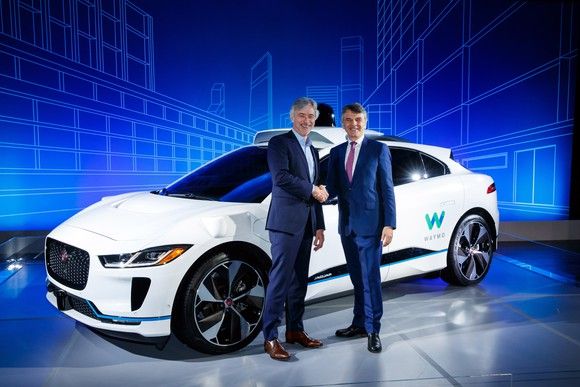
The two executives are standing in front of a white Jaguar I-Pace SUV with Waymo logos and visible self-driving sensor hardware.

Launching this year: Automated ride-hailing from Waymo

Although they were folded into one presentation, Krafcik really made two separate big announcements on behalf of Waymo:

  • Waymo will begin rolling out a commercial self-driving ride-hailing service in U.S. cities this year;
  • A self-driving version of Jaguar’s new electric I-Pace will be one of the vehicles available to customers of that service.

Details around the first point are still fuzzy. Krafcik didn’t give a timeline for the rollout of Waymo’s commercial ride-hailing service, except to say that it will begin this year in Phoenix. He said that it will expand to other U.S. cities in time, though he declined to say which cities were in line to follow the Phoenix rollout.

But he was willing to say quite a bit about the Waymo-ized Jaguar I-Pace:

This is a production-ready vehicle with self-driving technology that’s ready today. These vehicles will start testing this year and will become part of Waymo’s driverless transportation service.

With this partnership, we can add up to 20,000 I-Paces to Waymo’s fleet in the first two years of production. To put that into some perspective for you, those 20,000 self-driving vehicles can serve about a million trips in a single day.

If Waymo buys all 20,000, that’s a lot of I-Paces

Jaguar revealed the production version of the I-Pace last month. It’s a fully electric midsize crossover SUV with dual motors and a 90 kilowatt-hour battery pack. It’s not quite a direct Tesla challenger — it’s somewhat smaller than a Model X — but it’s clearly aimed at the same kinds of customers.

Tesla has shown that there are quite a few well-heeled customers willing to buy a good electric vehicle, and early indications have been that demand for the I-Pace is likely to be quite strong. But if Waymo takes all 20,000 I-Paces, that will likely represent a big slice of Jaguar’s total production over the next two years. My guess is that with production lines running flat-out, Jaguar will be able to build a total of something like 50,000 I-Paces between now and the end of 2019.

These vehicles won’t be cheap. For retail buyers of the non-self-driving version, the I-Pace will start at $69,500 (before government incentives) when it goes on sale in the U.S. later this year. (Given the constraints on supply and the early indications of demand, I have to wonder whether Jaguar is giving Waymo much of a discount.)

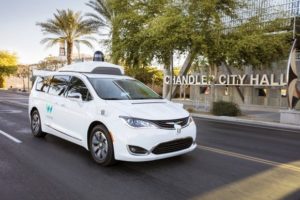
A white Chrysler Pacifica Hybrid minivan with Waymo logos and visible self-driving sensor hardware on a city street in Chandler, Arizona.

Waymo’s electric Jaguars will join, not replace, its existing fleet of Chrysler Pacifica minivans. Image source: Fiat Chrysler Automobiles.

The I-Pace won’t be the only Waymo vehicle
Krafcik didn’t give a lot of detail on Waymo’s upcoming offering. But it’s clear that these new self-driving I-Paces will co-exist alongside Waymo’s Chrysler Pacifica Hybrid minivans, rather than replace them.

When people use Waymo’s service, they’ll have access to a broad selection of vehicles tailored to their trip. They can choose a minivan if they’re traveling to soccer practice with the family — or if two people are running a quick errand, why not take a self-driving Jaguar? [Emphasis added.]

Translation: Jaguar is joining, not replacing, Fiat Chrysler Automobiles (NYSE: FCAU) on Waymo’s special-friends list. There may still be room for other automakers to join as well.

What it means for Jaguar

Jaguar Land Rover has thrived as a subsidiary of Indian automaker Tata Motors (NYSE: TTM). But as a smallish manufacturer, it hasn’t had the resources to invest in a full-blown self-driving development program of its own.

That had the potential to become a problem in a few years. It has long seemed likely that self-driving capabilities will come to the retail automotive market in luxury vehicles at first. That’s the usual vector for new technologies: Luxury vehicles sell in relatively small numbers and at high prices; and luxury-brand customers are typically willing to pay higher prices than mass-market customers for new technologies.

For Jaguar (and Land Rover), which can’t really match the resources being thrown at autonomous-vehicle research and development by companies like Mercedes-Benz parent Daimler, BMW, and Audi (not to mention Audi parent Volkswagen AG), the most realistic option has been to wait for an upcoming off-the-shelf system from a supplier like Aptiv. That would get Jaguar in the game, but at a cost: a perceived gap in technical sophistication versus the German brands, in a market where technical sophistication has become an important selling point.

By teaming with Waymo, Jaguar closes that gap (at least to some extent) in public perception. While it isn’t yet clear whether Jaguar will be able to (or will want to) offer I-Paces equipped with Waymo technology for sale to retail customers, there will be other advantages to the association. For starters, it’ll give lots of people the first-hand experience of riding in a Jaguar — an electric Jaguar, no less — and those riders might end up buying a fair number of I-Paces.

What Waymo gets out of the deal

This is simple: Waymo gets a technically advanced premium electric vehicle for its fleet, from an automaker that can build reliable vehicles at scale and isn’t trying to compete with it on self-driving. Nothing bad about that.

What it means for Tesla

“I’d like to introduce to you all the world’s first premium electric fully self-driving car,” said Krafcik, right before the curtains opened to reveal the Waymo-ized I-Pace.

That sure sounds like a dig at Tesla, doesn’t it? I was at Waymo’s press conference, and my impression was that it sounded that way to many, if not most, of the folks in the room. Tesla has certainly talked a lot about self-driving technology and about potential future “mobility”-related businesses. In fact, it’s probably fair to say that those two things are nontrivial parts of Tesla’s current Mars-high valuation.

And Tesla just got beat on both, by the most credible self-driving technology developer working in partnership with an automaker that will have no problems with “production hell.”

The implication for Tesla isn’t good.

What it means for General Motors

GM has said that it will begin rolling out its own autonomous ride-hailing service in 2019. It has also said that it thinks the first company to deploy self-driving vehicles at scale will have a significant first-mover advantage.

As of right now, it looks like GM will be second to market, not first. It also looks like Waymo is piecing together a more complete offering, with a selection of vehicles that may take GM a couple more years beyond 2019 to match.

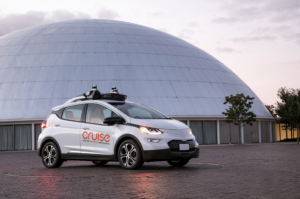
A white GM Cruise, a compact self-driving vehicle.

Will that matter in the long run? It’s not clear yet. But I’m quite sure that GM will be doing some deep thinking about these announcements in the next few days.

What it means for Uber Technologies
Waymo is launching a commercial automated ride-hailing service in Phoenix, while Uber was just banned from even testing on public roads in Arizona following a fatal accident that called its technology’s safety into question.

Uber’s business model depends on a transition to automated vehicles to reach sustainable profitability. But from all appearances, its technology and readiness to deploy are far behind both Waymo and GM — and possibly behind a few other players as well.

Uber needs to figure out a response to this, pronto. That may mean abandoning its own self-driving research effort and entering a partnership with a major automaker.

The takeaway: If you had any doubts about Waymo’s leadership, erase them
Waymo, which started life as the Google Self-Driving Cars Project, has been working on its self-driving system longer than just about anyone else. Here in 2018, it’s clearly ahead of all rivals (even GM, which has made impressive progress) in both software sophistication and overall readiness to go to market in the ride-hailing space.

GM is probably in second place, but as of right now, it doesn’t look like any other company — including Silicon Valley darlings Uber and Tesla — is even in the ballpark.

Report: Apple Inc. Prepping New iPhone Colors to Boost Sales

A report from Macotakara (via 9to5Mac) says that Apple (NASDAQ: AAPL) is “preparing to introduce a new color variant of the iPhone X” in a bid to shore up sales of the device.

The report, says 9to5Mac, doesn’t indicate what color the new iPhone X will come in. However, there have been reports and rumors pointing to both a new “blush gold” model and a possible red version.

Apple’s iPhone X

Let’s go over what this development could mean for Apple’s business.

More colors can only help

A nontrivial part of what makes a smartphone appealing to consumers is aesthetics, and color choices play a significant role in determining the aesthetic appeal of a device.

Apple first introduced a gold iPhone with the iPhone 5s, and the gold variant proved to be unexpectedly popular, leading the company to increase production. Apple also introduced a “rose gold” finish with the iPhone 6s-series smartphones.

A “jet black” finish with the iPhone 7 Plus also proved quite popular. Apple didn’t introduce these colors for fun — it did so because the company knew the new finishes would help boost demand to some nontrivial degree.

It would make sense, then, for Apple to introduce new colors for its current iPhone lineup midway through the product cycle, if sales of the devices in their current colors aren’t going as planned.

A gold iPhone X would have the most impact

It’s not clear what color(s) Apple will add to the lineup, but I think that if it wants maximum sales impact, it should introduce a gold version of the iPhone X. Such a model could help boost Apple’s sales, particularly in China. As the iPhone X is Apple’s most expensive iPhone, selling more of that model could have a substantial impact on the company’s iPhone business — its largest and most important business unit.

However, since Apple already sells gold versions of the iPhone 8 and iPhone 8 Plus, and it seemingly wants to pull out all the stops to increase overall iPhone shipments, I also wouldn’t be surprised to see the company introduce red variants of the iPhone 8 and iPhone 8 Plus.

While it would probably be quite difficult to introduce a red variant of the iPhone X (Apple would need to invest in a manufacturing process to turn the stainless-steel edges of the device red — hardly a smart investment to make for a limited-run model), putting out red versions of the iPhone 8 and iPhone 8 Plus probably wouldn’t be too difficult.

After all, Apple already has experience in building red aluminum casings –it did so for the limited-run red versions of the iPhone 8 and iPhone 8 Plus — and painting the glass back of the device to match shouldn’t require anything too exotic.

The seemingly conflicting rumors around additional colors might, in fact, be reconcilable…if Apple releases a gold version of the iPhone X, and red versions of the iPhone 8 and iPhone 8 Plus.

Who Wins When Toys R Us Closes Its Doors for Good?

Toys R Us is going out of business, liquidating its inventory, and planning to sell its 800 storefronts in the U.S. and U.K. In a fiercely competitive retail industry with one-stop shops like Walmart (NYSE: WMT), Target (NYSE: TGT), and Amazon (NASDAQ: AMZN), Toys R Us couldn’t keep up. In fact, it says those three are to blame for its decision earlier this month to completely shut down the business, after the bigger retailers ruthlessly slashed toy prices at their stores during the holiday season.

Of course, that was a strategic move by those three, as each stands to gain when one of the largest toy stores in the country shuts down and abandons its storefronts.

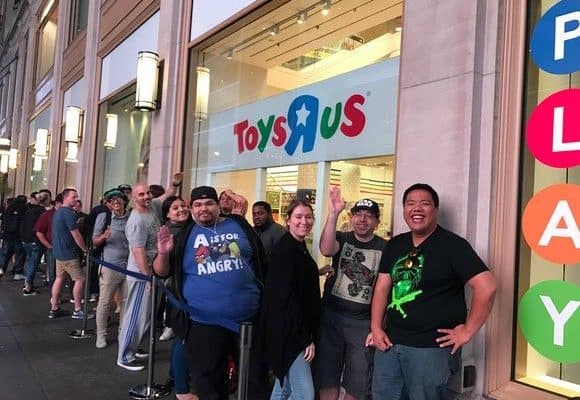
People waiting in line for Toys R Us to open

Target could take all the traffic

Target has a disproportionate number of stores located near Toys R Us locations. According to Credit Suisse analyst Seth Sigman, 90% of Toys R Us stores and 96% of Babies R Us stores have a target located within five miles. He notes that that could put pressure on Target’s sales through the first half of the year, as shoppers flock to Toys R Us for the liquidation sales. Long term, however, Target stands to win a lot of foot traffic in those areas.

Target’s store traffic growth accelerated last year, increasing 3.2% in the fourth quarter. That traffic increase barely offset the decrease in average ticket for the full year, however, resulting in same-store sales growth through its stores channel of just 0.1%. Target stores still have work to do to turn things around, but the exit of Toys R Us will help.

Don’t discount Walmart

Walmart has more than twice as many stores as Target in the U.S., so it’s a bit surprising that it doesn’t have more stores near Toys R Us locations. That said, 82% of Toys R Us locations have both a Target and a Walmart nearby, according to Sigman’s research.

Walmart is already the nation’s largest toy retailer, capturing nearly 30% of the market. It makes deals with manufacturers for exclusive toys just like Toys R Us, and it could be in line to win more exclusives once Toys R Us is gone.

If Walmart can use its buying power to grab more exclusives, it could entice shoppers to drive past Target to get to Walmart for those must-have toys. But Walmart is so big, the sales volume from Toys R Us would barely move the needle for the retail giant.

Amazon could benefit more than either

Toy shopping is often an experience. Kids want to go to the toy store and play with all the toys before deciding what they want to take home. Nonetheless, online retail has been able to steal away a good percentage of sales. There’s no reason to expect that trend to change, and Amazon will be its biggest beneficiary.

But Amazon also stands to benefit from the real estate opportunity presented by the liquidation of Toys R Us, which owned 274 of its U.S. stores as of the end of 2017. Amazon may grab dozens of locations to expand its brick-and-mortar efforts.

The average Toys R Us store is nearly the same size as the average Whole Foods Market, which means Amazon could expand the grocery chain using old Toys R Us locations. The toy chain also operates smaller-format stores, which could lend themselves to use by Amazon’s brick-and-mortar bookstores or its Amazon Go convenience-store concept.

If Amazon buys up some physical storefronts, it could become an even bigger threat to Walmart and Target. Not only would its physical presence potentially draw customers away from the big-box stores, it would also likely beef up the convenience of its online offerings like Prime Now same-day delivery.

The rich get richer

Target, Walmart, and Amazon might have squeezed their margins in the fourth quarter, but they’ll ultimately reap rewards from the downfall of Toys R Us. Target and Walmart stand to benefit from higher foot traffic at their stores, and Amazon could take advantage of the real estate opportunity that will soon become available.

A rebooted Palm smartphone could launch on Verizon later this year

We live in the era of the reboot. Forget movie reboots — we’re talking about phone reboots. BlackBerry’s still launching phones with hardware keyboards, Nokia is back from the dead, and now we may be treated to a reboot of the Palm.

The report comes from Android Police, which notes that a new Palm device may launch on Verizon in the second half of this year. The rumor, which cites an anonymous source, echoes rumors that were sparked last year when a TCL executive confirmed that the company wanted to launch a Palm device in 2018.

Apart from the fact that a Palm device may launch on Verizon later this year, we don’t really know all that much about the project. The report notes that the phone will likely run Android, and we know it will be launched by Chinese brand TCL, which bought the Palm brand in 2015. It will be interesting, though not surprising, to see an Android-powered TCL phone. Not surprising because recent BlackBerry phones have also featured the Android operating system, but interesting because Palm may want to load on some of its own software tweaks.

TCL seems to be building a reputation as the company that revives old smartphone brands, despite otherwise being known for its TVs. TCL is also the company behind the recent BlackBerry revival. While it is popular, the Palm brand doesn’t necessarily hold as much weight as BlackBerry or Nokia, so it will be interesting to see how the company can effectively market a new Palm device. Of course, Nokia does seem to have done pretty well for itself so far — the flagship Nokia 8 Sirocco is well-designed and features some pretty nice flagship specs, like the Qualcomm Snapdragon 835 and 6GB of RAM.

It does make sense that Verizon would be the company to carry the newly revived Palm. Verizon intended to carry the Palm Pre 3, a phone that was canceled by HP, Palm’s then-buyer, before the phone could be launched in the U.S.

While we don’t know all that much about the new Palm just yet, we’ll update this article when we find out more.

A Nikon company made a robotic camera operator that uses A.I. to track athletes

nikon mrmc robotic camera nab 2018 talen energy stadium chester pa copyright 2017 molly riley

Sports fans, coaches, and trainers could soon have an entirely new view of the game, thanks to a new robotic camera system from Mark Roberts Motion Control (MRMC), a company now owned by camera giant Nikon. Called the Polycam Player, the motorized camera support uses image recognition and artificial intelligence to automatically follow an athlete, keeping the action in the frame without the need for a human camera operator — remote or otherwise.

Interestingly, MRMC says that what differentiates the Polycam Player from other automated systems is how it imitates the movement of a such a human operator. Rather than using a large set of wide angle cameras to capture the full play, the Polycam Player physically follows the player’s motion by panning and adjusting both zoom and focus on the fly. The software controlling the cameras is even smart enough to track a specific player or multiple players.

We outmoded humans can rest easy, at least for now: MRMC isn’t trying to put us out of a job. The company says the system is designed to capture shots from locations that would be impossible for a person to access. The tool is expected to both give broadcasts a wider range of footage while also serving as a coaching tool for watching game films (or monitoring the competition). The system is launching with four different camera positions for covering football — two high end zone cameras, a high center line camera, and a player-tracking camera. Unlike the others, the player-tracking camera allows an operator to adjust the composition, while the software handles tracking.

MRMC also announced an automated system for keeping up to four people in the frame, including broadcasters and on-set guests. Called Polycam Chat, it goes beyond face recognition to also identify limbs, analyzing both to keep the speaker in frame. MRMC says that this approach leads to “unrivaled accuracy and stability.”

The company says Polycam Chat is designed for small studios, using AI to help reduce costs by automating camera control. The automation system is compatible with several different types of cameras, including, of course, DSLRs from parent company Nikon.

The new robotic systems will be on display at the National Association of Broadcasters (NAB) show in April. MRMC will also show off its Color Control Panel, which the company says is the first solution that allows remote, live color correction from a DSLR camera. It is designed specifically for the Nikon D5, allowing broadcasters to integrate the pro DSLR into their workflows.

Nikon acquired MRMC back in 2016 shortly after the two companies, along with Getty, worked on a camera system to cover the Olympic games that year. The latest products keep the company’s focus on motion control and broadcast robotics while adding compatibility with some Nikon cameras.