Archives for January 24, 2018

Find leftover foreign currency? Here’s 7 things you can do with the money

If for some reason you forget to exchange this stuff before your flight, all hope isn’t lost.

For convenience and good exchange rates, savvy travelers should try to settle bills using no-foreign fee credit cards when out of the country. But cash is always handy for buying rides on public transit, paying street vendors for food, and craft items and for leaving tips.

Going home with leftover foreign currency may feel wasteful, but there are plenty of ways to put that money to good use.

Spend it

No matter how much money is left over, “I pay my hotel bill with it,” said Chris McGinnis, of the TravelSkills blog. “Part in cash, the rest on a credit card.” Others suggest stopping at a Starbucks before leaving a country to have leftover cash added, fee-free, to a Starbucks card balance.

Airports offer plenty of places to spend money and the part-cash/part-credit card method works well when buying pre-flight snacks or items in the duty-free stores.

Save it for another time

“I have a box from [French Bakery] Ladurée on my dresser with all my leftover foreign currency in it,” said Christina Saull, of Alexandria, Virginia. “When I have a trip, I dig through it to see what I have to spend.”

Beth Whitman, founder of Wanderlust and Lipstick and WanderTours has a basket of envelopes and small purses filled with coins and bills from past trips around the world, organized by country.

“It helps to have some local currency upon arrival for taxis or tips without having to go to an ATM or change money,” Whitman said.

Exchange it

Services like Travelex exchang leftover currency at its stores in cities and in airports, and by mail. Airport stores swap bills and most coins on the spot, but keep in mind that each store sets its own rates and fees. Mail-in exchanges are limited to banknotes and getting you check may take three weeks to arrive, but the $5 fixed fee and day-of exchange rate is apt to net you more.

Another mail-in option is offered by Leftover Currency, which takes both notes and coins for circulating and discontinued currencies and promises to pay within five working days via PayPal, check or bank transfer, or to donate the funds to charity.

Donate it

Some airports have “change globes” or bins to collect leftover money from travelers leaving a country. And 10 airlines, including American, Cathay Pacific and Qantas, currently participate in UNICEF’s Change for Good program, which collects spare currency from passengers on international flights. In 2016 about $8 million was raised for UNICEF this way.

Make friends

Teachers may be able to use your leftover currency in a geography lesson. “Or ask around to see if friends or neighbors have nieces or nephews who collect coins,” said traveler writer Carol Pucci. “A little bag of foreign coins that had been sitting my desk for years recently found a good home in a kid’s collection.”

Make art

Leftover coins offer an opportunity to explore your inner Etsy. Drill holes to make earrings or a necklace, or get out the glue gun and decorate a frame to hold a favorite travel photo.

Surprise yourself

“Whenever I go to pay for something and stumble across the foreign currency I keep in my wallet, I’m transported, for a moment, back to that destination” said Francine Cohen, Director, Spirits Colangelo & Partners. “It is also good for a laugh when I accidentally try to pay for something in one country with another country’s currency. Canadians are indeed really nice, but not so nice that they’ll take pesos for a croissant.”

3 Things to Watch in the Stock Market This Week
SPX Chart

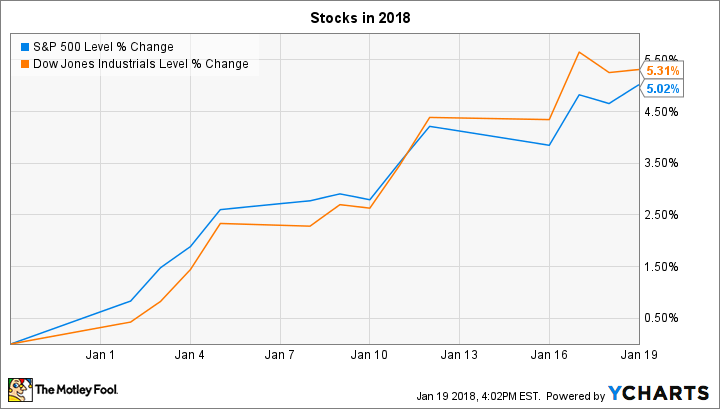
The stock market rally didn’t miss a beat last week, as both the Dow Jones Industrial Average (DJINDICES: ^DJI) and the S&P 500 (SNPINDEX: ^GSPC) pushed further into record territory.

The indexes are each up by more than 5% in just the 14 trading days that have passed so far in 2018.

Earnings season will determine whether that surge continues, and there are plenty of big-name reports set for the next few days. Netflix (NASDAQ: NFLX) is looking to set a positive tone with its quarterly report on Monday. Then, Procter & Gamble (NYSE: PG) and Starbucks (NASDAQ: SBUX) stocks could make big moves following their announcements later in the week.

Let’s look at what investors will be watching in these reports.

Netflix’s profit forecast

Investors are expecting lots of good news from CEO Reed Hastings and his team when Netflix releases its results on Monday afternoon. The holiday quarter is usually a strong period for the streaming video giant as TV-watching time spikes and millions of new internet-connected devices come online. That tailwind joins a few other positive trends, including rising demand in international markets and an improving content catalog, to paint a bright picture for sales and profit gains.

A Netflix browsing screen.

Netflix’s official forecast predicts the addition of 6.3 million subscribers during the quarter to bring the global user base up to 109 million. If the company reaches that target, or even comes up a bit short, it will have concluded its fourth consecutive year of accelerating membership gains.

That result is even more impressive when you consider that Netflix raised its monthly prices several times during this period. Still, it’s possible that the stock will take a hit this week on anything short of blowout results. Shares are up sharply in the past year, after all, and Netflix is the single best-performing stock of the past decade.

Procter & Gamble’s strategic direction

Consumer-goods titan Procter & Gamble announces its results on Tuesday, in what’s likely to be a closely watched report. For one, the latest operating trends will show whether the prior quarter’s slight market share rebound developed into an improved organic sales growth pace. We’ll also find out if the aggressive price cuts that P&G made in its core Gillette shaving franchise finally ended a multi-year sales volume slide in the key U.S. market.

Shareholders should hear discussion from CEO David Taylor and his management team on a new strategic path for the business, too. In announcing last month that activist investor Nelson Peltz had been elected to the board of directors, executives said they heard the message from shareholders that “P&G needs to move faster to deliver improved results.” It’s not clear yet what that strategic shift will look like, but until the company returns to market share growth the pressure will be on to make aggressive changes to key areas including innovation, marketing, and pricing.

Starbucks’ food sales

Starbucks kicks off its new fiscal year on Thursday, and investors are hoping this one looks more robust than 2017 did. After all, the coffee giant’s sales and profits trailed management’s forecast by a wide margin last year as customer traffic growth slowed to zero to mark its second straight year-over-year deceleration.

Starbucks is leaning on two big initiatives that executives hope will drive improvements in 2018. It is expanding aggressively in China, which has plenty of room for thousands of additional cafes. And in the domestic market, Starbucks believes a new lunch menu will drive higher shopping frequency and increased spending.

A limited rollout of these offerings helped the company log its best traffic figure in the U.S. in almost two years last quarter, and investors will find out on Thursday whether that momentum carried on to help Starbucks get food up toward 25% of sales by 2021, from 20% last year.

Thousands of Sask. Patients Could Benefit From New Technology Replacing Colonoscopies
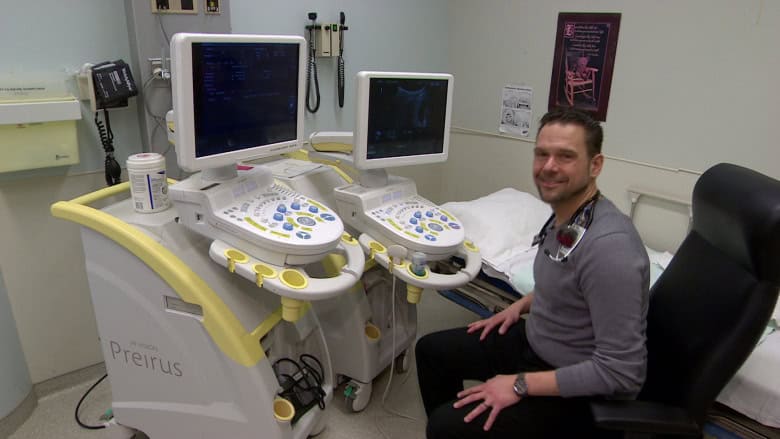
A gastroenterologist has brought new technology he discovered at a German hospital in the United Arab Emirates to Saskatoon after studying how to use the equipment in Italy.

The $200,000 machine will prevent patients with inflammatory bowel disease, such as Crohn’s disease and ulcerative colitis, from needing to have invasive colonoscopy procedures.

The monitoring they need can now be completed with an intestinal ultrasound, providing instant results at the patient’s bedside.

Dr. Tom Guzowski, an assistant professor of gastroenterology and internal medicine at the University of Saskatchewan, said intestinal ultrasound is a new technique in Canada that is only being used at two other universities in Calgary and Toronto.

Machine replaces colonoscopy, CAT scan

He said patients who previously needed to have a colonoscopy every year and a CAT scan every two years can now have an ultrasound instead.

Previously those patients might have waited months for a colonoscopy, which requires preparation with laxatives, a day in hospital and involves some risk.

Repeated CAT scans can also increase the patient’s risk of lymphoma, he said.

“This is right there and then. You can just scan them when they come to clinic and decide on treatment and things like that,” said Guzowski.

“It’s kind of a big step for us to be able to offer better care.”

International discovery

Guzowski came across the technology while he was working as a physician at a German hospital in the United Arab Emirates.

He moved to Italy to get more training in the field of clinical ultrasound, which he said is a growing trend in medicine.

“Bowel ultrasound is one piece of a bigger picture called clinical ultrasound, where you go to see patients, you talk to them and then you just do an ultrasound at the bedside,” he said.

“Which gives you information that would go along with your vital signs physical exam that can help make decisions in real time.”

When Guzowski returned to Canada he asked the university to apply for funding from the Saskatoon City Hospital Foundation and they agreed.

Misconceptions prevented previous use

Although ultrasound has been around for some time, Guzowski said it was previously thought it could not be used to screen lungs or intestines because they contain a lot of air which cannot be seen through ultrasound.

“It turns out that’s not really true because the intestines are very soft and compressible so you can actually get really good pictures despite the air,” he said.

“There is a way to use it you just have to know what you’re doing.”

The technology does have some limitations as it cannot be used to screen for colon cancer.

Usage expected to increase

Guzowski is now training other physicians in Saskatoon how to use the technology, which he said is stronger and more powerful with a higher-definition image than older ultrasounds.

An international bowel ultrasound course will be held in Calgary in April, with specialists from Germany and Australia, to recruit and train more doctors in Canada to do similar work.

The Saskatoon equipment is currently being used about 10 times a day, two days per week, but Guzowski expects that number will grow as more physicians are trained to use it.

Camera App Gets User Interface Upgrades in Latest Windows 10 Build

In early January, Microsoft released build 17074 of Windows 10 to members of the Insider program, giving them a preview of what’s next for its flagship operating system. Among the new and updated features was a new version its Camera app.

The update to the Camera app focuses on tweaks to its user interface, which have now been officially detailed by Microsoft in a recent blog post. The idea is to make the app a little more personal, by making some thoughtful tweaks to the nuts and bolts of how the tool operates.

Under the hood, there have been some edits to the core architecture that underpins the Camera function. Windows 10 is now able to do most of the heavy lifting when it comes to unsupported devices and functionality, so the duplicate handling that’s specific to the app has been removed. Since this could potentially cause some hiccups, Microsoft is rolling the change out to Insider program members first.

“From a Windows team perspective, the complexity of the Camera application made it difficult to innovate, fix bugs, and deliver new features,” the blog post from the Insider team reads. “From a Windows user perspective, this led to performance problems during photo capture time, lack of new features, and sometime failure of the Camera app. We think that this set of changes will long term yield a much higher-quality Camera experience for all users!”

The app now remembers which camera and scene were last selected, and loads them by default when it’s loaded, according to a report from On MSFT. More photo resolutions and video ratios are available, attached cameras can be used in parallel on different app windows, and the brightness slider is smoother and more accurate. A couple of features have also been removed; swiping left on the capture button to show all sliders, and wheeling on the capture button between scenes.

Members of the Insider program who have already updated to build 17074 should already have access to the latest version of the Camera app. Assuming that the Windows team doesn’t find any major issues, the rest of the Windows 10 user base should receive the new iteration soon.

Two Corvettes Crush a Mustang, But Everyone Wins

(GM/Ford)

The new Ford Mustang Bullitt may have been the hottest sports car at the Detroit Auto Show, but a pair of Chevrolet Corvettes left it in the dust in the desert.

GM put the first builds for its 2018 Corvette Carbon 65 Edition and 2019 Corvette ZR1 on the block at the Barrett-Jackson auction in Scottsdale, Ariz., over the weekend, while Ford did the same for the Bullitt, which is inspired by the Steve McQueen film of the same name.

The Corvettes sold for $1.4 million and $925,000, respectively, while the Bullitt got a high bid of just $300,000. There were no losers, however, as the cars were all sold for charity.

The proceeds for the Corvette Carbon 65 Edition are earmarked for the George W. Bush Center’s Military Service Initiative, which helps post-9/11 veterans on a variety of fronts, and featured the 43rd president’s signature alongside Jay Leno’s in the engine bay.

Rick Hendrick owns over a hundred Corvettes. (GM)

Meanwhile, the sale of the 755 hp ZR1 benefited the Stephen Siller Tunnel to Towers Foundation, which helps wounded first responders and veterans. It was purchased by NASCAR team owner and car collector Rick Hendrick, who has picked up pretty much the first of every all-new Chevy sports car at the auction in recent years.

The Bullitt went to an anonymous bidder, but the money from the sale went to a very relevant cause: The Boys Republic home for troubled teens in California where “Bullitt” star Steve McQueen lived for a time and credited with getting his life on the right track.

3 Low-Key Artificial Intelligence Stocks You Shouldn’t Miss

Man holding a tablet that’s representing an AI brain

You will be spoiled for choice when looking for stocks to take advantage of the booming artificial intelligence (AI) market. Almost all the well-known tech giants — including NVIDIA, Intel, Amazon, Alphabet, and many others — are betting big on this fast-growing field, as they don’t want to miss out on an opportunity that could be worth a total of almost $60 billion by 2025.

But these aren’t the only ways to take advantage of this space. Lesser-known stocks like Xilinx (NASDAQ: XLNX), Ciena (NYSE: CIEN), and CEVA (NASDAQ: CEVA) could win big from the AI revolution. Here’s how.

Xilinx

Xilinx makes programmable logic devices used across several growth segments such as data centers, automotive, and industrial. One class of its programmable logic devices, known as field-programmable gate arrays (FPGAs), has been gaining tremendous traction of late because it can train deep-learning models for artificial intelligence applications in data centers.

It is commonly believed that graphics processing units (GPUs) from vendors like NVIDIA are best suited for training deep-learning models in the cloud since they have massive computing power. FPGAs, however, are considered better than GPUs for certain applications.

For instance, Xilinx’s FPGAs deliver more performance for each watt of power consumption as compared to GPUs. This makes them ideal for deployment in large-scale data centers where energy savings are important. Moreover, the programmability of FPGAs allows them to be optimized for carrying out different varieties of workloads, something that isn’t possible for a GPU.

Because Xilinx’s FPGAs can accelerate the workload in a data center while consuming less power, they are being adopted by big cloud-computing players. Huawei, for instance, recently announced a cloud server platform for North America based on Xilinx’s FPGAs. Huawei claims that this FPGA-enabled platform can speed up the computation of intensive cloud applications by 10 to 100 times for machine learning and video processing, among others.

This isn’t Xilinx’s only win in the cloud computing space — Alibaba and Amazon have already selected its FPGAs to accelerate their cloud services. Moreover, FPGA adoption in data centers is expected to exceed the growth of GPUs and central processing units (CPUs), according to Allied Market Research.

Xilinx is in the running to take advantage of the rapidly growing AI chip market that could be worth $11.1 billion in 2023 as compared to just $661 million in 2016. More importantly, Xilinx could carve out a sizeable share of this market since it has established a clear lead over its nearest rival — Intel — in the FPGA space with a 59% market share.

Ciena

Ciena sells fiber-optic communication equipment. Its clients include telecom carriers and cable companies, which use Ciena’s equipment to enhance connectivity speeds. The company operates in a tough industry where the competition is stiff and business is driven by the spending budgets of its clients.

For instance, Ciena’s rival Infinera has been experiencing curtailed demand from its clients for its multiplexing equipment, which allows carriers to enhance network capacity without laying additional optical fiber networks. Instead, optical fiber networking clients have diverted their spending toward data center interconnection (DCI) equipment, which allows two or more data centers to share resources and workloads so they can be scaled up as required.

Demand for this DCI equipment is expected to increase at an annual pace of 10% over the next six years to an anticipated $6.4 billion in 2023. This isn’t surprising as DCI will play an important role in tackling fast-growing data traffic and meeting increased cloud computing demand.

Ciena is looking to take the lead in this market with its WaveLogic Ai modem that’s aimed at making networks more intelligent and flexible as needed. According to Ciena, WaveLogic Ai is an intelligent, autonomous, and self-driven networking chip that can be used by network operators and cloud service providers of all sizes to scale channel capacity while controlling costs.

A cloud service provider can deploy the WaveLogic Ai chip for both short-reach metro connections, which are used for short-distance data transmission, as well as submarine networks that cover thousands of miles. The intelligent chip will automatically decide the capacity required to transmit the data through the optical network, scaling the network as needed so that the remaining network capacity doesn’t go waste, and can be used by either Ciena or third parties.

Ciena expects that sales of this WaveLogic Ai chip will grow substantially in 2018, and it should help the company maintain its leading position in the growing DCI market.

CEVA

CEVA is an intellectual property (IP) vendor known for licensing its digital signal processors (DSPs) to larger chipmakers. The company licenses DSPs for several applications like imaging and computer vision, connectivity, audio, voice, speech, AI, and deep learning. Within the AI and deep-learning space, CEVA is focusing on fast-growing markets like automotive, augmented reality, and smart homes, among others.

The company also licenses its deep neural network frameworks to chipmakers for enabling AI applications in their devices. Apple, for instance, is reportedly using CEVA technology to power the much-hyped Neural Engine inside the new iPhone’s A11 Bionic processor, as reported by Charlie Demerjian of the technology news site SemiAccurate.

The financial gains of this supposed partnership will only become evident when CEVA reports its next set of quarterly results on Feb. 6. If the company has indeed licensed its intellectual property to Apple, its royalty revenue from audio, imaging, and vision products should increase, as pointed out by Fool.com’s Ashraf Eassa.

CEVA’s potential win at Apple could be a sign of bigger things to come for the company. It’s likely that Apple has decided not to use Qualcomm’s DSPs because of its feud with the chipmaker, so CEVA could be a long-term beneficiary. More importantly, CEVA has a pretty huge list of licensees that use its designs. The company includes the likes of Cypress, Intel, Broadcom, among many others, as its publicly announced licensees.

The semiconductor IP market could be worth $6 billion in 2023, according to Markets and Markets. CEVA provides chips for the AI space, so it has put itself in a strong position to take advantage of this multibillion-dollar opportunity.

CEVA has generated $87 million in revenue over the past four quarters, and it is growing at a terrific pace. Last quarter, its revenue jumped almost 35% year over year, boosting its earnings by 72.7%. So investors should definitely watch this chip licensing play.

The Foolish takeaway

Xilinx, Ciena, and CEVA are taking advantage of AI in different ways. More importantly, they are being successful to different degrees with the help of this emerging technology. Investors shouldn’t expect quick gains and should remain patient, as the AI chip market is still in its early phases, but these three companies are well positioned to take advantage.