
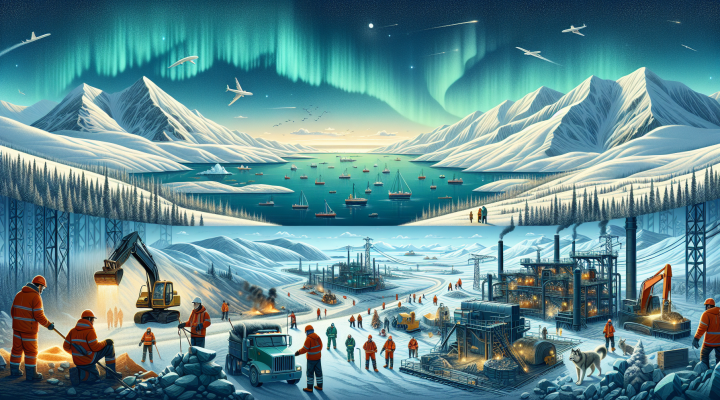
Arctic development

Arctic Mining Ventures Transform Global Supply Chains Through Advanced Technology Investment

The vast Arctic territories are experiencing an unprecedented transformation as advanced technologies converge with substantial capital investments to unlock previously inaccessible mineral wealth. Northern resource development has evolved from rudimentary extraction methods to sophisticated operations that leverage artificial intelligence, autonomous systems, and sustainable practices to meet growing global demand for critical minerals.

Investment flows into Arctic regions have accelerated dramatically, driven by geopolitical shifts and the urgent need for rare earth elements essential to renewable energy infrastructure. Major mining corporations are deploying billions of dollars in cutting-edge equipment designed to operate in extreme conditions, while smaller exploration companies utilize satellite imaging and machine learning algorithms to identify promising deposits beneath permafrost layers.

The technological revolution in northern resource development extends beyond traditional mining equipment. Autonomous hauling systems now navigate treacherous terrain with precision that surpasses human operators, while remote-controlled drilling platforms can operate continuously despite harsh weather conditions that would halt conventional operations. These innovations have reduced operational costs by up to 35% while significantly improving worker safety in dangerous Arctic environments.

Environmental considerations play an increasingly central role in modern northern resource development strategies. Companies are implementing advanced water treatment systems, utilizing renewable energy sources for remote operations, and developing restoration techniques specifically designed for fragile Arctic ecosystems. These sustainable practices are not merely regulatory compliance measures but strategic investments that enhance long-term project viability and community acceptance.

Strategic Investment Patterns Reshape Arctic Resource Landscape

Global supply chain disruptions have accelerated investment in northern resource development as nations seek to diversify their mineral supply sources. Countries with substantial Arctic territories are implementing favorable regulatory frameworks to attract international investment while maintaining strict environmental standards. This balanced approach has resulted in a surge of public-private partnerships that combine government support with private sector expertise and capital.

The infrastructure requirements for successful northern resource development projects have attracted additional waves of investment. Transportation networks, power generation facilities, and communication systems designed for Arctic conditions represent multi-billion-dollar opportunities that extend far beyond the mining sector itself. These infrastructure investments create economic multiplier effects that benefit entire regional economies and indigenous communities.

Risk assessment methodologies have become increasingly sophisticated as investors recognize both the tremendous opportunities and unique challenges associated with northern resource development. Climate change impacts on permafrost stability, shifting ice conditions, and extreme weather patterns require comprehensive modeling and adaptive management strategies that traditional mining operations rarely encounter.

Technology Integration Drives Operational Excellence

The integration of Internet of Things (IoT) sensors throughout northern resource development operations provides real-time monitoring capabilities that were unimaginable just a few years ago. These sensor networks track equipment performance, environmental conditions, and resource quality simultaneously, enabling predictive maintenance schedules that minimize costly equipment failures in remote locations where replacement parts and technical expertise may be thousands of miles away.

Advanced data analytics platforms process vast amounts of information generated by modern northern resource development operations, identifying optimization opportunities and potential problems before they impact production schedules. Machine learning algorithms continuously improve operational efficiency by analyzing historical performance data and environmental conditions to recommend optimal extraction strategies.

Satellite communication systems and high-speed internet connectivity have transformed remote Arctic mining operations from isolated outposts into fully integrated components of global supply chains. Real-time collaboration between Arctic operations and engineering teams in major urban centers enables rapid problem-solving and continuous process improvement that was previously impossible due to communication limitations.

The convergence of technological innovation and strategic investment in northern resource development represents a fundamental shift in how the global economy accesses critical minerals. As climate change opens new Arctic territories while simultaneously increasing demand for clean energy minerals, the companies and nations that master sustainable northern resource development will play pivotal roles in shaping the world’s energy transition. The substantial investments being made today in Arctic mining technology and infrastructure are laying the foundation for decades of economic growth while establishing new standards for environmentally responsible resource extraction in the world’s most challenging environments.

Smart Investors Are Betting Big on Northern Resource Development Technology

The frozen frontiers of the Arctic are experiencing an unprecedented technological revolution. As traditional resource deposits become increasingly difficult to access, northern resource development has emerged as one of the most capital-intensive yet promising sectors for investors seeking long-term growth opportunities. The convergence of advanced extraction technologies, climate adaptation solutions, and strategic geopolitical positioning is creating a perfect storm of investment potential in these previously untouchable regions.

Modern northern resource development projects are fundamentally different from their predecessors. Gone are the days when companies could rely solely on brute force extraction methods in harsh climates. Today’s successful operations integrate artificial intelligence-powered geological surveys, autonomous mining equipment designed for extreme temperatures, and sophisticated logistics networks that can operate year-round despite challenging weather conditions. These technological advances have reduced operational costs by up to 40% while simultaneously increasing safety standards and environmental compliance.

The investment landscape reflects this transformation. Major mining corporations are allocating billions toward northern resource development initiatives, with particular emphasis on rare earth elements, lithium deposits, and untapped oil reserves. Canadian and Scandinavian projects are leading the charge, benefiting from political stability and established regulatory frameworks that provide investor confidence. Meanwhile, breakthrough technologies in ice-road alternatives and modular processing facilities are making previously uneconomical deposits viable for commercial extraction.

Emerging Technologies Reshape Arctic Operations

The backbone of modern northern resource development lies in its technological sophistication. Satellite-guided drilling systems now operate with precision unimaginable just a decade ago, while machine learning algorithms predict equipment failures before they occur, minimizing costly downtime in remote locations. Advanced materials science has produced equipment capable of functioning reliably at temperatures below -50°C, extending operational seasons and improving project economics.

Renewable energy integration represents another crucial advancement. Solar panel arrays designed for low-light conditions and wind turbines engineered for arctic conditions are reducing diesel dependency by up to 60% in some northern resource development projects. This shift not only cuts operational costs but also addresses environmental concerns that have historically plagued resource extraction in sensitive northern ecosystems. Battery storage systems specifically designed for extreme cold ensure continuous power supply during the harshest weather conditions.

Transportation innovations are equally transformative. All-season ice roads constructed with advanced polymers extend access periods, while drone delivery systems handle smaller equipment and supply runs without requiring full convoy deployments. Some operations now utilize underground conveyor systems that remain functional regardless of surface weather conditions, ensuring consistent material flow from extraction point to processing facility.

Investment Outlook and Market Dynamics

The financial metrics supporting northern resource development investment are compelling. Despite higher upfront capital requirements, these projects often deliver superior long-term returns due to the premium quality of untapped northern deposits and reduced competition compared to traditional mining regions. Infrastructure investments made today create lasting competitive advantages, as established operations benefit from economies of scale that make it difficult for new entrants to compete effectively.

Geopolitical factors add another dimension to investment appeal. As global supply chains seek diversification away from politically unstable regions, northern resource development offers access to critical materials within stable democratic nations. This strategic value often translates into favorable government policies, tax incentives, and streamlined permitting processes that enhance project viability.

Risk management strategies have evolved significantly, with sophisticated weather prediction models, redundant supply chains, and comprehensive insurance products specifically designed for arctic operations. These developments have made northern resource development projects more predictable and attractive to institutional investors who previously viewed the sector as too volatile.

The convergence of technological advancement, favorable economics, and strategic positioning makes northern resource development one of the most compelling investment themes in the natural resources sector. As climate change ironically makes northern regions more accessible while simultaneously increasing demand for the critical materials found there, investors who position themselves early in this transformation stand to benefit from both immediate returns and long-term strategic value creation. The Arctic’s resource wealth is no longer locked away by technological limitations—it’s simply waiting for the right investment approach.

Smart Investors Are Turning Their Attention to Canada’s Northern Resource Development Boom

A seismic shift is occurring in Canada’s investment landscape, with northern resource development rapidly emerging as the country’s most compelling economic opportunity. As global demand for critical minerals reaches unprecedented levels and climate change opens new Arctic corridors, investors are recognizing the untapped potential lying beneath Canada’s northern territories.

The transformation is remarkable. What was once considered too remote, too expensive, and too challenging for large-scale development is now attracting billions in investment capital. Northern resource development projects across Nunavut, the Northwest Territories, and northern regions of provinces are securing funding at record pace, driven by a perfect storm of technological advancement, geopolitical necessity, and environmental accessibility.

Critical minerals represent the cornerstone of this northern renaissance. Canada’s Arctic regions contain some of the world’s largest untapped reserves of rare earth elements, lithium, cobalt, and other materials essential for renewable energy infrastructure and advanced manufacturing. The global energy transition has created insatiable demand for these resources, with supply chains previously dominated by geopolitically unstable regions now seeking reliable North American alternatives.

Recent geological surveys have identified massive mineral deposits across northern Canada that were previously unknown or considered economically unviable. Advanced exploration techniques, including satellite imaging and AI-driven geological analysis, have revealed resource concentrations that rival the world’s most productive mining regions. These discoveries are reshaping how investors view northern resource development opportunities.

Infrastructure development is accelerating at unprecedented speed, addressing what was historically the primary barrier to northern resource extraction. New transportation networks, including upgraded Arctic shipping routes and expanded rail connections, are dramatically reducing logistics costs. The extension of power grids and telecommunications networks into previously isolated regions is making large-scale mining operations increasingly feasible.

Climate change, while presenting global challenges, has paradoxically improved accessibility for northern resource development. Extended ice-free periods in Arctic waters are allowing longer shipping seasons, while changes in permafrost conditions are enabling construction techniques previously impossible in these regions. Mining companies are adapting operations to leverage these environmental shifts while implementing rigorous sustainability practices.

Government policy is strongly supporting this northern resource development surge. Federal and territorial governments have streamlined permitting processes, offered substantial tax incentives, and established partnerships with Indigenous communities that provide both social license and economic partnerships. The recognition that northern resource development is essential for national economic competitiveness has created unprecedented political alignment.

Indigenous partnerships have become central to successful northern resource development projects. Rather than the confrontational relationships that historically characterized resource extraction, modern developments are increasingly structured as joint ventures that provide Indigenous communities with ownership stakes, employment opportunities, and long-term economic benefits. This collaborative approach is proving both socially responsible and economically advantageous.

Technology is revolutionizing the economics of northern resource development. Automated mining equipment, remote monitoring systems, and advanced processing techniques are reducing operational costs while minimizing environmental impact. These innovations make projects economically viable at much smaller scales than previously possible, opening opportunities for numerous mid-size developments rather than only massive industrial complexes.

International investment is flowing into Canadian northern resource development at remarkable levels. European and Asian investors, seeking supply chain security for critical materials, are viewing Canadian northern projects as strategic investments rather than purely financial opportunities. This geopolitical premium is creating valuations that exceed traditional mining project metrics.

The investment opportunity extends beyond direct resource extraction. Supporting industries including specialized construction, Arctic logistics, environmental services, and advanced materials processing are experiencing rapid growth. Companies positioned to serve the northern resource development ecosystem are capturing significant value as the sector expands.

As global competition intensifies for secure access to critical minerals and Canada’s northern territories become increasingly accessible, northern resource development represents more than just another investment theme—it’s positioning itself as the foundation of Canada’s next economic era. Investors who recognize this transformation early are positioning themselves for what may prove to be the most significant Canadian resource opportunity in generations.