Staff Editor

11 Things the Health Care Sector Must Do to Improve Cybersecurity

No industry or sector is immune to hacking. That reality was made painfully clear in mid-May, when a cyberattacker using WannaCry ransomware crippled health care institutions and many other kinds of organizations around the world. In 2015 over 113 million Americans health records were exposed, and in 2016 the number was over 16 million, according to reports submitted to the U.S. Department of Health and Human Service’s Office for Civil Rights. At the beginning of 2017 Experian predicted that the health care sector would be the most heavily targeted vertical industry. A March 2017 report from the Identity Theft Resource Center indicated that more than 25% of all data breaches were related to health care. The estimated loss to the industry is $5.6 billion per year. These stats should be a wake-up call for the entire industry.

Breaking: Could a simple health care products company outshine biotech

There are three reasons health care is the source of so much stolen data right now. First, health care data can be monetized. For instance, cybercriminals can use medical data to sell fake identities, construct synthetic identities, and enable someone to conduct medical identity theft. If that doesn’t work, they can use the stolen information for traditional identity theft, since medical information tends to include enough information to allow a criminal to open a credit card, bank account, or loan in the victim’s name. If neither of those works, cybercriminals can use ransomware to extort health care organizations to pay them money to regain access to compromised systems and data.

Second, health care organizations have been slow to adopt practices that have worked for other industries. Most health care portals, for example, don’t have strong multifactor authentication. Many medical personnel are unaware of the risks to data security (which is ironic given the strong emphasis on patient privacy). And health care organizations tend to have smaller security budgets and teams than financial services organizations.

Finally, as other industries have become more sophisticated in detecting and blocking cyberattacks, criminals have had to find new sources of data. Aside from the fact that health care institutions collectively hold information on the vast majority of the population, their IT systems also have links to financial services (e.g., flexible spending accounts with their own debit cards or health savings accounts that can have five-figure balances after two to three years).

Given that most transactions in the health care sector are conducted through vulnerable hardware and software, it’s critical for providers and payers to strengthen their cybersecurity. For an example of how to proceed, they can look to the financial services industry, where some of the most well-known examples of cyberattacks in the last decade have occurred. This turmoil led to huge operational shifts in the financial services sector, where there’s more focus than ever on consumer education, industry information sharing, and stronger forms of authentication, among other things.

Read: Healthcare Stocks are outperforming biotech 3 to 1

Here are some specific recommendations, which are based on our collective expertise in care delivery, health systems, financial regulation, and risk management.

Update HIPAA. Like the PCI DSS rules for debit and credit card security, the HIPAA Security Rule and the HIPAA Privacy Rule are already well-known frameworks for defining how a health care organization should secure its people, systems, data, and equipment. These established methods of approaching health care security would merely need to be updated to cover new forms of cyberattacks and new tactics employed by cybercriminals.

Take stock of basic housekeeping. Care providers should apply strong encryption to all patient data and limit who has permission to access medical charts. In addition, organizations should monitor searches and downloads from their IT systems by tracking exfiltrated data such as large batch files of patient, research, financial, or other sensitive data.

Purchase insurance. Many financial services organizations have cyber insurance, and health care systems should get it, too. Since this is a relatively nascent kind of insurance, most leaders of health care organizations and boards of directors may not be aware that it exists. Significant open questions about it remain, including who should pay for such policies and whether it should protect the institution, the patient, or both. At the moment, the institutions themselves are paying, and this likely will not change in the foreseeable future.

Require training for personnel. Human error, including falling for phishing attacks,  is the leading cause of major security breaches today. Health care systems should regularly remind people of the importance of information security best practices through required training, strategic reminders, and other means.

Related: Sometimes the sectors change course. Healthcare products are the latest rage

Protect supply chains. Hospitals and health care systems have diversified supply chains and massive lists of vendors with whom they digitally interface. They are a tempting way for cybercriminals to gain access to health care organizations’ IT systems. Consequently, care providers must understand the many moving parts that are involved and protect their relationships and information exchanges with and among those groups. Third-party vendors can help assess such risks and recommend ways to minimize them.

Share industry best practices regarding cybersecurity. The FS-ISAC has made life easier and safer for the financial services sector by enabling peer financial institutions to share information rapidly and directly. Similar groups, such as the NH-ISAC, can serve as starting points for expanding similar types of discussions and planning.

Deploy strong authentication. Health care systems should use multifactor authentication or other types of consumer security that are already ubiquitous in the U.S. financial services arena. Most U.S. consumers are already familiar with this type of technology and won’t need to be significantly reeducated (a challenge the financial services sector had to deal with a decade ago).

Adopt “tokenization.” This approach, which involves substituting sensitive data with other unique but nonsensitive data, has been in vogue in the credit card world for the past few years. It is a suitable way to protect data in situations in which a consumer (i.e., a patient) is involved in some type of card-based transaction. This might involve using a flexible spending reimbursement card or paying a health care–related bill online.

Copy the chip card approach. The U.S. consumer first encountered chip cards in a significant way in early 2015, when card issuers began to widely distribute them. Much of this was done in the run-up to a shift in who was liable for fraud. U.S. consumers are now intimately familiar with how to use such cards. (The cards have been in use for many years in France, the UK, Canada, Australia, and elsewhere.) Public and private payers are discussing the merits of issuing chip cards to beneficiaries to expedite patient identification and eligibility verification.

Experiment with blockchain. The technology can record transactions between two parties efficiently and in a verifiable and permanent way. It is being used in financial services as well as other areas. For instance, after Estonia suffered a significant cyberbreach in 2007, the country became more aggressive about protecting its society and is now using blockchain to protect its citizens’ medical data. A number of blockchain-based identity-credentialing systems exist, including Guardtime, TruCred, Civic, and OneName.

Consider biometric-based security. Biometrics are increasingly being embraced as the ultimate “bio-identifier.” Start-ups such as Simprints and RightPatient are testing its value as a verification feature for electronic medical records. Perhaps the most ambitious application of biometrics is the Indian government’s Aadhaar project, which has created 12-digit unique identity numbers based on biometric and demographic information (e.g., iris scans, digital fingerprints, and a digital photo) for nearly all of the country’s 1.2 billion citizens. But underlining the sad reality that no system is totally safe, this new system has already faced difficulties: Last month, the Centre for Internet and Society reported that 130 million Aadhaar numbers and around 100 million bank numbers of beneficiaries have been leaked online.

In The News: Healthcare company is making giant waves

The great boon of the digital era has been that patients’ medical data is becoming increasingly portable. This promises to make it vastly easier to collect and share data from all the players in health care in the years ahead. But, unfortunately, it also poses major cybersecurity risks.

In this new world, protecting patients’ health information in accordance with HIPAA will take a highly coordinated effort among care providers, insurers, and institutions, as well as significant investments in new tools and practices. It also will require health care institutions to look at the cyber risks across their business, not simply in one niche area (e.g., access to patient records). In the risk management world, that is known as taking a holistic approach.

The health care sector needs to adopt lessons from industries, such as financial services, that are much more advanced in their ability to thwart cyberattacks. Given how badly health care organizations are lagging others, they must make boosting cybersecurity a priority.

Check out the new and improved ‘dark mode’ coming to your iPhone this fall

Apple launched several new products and features for iPhones and Macs at its annual developers’ summit on Monday, but one of the biggest improvements for many iPhone users was buried in the fine print.

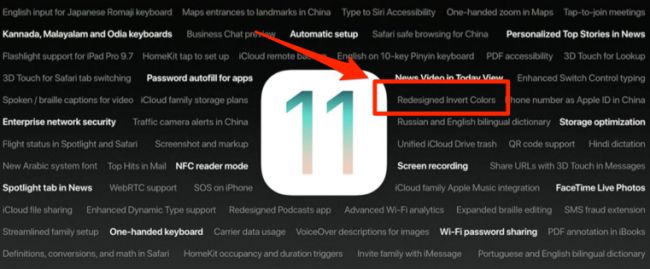
Apple has developed a new and improved dark skin for the iPhone, which it’s calling “redesigned invert colors.”

redesigned invert colors
redesigned invert colors (Apple)

This new setting will be available to most people in the fall, when Apple pushes the latest version of iOS to most people.

dark mode

But developers can install iOS 11 now, and they’re discovering that “smart invert” is actually a pretty good dark mode — great for iPhone users who want to use their phone in bed or who simply prefer a darker design. It’s not a full dark mode. Previously, Apple’s invert colors feature was designed for people with accessibility issues, and one of the things it did was invert images — taking the colors you’d expect to see and totally warping them.

Read: This Could Be The End To Banking As We know It

This new and improved invert colors doesn’t invert as many images as it did before, and Apple hasn’t removed the old invert mode, in case someone relies on it. But “smart invert” seems to work very well with Apple’s own apps.

The iPhone already has “night shift,” the feature that “warms” the colors on the display, eliminating the so-called blue light that can interfere with your sleep. Inverting the screen’s colors to dark mode might not help you sleep better at night, but it’s a nice way to make your phone glow less brightly in a dark room, so that using your phone at night is less disruptive to others.

But before you install iOS 11, remember it’s still beta software, possibly buggy, and smart invert is not being explicitly billed as a full-fledged dark mode at the moment.

But it’s still something to check out if you try out the iOS 11 beta. It’s in Settings>General>Accessibility>Display Accommodations>Invert Colors.

All the news we expect from Apple’s huge developers conference

Apple CEO Tim Cook will be on hand for the company’s Worldwide Developers Conference on June 5. (Photo: Marcio Jose Sanchez/AP)

Apple’s (AAPL) massive Worldwide Developers Conference kicks off Monday, June 5 at 1 p.m. E.T., and we’re expecting a host of new announcements.

These announcements will give us a view into what the company has been working on over the past year, as well as what we can expect with its upcoming iPhone 8.

Apple is known for using WWDC to showcase its newest software updates. That means we’ll likely see the latest versions of the company’s iOS for the iPhone and iPad, as well as macOS for Mac desktops and laptops.

Apple should also announce improvements to its watchOS and tvOS systems, and could even roll out its very own Siri speaker to compete with the likes of Amazon’s (AMZN) Echo and Google’s (GOOGL, GOOG) Home.

iOS 11

Apple regularly debuts the latest version of its iOS operating system at WWDC, and this year’s event should be no different. Interestingly, while hardware leaks are the norm for Apple’s devices now, we hardly see as many software leaks hit the web. That means we don’t know very much about iOS 11 quite yet.

So far, the big rumors point to major updates to Apple’s Siri voice assistant, which first landed on the iPhone in 2011. While Siri has seen a slew of updates since then, it still can’t quite match the power of Amazon’s Alexa or Google’s Assistant apps.

Apple’s iOS 11 will bring updates to the iPhone 7 and 7 Plus, and some hints as to what we might see in the iPhone 8.

With iOS 11, Apple could change that by bringing Siri more in line with what modern voice assistants have to offer such as expanded voice capabilities and improved language understanding.

According to The Verifier, Apple could also add group calling to its FaceTime app, which would bring it in line with Google’s Hangouts and Microsoft’s Skype offerings.

Whatever updates we see for iOS 11, it’s important to keep on eye on even the smallest changes, as they could provide a hint of what the iPhone 8 has to offer.

Siri speaker

Outside of iOS 11, Apple’s biggest potential announcement at WWDC is the Siri speaker. There haven’t been any leaked images of the speaker, which would compete directly with Amazon’s Echo, Google’s Home and Microsoft’s (MSFT) upcoming Cortana-enabled offerings.

MacRumors says that Apple device will likely include facial-recognition technology and run off of the company’s iOS operating system.Bloomberg reports that Apple has already begun manufacturing the speaker, which means it could go on sale in the relatively near future.

It will be interesting to see if Apple is capable of producing a product as powerful as Amazon’s Echo, especially since the Echo allows you to purchase items directly through Amazon using only your voice.

macOS

The software behind Apple’s Mac laptops and desktops, macOS is also expected to see some improvements at WWD. Little is known about the next major update to macOS, though if Apple sticks to recent patterns, it will likely throw in more iOS compatibility features to ensure iPhone users and Mac users stay within Apple’s product ecosystem.

watchOS and tvOS

As with Apple’s macOS, it’s still not clear what updates are coming to watchOS and tvOS.As CNET notes, Apple could begin offering a glucose monitor for the Apple Watch that would help diabetics monitor their blood sugar levels.CNBC reported in March that Apple CEO Tim Cook was seen walking around the company’s campus with a device connected to his watch that monitored his glucose.

MacBook updates and a new iPad

These rumors are a bit of a stretch, as Apple doesn’t usually announce much hardware at WWDC: But the mill keeps pointing to the potential for updated MacBooks and a new iPad debuting at the big show.

According to Bloomberg, Apple will roll out three new MacBooks including a new version of the super-slim MacBook with a more powerful Intel processor, an upgraded MacBook Air and MacBook Pro with a new CPU.

Apple’s insanely thin and light MacBook is rumored to be getting an update at WWDC.

It sounds like these MacBooks will only get improved internals, so don’t expect them to sport any new designs.

The new iPad, meanwhile, is said to sport a 10.5-inch display and offer stylus support. 9to5Mac says the iPad will manage to pack its large screen into a body that’s not much larger than the current 9.7-inch iPad.

The Hot Stock: Broadcom Soars 8.5%

Better-than-expected earnings made Broadcom the best performing stock in the S&P 500 Friday.

Broadcom (AVGO) soared to the top of the S&P 500 today after reporting higher-than-expected earnings and a larger role in Apple’s (AAPL) iPhone 8.

Broadcom gained 8.5% to $254.53 today, while the S&P 500 advanced 0.4% to 2,439.07.

AVGO reported another solid quarter, beating expectations handily. Management noted that seasonal declines in the wireless segment were less than expected and more than offset by contributions from other segments. All segments, including wireless, increased on a year-over-year basis. Looking ahead to fiscal Q3, AVGO’s guidance is above expectations on seasonal wireless strength, albeit slower initially than AVGO has experienced in previous cycles, continued, and somewhat unexpected, strength in storage, and a stable wired communications environment. We continue to view AVGO as one of the strongest technology companies within the semiconductor universe and we believe that meaningful upside to the company’s longer-term margin targets is possible. We continue to expect AVGO’s valuation discount to the peer group average (~14.5x versus 18.9x) to narrow as management continues to execute on its longer-term strategy. Our 12-month price target of $261, raised from $250, is based on a 16x multiple on our new 2018 EPS estimate of $16.34.

Broadcom’s market capitalization rose to $107.9 billion today from $94.2 billion yesterday.

Putin Says ‘Be Happy’ About Trump on Climate, on Everything

  • Russian leader urges American executives to support Trump
  • Anti-Russia ‘hysteria’ is like anti-semitism, Putin says


Russian President Vladimir Putin said he wouldn’t judge U.S. President Donald Trump for withdrawing from the Paris climate-change agreement. He spoke during a panel at the St. Petersburg International Economic Forum. (Excerpt. Language: English translation. Source: APTN) (Source: Bloomberg) 

Vladimir Putin shrugged off Donald Trump’s decision to abandon the most ambitious effort to combat global warming, marking the third time in two days that the Russian president came to the defense of his embattled U.S. counterpart.

“Don’t worry, be happy,” Putin said in English, responding to a question about the Paris climate accord from Megyn Kelly, the NBC television host who moderated the main event at his annual investment forum in St. Petersburg.

During an expansive three-hour panel discussion that was joined by Indian Prime Minister Narendra Modi, the Kremlin leader once again rejected U.S. claims of Russian state-sponsored hacking in elections and dismissed reports of improper contact between his officials and Trump’s presidential campaign, comparing the allegations to anti-semitism.

“They blamed the Jews for everything — we know what this sort of attitude leads to,” Putin said. “It’s easier to say that it’s not our fault, that it’s the Russians, they meddled in our elections and we’re the good guys.”

‘Take a Pill’

Putin said he wouldn’t “judge” Trump for pulling out of the climate pact, which almost 200 nations approved in 2015, including Russia. He said there’s still time to reach a new deal but not without the U.S., so the international community should “create the conditions for joint work.”

The New York property tycoon, who praised Putin repeatedly during last year’s presidential campaign, is facing multiple probes in Washington into the extent of his alleged links to the Kremlin. Putin said that Russia struck no agreements at meetings with representatives of the incoming Trump team and that Americans “should take a pill” to calm the “hysteria” over the issue.

“They didn’t talk about anything concrete, just general words about how to build relations — shouldn’t they think about how to build relations?” he said.

Earlier on Friday, Putin made an unscheduled appearance at a roundtable for U.S. and Russian companies to urge American executives to help Trump end tensions between the two countries, which he said are at “Cold War” levels.

Help Trump

“Help us to restore normal political dialogue,” Putin told the participants. “I ask you on behalf of Russia and I urge the American side — help the newly elected president and the new administration of the United States.”

“Of course, we’ll make every effort to ensure that business in Russia is beneficial for our American partners,” Putin said.

On Thursday, the KGB veteran told a small group of journalists at a czarist-era palace here that he likes outspoken guys like Trump and he applauded the new White House occupant for defending himself against the kind of entrenched bureaucracy that’s prevalent in capital cities around the world.

“He’s direct, open,” said Putin, who’s commanded Russia for 17 years. “He can’t be put in the same category as traditional politicians. I see great advantages because he’s a person with a fresh view.”

Artistic Hackers

Putin, who is widely expected to seek a final six-year term in March, went out of his way to use Russia’s premier business event of the year to heap praise on Trump, at one point calling him a “real man.” He also used the spotlight to intensify his rejection of allegations by U.S. intelligence agencies that Kremlin-backed hackers interfered in the 2016 election.

The nature of sophisticated cyberattacks are such that they can be made to look like they came from anywhere, Putin said, adding that there’s “no proof” of any involvement by Russia at the “state level.” Still, he dangled the possibility that patriotic Russians could have been behind the electronic intrusions into the campaign of Trump’s main challenger, Hillary Clinton.

The St. Petersburg native, 64, compared hackers to free-spirited “artists” who may wake up one morning, see how their homeland is being maligned in the foreign media and decide to act on their own.

“If they’re patriotically minded, they start making their contribution,’’ he said.

It Looks Like The ‘Brexit Fallout’ Is Nowhere In Sight

A year after the Leave vote, Britain’s capital is scheming to dominate global finance, Europe be damned.

Thirty years ago, London’s Isle of Dogs was a barren expanse of abandoned wharves and crumbling warehouses, never recovered from the wartime attentions of the Luftwaffe. Even the names of nearby boat basins were reminders of Britain’s lost empire and postwar decline: the West and East India docks.

George Iacobescu arrived in 1988, sent to oversee what at the time seemed like a bold, verging-on-insane idea: the creation of a financial district that would supplant the winding lanes and low-slung stone of the City, London’s traditional banking hub. Maintaining the City’s historical character and its views of St. Paul’s Cathedral made building skyscrapers there all but impossible then. Canary Wharf, as the development would be called, would offer bright, modern office towers and cutting-edge telecommunications, allowing London to compete with New York as a center of global finance.

For the first few years, Canary Wharf looked like a colossal failure. Then, in the late 1990s, it began taking off, slowly at first and soon with dizzying speed—transformed, like London as a whole, by the power of international finance.

Related: Is this the end to banking as we know it?

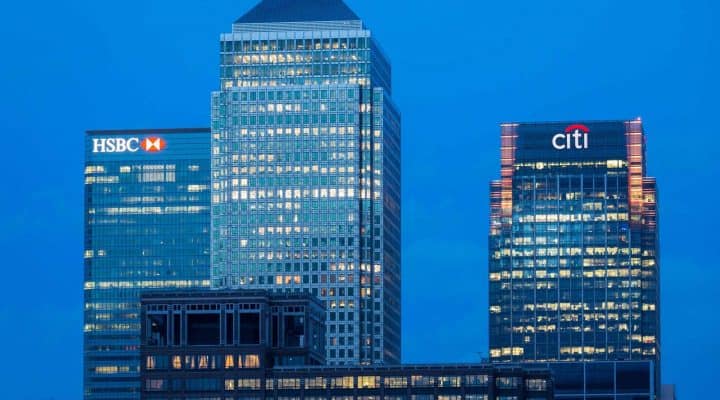
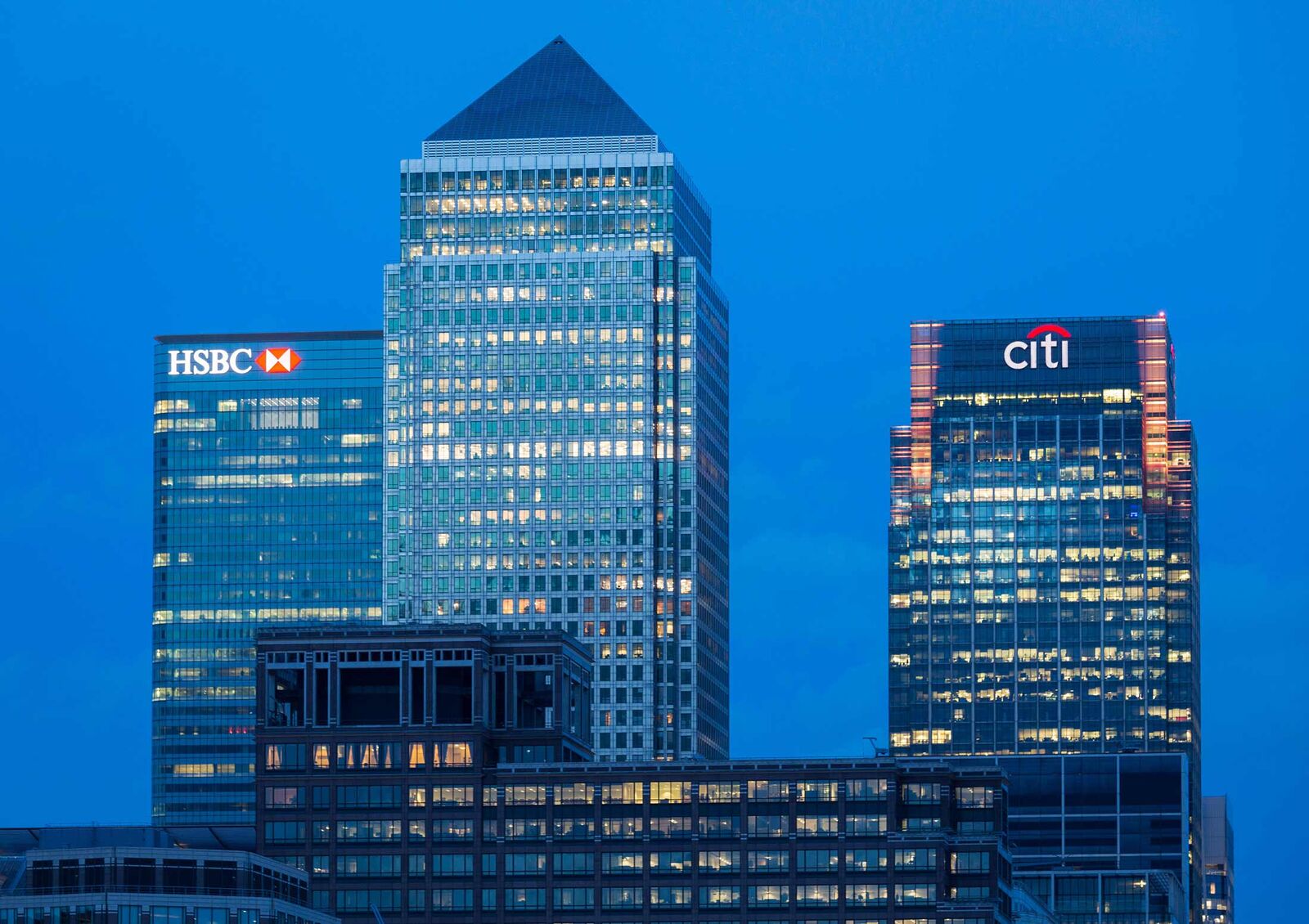
On the 30th floor of its tallest skyscraper, Romanian-born Iacobescu, now the chief executive officer of Canary Wharf Group Plc, beams with pride as he surveys his domain, where 100,000 workers arrive every weekday at Chevron, HSBC, Intel, and JPMorgan Chase, among others. In an adjacent room, a forest of architectural models the size of small children shows its 16 million square feet of towers, malls, and underground rail links. Iacobescu gravitates to one in particular, illustrating the plans for a new district under construction east of the original site. Canary Wharf has changed so much that now people want to live there, and its tallest building will be residential.

“The Chinese look at Canary Wharf and they say, ‘This is how cities should work,’ ” Iacobescu boasts. “The world wants to come here.”

Perhaps, though, not as much as it did a little more than a year ago. The city that breathed life into Canary Wharf faces a fight for its future. Last June pollsters and investors confidently ruled out the possibility that British voters would decide to leave the European Union. The morning after 52 percent of them rebuked everything Canary Wharf stands for by voting to leave, the pound plunged to its lowest level in 30 years. By 9 a.m., Prime Minister David Cameron had announced his resignation. Within weeks, banks such as Goldman Sachs Group and JPMorgan were weighing how many staff they would have to relocate to Frankfurt or Dublin, threatening the engine of London’s $490 billion economy. Airlines slashed flights, universities reported plunging European applications, and—truly shocking—house prices slid.

Its economic foundations under assault, the idea that London could ever, as then-Mayor Boris Johnson suggested in 2012, be the “capital of the world” sounded suddenly like a bad joke. At the rate things were going, the city would be lucky to even stay the capital of the United Kingdom if the Scots made good on renewed threats to secede. And that was before a pair of recent terror attacks—a March vehicle assault on Westminster Bridge and a suicide bomb on May 22 at Manchester Arena, which killed 22 people—gave London another reason to be on edge.

But while the ubiquity of the “Keep Calm and Carry On” mantra may have diluted the brand a little, that’s exactly what London is doing. A loose grouping of London business and political leaders has coalesced to make the case that with the right mix of policies, the city’s economy can thrive despite Brexit. Earlier this year, TheCityUK, the main lobbying group for the all-important financial industry, called leaving the EU “a once-in-a-generation opportunity” to reorient trade and investment links to new markets. Mayor Sadiq Khan is using the tumult to try to wrest more autonomy over transport, infrastructure, and perhaps even immigration. And the booming tech sector is pushing to turn the crisis into an opportunity to overhaul regulations to make the U.K. the preferred jurisdiction for testing uncharted inventions.

Those plans are taking shape in an environment of continued political turbulence. Cameron’s Conservative Party successor, Theresa May, is fighting an unexpectedly fierce battle in the June 8 general election against Labour leader Jeremy Corbyn. After a series of missteps by May and her advisers—including a perceived U-turn on a key plank of her party’s manifesto on social care—her once seemingly unassailable lead is under threat as voters fret about her ability to deliver a “strong and stable” Britain.

May is still expected to win a majority of seats, and whatever the U.K.’s immediate political future, economic apocalypse is nowhere in sight. More skyscrapers are under construction than ever, and residential asking prices have hit a record. Amazon.com, Facebook, and Google have announced major expansions of their London footprints since last summer, the latter becoming a principal tenant in a massive redevelopment of the once slightly seedy King’s Cross neighborhood. Next year the ribbon will be cut on the Elizabeth Line, or Crossrail, a 13-mile, ultrahigh-capacity express subway linking Heathrow to the heart of the city and beyond. The airport itself is midway through an ambitious expansion, with shiny new terminals largely complete and a long-contested third runway finally moving forward.

Indeed, what some supporters of the “Remain” camp warned of seems to be coming to pass: The places likeliest to suffer badly from Brexit are the U.K.’s troubled industrial heartlands, regions that overwhelmingly supported leaving but have far less ability to adapt to its effects than the dynamic capital.

London “has a global and particularly European competitive advantage that has been built over decades,” says John McFarlane, the chairman of banking group Barclays Plc. “It cannot be replicated easily in other centers.”

It’s impossible to overstate the intensity of the U.K.’s ties with the rest of Europe, and those pulling for London still have deep concerns about what’s to come. Nonetheless, as Iacobescu’s experience at Canary Wharf shows, the global metropolis that’s contemporary London didn’t just spring fully formed from the damp Thames clay. It had to be made, by people, capital, and policies. That means it can be remade, too.

By the turn of the 21st century, London was the economic center of Europe. Ambitious Scandinavian bankers, German architects, and Italian lawyers arrived in droves, able to move to the U.K. without so much as filling out a form, thanks to the EU’s free-movement rules. At one point, Mayor Johnson claimed there were a quarter-million French citizens in the capital, more than in the city of Bordeaux. It’s not exactly verifiable, but the fact that many Europeans accepted it as received wisdom served as further evidence of London’s dominance.

Un-Related News: Bullfrog Gold Raises $816,000 Of Equity To Advance Its Nevada Gold Project

At the same time, the city prospered from the expansion of emerging markets. It was where the multiplying elites from Russia, Saudi Arabia, India, and elsewhere came to spend their money, educate their children, start fashion lines, and occasionally race their custom Lamborghinis through the streets of Knightsbridge. As its internationalization intensified, the city came increasingly unmoored from the country as a whole, as if it had achieved escape velocity from the very idea of national borders. Many businesspeople use the U.K. “as a place to do business from, not necessarily to do business in,” says John Browne, former CEO of BP Plc, who now leads a Russian-backed global investment fund from offices in—where else?—London.

The city’s success had many ingredients. The English language helped, as did a legal system of impartial courts and enforceable contracts, elite universities, and a tolerant attitude toward foreigners that dates back centuries. (It was London that gave Karl Marx a place from which to unpack capitalism’s evils after Germany, Belgium, and France expelled him.) Less talked about, but essential, is a degree of semi-deliberate government indifference to the precise sources of money flowing in from Moscow, the Middle East, and elsewhere—a stance unimaginable in the more prosecutorial U.S. That’s made investing in London far more attractive to emerging-country oligarchs eager to avoid taking chances with the IRS and U.S. Department of Justice.

Despite London’s global appeal, the U.K.’s European status also has offered huge advantages. The EU is the destination for almost half of U.K. exports and the source of the same proportion of foreign direct investment. EU law allows a bank established in any member state to operate freely in any of the others, an advantage that U.S. and Asian lenders used to locate their European headquarters overwhelmingly in the U.K. Despite being outside the euro zone, the City came to dominate the market for euro-denominated derivatives, worth hundreds of billions of dollars daily, and to rival New York as the heart of investment banking and trading of all kinds. Just a mile up the road, a tech sector clustered around the ugly junction half-jokingly called Silicon Roundabout thrived as well, sustained by City investment and workers from throughout Europe and beyond.

The victory of the nationalist Brexit campaign seemed to put all this at risk. How great a risk is hard to say. Some financial jobs will almost certainly have to relocate to meet EU regulatory requirements, depending on the shape of a final settlement with Brussels, and banks are making contingency plans. Estimates range from as few as 4,000 or so, according to management consultant Oliver Wyman, to a worst-case scenario of 232,000 detailed by Xavier Rolet, CEO of the London Stock Exchange Group, in January to a parliamentary committee. In other words, no one has a clue.

How can London be saved from the worst predictions? As it happens, in addition to the Little England fantasies of cream teas and village cricket with which the “Leave” vote was often associated, there was always a liberal vision for Brexit, espoused by Johnson and others. The plan was a form of doubling down. Broadly, it entailed making the post-EU U.K. a sort of giant, cold Singapore—rabidly pro-capital, lightly taxed, and hospitable to innovation. The Brexit twist: a focus on connecting tightly to emerging markets. Within the EU, the U.K. benefited from the bloc’s network of trade agreements but was prohibited from negotiating any on its own. Now, the slightly wishful theory goes, it can do so with enthusiasm and speed—while winning a post-Brexit deal that preserves access to the EU’s huge economy.

May began earlier this year to at least pay lip service to this notion of “Global Britain”and got away with it, despite the apparent desire of half the country’s citizens for exactly the opposite, in part by stoking a bit of indirect nostalgia for the bygone age of empire. Speaking in January to top-tier investors and CEOs at the World Economic Forum in Davos, she pledged to make the U.K. “the strongest and most forceful advocate for business, free markets, and free trade anywhere in the world.”

If May follows through, implementing that vision shouldn’t, theoretically, be too difficult. The U.K. has a highly centralized system of government in which American-style gridlock is a virtual impossibility. Within reason, what the prime minister wants, she gets. Her government has already hinted that if it receives an unfavorable deal in negotiations with Brussels, it could retaliate by slashing its corporate tax rate—which at 19 percent is already far lower than those of the U.S., France, and Germany—to poach companies from neighboring countries. The U.K. has a track record of this sort of thing. Fiat Chrysler, Liberty Global, Aon, and other businesses, attracted by low taxes, have relocated operations to London in recent years.

One of the architects of London’s emergence as a financial capital is among those urging May to make some version of Global Britain a reality. Lord Nigel Lawson of Blaby, now 85 and ensconced in the oak-paneled sanctum of the House of Lords, oversaw the “Big Bang”—the U.K.’s sudden move to deregulate financial services—as chancellor of the Exchequer under Margaret Thatcher. He figured that a gradual removal of rules that benefited incumbents would foment too much opposition, so the decision was made to implement the changes on a single day in October 1986. It opened up the London Stock Exchange, previously run something like a not-very-lively gentlemen’s club, to a rush of overseas capital and brainpower.

Sitting in an overstuffed red leather chair in one of the Palace of Westminster’s ubiquitous private bars, morning sun streaming in from the Thames through tall, neo-Gothic windows, Lawson advocates a similarly aggressive approach for prospering from Brexit. He rejects the charge that he’s anti-European; after all, he says, he lives most of the time at his country estate in southwest France, flying in to Heathrow for Lords debates.

“London’s success owes nothing whatever to being in the European Union,” Lawson says, as if it should be obvious, but rather to “this huge collection of expertise” in finance and related industries that he argues will never pick up and go. The picture he paints of post-Brexit Britain is of a nation shorn of unhelpful multilateral entanglements, with “complete autonomy over our tax system,” which “should be, en principe, a low-tax system.” He speaks optimistically of restructuring immigration to remove the current distinction whereby bricklayers from Slovenia face no visa restrictions, yet American Ph.D.s must fill out miles of forms and cross their fingers—treating “citizens from anywhere in the world on an equal basis.”

And proving the notion that to scratch a Brexiteer is to quickly uncover fond memories of the last time there was such a thing as Global Britain, Lawson says that as Europe’s economy stagnates, “it’s the emerging world which is really going places. And a large part of the emerging world is the former empire”—India, Nigeria, Malaysia, and so on, with which Britain still enjoys close cultural and political ties. Indeed, there’s an argument to be made that the emerging economies need London as a stable venue for making deals and protecting assets.

For its part, TheCityUK has suggested reimagining trade deals to focus on the sale of services, which the U.K. exports in spades, rather than just goods, which are less important to its economy. Another possibility being floated in the City: scrapping or loosening the EU-imposed cap on bonuses for bankers. Limiting windfalls to twice a person’s fixed pay, the gap is understandably unpopular there.

The tech industry has also been active. In December a collection of local players, including Skype co-founder Niklas Zennstrom and Sonali De Rycker of venture capital company Accel, wrote an open letter to May calling on her to preserve maximum access to the EU’s “single market” and to provide automatic visas for tech graduates as part of a post-Brexit immigration strategy. The group had other, more unusual suggestions. The most eye-catching was that the U.K. should engage in “regulatory arbitrage” for technologies such as drones and blockchain. In the words of Mattias Ljungman of venture firm Atomico, which he co-founded with Zennstrom, the country could use its nimble system of government to become a “neutral zone” for testing ideas that other places restrict. There are some indications this is already happening. The U.K.’s main financial watchdog has created a “regulatory sandbox” that allows fintech firms to do real-world tests of products that normal rules might not allow. And Amazon is conducting trials of its delivery-by-drone program near Cambridge after complaining the U.S. Federal Aviation Administration wasn’t moving fast enough to change American flight rules.

In Focus: Is This Tiny Gold Mining Company The Next Big Thing?

The task of marshaling these forces has fallen to Mayor Khan. The 46-year-old’s biography couldn’t be further from the usual Eton-and-Oxbridge CV of British politics. His parents were immigrants from Pakistan who raised Khan and his seven siblings in public housing. After university he became a lawyer, working on racial discrimination and police brutality cases, before entering Parliament in 2005. Last year he became the first Muslim mayor of a major Western capital. Khan is often discussed as a future prime minister, and his political standing is in direct contrast to his physical presence. He’s quite short, and the navy blue suits he wears—always without a tie—as an unvarying uniform can look at least half a size too big. At one recent event, a photo op with high school students who towered over him, Khan’s dark-brown leather belt was cinched to the sixth notch.

The mayor’s first year at City Hall, a riverside orb that Johnson dubbed “the glass gonad,” has been consumed by the fallout of the referendum. Like a lawyer making arguments before an all-powerful judge, he’s relentlessly made the case to business leaders not to give up on London and sought to counter the Britain-first message of Brexit with a nonstop calendar of speeches, international trade missions, and slickly produced ads showing off the city’s diversity. There’s substance behind the marketing blitz. To protect London’s appeal, Khan is pursuing even more heavy-duty infrastructure, including Crossrail 2, another massive rail line through the heart of the city. He’s also suggested the creation of a “London visa,” whereby a foreigner with a job offer from a local company could be given permission to live and work in the capital and not elsewhere. That’s not as crazy as it sounds. Canada and Australia have regional visa policies for some migrants. And it’s hard to argue with the idea’s inherent logic. Unlike much of the rest of the country, diverse London has no problem with newcomers.

What these prescriptions for a vibrant metropolis all share is a focus on talent, a conviction that London can’t hope to succeed without brainy immigrants. Politically, that happens to be the most difficult item on the wish list to deliver. The Brexit vote was widely interpreted by politicians as a backlash against immigration, and May has said repeatedly that gaining control of the borders—i.e., ending freedom of movement for European citizens—is a nonnegotiable red line for her government in talks with its European counterparts.

What will replace the open-door policy is anyone’s guess. So, too, is the evolution of the current, less permissive system for non-EU workers. While May in January said that “openness to international talent must remain one of this country’s most distinctive assets,” she’s not a likely candidate to champion a relaxed approach. In her previous role as home secretary, she was the public face of a pledge, never fulfilled but recently reiterated as Conservative policy, to reduce annual inflows to the “tens of thousands.” Despite pleas from business groups and members of her own party, she’s also refused to formally guarantee that EU citizens already in the U.K., who number in the millions, will be able to stay—even though no one realistically expects any other outcome.

“If you really want to understand what’s behind the success of London, it’s that the city is a powerful magnet for international talent. It’s all based on people,” says Gregor Irwin, the chief economist at political consultant Global Counsel. Politicians who want to preserve that will have to contend, he says, “with a prime minister who’s still hellbent on bringing down the overall numbers.”

Free trade and a permissive attitude to technological disruption weren’t what, say, underemployed pipe fitters in Stoke-on-Trent had in mind when they voted for Brexit. Telling them the country must continue to prioritize the interests of footloose international capital to prosper is a lot to ask of May, who leans more populist than many Conservatives.

Perhaps more daunting, a swashbuckling, neo-Elizabethan vision of a Britain dedicated to conquering new markets ignores that U.K. companies have prioritized the giant bloc on their doorstep for decades. As an alternative, reorienting the economy toward emerging markets would mean “a quantum shift in terms of our trade strategy,” says Martin Sorrell, CEO of London-based advertising giant WPP Plc. If the U.K. loses its links to the EU and fails to develop ones with other regions, the risk is that “we become an isolated island instead of a connected one,” he says.

As London’s business elites weigh how to sell politicians on their vision, what they view as sensible economic policy can feel hard to reconcile with the demands of an angry populace. On a chilly early March evening, a crowd of bankers, corporate executives, and diplomats filed past a military string ensemble in formal red uniforms as a crier in an elaborate sash shouted entering guests’ names. The occasion was the annual Business and Investment Dinner at Mansion House, the City’s ceremonial heart—a Palladian pile that since the 1700s has been where deals are struck, successes are celebrated, and postprandial port is passed to the diner on one’s left. “The pound is down,” began the grace as guests sat down to smoked-and-peppered mackerel terrine. But “stocks are up, so let us be thankful as we sup.”

As dinner moved on past the roast rib-eye served with mushroom panna cotta and a full-bodied 2001 Pessac-Léognan, Lord Mayor Andrew Parmley, the City’s official leader, rose to address the subject on everyone’s mind. Next to him was Business Secretary Greg Clark, a member of May’s cabinet responsible for economic policy, representing the national government. “Free trade, ambition, openness to new ideas, techniques, and talent,” Parmley recited, glancing occasionally at his neighbor. “They can power the future success of what is, what has always been, and indeed in my opinion always will be, the world’s greatest city.” It was meant as a confident affirmation of the obvious. Instead, it sounded a little like a plea.

At Canary Wharf, Iacobescu talks up London’s advantages with the zeal of a convert, which he is—before he arrived, he lived in Toronto and then New York, helping build the World Financial Center. “Why are all the institutions here?” he asks. “Because of the language, because of the regulatory regime, because of the time zone, because of the infrastructure, because of the know-how. All these things haven’t disappeared.” Banks and companies that depend on them, he says, have no intention of abandoning a city that helped make them rich. Yet even the optimism of a man whose job it is to sell London to the world has its limits. As Iacobescu circumnavigates his largest architectural model of the district, reciting from memory the addresses of companies such as Morgan Stanley, Credit Suisse, and American Express, one tower makes him wince slightly: the European Medicines Agency, the EU equivalent of the U.S. Food and Drug Administration, a major Canary Wharf tenant. Like every other EU institution with a U.K. presence, it will almost surely soon depart, perhaps for Milan, perhaps Copenhagen.

It’s a small example of an important reality: If London is no longer the “gateway to Europe,” he says, losing growth to Frankfurt, Paris, or New York is inevitable. While Iacobescu believes in London as much as anyone, he concedes that without enlightened leadership, its strengths may not be enough to overcome harsh political reality.

“London is a great city,” he says. “But the effort should be to keep it the capital of the world.”