
Staff Editor

There’s a 20-year gap in life expectancy for people living in these parts of the U.S.

This is where life expectancy is longest (and shortest) for Americans

life expectancy

‘Geographic disparities in life expectancy among U.S. counties are large and increasing,’ a new study finds. Photo: Kristen Bell in ‘The Lifeguard’ (2013).

How long you live may depend on where you live.

Life expectancy at birth for both sexes combined was 79.1 years overall, but differed by 20.1 years between the counties with the lowest and highest life expectancy, this study, published in Jama — Journal of the American Medical Association this month. What’s more, geographic inequality in life expectancy actually increased between 1980 and 2014. While this inequality in the risk of death fell among children and adolescents during that time, it increased among older adults.

Don’t miss: Cannabis is saving lives and changing the medical world – This company is a sure bet

Several counties in South Dakota and North Dakota — typically those with Native American reservations — had the lowest life expectancy, and counties along the lower half of the Mississippi and in eastern Kentucky and southwestern West Virginia also had very low life expectancy compared with the rest of the U.S. (highlighted in deep red in the map), the study found. In contrast, counties in central Colorado had the highest life expectancies (highlighted in purple, below).

“Geographic disparities in life expectancy among U.S. counties are large and increasing,” the study says. Much of the variation in life expectancy among counties can be explained by a combination of socioeconomic and race/ethnicity factors of the people living in those counties, their nutrition and behavior, income and health care. Government policy targeting these issues may help reverse the trend of increasing disparities in life expectancy in the U.S., it adds.

The researchers from the University of Washington, Seattle used county-level death records from the National Center for Health Statistics (NCHS), which is part of the Centers for Disease Control and Prevention, and population counts from the U.S. Census Bureau, NCHS and the Human Mortality Database, which was created by researchers in the U.S. and Germany to provide detailed mortality and population data to researchers, students, journalists and policy analysts.

Previous analyses of life expectancy at the county level have found large and increasing disparities in how long people lived based on where they actually lived. However, this latest analysis either excluded or combined a large number of smaller counties, “likely leading to an underestimation of geographic inequality,” the researchers said. “Moreover, recent research has highlighted the need to consider age-specific metrics of survival in addition to life expectancy overall.”

Also see: Is this this end to banking as we know it?

A separate 2016 study found that Mississippi’s citizens are the least healthy, followed by Louisiana, Arkansas, Alabama and Oklahoma. In that study, Hawaii ranked as the healthiest state for the fifth consecutive year, followed by Massachusetts, Connecticut, Minnesota and Vermont. Conducted by United Health Foundation, a Minnetonka, Minn.-based nonprofit health care group established by UnitedHealth Group, it looked at the health of U.S. residents at state-level.

Health was measured by behaviors like smoking and excessive drinking, the community and environmental situation — including air pollution and the number of children in poverty — policy issues such as health insurance (or lack thereof), the number of active primary care physicians and public health funding, and health issues such as cancer deaths and diabetes, and clinical care. “The years of potential life lost before age 75 increased for the second consecutive year,” it concluded.
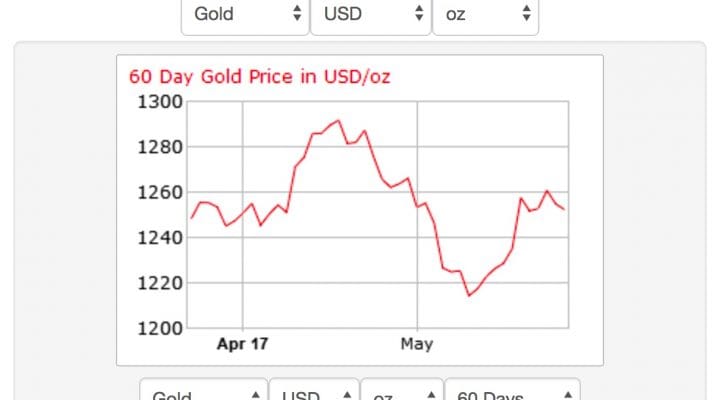
Gold prices poised for third weekly gain

Gold on Friday traded at their highest level of the month, setting prices up for a third weekly gain in a row as a fresh round of geopolitical jitters offset expectations for higher interest rates, which would otherwise be bearish for gold prices.

Investors were watching North Korea, this weekend’s Group of Seven meeting, the coming U.K. elections, and the Trump administration, helping to boost gold’s appeal as a hedge against uncertainty.

“At the moment it’s increasing political uncertainty that is driving the gains rather than [Federal Reserve] speculation,” Colin Cieszynski, chief market strategist at CMC Markets, told MarketWatch.

Related: Is This Tiny Gold Company The Next Big Thing

“Between [Thursday’s] contentious NATO summit and the potential for fireworks at this weekend’s G-7 Summit, plus a tightening U.K. election race, capital has been moving back in to defensive havens like gold,” he said, adding that silver and the Japanese yen USDJPY have been climbing. The yen is typically viewed as a currency that investors turn to in times of height

June gold GCM7 rose $10.90, or 0.9%, to $1,267.20 an ounce. A close at this level would be the highest since April 28, according to FactSet data. Prices were set to post a gain of about 1.1% for the week.

 Gold Price
July silver SIN7 rose 15.7 cents, or 0.9%, to $17.35 an ounce, with prices up around 3.3% for the week.

“Traders may also be looking ahead to next week when President [Donald] Trump returns to the U.S. and domestic political turmoil,” said Cieszynski.

Trump reportedly said Friday at his bilateral meeting with Japanese Prime Minister Shinzo Abe that the “big problem” of North Korea’s ambitions for a nuclear weapon will be dealt with, telling reporters that “you can bet on that,” according to Politico and other news outlets.

Trump met with Abe in Italy ahead of the day’s slate of larger Group of Seven meetings.

And a YouGov poll for The Times newspaper released Friday showed the lead for the ruling Conservative Party has been cut to 5 percentage points over the Labour Party ahead of the June 8 election, raising the chances for unexpected outcomes in that snap election.

Meanwhile, news that the president’s son-in-law Jared Kushner is a focus in the FBI investigation into Russia’s involvement in the U.S. presidential election is “also adding some uncertainty to the marketplace,” said Jim Wyckoff, senior analyst at Kitco.com.

Looking ahead to next week, the focus is likely to will turn back toward Federal Reserve interest-rate speculation, U.S. ADP payrolls due Thursday and nonfarm payrolls out Friday, Cieszynski said.

The U.S. dollar could rebound on strong economic data, he said. A stronger dollar can put pressure on gold, which is traded in the greenback. On Friday, the ICE U.S. Dollar Index DXY rose 0.2%, trading 0.3% higher for the week, but down 1.7% month to date.

Minutes from the Fed’s May meeting released on Wednesday appeared to show that the majority of the central bank’s officials remain resolute about hiking rates at their meeting in June. Financial markets are currently pricing in an 83% probability of a rate rise then, according to CME’s FedWatch tool.

Higher interest rates tend to be dollar-supportive, cutting demand for dollar-priced gold for investors using other currencies. Higher rates also weigh on demand for nonyielding gold in favor of yield-bearing investments.

Read: Bullfrog Gold Raises $816,000 Of Equity To Advance Its Nevada Gold Project

Elsewhere in the metals trading, July copper HGN7 fell 0.8% to $2.577 a pound, down about 0.2% for the week. July platinum PLN7  added 1.5% to $967.40 an ounce, trading up 2.9% on the week, while September palladium PAU7 traded at $786 an ounce, up 2.3%—set for a weekly rise of 3.3%.

The SPDR Gold Trust GLD, rose 1%, while the iShares Silver Trust SLV rose 1.2%. The VanEck Vectors Gold Miners ETF GDX gained 1.3%. All three ETFs traded higher for the week.