Staff Editor

25-year-old contractor accused of leaking top-secret NSA document is facing espionage charges

Reality Leigh Winner

                                         (Reality Leigh Winner Screenshot via Twitter)


The 25-year-old federal contractor who was arrested on suspicion of leaking top-secret intelligence to a news outlet has reportedly confessed to an agent, The New York Times reported on Monday.

Reality Leigh Winner, an Air Force veteran from Augusta, Georgia, allegedly mailed to news outlet The Intercept a top-secret report revealing Russia’s hacking operation in the 2016 US presidential election.

About an hour after The Intercept published the document, the Justice Department announced its case against Winner, who is being charged under the Espionage Act, The Times reported.

This would be the first criminal leak case filed during Donald Trump’s presidency, and an apparent follow-through on his threat to pursue federal employees who leak potentially damaging information to media organizations. In May, Trump said that he ordered officials “to find the LEAKERS in the intelligence community,” and that the leaks were “deeply troubling.”

“These leaks have been going on for a long time and my Administration will get to the bottom of this,” read a statement from the White House. “The leaks of sensitive information pose a grave threat to our national security.”

The leaked report details two cyberattacks conducted by the GRU — a Russian military intelligence unit — that targeted voter registration-related software and 122 local election officials, The Times reported.

Winner, who holds a top-secret security clearance, was an employee of Pluribus International Corporation in February. The company’s clients includes various defense agencies, such as the US Army and Defense Intelligence Agency.

Microsoft’s Skype draws inspiration from Snapchat in big redesign

A web camera is seen in front of a Skype logo in this photo illustration taken in Zenica
A web camera is seen in front of a Skype logo in this photo illustration taken in Zenica, May 26, 2015. REUTERS/Dado Ruvic

By Salvador Rodriguez

SAN FRANCISCO (Reuters) – You can add Skype to the growing list of services copying features straight from Snapchat.

The Microsoft Corp <MSFT.O> communications service on Thursday announced a major redesign of its mobile app, including a “Highlights” feature that lets customers snap photos and videos that will be temporarily visible to their connections.

The feature carries a strong resemblance to Snapchat’s “Stories.” That format has been growing in popularity within social and messaging services and has recently been incorporated into Facebook Inc’s <FB.O> family of apps, most notably by Instagram.

Highlights is a key capability included in the revamp of Skype, which has not had a radical facelift like this since it introduced video calls in 2006. It is also the most extensive update since Microsoft purchased Skype for $8.5 billion in 2011.

Skype does not disclose exact user figures but claims to have hundreds of millions of monthly users, of which 50 percent access the service on mobile. The hope is that the combination of new features and the large existing base of Skype users will be enough of a draw to get people to use the app every day.

“What differentiates one application from the other is the network that you have,” said Amritansh Raghav, corporate vice president of Skype. “For us, we have a network on Skype, and it is the exact network that we want to grow – the personal network.”

Besides Highlights, the new Skype puts an emphasis on group messaging. Users can react to one another using emoji, they can send messages on top of attractive and colorful backgrounds or they can infuse a chat with content from third-party services, such as animated images from Giphy.

The service also features a variety of bots made by Microsoft with the purpose of helping users get more done. This includes Scoop, a bot that can fetch news of interest to an individual, and Cortana, Microsoft’s virtual assistant.

Staying true to its identity, Skype has also improved its video calling capabilities, adding the ability to send photos, stickers and emoji during calls. Over time, Skype hopes to enable users to watch videos and play games together during video calls.

“We want people to experience things together,” Raghav said

Goldman: Follow the ‘smart money’ because the stocks most loved by pro investors are crushing the market

Stocks most owned by hedge funds and mutual funds managing more than $3 trillion are handily beating the market this year, according to Goldman Sachs.

Technology is by far the favorite sector of professional investors, with hedge funds increasing their bets in the space last quarter by a large amount.

“Follow the proverbial ‘smart money.’ The favorite stocks shared by both mutual fund and hedge funds have generated higher median YTD returns than the consensus most out-of-favor stocks,” strategist David Kostin wrote in a note to clients Friday.

The firm’s basket of 13 companies, which are on both the Goldman “Hedge Fund VIP” and “Mutual Fund Overweight Positions” lists, rallied 21 percent this year through Friday versus the S&P 500’s (^GSPC) 9 percent return.

Here are the 13 stocks hedge funds and mutual funds are betting on. Goldman says its analysis covers $1.9 trillion in hedge fund assets and $1.3 trillion in large cap mutual fund assets.

Goldman noted that technology is the favorite sector by far of professional investors. Hedge funds particularly love the ” FAANG ” stocks: Facebook (FB), Apple (AAPL), Amazon (AMZN), Netflix (NFLX) and Google parent Alphabet (GOOGL), the firm said.

Hedge funds are increasing their bets on technology, while mutual funds appear to be taking some profits, according to Goldman.

“Hedge fund managers increased net positioning in Info Tech by 82 bp, ending the quarter 352 bp [basis points] overweight relative to the Russell 3000 (25% vs. 21%),” the report said.

The two big money manager classes don’t agree on everything, according to the Goldman report. The financial sector is the most underweight group among hedge funds, but it is the second-most overweight sector by mutual funds, the report said.

Microsoft (MSFT) Stock Hits New Highs: Should You Buy?

Microsoft MSFT shares continued their impressive run on Monday morning, moving more than 1.5% higher and hitting a new 52-week high in the process. The software giant will now try to break into a new range, which could lead some investors to wonder whether now is a great—or risky—time to buy this stock.

After closing at $71.76 per share on Friday, MSFT gained as much as 1.6% in early trading Monday, hitting an intraday peak of $72.89 per share—a new 52-week high.

Microsoft has been one of several tech giants to capture the attention of investors throughout the year. The software pioneer has gained a solid 13% year-to-date, outpacing the S&P 500—but notably behind its on-fire rivals like Apple AAPL and Amazon AMZN.

Nevertheless, the stock has ignited over the past several trading days, gaining more than 4% since this time last week. Shares have actually been steadily climbing ever since Microsoft’s latest earnings report in late April, as the company once again reported better-than-expected EPS results.

The catalyst for Microsoft’s recent success—and its primary potential growth driver in the near future—is its rapid cloud growth. In the latest quarter, Microsoft’s Intelligence Cloud revenue increased 11% to $6.8 billion. Breaking that down, the company’s “Server Products and Cloud Services” revenue increased 15%, driven by Azure revenue growth of 93%. Interestingly enough, that growth rate was actually down from the 120% growth in Azure that Microsoft posted in the prior-year quarter.

As we look towards Microsoft’s future, the Azure division will continue to be a major factor for its stock performance. The company has certainly doubled down on Azure, and recent rumors indicate that the company is eyeing smaller cloud companies to buyout—a strategy that is clearly an effort to chip away at Amazon Web Services’ lead in the public cloud space.

It’s also worth noting that Microsoft’s recent purchase of LinkedIn provides the company with a plethora of new enterprise data, which could be used to expand into the CRM space and compete with the likes of Salesforce (CRM).

Nevertheless, Microsoft remains a Zacks Rank #3 (Hold). The Zacks Rank is a short-term indicator, so the company’s long-term potential is less of a factor, and we’ve seen some mixed estimate revision activity for the stock recently.

Indeed, Microsoft has seen plenty of positive revisions to its current-quarter, full-year, next-quarter, and next-year earnings, but its Zacks Rank is being held down slightly by a couple of negative revisions in those categories.

Still, there’s plenty of growth opportunity here, especially considering how long Microsoft has been around. Our current consensus estimates would represent sales growth of nearly 18% in both the current and next quarter.

As MSFT looks to break into a new range, investors should focus on whether sentiment surrounding the industry remains positive, as well as any M&A rumors or other noteworthy stock movers. If the company can post another earnings beat on the back of strong cloud growth when it reports again, that should definitely send shares higher. We expect Microsoft to report again on July 20.

Almost Everyone Has Given Up on Ford, but This Chart Says a Surprising Reversal In Its Stock Is Near

It could be time to cheer up, Ford (F) shareholders.

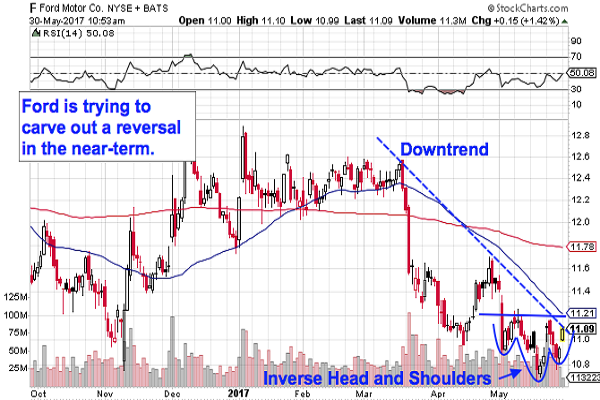
The year has been a tough one for Ford as it has dealt with a lack of love on Wall Street and more recently, an overhaul in its executive suite. Since the start of the calendar year, the automaker’s stock has shed nearly 7% of its market value, trailing the S&P 500 by about double that. Thing is, Ford’s price trajectory could finally be about to change (in the short-term, at least). Shares are working on carving out a near-term bottom believe it or not.

Ford shares fell 0.5% early Monday to $11.29.

The pattern in play right now for Ford is an inverse head and shoulders pattern, a bullish reversal setup that signals exhaustion among sellers. The pattern triggers a buy signal with a push through $11.20. It’s worth noting that a breakout above $11.20 would also coincide with a break through the downtrend that’s harangued Ford’s share price since mid-March.

That’s extra evidence that buyers could be building strength here.

Source: TheStreet
Source: TheStreet

The 6 words billionaire Warren Buffett uses the most, according to a data scientist

Self-made billionaire and Berkshire Hathaway CEO Warren Buffett’s steadfast optimism has grown his following over the years — and he even uses specific words to achieve his success, according to recent analysis.

Thanks to his leadership, the legendary investor has inspired upwards of 160 other billionaires to promise to give away at least half of their wealth to philanthropic causes. In February, Bill and Melinda Gates turned their annual letter into a valentine dedicated to Buffett , suggesting his unceasing optimism is the secret to the 86-year-old’s success .

Now, that claim is backed by data. In March, data scientist Michael Toth performed a sentiment analysis on Buffett’s annual Berkshire Hathaway shareholder letters from 1977 to 2016. Using the R programming language, Toth, 28, identified Buffett’s most commonly used positive and negative words over the past 40 years.

The top six unique words are, in this order: loss, gain, worth, significant, debt and outstanding. Although two of those words have negative associations — loss and debt — Toth found a surprising explanation as to why those landed on Buffett’s list of most utilized words.

Toth tells CNBC that Buffett limits his use of negative words to describe Berkshire Hathaway’s hardship. Instead, he focuses on the positive.

“He uses words like ‘outstanding,’ ‘excellent,’ and ‘extraordinary.’ To me this communicates that he has strong confidence in his optimism, and that he is comfortable committing to and expressing that optimism,” Toth says. “The negative words he uses, particularly cases like ‘unusual’, and ‘difficult’ seem to refer to challenges and unique circumstances.”

For example, in the 2017 letter published, Buffett uses the word “debt” to discuss how Berkshire Hathaway Energy’s “many sources of profit” allow it to “significantly lower [its] cost of debt.” He tells his readers, “That economic fact benefits both us and our customers.”

“I think that it’s important to be on top of what people are thinking, to think for yourself and make decisions beyond the numbers, ” Toth says about the benefits of his sentiment analysis.

Another standout detail: How positive Buffett remained in his letters leading up to moments of economic downturn, especially in 2001 and 2008. Toth notes that Buffett’s ability to balance both optimism and realism are reflected in whether a letter was positive or negative in any given year.

“What surprised me was how well these negative letters lined up with negative recession events,” Toth tells CNBC. Those five events comprised of the market downturn in 1987 dubbed Black Monday, the recession of 1990, the September 11 attacks and collapse of the dot-com bubble in 2001 and 2002, as well as the Great Recession of 2008.

“Even when things are going badly, like in 2008 when everything was falling apart, he is still measured in his approach in speaking to his shareholders,” Toth says. “Things are not always going to be perfect and I think Buffett’s ability to still communicate and inspire confidence during those bad time periods is important.”