Editor

34 things you need to know about the incoming tax law

It’s official. Congress has ushered through the first major tax overhaul since Ronald Reagan was president.
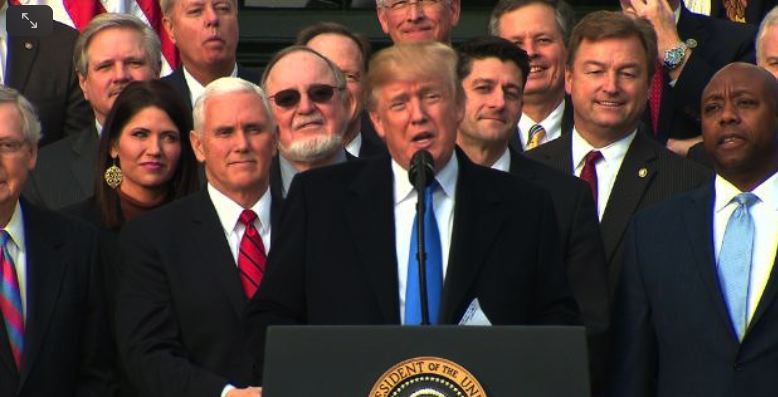
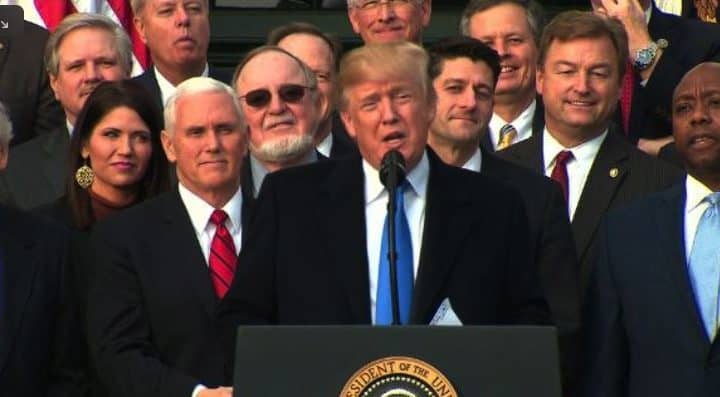
The measure, which now awaits President Trump’s signature, is about to shake up life for millions of Americans. It will redistribute the country’s wealth. It could sway decisions about whether to buy a home, or where to send kids to school. It could even affect when unhappy couples decide to get a divorce.

As the bill becomes law, here are 34 things you need to know.

1. This is the first significant reform of the U.S. tax code since 1986.

Reagan signed major legislation for corporations and individuals in 1986. Since then, serious tax reform has eluded Republicans, though they repeatedly called for it as the tax code became longer and more arcane.

2. Changes have been made to both individual and corporate tax rates.

Individual provisions in the new legislation technically expire by the end of 2025, though some people expect that a future Congress won’t actually let them lapse. Most of the corporate provisions are permanent.

3. Tax reform will increase deficits by $1.46 trillion over the next decade.

That’s the net number that’s been crunched by the nonpartisan Joint Committee on Taxation. The future law’s contribution to the debt will likely be even higher if individual tax cuts are re-upped in eight years.

4. There are still seven tax brackets for individuals, but the rates have changed.

Americans will continue to be placed in one of seven tax brackets based on their income. But the rates for some of these brackets have been lowered. The new rates are: 10%, 12%, 22%, 24%, 32%, 35% and 37%. Find out where you fit here.

5. The standard deduction has essentially been doubled.

Republicans want fewer people to itemize their taxes. To achieve this, they’ve nearly doubled the standard deduction. For single filers, the standard deduction has increased from $6,350 to $12,000; for married couples filing jointly, it’s increased from $12,700 to $24,000.

6. The personal exemption is gone.

Previously, you could claim a $4,050 personal exemption for yourself, your spouse and each of your dependents, which lowered your taxable income. No longer. For some families, the elimination of the personal exemption will reduce or negate the tax relief they get from other parts of the reform package.

7. The state and local tax deduction now has a cap.

The state and local tax deduction, or SALT, remains in place for those who itemize their taxes — but now there’s a $10,000 cap. Previously, filers could deduct an unlimited amount for state and local property taxes, plus income or sales taxes.

8. The child tax credit has been expanded.

The child tax credit has doubled to $2,000 for children under 17. It’s also now available, in full, to more people. The entire credit can be claimed by single parents who make up to $200,000, and married couples who make up to $400,000.

9. There’s a new tax credit for non-child dependents, like elderly parents.

Taxpayers may now claim a $500 temporary credit for non-child dependents. This can apply to a number of people adults support, such as children over age 17, elderly parents or adult children with a disability.

10. Fewer people will have to deal with the alternative minimum tax.

The alternative minimum tax, a parallel tax system that ensures people who receive a lot of tax breaks still pay some federal income taxes, remains in place for individuals. But fewer people will have to worry about calculating their tax liability under the AMT moving forward. The exemption has been raised to $70,300 for singles, and to $109,400 for married couples.

11. And the mortgage interest deduction has been lowered.

Current homeowners are in the clear. But from now on, anyone buying a new home will only be able to deduct the first $750,000 of their mortgage debt. That’s down from $1 million. This is likely to affect people looking for homes in more expensive coastal regions.

12. None of this will affect your 2017 taxes.

Americans won’t need to worry about these changes when they start filing their 2017 tax returns in about a month. The new laws will first be applied to 2018 taxes.

13. By the way, you can still deduct student loan interest.

The deduction for student loan interest, which is up to $2,500 per year, is safe.

14. You can still deduct medical expenses.

The deduction for medical expenses wasn’t cut. In fact, it’s been expanded for two years. In that time, filers can deduct medical expenses that add up to more than 7.5% of adjusted gross income. In the past, the threshold for most Americans was 10% of adjusted gross income.

15. If you’re a teacher, you can still deduct classroom supplies.

The deduction for teachers who spend their own money on school supplies was left alone. Educators can continue to deduct up to $250 to offset what they spend on classroom materials.

16. The electric car tax credit lives on.

Drivers of plug-in electric vehicles can still claim a credit of up to $7,500. Just as before, the full amount is good only on the first 200,000 electric cars sold by each automaker. GM, Nissan and Tesla are expected to reach that number some time next year.

17. Home sellers who turn a profit keep their tax break.

Homeowners who sell their house for a gain will still be able to exclude up to $500,000 (or $250,000 for single filers) from capital gains, so long as they’re selling their primary home and have lived there for two of the past five years.

18. 529 savings accounts can be used in new ways.

In the past, funds invested in 529 savings accounts wasn’t taxed — but it could only be used for college expenses. Now, up to $10,000 can be distributed annually to cover the cost of sending a child to a “public, private or religious elementary or secondary school.” This change is a win for Education Secretary Betsy DeVos.

19. And tuition waivers for grad students remain tax-free.

Graduate students still won’t have to pay income taxes on the tuition waiver they get from their schools. Such waivers are typically awarded to teaching and research assistants.

20. But say goodbye to the tax deduction for alimony payments.

Alimony payments, which are codified in divorce agreements and go to the ex-spouse who earns less money, are no longer deductible for the person who writes the checks. This provision will apply to couples who sign divorce or separation paperwork after December 31, 2018.

21. The deduction for moving expenses is also gone …

There may be some exceptions for members of the military. But most people will no longer be able to deduct the cost of their U-Haul when they move for work.

22. As is the tax preparation deduction …

Before tax reform passed, people could deduct the cost of having their taxes prepared by a professional, or the money they spent on tax prep software. That break has been eliminated.

23. … The disaster deduction …

Losses sustained due to a fire, storm, shipwreck or theft that aren’t covered by insurance used to be deductible, assuming they exceeded 10% of adjusted gross income. But now through 2025, people can only claim that deduction if they’ve been affected by an official national disaster. That would make someone whose house was destroyed by a California wildfire potentially eligible for some relief, while disqualifying the victim of a random house fire.

24. … And the reimbursement for bicycle commuters.

The tax code used to let you to knock off up to $20 from your income per month for the costs of bicycle commuting to work, assuming you weren’t enrolled in a commuter benefit program. That’s gone.

25. Almost everyone is now exempt from the estate tax.

Before tax reform, few estates were subject to the estate tax, which applies to the transfer of property after someone dies. Now, even fewer people have to deal with it. The amount of money exempt from the tax — previously set at $5.49 million for individuals, and at $10.98 million for married couples — has been doubled.

26. Adjustments for inflation will be slower.

The new legislation uses “chained CPI” to measure inflation. It’s a slower measure than what was used before. Over time, that will raise more money for the federal government, but deductions, credits and exemptions will be worth less.

27. Oh, and the individual mandate on health insurance has been scrapped.

Republicans failed to repeal Obamacare earlier this year, but they managed to get rid of one of the health law’s key provisions with tax reform. The elimination of the individual mandate, which penalizes people who do not have health care, goes into effect in 2019. The Congressional Budget Office has predicted that as a result, 13 million fewer people will have insurance coverage by 2027, and premiums will go up by about 10% most years.

28. You won’t be able to file your tax return on a postcard.

Trump said H&R Block would go out of business after tax reform because filing taxes would become so simple. Not quite. While doubling the standard deduction will ease the process for some individuals, there’s still a web of deductions and credits to work through. And for small businesses, filing could become even more complicated.

29. The corporate tax rate is coming down.

The corporate tax rate has been cut from 35% to 21% starting next year. The alternative minimum tax for corporations has been thrown out altogether. Earnings are expected to go up as a result.

30. Pass-through entities will also get a break.

The tax burden by owners, partners and shareholders of S-corporations, LLCs and partnerships — who pay their share of the business’ taxes through their individual tax returns — has been lowered via a 20% deduction. The legislation includes a rule to ensure owners don’t game the system, but tax experts remain concerned about abuse of this provision.

31. Not all CEOs think they’ll use their savings to create jobs, though.

Just 14% of CEOs surveyed by Yale University said their companies plan to make large, immediate capital investments in the United States following tax reform. Capital investments, like building plants and upgrading equipment, can spur hiring.

32. Plus, the way multinational corporations are taxed is about to change.

The U.S. is switching to a territorial system of taxation, which means companies won’t owe federal taxes on income they make offshore. To help the transition, companies will be required to pay a one-time, low tax rate on their existing overseas profits — 15.5% on cash assets and 8% on non-cash assets, like equipment in which profits were invested.

33. By the way, there’s a provision to rein in executive pay at nonprofits.

The legislation includes a new 21% excise tax on nonprofit employers for salaries they pay out above $1 million. That may mean some well-paid executives at nonprofits take a pay cut.

34. Businesses won’t be able to write off sexual harassment settlements.

New Jersey Democratic Senator Bob Menendez’s amendment born of the #MeToo momentmade it all the way through. Companies can no longer deduct any settlements, payouts or attorney’s fees related to sexual harassment if the payments are subject to non-disclosure agreements.


Tax bill opens Alaska to oil production worth billions of dollars

An important provision of the tax cut legislation passed by Congress this week allows the American people to finally benefit from abundant petroleum resources that experts predict will be found in a very small area of the Arctic National Wildlife Refuge (ANWR) on Alaska’s northern coast.



The legislation directs the Interior Department to hold at least two lease sales over the next 10 years, for a maximum of 2,000 acres opened to drilling. Analysts say the sales could fetch as much as $2.2 billion.

ANWR is enormous – 19 million acres, about the size of South Carolina. The 2,000 acres along the coastal plain that would actually be disturbed by drilling, roads and other development work account for about one-hundredth of 1 percent of the vast area.

The narrow coastal plain affected by the legislation contains an estimated 10.4 billion barrels of oil, says Sen. Lisa Murkowski, R-Alaska, who chairs of the Senate Energy and Natural Resources Committee. This could produce about 1 million barrels of oil each day, amounting to about 20 percent of daily U.S. oil production, according to the U.S. Geological Survey.

And there’s a good chance the petroleum potential of the area where drilling would be allowed is even higher.

The U.S. Geological Survey and Congressional Research Service say it’s 95 percent likely that there are 15.6 billion barrels of oil beneath ANWR. With today’s prices and fracking technology, up to 60 percent of that oil may be recoverable.

At $50 a barrel, all that oil represents $460 billion that we will not have to send to other countries to buy foreign oil. It also represents tens of billions of dollars in royalty and tax revenues to Alaska and the U.S. government. And opening up a tiny part of ANWR for our energy industry will create thousands of jobs in oilfield, manufacturing and many other sectors.

After overall tax revenue collected by the Internal Revenue Service, oil and gas royalty payments represent the single largest contribution to the U.S. Treasury.

Companies that extract oil from federal onshore and offshore leases pay royalties of up to 18 percent of wellhead prices. They then pay corporate taxes on profits and sales taxes at the pump. Workers pay income taxes, instead of receiving unemployment and welfare checks.

Every step in the leasing, drilling, production and pipeline process will require extensive environmental reviews. Unfortunately, each step will likely generate lawsuits.

As they have for some four decades, activists continue to claim drilling would destroy the entire ANWR area’s wilderness character and threaten its caribou, polar bears, birds and other wildlife. That is a completely false narrative.

To claim the minimal impact on 2,000 acres of a 19-million acre refuge will despoil the entire refuge is like saying an airport on North Carolina’s northern border would ruin scenery and kill wildlife throughout the state.

The potentially oil-rich area of ANWR is actually flat, treeless tundra, 50 miles from the beautiful Brooks Range mountains that feature so prominently and deceptively in Sierra Club and other anti-drilling campaigns.

During some eight months of winter, when drilling will take place, virtually no wildlife are present. Food is buried under snow and ice, and temperatures plummet as low as 40 below zero Fahrenheit. The tundra turns rock solid.

The harsh winter conditions mean drilling can be done using airstrips, roads and drill pads that are all constructed with ice and snow. Come spring, all of this will melt, leaving only puddles, little holes and a few permanent facilities.

The caribou will return – just as they have for years at the nearby Prudhoe Bay and Alpine oilfields – and do what they always have done: eat, hang out and make babies.

In fact, the Prudhoe Bay oilfield’s Central Arctic caribou herd has over 20,000 of the animals today, compared to just 5,000 in 1975. Arctic fox, geese, shore birds and other wildlife also return each spring, along with giant mosquitoes.

Each drill pad will support multiple wells. Modern “directional drilling” technologies will allow companies to punch holes a mile deep and five miles long in any direction, steering drill bits to penetrate multiple oil zones and hit targets the size of basketball courts – or even backboards.

Coupled with the ability to fracture rock formations and stimulate them to produce far more oil and natural gas liquids than previously possible, this accuracy means that the 2,000-acre footprint could produce up to 15 billion gallons of petroleum annually.

That’s far better than producing 15 billion gallons of ethanol annually from corn grown on an area larger than Iowa: 36 million acres. Ethanol is produced via a process that also requires massive amounts of water, pesticides, fertilizers and fossil fuels to create fuel that gets one-third less mileage per gallon than gasoline.

Inuit natives who live in or near ANWR have supported drilling by an 8-to-1 margin. They no longer want to live in poverty – after having given up their traditional land claims for oil rights that Congress, greens, presidents and courts have repeatedly denied them.

Gwich’in Indians have opposed ANWR drilling, and some were paid by environmentalist groups to appear in anti-drilling commercials. However, they actually live hundreds of miles away – and leased many of their own tribal lands to generate revenue. Their leased areas were close to a major migratory path, where caribou often give birth to their calves before arriving in ANWR. No oil was found.

Drilling in ANWR will also ensure sufficient production to keep the Trans-Alaska Pipeline in operation. Right now, declining North Slope production threatens to reduce oil in the pipeline to a point where it cannot stay sufficiently warm to flow under months-long winter conditions.

The pipeline needs between 250,000 and 350,000 barrels of oil per day to stay open. If there are inadequate supplies, because ANWR or other deposits are not developed, the pipeline will be shut down – leaving millions of barrels and billions of dollars behind and destroying jobs.

ANWR’s energy belongs to all Americans. It can and should be produced safely, to generate tremendous oil, gas, job, revenue and other bounties – in yet another huge benefit from this tax reform legislation.

Apple just patented a navigation system for self-driving cars

A patent application published on Thursday revealed details on Apple’s autonomous vehicle research, which CEO Tim Cook has called the “mother of all AI projects.”

The lengthy patent application titled simply “Autonomous Navigation System,” was published by the U.S. Patent and Trademark Office on Thursday and has apparently been in the works since at least 2015.

In the patent, Apple describes methods to make self-driving vehicle navigation more efficient, reducing the need to constantly remake detailed maps.

The patent claims that many autonomous vehicle systems base their navigation on static information — like maps — and use sensors to identify real-time information on the elements that change from day to day, as a way of minimizing the intense computing power needed to drive a car.

Instead, Apple’s system would be able to direct the car “independently of any data received from any devices external to the vehicle, and any navigation data stored locally to the vehicle prior to any monitoring of navigation.” Apple’s technology proposes a computerized model for predicting routes using sensors and processors in the vehicle.

The patent comes after a Bloomberg report last year that said Apple was using virtual reality to test self-driving cars. A year ago, Apple also said it was investing in transportation-related automation in a letter it submitted to the National Highway Traffic Safety Administration.

To be sure, patented ideas are just that — ideas, that may or may not ever become commercial products. Still, the pages-long patent application gives some insight into how the company is thinking about potential future projects.

But while Apple has previously been granted adjacent patents — such as a tile interface for upcoming locations on a map, location awareness between two mobile phones and a way to model crowds of people using mobile devices — Thursday’s patent appears to be one of the most detailed yet.

The company did not immediately respond to a request for comment.

Tax bill ‘winners’ could help drive the stock market’s traditional year-end Santa rally

Oh, by gosh, by golly, it’s time for the Santa rally.

According to “Stock Trader’s Almanac,” the Santa rally officially begins Friday, the start of the final five trading days of 2017, and ends at the close Jan. 3, the end of the second trading day of the new year.

Some strategists are saying humbug to the seasonal rally because the S&P 500 has already gained 20 percent this year, with 5 percent in just the last five weeks. But Jeffrey Hirsch, editor-in-chief of the almanac, says they’ve got it all wrong. It’s an indicator, not a seasonal trade.

He says the phrase used to explain the year-end phenomena has proven to be true: “If Santa Claus should fail to call, bears will come to Broad and Wall.” Hirsch notes that since 1950, the S&P 500 has averaged a consistent 1.3 percent gain in that seven-day period.

“It’s an indicator of market health, and if we get the Santa rally, that’s good, and if not … The last six times that Santa didn’t show up, three were followed by flat years: 1994, 2005 and 2015. Two were nasty bear markets in 2000 and 2008, and a mild bear … in January 2016,” said Hirsch.

In 2016, the S&P 500 lost 2 percent during the Santa rally period and continued falling, losing 10.5 percent for the year to date before bottoming on Feb. 11. It then turned around and ended 2016 up 9 percent.

“For the Santa rally itself, a lot of it has to do with the end of tax loss selling and the fact that a lot of us are not around to really trade the market during this period,” he said. “It’s a period of time where a lot of participants are away, and the smart money comes in and picks up values. It’s a time of year for positive vibrations and bullish buying, and if it doesn’t happen you get the first sign that things are not so rosy.”

Hirsch said while he finds it an important indicator, it’s more important when combined with other indicators, such as how stocks trade in the first couple of days in January and the January effect — which is using the first month of the year as a barometer for the rest. “So goes January, so goes the year,” is the old adage.

Some find talk of the indicator as just another old Wall Street tradition, kind of like when the traders sing “Wait Till the Sun Shines, Nellie” on the New York Stock Exchange floor on Christmas Eve.

One of those traders, Wall Street veteran Art Cashin, tells me he believes in the Santa rally “a little bit.” This past year’s Santa rally ended with a 0.3 percent gain, and the month of January was up 1.8 percent.

He said stocks were lifted Thursday, in part by traders picking winners from the sweeping GOP tax bill, approved by Congress on Wednesday. That type of buying could fuel the Santa rally, he said.

Sectors that would benefit from tax reform were trading higher, such as financials, energy, telecom, industrials and materials. Technology companies were trading lower. Many already have a low tax rate and could face new taxes on their overseas operations.

“You could see by the volume, it’s not a runaway rally,” he said. “Let’s remember this year has not been a good year for seasonal patterns. The January effect may be complicated by the tax bill. People weren’t doing their tax selling because they weren’t sure how things were breaking down.”

Qualcomm gets a permit to test self-driving cars in California

Qualcomm has obtained a permit to test autonomous vehicles on public roads in California, the latest step in the chipmaker’s effort to gain a foothold in the self-driving car market.

California’s Department of Motor Vehicles issued the permit, which authorizes testing for one vehicle and three drivers, on Dec. 12, a spokesperson from the agency told CNBC in an email.

“We certainly expect to be a key player in the autonomous space,” Nakul Duggal, Qualcomm’s vice president of product management for automotive, said in an interview. He declined to talk about forthcoming products that could enable autonomous driving.

In September Qualcomm announced the 9150 C-V2X chipset, which lets cars communicate with other cars as well as infrastructure like traffic lights. That technology could work alongside chips dedicated to autonomy by improving safety, Duggal said.

Qualcomm has begun field trials of Ford vehicles containing the chipsets in San Diego County, where the company is based, Duggal said. Similar tests of the technology will take place in Michigan, China, Germany, Italy and Japan, he said.

Nvidia picked up a permit to test self-driving cars in California just over a year ago, and earlier this year Samsung received a permit from the state. Nvidia has several automotive partners, including Tesla, Toyota and Volvo. Intel has expressed interest in autonomous driving but doesn’t have a California self-driving permit.

Qualcomm technology is currently employed for telematics and infotainment systems. Last year the company announced a plan to acquire NXP, which sells several automotive components. The deal has not closed. In November Broadcom said it wanted to acquire Qualcomm for more than $100 billion, a proposal that Qualcomm’s board rejected.

U.S. home sales hit 11-year high, supply still tight

WASHINGTON – U.S. home sales increased more than expected in November, hitting their highest level in nearly 11 years, the latest indication that housing was regaining momentum after almost stalling this year.

The report on Wednesday from the National Association of Realtors also added to data ranging from the labor market to retail sales that have suggested the economy was ending 2017 on a strong note.
“The greater home sales will stoke the fires for stronger economic growth next year as consumers spend more to furnish their new homes with new appliances and furniture and all the decorations and trimmings,” said Chris Rupkey, chief economist MUFG in New York.

Existing home sales surged 5.6 percent to a seasonally adjusted annual rate of 5.81 million units last month amid continued recovery in areas in the South ravaged by Hurricanes Harvey and Irma, and solid gains in other parts of the country.

That was the highest level since December 2006 and marked the third straight monthly rise. Economists had forecast home sales rising only 0.9 percent to a 5.52 million-unit rate in November.

Existing home sales make up about 90 percent of U.S. home sales. They rose 3.8 percent on a year-on-year basis in November. Sales in the South, which accounts for almost half of the existing homes sales market, increased 8.3 percent last month. Sales rose 6.7 percent in the Northeast and jumped 8.4 percent in the Midwest.

They, however, fell 2.3 percent in the West, which has seen an acceleration in house price increases. While the housing market is expected to continue growing next year, there are concerns that a Republican overhaul of the U.S. tax code could hurt sales at the high end of the market.

The biggest overhaul of the tax system in more than 30 years, which could be signed into law by President Donald Trump soon, will cap the deduction for mortgage interest at $750,000 in home loan value for residences bought from Jan. 1, 2018, through Dec. 31, 2025.

The cap would revert to $1 million in loan value after Dec. 31, 2025.

“We expect further increases in sales in 2018, although tax reform is likely to modestly reduce demand at the high end as well as to lower prices for high-priced homes,” said David Berson, chief economist at Nationwide in Columbus Ohio.

The report came on the heels of data this week showing homebuilder confidence vaulting to a near 18-1/2-year high in December and single-family homebuilding and permits rising in November to levels last seen in the third quarter of 2007.

Housing is expected to contribute to economic growth in the fourth quarter after being a drag for two straight quarters.

The PHLX housing index was trading higher, outperforming a broadly flat stock market. The dollar slipped against a basket of currencies. Prices for U.S. Treasuries fell.

SUPPLY SQUEEZE
Despite the recent gains, home resales remain constrained by a chronic shortage of houses at the lower end of the market, which is keeping prices elevated and sidelining some first-time buyers, who accounted for 29 percent of transactions last month.

Economists and realtors say a 40 percent share of first-time buyers is needed for a robust housing market.

The number of previously owned homes on the market dropped 9.7 percent to 1.67 million units in November from a year ago, the second lowest reading since 1999. Housing inventory has dropped for 30 straight months on a year-on-year basis.

At November’s sales pace, it would take a record low 3.4 months to exhaust the current inventory, down from 3.9 months in October. A six-month supply is viewed as a healthy balance between supply and demand.

With supply tightening, the median house price increased 5.8 percent from a year ago to $248,000 in November. That was the 69th consecutive month of year-on-year price gains. In contrast, annual wage growth has struggled to break above 2.9 percent since the 2007/09 recession ended.

The government reported on Tuesday that groundbreaking on single-family homes, which account for the largest share of the housing market, jumped 5.3 percent in November to the highest level since September 2007. Housing completions continued to lag at a rate of 1.116 million units.

Realtors estimate that the housing starts and completions rates need to be in a range of 1.5 million to 1.6 million units per month to plug the inventory gap.