Editor

Iceland Shows What Beats Populist Parties: Growth and Jobs

The man who probably will be Iceland’s next prime minister says he knows how to deal with the global wave of populism that’s threatening the established order: Deliver plenty of economic growth and jobs. 

Bjarni Benediktsson, the 46-year-old leader of the conservative Independence Party, on Sunday emerged as the big winner in the nation’s snap election. The populist Pirate Party, which had led in some polls even though it is only four years old, largely failed to live up to its hype. In a year where the British people voted to leave the European Union and political outsider Donald Trump is the Republican nominee for president, Icelanders were persuaded to vote for the status quo.

“We just took a stand against populist ideas,” Benediktsson said in an interview Sunday in Reykjavik. “What we’ve been saying lately is, don’t overspend, don’t over-promise, just keep your way when things are going well. They were calling for us to push the refresh button and we said, ‘Well, there’s no need to.”’

Even so, Benediktsson, finance minister in the outgoing government, will need to use all his negotiating skills to put together a viable majority. Due to the governing Progressive Party’s poor performance in Saturday’s vote — it only retained eight of the 19 seats won in 2013 — the next coalition will necessarily have to be expanded to at least one more party in a country where the center is losing ground.

For an explainer on Iceland’s political parties, click here

In Benediktsson’s favor: the lowest unemployment rate and one of the highest economic growth rates in Europe. And that only eight years after the implosion of its banking system plunged Iceland into the worst recession in six decades and turned it into a financial pariah.

“This is going to be a completely different set of challenges than we were faced with three or four years ago,” Benediktsson said. “So it’s going to be exciting. I think good times are ahead for Icelanders.”

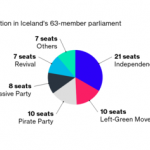
The Progressive Party was badly punished by voters as a result of its former leader’s dealings with offshore accounts, while Benediktsson’s party increased its support. Final results showed that nearly one in three voters cast their ballots for Independence, making it parliament’s biggest force by far. The Pirates and the Left-Greens, which had been tipped by pollsters as potential winners, can’t even match the Independents’ 21 seats if their forces are combined.

Although the trained lawyer often talks of the need to “rebuild trust” between the Icelandic people and the politicians in the wake of the 2008 bust, Benediktsson’s electoral success was largely attributable to the strong rebound in the economy.

In fact, one of the main tasks of the next administration will be to make sure there’s no overheating. The country’s unemployment rate has fallen from its March 2010 peak of 9.3 percent to just 2 percent, while the economy is projected to grow at an annual rate of about 4 percent this year.

But Benediktsson does face economic challenges. A seemingly unstoppable surge in the number of tourists has helped push the krona up 12 percent against the euro this year, while recent pay rises of 13 percent are way above any productivity gains.

Should he become Iceland’s next prime minister, he will also be expected to stick to the current plans on the lifting of capital controls and with the outgoing government’s confrontational strategy with U.S. funds burned by the 2008 crisis.

While the Pirate Party fell short of expectations, the loose collective of Internet activists and direct democracy activists did gain a sizable following that will make it the second-biggest party in parliament, along with the Left-Greens. Its gains could have been stymied by heavy rains and wind on Saturday, which kept turnout down and potentially the younger voters at home. A total of 195,200 votes were cast for a turnout of 79.2 percent, down from 81.9 percent in 2013.

One likely candidate for a coalition with Benediktsson’s Independence is A Bright Future, a centrist movement; another is Revival, a free-market party that was founded earlier this year by disgruntled Independence Party members. One potential sticking point is the country’s relationship with the European Union. Iceland is part of the European Economic Area, which has near-free trade with the EU.

The key now is to find stability.

“It’s a strong government that we need now,” said Benediktsson. “Things are going quite well at the moment, we have strong growth, low unemployment, so the new government has to be able to follow through on that.”

Source: Bloomberg Markets
Big Oil’s Shrinking Act Has More to Go in China

China’s oil output slump shows no signs of abating as the country’s state-run energy giants hold back spending to cope with the crash in prices.

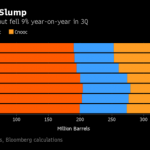
China’s Big Three producers, led by PetroChina Co., have spent about half of their 2016 capital-expenditure targets in the first nine months of the year, according to operational data released last week by the companies. Their domestic crude output has slumped 6 percent over that period amid the cutbacks, Bloomberg calculations show. China Petroleum & Chemical Corp., known as Sinopec, has seen the largest production declines and spent the least so far this year.

“Low crude prices led to lower spending, and lower spending caused the lower output,” said Tian Miao, a Beijing-based analyst at North Square Blue Oak Ltd. “The only thing that can change the game is a substantial rebound in crude prices.”

While output drops, crude imports have surged to all-time highs as the country’s refineries are on track to process a record amount of crude this year and the government takes advantage of the slump in prices to fill emergency stockpiles. China edged past the U.S. last month as the world’s biggest importer and the country has relied on overseas supplies for 65 percent of its needs this year, a record ratio, according to analysts at consultant ICIS China.

“The Chinese government has no problem with reduced domestic crude production as long as crude imports can be guaranteed,” Tian said. “The national duty of the Big Three in a low-crude environment is more about securing imports than producing at a loss.”

PetroChina on Friday said net income during the first nine months of the year fell 94 percent to 1.73 billion yuan. Full-year results are expected to “decrease substantially” from 2015, it said in a statement.

Sinopec said Thursday profit rose 11 percent over the period as the world’s biggest oil refiner benefited from lower crude costs for its fuel-making business. Cnooc Ltd., which doesn’t release quarterly net income, reported Wednesday a 15 percent fall in third-quarter sales.

Sinopec has spent about 25 billion yuan in the first nine months of the year, down a third from same period last year and a quarter of its 100.4 billion yuan target. Domestic crude output during that period is down 14 percent. The company may consider buying overseas assets or stakes in other projects, Chairman Wang Yupu said after the half-year results were released in August.

“The company is likely to significantly underspend the full-year budget,” Neil Beveridge, a Hong Kong-based analyst at Sanford C. Bernstein, said in a research note after the company released quarterly earnings last week.

PetroChina has spent 114 billion yuan in the first nine months of the year, down 23 percent from the same period a year ago. The company said in March that it was targeting a 5 percent decline in capital spending to 192 billion yuan.

Cnooc has reached slightly more than half its full year target in the first three quarters. The offshore explorer intends to keep its 60 billion yuan spending cap this year, Chief Financial Officer Zhong Hua said in a conference call after the sales figures were released Wednesday. Having spent just 33.7 billion yuan in the first nine months, Cnooc will try to spend more in the last three months on improving output and preparing for new projects, he said.

China’s total crude output fell 6.1 percent in the first nine months of the year. Production can stabilize with prices around $50 a barrel and may not rebound until they are above $60, Bernstein’s Beveridge said earlier this month. Production from the Big Three in the third quarter slipped by 9 percent from the same period last year, according to Bloomberg calculations.

Source: Bloomberg Markets

U.K. Banks May Gain $14.6 Billion Yearly Leaving EU, Says Lobby

The U.K.’s biggest banks and financial firms could gain an additional 12 billion pounds ($14.6 billion) a year in revenue from Britain leaving the European Union, according to a report from a pro-Brexit lobby group.

Leaving the 28-nation trading bloc and ending membership in the EU single market for trade and services would help Britain cut “stifling Brussels red tape” to help U.K.-based financial firms grow sales, the Leave Means Leave campaign said in the report published on Sunday. London will also avoid a banking crisis and a fight for the survival of the euro area, according to the group.

The report comes in stark contrast to warnings from numerous global financiers arguing the City of London will be damaged by Britain leaving the EU, putting at risk tens of thousands of jobs and billions of pounds in revenue and taxes. Barclays Plc Chief Executive Officer Jes Staley said Friday he’s looking at “incremental steps” to relocate operations elsewhere in the trading bloc to offset the impact from Brexit.

“The U.K. is facing a very promising and profitable future outside the EU,” Richard Tice, co-chairman of Leave Means Leave, said in an e-mailed statement. “Being able to cut unnecessary regulation and bring back legal jurisdiction to the U.K. opens up a whole host of opportunity.”

Britain crashing out of the European single market could cost financial firms in the U.K. almost 40 billion pounds in lost revenue, deprive the nation of 10 billion pounds in taxes and lead to 70,000 jobs relocating overseas, according to a report earlier this month prepared by Oliver Wyman on behalf of TheCityUK lobby group, which represents the biggest banks and insurers in the country. That many jobs would only be at risk if all intra-EU trade from London collapsed, according to Leave Means Leave.

In contrast to warnings over the relocation of business overseas, the Leave Means Leave report said European financial companies may consider relocating to London following Brexit to keep access to the “deepest, most liquid capital market” in the region. While firms in the U.K. will maintain access to EU markets because they already comply with the trading bloc’s laws, Britain will also be able to “deregulate away unnecessary rules” following Brexit.

Source: Bloomberg Markets