
Editor

Canada Adds 79,000 Jobs in December, Pushing Jobless Rate to Lowest Level Since 1976

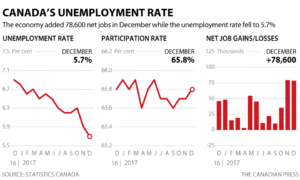
Canada’s jobless rate fell to 5.7 per cent last month.

Canada added 79,000 jobs last month, blowing past expectations and pushing the jobless rate to its lowest level since 1976.

The jobless rate was pushed down two-tenths of a percentage point to 5.7 per cent, Statistics Canada reported Friday.

That’s the lowest on record since comparable data became available 42 years ago.

Economists polled by Bloomberg were expecting a flat showing, with about 2,000 jobs added. Every province added jobs during the month, but more than half of the new jobs came in Alberta and Quebec, with each adding more than 26,000 jobs.

“Quebec was probably the most compelling story throughout the year, with job growth running strong and the unemployment rate plunging to a record low [of 4.9 per cent],” Bank of Montreal economist Robert Kavcic noted in a report to clients.
The loonie jumped on Friday’s news, gaining almost three-quarters of a cent to change hands at 80.74 cents US shortly after the numbers came out at 8:30 a.m. eastern time. The strength of the report also prompted investors to peg the odds of a rate hike from the Bank of Canada this month at about 70 per cent. Before the jobs report, a hike was being given less than 50/50 odds.

December’s numbers bring a close to the data for 2017 as a whole, which ended up being Canada’s best year for jobs since 2002, with 423,000 jobs added.

Most of the jobs added in December were part-time, but for the year as a whole, the vast majority — 394,000 — were full time.

Scotiabank economist Derek Holt called the numbers “another ridiculously strong employment report that is marked by over 150,000 new jobs in two months,” singling out the strength in both full-time work and also private sector jobs.

“The job market is absolutely booming north of the border,” Holt told his American readers.
High Arctic Fossils Reveal Ancient Bear’s Weakness for Sweets

Ellesmere Island fossil site yields bear teeth with cavities and remains of berry plants

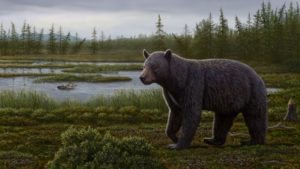
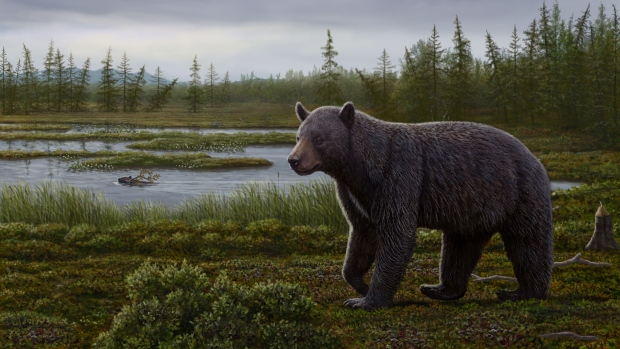
An artist’s reconstruction shows Protarctos Abstrusus in the Beaver Pond site area during the late summer. An extinct beaver, Dipoides, is shown carrying a tree branch in the water. Plants include black crowberry with ripened berries, dwarf birch in the foreground, sedges in water margins, and larch trees in the background.

Two bears living in a boreal forest in Canada’s High Arctic millions of years ago munched on too many sweets and didn’t brush their teeth, fossil evidence suggests.

As you might imagine, those bears ended up with cavities — something that paleontologists were very excited to see.

“These individuals actually suffered from a condition that well, humans also experience,” said Natalia Rybczynski, a research scientist at the Canadian Museum of Nature in Ottawa who helped excavate and study the fossils.

“I’m fascinated … because these are giving you insight into what these animals were actually doing.”

That evidence — along with remains of raspberry, blueberry, lingonberry and crowberry plants at the fossil site — suggests that ancient bears had a taste for sugary foods, probably berries, even then.

And, as with modern bears, that may have helped them fatten up to hibernate through the polar winter with its 24-hour darkness, Rybczynski and colleagues suggest in a new paper published today in the journal Scientific Reports.

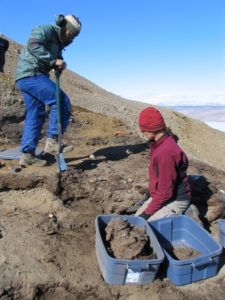
Natalia Rybczynski (kneeling) excavates the Beaver Pond site at Strathcona Fiord on Ellesmere Island with post-doctoral Ashley Ballantyne in July 2006. They found some Protarctos bones on this field trip.

The bear fossils were found at a site on Ellesmere Island, Nunavut.

While that area today is a frozen, barren, polar desert, 3.5 million years ago during the Pliocene (about the time when the ancient human relative Lucy roamed in Africa), it was about 20 degrees warmer — though it still dipped to one or two dozen degrees below zero in winter.

Ancient beaver pond

At that time, one of the first boreal forests grew there, providing a home to animals like beavers, small deer, three-toed horses — and, it appears, bears. The “Beaver Pond site” is one of very few fossil sites in the Arctic, and one of the only sites with mammal fossils, Rybczynski told CBC News: “So it’s a really important window into the past.”

This is closeup of the excavation area at the Beaver Pond site. While you have to chisel fossils out of the rock at fossil sites further sites further south, at the Beaver Pond site you use a trowel to dig out felt-like peat.

While you have to chisel fossils out of the rock at fossil sites further south, at the Beaver Pond site you use a trowel to dig out felt-like peat full of well-preserved wood, leaves and pine cones.

“You have to pick up chunks of peat, and you sort of like peel it apart, and sometimes there’s a bone in there,” Rybczynski said. The bones are usually fragments broken up by freezing and thawing, chocolate brown in colour or iridescent blue due to the formation of a mineral called vivianite.

The first pieces of a bear’s skull were found by now-retired Museum of Nature paleontologist Dick Harington in the 1990s.

Other pieces of the skull, a jaw, and pieces of skeleton were excavated over 14 years. They were found to belong to two bears, one a young adult bear likely between five and seven years old and another who was older. Both had cavities in their teeth.

Cavities are also found in up to 44 per cent of modern black bears, which fatten up on berries before hibernation, but are rare in other animals, Rybczynski said.

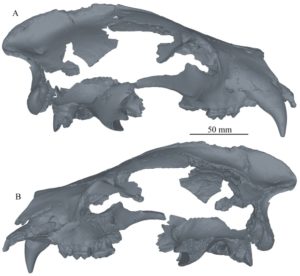
Composite laser scans show recovered pieces of the skull of Protarctos abstrusus. Based on the size of the skull, it grew to be about 100 kilograms, or slightly smaller than a modern black bear.

Missing link

One reason the discovery is exciting is that the fossils are a missing link between primitive and modern bears, said Xiaoming Wang, lead author of the study. Wang, head of vertebrate paleontology at the Natural History Museum, says it suggests that bears likely began eating a high-sugar diet to fatten up and then hibernate very early in their evolutionary history.

“I can’t really imagine that these animals could really still sustain an active lifestyle through the winters,” he added.

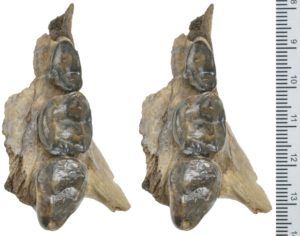
Closeup stereo photos of the upper teeth of Protarctos abstrusus from the Beaver Pond site. Cavities were found in the teeth, suggesting that the bear ate a lot of sugary foods, probably fruit.

The bear grew to be about 100 kilograms, making it slightly smaller than modern black bears that it looked quite similar to. However, Wang says it wasn’t a direct ancestor of modern black bears, which are known to have crossed into North America from Asia much later, during the last ice age.

The researchers can’t be sure whether the fossil bears they found were male or female, but one of the fossils includes canine teeth, which are typically much larger in males than females. Wang said their size leads him to believe the animal was male, but he can’t tell without having other specimens of the same species to compare to.

This bear isn’t a new species — a tooth from the bear of the same species was found in Idaho in 1970 and given the scientific name Ursus abstrusus. But scientists couldn’t get much information from a single tooth.

The fossils excavated from Ellesmere Island provide a lot more information and a “rare glimpse” into life in the High Arctic at that time, Wang said.

Nissan Wants to Make Cars That Can Read Your Mind

nissan brain to vehicle

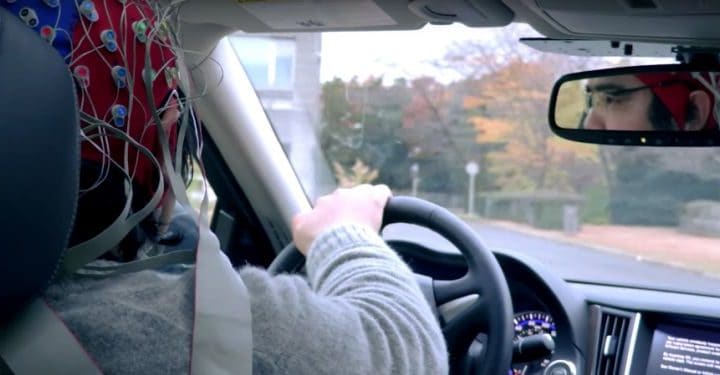
Nissan is working on making cars that can read your mind.

The company plans to demonstrate its Brain-to-Vehicle technology at the International Consumer Electronics Show (CES) in Las Vegas. Drivers would wear a skullcap covered in electrodes and wires that would read their brain waves to make the car’s reaction time faster.

If the driver decides to turn the car, for example, the technology could initiate the process before the driver can react to his or her thoughts. A Brain-to-Vehicle system could also be used in an autonomous car, allowing the car to adjust its driving style based on the owner’s desires.

“When most people think about autonomous driving, they have a very impersonal vision of the future, where humans relinquish control to the machines. Yet B2V technology does the opposite, by using signals from their own brain to make the drive even more exciting and enjoyable,” Nissan Executive Vice President Daniele Schillaci said in a statement.

Nissan introduced other technological features for its cars in 2017, including an enhanced cruise-control system that can help control a car in stop-and-go traffic and keep it in its lane, and the ability to start some cars remotely with Alexa devices.

Relief From Extreme Cold Weather is on The Way, Experts Say

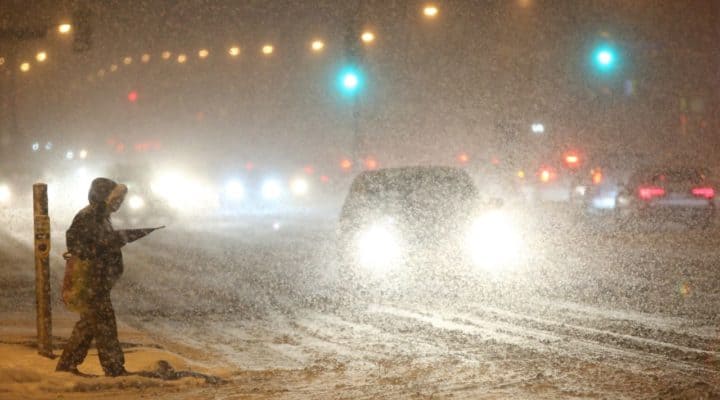
The Greater Toronto Area is covered in 15-20 centimeters of snow during a snowstorm in Toronto.

You might be freezing right now, but rest assured that a break from the frigid temperatures is on its way for much of Canada.

According to Brett Anderson, senior meteorologist with AccuWeather, temperatures will start to warm up early next week.

“There’s going to be relief in all of southern Canada next week,” Anderson said. “Temperatures start to warm up nicely.”

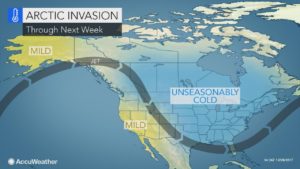
Arctic invasion across North America/AccuWeather

Most of the country has been experiencing unprecedented cold temperatures from the recent “polar vortex” – a biting cold weather phenomenon we were introduced to as it made its way through North America late last year – and Environment Canada has been regularly issuing extreme cold warnings across the bulk of the country since.

Toronto has hit record-breaking temperatures past -20 C, feeling closer to -40 C with the wind chill, demolishing a record that was establishing in 1959. This cold weather is expected to continue into the weekend with temperatures in Toronto being forecasted at -22 C on Saturday night and outlying areas will likely experience even colder temperatures around -30 C.

“The worst of the cold is probably going to be through Saturday, Saturday night,” Anderson said.

AccuWeather’s senior meteorologist does identify that Saturday is likely the end of this extended cold snap, with temperatures expected to warm up on Sunday and into Monday.

“Monday we’re looking at temperatures around 2 C for a high, that’s normal,” Anderson said for the Toronto area. “Only getting down to about -5 C at night on Monday.”

Some snow is expected to accompany this milder Monday weather in the region.

“We’re looking at potential for some snow coming across southern, eastern Ontario later Sunday night and into Monday,” Anderson said. “Not a big storm but something that could bring 2 to 8 cm.”

If temperatures hovering closer to 0 C still isn’t warm enough for your liking, look out for above normal temperatures around January 20, 2017.

“By the 18th, 19th, 20th, the core of that arctic air is going to shift to the other side of the pole over Siberia and usually when that happens, you tend to see a significant warm up across North America,” Anderson said. “That’s what we think’s going to happen.”

Although milder temperatures are on the way for the eastern portion of the country, Mother Nature is bringing the cold to British Columbia next week. Anderson expected that temperatures will average around 5 to 10 C below normal from northern B.C. to southern Manitoba.

There’s This Entrepreneurial Spirit’: Calgary Charts New Course for its Economic Future — Again

The skyline of downtown Calgary, as seen from the ridge above the north bank of the Bow River. Calgary Economic Development is now working on a new economic strategy for the city’s next 25 years.

With arched windows and Edwardian pilasters, the Odd Fellows Hall in downtown Calgary harkens back to a time when city fathers dreamed of a prairie metropolis as great as Chicago.

Today, the 105-year-old structure is alive again with the ambitions of another generation of Calgarians, one with an eye on Silicon Valley, not the Windy City.

It’s the home of Nucleus, a not-for-profit hub where the users — ranging from startups to post-secondary schools to venture funds — meet, work, learn and discuss innovation.

If all goes well, it’ll be a hotbed for Calgary’s emerging technology sector.

Or as 29-year-old Mark Blackwell, one of the bright minds behind Nucleus, enthusiastically puts it, this will be a place to “start figuring our shit out as it relates to Calgary 2.0.”

High-tech entrepreneur Mark Blackwell, who found success in California’s Silicon Valley, believes Calgary’s technology sector has a promising future.

What will Calgary 2.0 look like? Blackwell is one of many people invested in that question. Calgary’s future is a hot topic in offices from corporate headquarters to city hall.

It’s also a subject of intense focus at Calgary Economic Development (CED). The organization, already spearheading efforts to land Amazon’s second headquarters, is now crafting Calgary’s new economic strategy.

‘I think we still suffer from the stereotype of Stampede and cowboys and pickup trucks and oil, which is not a very innovative stereotype.’
– Adam Legge, former president of the Calgary Chamber of Commerce
It’s a sweeping exercise scrutinizing the city’s strengths and weaknesses, the talent it’s producing, industries that could be built upon and potential opportunities for upcoming sectors.

“For the last 25 years we have led economic and population growth in this country,” said Court Ellingson, CED’s vice-president of research and strategy.

‘We will continue to lead this country’

“And it is our plan that over the next 25 years we will continue to lead this country and we will double our city in size.”

It’s a tall order.

While it’s been barely five years since CED’s last strategy was inked, in some ways, it’s been a lifetime. Calgary once had the swagger that came with $100 US oil and a boom that delivered jobs, immigration and investment.

The good times would never end. Then they did.

Oil prices began a long slide in 2014, ultimately skidding below $30 per barrel two years later. Downtown towers emptied out as layoff notices spread far and wide. Alberta’s unemployment rate hit its highest point in two decades.

Even now, with the provincial economy leading the country in growth, unemployment at 7.3 per cent remains greater than the national average.

Calgary Economic Development, which has received international attention for its efforts to lure Amazon, is now working on an economic strategy for the city’s next quarter century.

CED is now looking to further broaden Calgary’s financial prospects, with perhaps no better example than the organization’s ambitious chase of the Amazon prize — a bid that has grabbed headlines despite going up against the likes of Toronto, New York and Washington, D.C.

CED is sifting through reams of analysis to identify Calgary’s advantages. Grafted onto it will be consultations with hundreds of citizens. The work, which began late last year, will be completed in the next few months.

“There’s an understanding in this community that we are going through a structural change of the economy,” Ellingson said.

“We often see or think about the reflection of that structural change being the change to oil and gas, but actually the whole globe is going through an era of change right now.”

Recent upheaval has forced many cities to take a hard look in the mirror. And there’s no shortage of communities looking for ways to shift their reliance from one industry and spread it over several.

Calgary — and the province — has been down this road before.

Diversification efforts important

In the late 1990s, with oil prices sagging, the province pumped both money and air into Alberta’s nascent technology sector. While there were successes, diversification efforts took a back seat when oil boomed again.

Former chamber president Adam Legge says Calgary must not lose focus on diversification, especially with the strides made in agriculture, technology, tourism and transportation.

These days, officials note that the city is making big strides in agriculture, technology, transportation and tourism.

For instance, Tourism Calgary reports that the city attracted a record 83 events in 2017, ranging from the arts to athletics. In the third quarter of the year, the sector saw a year-over-year increase of an additional 72,779 overnight hotel rooms sold during the three-month summer period — also a record.

“Tourism brings over $1.7 billion [Cdn] to our economy, locally, every year,” said Cassandra McAuley of Tourism Calgary.

“When tourism is strong, and when we have a strong city, it really has a strong ripple effect.”

Former Calgary Chamber of Commerce president Adam Legge says the focus on diversification can’t be lost.

It’s important, regardless of oil prices, because Calgary is facing a long climb after the last collapse. In fact, it could be 10 years before it feels like the city has got its groove back, Legge said.

He cites Calgary’s education levels, quality of life and enviable location as reasons for optimism. But the city has challenges.

He worries local government may struggle with the pace of innovation and believes Calgary still labours under the stereotype of a city that doesn’t necessarily embrace change.

“I think we still suffer from the stereotype of Stampede and cowboys and pickup trucks and oil, which is not a very innovative stereotype,” Legge said.

Innovation is no stranger to Blackwell, however. And, as Calgary tries to find its economic way, it’s people like him from whom CED will seek input.

Blackwell knows the buzz of a thriving tech sector, taking a Calgary software company on a “roller-coaster ride” through California’s Silicon Valley.

“We almost went bankrupt twice … but we got some really good advisers,” he said. “Long story short, we kind of kept it between three of us and sold it for just about $30 million.”

Valley life was good, but Blackwell chose to return to his hometown to help grow the local sector. He thinks Calgary can create something special and sees a lot of promise in the young, talented entrepreneurs who are striking out on their own instead of scanning job boards.

“We can’t forget that this city was built from entrepreneurs in a whole different era, and there’s this entrepreneurial spirit that drives this town,” he said. “It’s now just an entirely different game.”

SpaceX Launches Secretive Zuma Spacecraft

SpaceX kicked off the new year with a mystery-shrouded mission to deliver a government spacecraft, called Zuma, into orbit.

SpaceX launches secretive Zuma spacecraft

After more than a month of delays, a SpaceX Falcon 9 rocket vaulted toward the skies at 8 p.m. ET Sunday with the secretive payload. It launched from Cape Canaveral Air Force Station in Florida.

The space exploration firm, which is headed by Tesla (TSLA) CEO Elon Musk, initially scheduled the Zuma mission last November.

SpaceX gave a couple reasons for the schedule changes. At one point, SpaceX said it delayed the mission for “fairing testing.” The fairing is the very top portion of the rocket that houses the payload. “Extreme weather” also slowed down the company’s launch preparations.

Last week, SpaceX finally declared that both the rocket and the payload were “healthy” and ready for launch.

On Sunday, Zuma was delivered to low-Earth orbit, which is typically defined as any orbital path less than about 1,200 miles above the Earth’s surface, according to NASA. Zuma’s precise destination was not disclosed.

That was not the only thing kept secret about Zuma.

The spacecraft was built for the U.S. government, and it’s not unusual for the government to keep information about sensitive payloads under wraps. Typically these payloads involve a military concern, such as national security, defense or surveillance.

When asked about the project in November, Northrop Grumman (NOC) — the Virginia-based aerospace and defense company that built the Zuma spacecraft — declined to give any details about the spacecraft or reveal which arm of the government funded it.

“The U.S. Government assigned Northrop Grumman the responsibility of acquiring launch services for this mission,” the company said in a statement. “Northrop Grumman realizes this is a monumental responsibility and we have taken great care to ensure the most affordable and lowest risk scenario for Zuma.”

The company declined further comment Sunday.

Because of Zuma’s secrecy, SpaceX didn’t live stream the entire mission. But there was still plenty for SpaceX to show off after launch.

The company executed its signature move: guiding the first-stage rocket booster back to Earth for a safe landing.

Just over two minutes after liftoff Sunday, the first-stage booster separated from the second stage and fired up its engines. The blaze allowed the rocket to safely cut back through the Earth’s atmosphere and land on a pad at the Cape Canaveral Air Force Station.

SpaceX lands boosters so they can be reused in future missions. It’s meant to help make spaceflight cheaper.

The Zuma launch kicked off what SpaceX hopes will be an exciting year.

The company completed a record-setting 18 launches last year, and SpaceX plans to do even more this year, according to spokesman James Gleeson.

Later this month, the company plans to debut its latest invention: the Falcon Heavy. The monstrous rocket will have three times the thrust of the Falcon 9.

An exact date for the inaugural launch has not been set, but Musk wrote on Instagram last week that SpaceX is looking to do it before the end of the month.