Archives for June 17, 2018

Bank will name new Dieppe arena after giving $1M to project

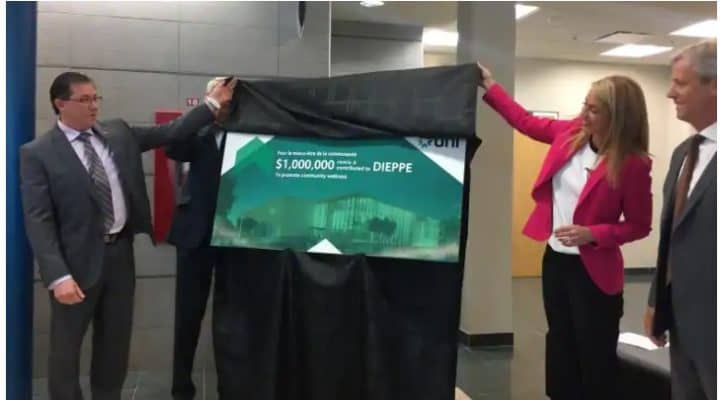
Uni Financial Cooperation CEO Robert Moreau, left, and Go Dieppe fundraising campaign co-chair Annick Laforge reveal the company’s $1-million donation to Dieppe’s planned arena complex. (Shane Magee/CBC)

Dieppe’s new arena complex will be named by a bank after Uni Financial Cooperation donated $1 million to the project set to begin construction this fall.

The name will be announced later in the year, although a news release Thursday said the complex would “bear Uni’s name.”

Uni’s contribution to the $29-million project gives the New Brunswick-based bank the right to name it.

The project includes two ice rinks, an indoor walking track, community kitchen, meeting spaces and a greenhouse.

Dieppe Mayor Yvon Lapierre and representatives of the company announced the donation at City Hall.

“It’s a good mix, a good marriage — a financial company that’s oriented toward the community and a community that was in need of a major sponsor in order to move our project forward,” Lapierre said.

Robert Moreau, CEO of Uni Financial Cooperation, called it an “honour and a pleasure” to be involved in the project that fits with the bank’s community-focused values.

Go Dieppe, a volunteer group set a goal to raise $4.5 million of the project’s cost.

70 per cent of target reached

Bob Cormier, co-chair of group, said the bank donation is one of several that has helped Go Dieppe raise more than 70 per cent of its goal before construction of the facility.

“Without them, we’d be significantly less, so it’s a major milestone for us,” Cormier said.

Cormier declined to say what other major donations the group has received, but they will be named later.

The mayor said talks with the bank began about six months ago. Discussions slowed as the city awaited confirmation of money from the federal and provincial governments.

Support from all 3 levels

In April, the two higher levels of government announced a combined $16.8 million to build the arena.

The city will cover the remainder of the cost.

The planned centre, known now as the “intergenerational community complex,” will be built beside the Centennial Arena off Notre-Dame Street. A 2011 consultant’s report recommended closing the arena built, which was built in 1967.

Construction of the new arena is expected to start in the fall and finish by spring 2020.
New hands-on hub broadens learning at Saint John library

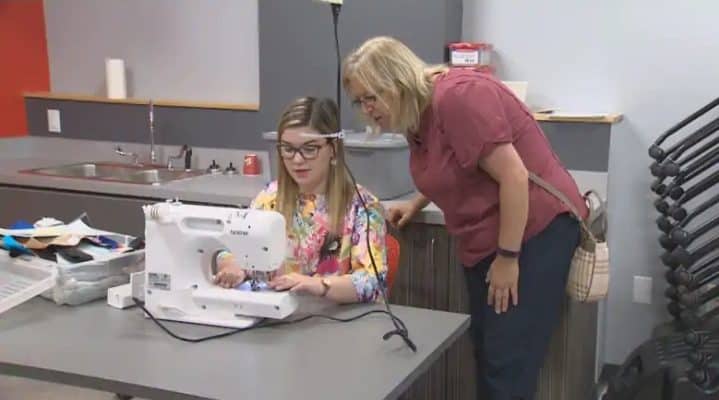
The Saint John Free Public Library recently opened a makerspace, an area where people can come together and learn. (Roger Cosman/CBC)

The Saint John Free Public Library celebrated its 135th anniversary on Wednesday by opening a hands-on learning hub.

Even though the library is 135-years-old, director Joann Hamilton-Barry, said the library is still evolving to meet the needs of the public.

Its newest addition is a makerspace, where people can come together to try out new tools.

“It’s going to be a space where people in our community can come together to learn by doing — hands-on or experiential learning — everything from how to use the sewing machine to how to do coding for computers,” Hamilton-Barry said.

“Here, you can come and, like I say, sew the seam on your jeans or hem something or whatever.”

The makerspace features a sewing machine, button maker, Photoshop, Cyberdirector video editing software, Makey Makeys, Little Bits, a 3D printer and a 3D scanner, among other tools.

Hamilton-Barry said people want to learn in other ways, besides cracking open books.

“One of the things that people want to do now is not just learn by reading — that’s still a very important thing and we’re finding more and more people are reading paper books, but people now want to actively learn,” she said.

This summer, the library is working with Brilliant Labs, a not-for-profit technology and experiential learning platform, to run a coding session for kids. They’re also working with people from the New Brunswick Community College to develop a coding camp too.

“We want people in our community to come in and tell us what they want to learn and we’ll find an expert in the community to come in and do a program,” said Hamilton-Barry.

“So people can find out how to rewire a lamp or make a lamp out of a stack of hold books.”

Tesla is now making 3,500 Model 3 cars per week

This includes its first dual motor performance model.

A 2018 Tesla Model 3 electric vehicle is shown in this photo illustration taken in Cardiff, California, U.S., June 1, 2018. Picture taken June 1, 2018. REUTERS/Mike Blake

Tesla has been scrambling to make its goal of producing 5,000 Model 3 cars per week by July, and it appears to be making good progress… although it also has a long way to go. Electrek has obtained a company-wide email from Elon Musk indicating that Tesla is now reliably producing “above 500” vehicles per day, or about 3,500 per week. Some portions of the line are “almost at 700” per day, he added. In a tweet, Musk also noted that Tesla had assembled its first performance-oriented dual motor model.

Musk pointed out that a few parts of the production line still needed “radical improvements,” such as the paint shop and the end of the line. And there’s still a tremendous sense of urgency — Musk said he would be at his company’s Fremont factory “almost 24/7” over several days to ensure teams get “as many resources as they can handle.”

it’s difficult to know whether or not this will be enough for Tesla to meet its target, but it doesn’t have much choice but to try. The automaker was originally supposed to make 5,000 Model 3 units per week by the end of 2017, and the six-month delay has hurt Tesla’s bottom line in addition to frustrating early adopters. Even with job cuts, Tesla needs to up its production rate quickly if it’s going to turn its finances around.


This article originally appeared on Engadget.

iPhone 3GS comes back from the dead in South Korea

Kick it like it’s 2009.

SEOUL, SOUTH KOREA – NOVEMBER 28: People hold their iPhone during the Apple iPhone 3Gs launching ceremony at the Olympic stadium on November 28, 2009 in Seoul, South Korea. Hundreds of people lined up overnight outside the Olympic stadium in Seoul to pick up their iPhone as soon as it was launched. The Internet and multimedia enabled iPhone immediately emerged as the country’s most popular smartphone with nearly 60,000 people making online pre-sale orders. (Photo by Chung Sung-Jun/Getty Images)

Have you ever wished you could relive the experience of owning a classic smartphone? You can, if you live in South Korea. SK Telink is putting the iPhone 3GS back on sale at the end of June after finding a slew of unsold units in a warehouse. Yes, you too can revisit the heady days of 2009, when the Black Eyed Peas dominated the music charts and LTE was still a pipe dream. It won’t cost a lot to walk down memory lane when the phone costs 44,000 won (about $40), and don’t stress too much over the nine-year-old battery — SK Telink is inspecting each unit to be sure it’s working.

Whether or not you’d enjoy this nostalgia trip is another matter. Remember, the iPhone 3GS didn’t even have a front-facing camera, let alone other modern bells and whistles — selfies on an Apple smartphone had to wait until 2010. And since Apple dropped software support for the 3GS after iOS 6, many of the apps you take for granted these days just won’t work. Sorry, folks, no Instagram Stories or Spotify streaming. Really, you’re buying this more as a living museum piece — it just happens to make calls and take pictures.


This article originally appeared on Engadget.

Arcade classic ‘Donkey Kong’ comes to the Nintendo Switch

With rare co-op game ‘Sky Skipper’ to follow in July.

Donkey Kong, the arcade trailblazer responsible for helping to catapult Nintendo into the spotlight, has been re-released on the Nintendo Switch. That’s not all — it will soon be accompanied by the lesser known Sky Skipper.

Nintendo welcomed Donkey Kong into its Arcade Archives program — a repository of retro hits managed by Hamster Corporation — during the opening moments of its Treehouse Live event at E3. The classic barrel-hopping action game is currently available through the eShop for $7.99.

In addition to the quarter-guzzling version that took US arcades by storm, fans will have access to a couple other versions, including the early edition — the very first (and very buggy) release that enjoyed an exclusive Japan launch. Glitch lovers might be interested to know that the earliest Donkey Kong allowed players to skip the barrel stages entirely.

Donkey Kong’s cultural impact is indisputable, but its limited color palette and basic sprites are a far cry from Donkey Kong Country: Tropical Freeze’s luscious landscapes. Nintendo’s obviously capitalizing on nostalgia, and has done so in the past by launching slightly redefined versions of Donkey Kong for NES, GameBoy, Wii’s virtual console and the NES Remix on Nintendo 3DS. One crazily entrepreneurial individual even built his own miniature cabinet devoted to Donkey Kong. The biggest selling point when it comes to the Switch edition, however, is how pristine and unmodified Donkey Kong is going to be.

Sky Skipper acts as a portal to the eighties too, though its co-op pilot antics never officially debuted on US soil. Despite that, Sky Skipper still carries a certain prestige amongst arcade enthusiasts — who will finally be able to try it this July when it joins Nintendo’s growing list of Arcade Archive games.


This article originally appeared on Engadget.

A complete 5G standard is finally here

Now companies will have to get their hardware and infrastructure up to speed.

A 5G sign is displayed at the Mobile World Congress in Barcelona, Spain, February 26, 2018. REUTERS/Yves Herman

Last December, the 3GPP — the international organization that oversees cellular standards — approved a non-standalone 5G specification that still relied on existing 4G/LTE networks. That move got us closer to an actual, functional 5G network. But now we’re even closer because the 3GPP just approved standalone 5G specifications. “Now, the whole industry is taking the final sprint towards 5G commercialization,” the 3GPP said in a statement.

“Two years ago, 5G was seen as a vision or even just a hype — with the closing of Rel-15, 3GPP has made 5G a reality within a very short time,” Georg Mayer, chairman of 3GPP CT, said in a statement. “The outcome is an amazing set of standards that will not only provide higher data rates and bandwidth to end customers but which is open and flexible enough to satisfy the communication needs of different industries — 5G will be the integration platform for heterogeneous businesses.”

A number of companies are already gearing up for 5G including Verizon, Sprint, T-Mobile and AT&T. “This milestone will allow for more advanced testing using standards-compliant equipment and paves the way for our commercial 5G launch in a dozen cities later this year,” AT&T said in a statement.

However, while this is an important step, keep in mind that getting all of the necessary hardware and networks up to speed will likely take some time. There’s still plenty of work to do.

This article originally appeared on Engadget.