
Archives for June 17, 2018

New wheelchair-accessible trail means ‘freedom’ for Yukon man

Trail is built wide and flat to allow easier navigation, leading to a spectacular view
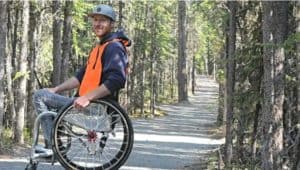
Darryl Tait says the new trail in Whitehorse offers a smooth ride with manageable inclines. (Philippe Morin/CBC)

Darryl Tait says a new trail in Whitehorse — which allows anyone to access a spectacular view of the Yukon River — means a lot to him.

“To me, it speaks of freedom,” says Tait, who uses a wheelchair and knows how tough it can be to access the outdoors.

The trail is built flat and wide to be wheelchair-accessible. The gravel has also been stamped, making it easier to navigate for people on crutches, using a walker, pushing a baby stroller or even young children learning to walk.

Tait has been working on the trail project as a consultant and driving heavy machinery

With this, I am fully independent, and I can come out here anytime I want.
– Darryl Tait

Tait said in the past, he’s tried other options like a fat-tire wheelchair and an adapted mountain bike on other trails. Even though he’s a noted athlete, the options often left him struggling.

“Lots of times, I do require help from friends who will help pull me over obstacles or help to carry me over some things. But with this, I am fully independent and I can come out here anytime I want,” he said.

The new trail runs just over one kilometre out from Wolf Creek campground.

“It comes out to this an amazing viewpoint. You get to absorb what Yukon is all about. And as you can see, I am sitting here in a wheelchair, I am not sweating, I made it out here no problem, due to this beautiful new trail,” he said.

Signs will tell Indigenous history

Improvements to the trail at Wolf Creek campground started last fall and the landscaping was recently completed.

The project was built by local workers including Indigenous youth who have been trained through a project called Singletrack to Success which helped plan and organize the construction of mountain bike trails in Carcross.

The next step will be installing signs which tell the story of the region and its traditional use by Indigenous people as part of a partnership with the Kwanlin Dün First Nation and Ta’an Kwäch’än Council.

As of now, the accessible trail doesn’t have an official name. The First Nations will also discuss a name for the new section.

Another accessible trail coming to Haines Junction

Yukon parks planner Sara Nielsen says the idea is to share the campgrounds with as many people as possible.

“It is about allowing more people to access our wonderful parks and feel that connection,” she said.

My passion is connecting people with the land, the culture and the people and the stories of the place. But how are we going to do that if people can’t get there?
– Sara Nielsen, Parks planner

Yukon already has a wheelchair-accessible trail at Tombstone territorial park. It’s also been building wheelchair access into new campgrounds.

Another wheelchair-accessible trail is being built at Pine Lake campground near Haines Junction using a boardwalk to create a flat path over wetlands.

The Champagne and Aishihik First Nation will help write signs that describe the region as used by Indigenous people.

The accessible-trail projects have been partly funded by a $50,000 grant through the Canadian Northern Economic Development Agency as well as funding from the territorial government through Environment Yukon.

The budget for both the Pine Lake and Wolf Creek trails is roughly $130,000 combined, though this amount doesn’t account for some associated costs such as Yukon government employees’ hours and use of the territorial government’s heavy equipment.

“We need to do better at providing accessible facilities. My passion is connecting people with the land, the culture and the people and the stories of the place. But how are we going to do that if people can’t get there?” she said.


P.E.I. to use shredded tires as drainage on wet, unpaved roads

‘If it works, that’ll be a bonus for recycling these tires,’ says Transportation Department official

Shredded tires will be used to provide drainage on unpaved P.E.I. roads that turn muddy when wet. (CBC)

Prince Edward Island is launching a pilot project using shredded tires to help dry up muddy unpaved roads.

A similar project was done about a decade ago when the province used chipped tires on roads, but Stephen Yeo, chief engineer for the Department of Transportation, says those 20-25 centimetre chunks were too big to be effective.

This time, the pieces are smaller, about five centimetres, which he says should work better.

“We’ll put a foot thick of the shredded tires down and sandstone over the top and see how they perform,” he said.

“It should create a good drainage system in the roadbed itself for getting rid of moisture — if it works, that’ll be a bonus for recycling these tires.”

Could be used in the future, if project proves successful

Last year, a Moncton company shredded a quantity of tires at Island Waste Management.

Those tire fragments should help roads to dry up quicker, moving water to the ditches instead of pooling on roadways, Yeo said.

“If this works out, and dries up the road a lot quicker, and you’re able to maintain traffic on it better, we’d certainly look at doing this to a number of roads every year,” he said.

If this works out … we’d certainly look at doing this to a number of roads every year
— Stephen Yeo

If successful, the tires could be used in place of “expensive gravel” from the mainland, Yeo said. It will also mean fewer tires to be trucked off the Island or thrown in the waste.

The Department of Environment has been consulted, Yeo said, and concluded that there are no environmental concerns.

City looks at spending $7M to build a ‘Winter Wonderland’ with designer toboggan hills

A staff report says it’ll cost about $7 million to build a Mountain “Winter Wonderland” park. (City of Hamilton)

Hamilton city councillors will vote next week whether to spend $7 million to transform some Mountain park space into “Winter Wonderland” – complete with professionally designed tobogganing hills.

The proposal comes just a few years after the city gained national notoriety for a de facto ban on tobogganing.

A staff report coming to the public works committee Monday recommends building a winter playground at William Connell Park, a new park on West 5th Street between Stone Church and Rymal roads.

The city has already spent $100,000 in Ward 8 money to look into the concept of a winter playground. That includes hiring a professional tobogganing hill designer.

Now staff recommend spending another $100,000 to add more design detail — a concrete skating loop, space for cross-country skiing, snowshoeing and “fat tire biking.” The skating loop would be artificially refrigerated and require a separate Zamboni building.

It would cost $7 million to build out the park overall, the report says. And the city isn’t sure where the money would come from.

Terry Whitehead, councillor for Ward 8 on the west Mountain, isn’t deterred by the cost.

“When you look at safe places for families to congregate for winter outdoor activities, Hamilton is in deep need,” he said.

“How much does a rec centre cost to build? How much does an arena cost to build?”

Whitehead said the city could tap into provincial and federal grants, as well as foundations, to offset the $7 million. And it would be a year-round destination for residents city wide.

Other Mountain councillors are less enthusiastic. Tom Jackson, councillor for Ward 6 on the east Mountain, wonders why the cost is so high, and what other priorities it would push down the line.

“I’m not supportive of $7 million for this Winter Wonderland unless it is solely coming out of the Ward 8 area rating fund, which the ward councillor can then explain and/or defend,” said Jackson via email.

“If, however, it is from the city’s capital budget, my answer is definitely no.”

“We have much greater priorities than this initiative.”

The city is currently building William Connell City-Wide Park, a 20-hectare park that includes a lit football and soccer fields, nature trails, play structures and tennis courts.

As for the tobogganing hill design, the city hired Baker Turner Inc. without putting it out to tender. The staff report says this happened because there are so few firms who can do the work.

Whitehead has been a champion of winter sports on council.

For years, Hamilton shut down tobogganing for years after a Hamilton lawyer was injured tobogganing and sued the city.

Whitehead led a charge in 2015 to designate official tobogganing hills. He and Mayor Fred Eisenberger celebrated with a toboggan race.

Hospital ICUs bring daylight to night shifts via telemedicine

In addition to providing expert consultation to overnight staff, eICUs allow patients’ spouses and relatives to talk to specialists during off hours. (shapecharge)

ATLANTA – Hospital intensive care units (ICUs) treat patients around the clock. But overnight shifts are hard to fill and can lead to burnout.

“Not only is it hard on the body to work at night, but it’s hard at 3 in the morning to decide if this problem is enough of a problem to call a physician,” said Katie Casey, an ICU nurse practitioner at Emory Saint Joseph’s Hospital in the Atlanta suburb of Sandy Springs.

Emory Healthcare is tackling the problem by sending teams of doctors and nurses to deliver telemedicine from the other side of the world.

“I get more phone calls now without feeling bad that they’re waking somebody up in the middle of the night,” said Dr. Milad Sharifpour.

Sharifpour and his colleagues travel to Australia on tourist visas and stay no more than 90 days at a time. They monitor and communicate with patients over a closed network to insure privacy.

“By sending our staff to Australia, they have better sleep patterns,” said Dr. Timothy Buchman, director of the Emory Critical Care Center. “They’re better rested. They make decisions more efficiently, more quickly and more reliably.”

Multiple studies suggest the introduction of telemedicine to ICUs can reduce medical costs while improving patient outcomes. Emory’s Electronic ICU (eICU) program saved $4.6 million in Medicare spending over 15 months while shortening the length of hospital stays and reducing readmissions, according to an independent audit by Abt Associates for the Centers for Medicare & Medicaid Services (CMS).

In addition to providing expert consultation to overnight staff, eICUs allow patients’ spouses and relatives to talk to specialists during off hours.

“Most families don’t converge in the hospital at 10 or 11 a.m. when the physician is there,” said Cheryl Hiddleson, director of the Emory eICU Center. “They come when they get off work. It may be 8, 9, 10 at night.”

Doctors and nurses say patients and families appreciate the extra care overnight and quickly get used to speaking to someone on a video monitor.

“It’s not as personal, obviously, because you’re not right at the bedside,” said eICU nurse Terri Reece, speaking from Australia by video conference. “But it’s a different relationship. It’s more of a supportive role. And the patients have been… very receptive, glad to see someone. It’s more of a talking relationship. But they’re very receptive.”

Fox News Producer David Lewkowict contributed to this report.

Jaguar breaks the world’s electric boat speed record

The previous record lasted for a decade.

You frequently see car manufacturers trying to break electric speed records on land, but where are the boats? Don’t worry — Jaguar, Vector and Williams feel the need for nautical speed. The trio have broken both the world and UK speed records with the Jaguar Vector Racing V20E, reaching an average speed of 88.61MPH on England’s Coniston Water. While that may not sound fast, that’s nearly 12MPH faster than the previous best, set all the way back in 2008.

The companies are shy about the exact technology in the vessel, but it’s drawing on the same technology Jaguar and Williams use in Formula E. Aerodynamics clearly played a part as well — the single-seater design is optimized for speed.

You probably won’t travel that quickly in an EV watercraft in the near future, then. However, this could foster electric boating if and when the technology filters down to seacraft you can actually buy. And crucially, this is just the start of the collaboration. The companies are hoping for more powerful boats in the future, so these seemingly modest records might not last for much longer.


This article originally appeared on Engadget.

Leica C-Lux brings style to long-zoom compact cameras

So long as you’re willing to pay for the privilege, that is.

Leica

When you think of compact cameras with long-zoom lenses, “fashionable” probably doesn’t come to mind. They tend to be very utilitarian devices where looks take a backseat to the optics you need for a dramatic vacation shot. Leica wants to change that: it’s introducing a new C-Lux camera that gives the category some flair. It’s ultimately a reskinned Panasonic Lumix ZS200, but that’s not necessarily a bad thing. The C-Lux combines the ZS200’s 15x (24-360mm equivalent) f/3.3-6.4 lens and 1-inch, 20.1-megapixel sensor with a considerably posher design in an attention-grabbing “Light Gold” or a more sober “Midnight Blue.” This is a camera that wouldn’t look out of place at a classic car show or a polo match.

The similarity promises some solid performance, too, with 49-point fast autofocus, continuous shooting at 10 frames per second and 4K videos at up to 100Mbps (albeit with a 15-minute time limit). You can also rely on a 2.33-megapixel electronic viewfinder as well as Bluetooth and WiFi to transfer your photos.

Not surprisingly, you’ll be paying a stiff premium for the looks and Leica’s signature red dot. The C-Lux will cost you $1,050 when it arrives in mid-July, or a solid $250 more than the Lumix. That’s utter overkill if you’re purely interested in functionality, but it might be tantalizing if you’re determined to get an all-purpose camera that stands out in a sea of drabness.


This article originally appeared on Engadget.