Archives for June 17, 2018

3 Reasons It’s a Mistake to Sell Corning’s Shares Right Now

Massive spending has depressed free cash flow in recent quarters, but several projects and trends should drive shares higher for investors with a little patience.

GORILLA GLASS COVERING BOTH SIDES OF SMARTPHONES AND MAKING INROADS IN THE AUTOMOTIVE INDUSTRY ARE TWO TRENDS THAT MIGHT DRIVE SALES HIGHER FOR CORNING’S TOUGH GLASS. IMAGE SOURCE: CORNING INC.

After enjoying a spectacular 2017, shares of Corning Incorporated (NYSE:GLW) have struggled in the first half of 2018, declining almost 11% year to date. At first glance, this fall is more than understandable: The company has suffered two consecutive quarters of earnings losses and, last quarter, even showed negative free cash flow. However, once investors look under the hood, they can see that some of these concerns might be overblown, and that several catalysts could propel the shares higher in the years to come.

A glass half full

In 2017’s fourth quarter, Corning showed a loss due to the new tax law. In Corning’s first quarter, it was forced to mark-to-market its currency hedges — a noncash paper loss since hedging contracts are recorded at current value at the end of each quarter, even though the contracts will only be settled in the future. Also, due to massive capital expenditure spending, free cash flow was depressed in the first quarter. In Corning’s first-quarter conference call, transcribed by S&P Global Market Intelligence, management explained that 23 expansion projects were currently underway, including the building of 11 new plants.

These expansion projects, management insists, are to fulfill current demand for its products, including optical fiber and Gorilla Glass, Corning’s popular covering for consumer electronic devices. As these projects begin to come online, starting in the second half of this year, management believes margins will improve and sales will increase. While Wall Street never likes the uncertainty that comes from spending money today to earn sales tomorrow, this seems a good bet for investors willing to show some patience and wait for a long-term thesis to play out.

Even beyond the near-term catalysts these expansion projects might bring, however, Corning also has other longer-term catalysts in its future. Let’s take a closer look at three such trends — mobile phones in all-glass enclosures, Gorilla Glass use for automobile interiors and exteriors, and Corning’s new pharmaceutical glass packaging Valor Glass — and how they might drive profitable growth for the glass maker.

1. A two-faced Gorilla

In its first quarter, Corning’s specialty materials division, the unit responsible for manufacturing Gorilla Glass, saw sales decline by 7% year over year to $278 million. Management listed several reasons for this drop, primarily that sales of Gorilla Glass are largely dependent on product cycles for consumer electronic devices. CEO Wendell Weeks said the company still expects overall sales to increase this year; this will be driven partly by the newest generation of Gorilla Glass, due later this year, and the timing of popular mobile-device launches. More importantly, Weeks said, the company still expects to double sales in mobile consumer electronics despite a maturing smartphone market.

One of the reasons Weeks believes this is possible is because of the growing trend to wrap entire smartphones in glass casings. As Gorilla Glass gets tougher and stronger, it becomes more feasible for manufacturers to exercise this option. For instance, the latest Samsung Galaxy S9 and S9 Plus use Gorilla Glass on the front and back of each phone. The benefits for device makers in going this route are enormous, Weeks said, including better radio-frequency (RF) transparency and wireless charging. As these needs increase, he said, it will be easy to see phones going to all-glass enclosures.

2. Gorilla Glass races to new markets

Gorilla Glass isn’t just for phones and wearables, though. In the Q1 conference call, Weeks said the company was currently working with 20 car manufacturers to help equip automobiles with Gorilla Glass on both the inside and outside. Weeks said:

Excitement about car interiors continues to grow. Integrated and interactive displays are becoming a seamless part of the cabin and user experience. Corning is helping OEMs [original equipment manufacturers] with this transition because Gorilla Glass provides a durable, optically advantaged interface surface with tremendous economics. For exteriors, Gorilla Glass laminates are tougher and lighter than conventional auto glass, plus the superior optical quality allows for larger and clearer head-up displays. We believe that our solutions provide compelling value, and we are invested to deliver as the industry transitions to highly connected and autonomous vehicles using Gorilla Glass.

He later said investors could begin to see results in this market in as few as 18 months.

3. The better part of Valor

Valor Glass is Corning’s new pharmaceutical packaging which is supposed to dramatically decrease lamella, tiny flakes of glass that can contaminate pharmaceutical products. One of Corning’s plants under construction in North Carolina is for the manufacturing of this new product. Valor Glass should also help eliminate cracks and breaks in medicine packaging, translating into less waste for pharmaceutical companies.

Two pharmaceutical industry giants, Pfizer and Merck & Co., have each given the project their blessing; they sent representatives to join Corning at the event in North Carolina when the project’s construction was first announced. Weeks said Corning was working closely with the Food and Drug Administration to ensure that Valor Glass gets a speedy approval. He concluded, “We continue to believe Valor has the potential to power Corning’s growth through the next decade and beyond.”

Watch for a bounce

Corning’s shares have not had the best start in 2018, but let’s not panic yet. The company is building out capacity almost as fast it can to meet demand for its products and increase margins — overall, that’s not a bad place to be. And beyond the project expansions and new plant openings, Corning sits on the cusp of entering new industries and finding new uses for existing products.

Based on the company’s core earnings per share (EPS) of $1.65, shares are currently trading at a price-to-earnings ratio of 17. While that’s not exactly cheap, given Corning’s struggles in its two most recent quarters, it is still a substantial discount to the S&P 500 index. With all these long-term catalysts in place, I believe it would be a big mistake for investors to sell Corning shares now.

This article originally appeared on Motley Fool.
Why Roku, Inc. Stock Climbed 15.1% in May

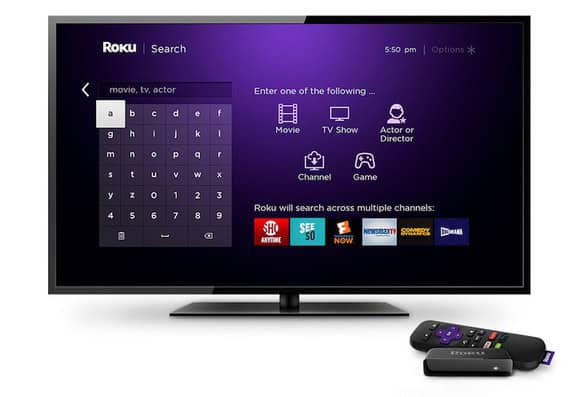
IMAGE SOURCE: ROKU.

What happened

Shares of Roku Inc. (NASDAQ:ROKU) jumped 15.1%, according to data from S&P Global Market Intelligence, after the streaming media platform company delivered strong quarterly results and positive commentary from an unlikely source.

On the former, early last month Roku announced that revenue in its first quarter climbed 36% year over year to $136.6 million — well above even the high end of its previous guidance a range of $120 million to $130 million — including 106% growth in Platform segment revenue to $75.1 million. Roku shares surged 6% the following day as investors digested the news.

So what

Then later in the month, Roku stock popped again after infamous short-seller Citron Research revealed that it had reversed its prior short position on the company following the quarterly report. Instead, Citron surprisingly argued that, with its stock trading at a discount to peers and its shift in focus toward the platform business (and away from hardware sales) gaining steam, Roku could be an attractive acquisition candidate.

Sure enough, analysts on Wall Street have begun to take notice. Roku shares are up another 17% so far in the month of June, most recently helped by encouraging comments from analyst firm Keybanc Capital Markets. More specifically, Keybanc argued that Roku’s accelerating Platform user growth could create a virtuous cycle where advertisers and content distributors alike flock to the product, in turn helping it become a more viable alternative as cord-cutters continue to flee their cable subscriptions.

Now what

To be fair, Keybanc set a $44 price target on Roku stock, which represents only a slight premium from its current levels after the recent rise. But between its strong quarterly results, short-sellers reversing course, and analysts piling on, that rise appears to be well deserved. And if Roku can sustain its business momentum to continue to outgrow its peers, I think the stock could have more room to run from here.

This article originally appeared on Motley Fool.

Ford Is Still Cruising Along in Europe

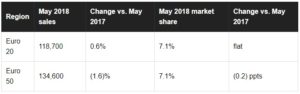
Ford Motor Company (NYSE:F) said that its sales in Europe rose 0.6% in May from a very good year-ago result, on strong sales of SUVs, commercial vehicles, and a big jump in sales of the outgoing version of the compact Focus.

Ford has nearly overcome a weak start to 2018 in the Old World, when its all-new Fiesta, a best-seller, was still in short supply. Now that its dealers have ample inventories of the little Ford — and of Ford’s smaller crossover SUVs — the Blue Oval is keeping pace with a growing European market. Year to date, Ford’s sales are down just 0.4% through May.

THE LITTLE FIESTA IS STILL FORD’S BEST-SELLER IN EUROPE — BUT GOOD DEALS ON THE OUTGOING FOCUS GAVE IT STIFF COMPETITION LAST MONTH. IMAGE SOURCE: FORD MOTOR COMPANY.

The raw numbers

Ford reports several sets of sales results for Europe, but two are particularly important. The first is for the 20 Western and Central European centuries that Ford thinks of as its primary market in Europe. (Ford refers to that group of countries as the “Euro 20.”) The second is for all of Europe, including the countries of Eastern Europe, the former Soviet republics, Russia, and Turkey. (Ford calls the second group the “Euro 50.”)

DATA SOURCE: FORD MOTOR COMPANY. SALES TOTALS ARE ROUNDED TO THE NEAREST THOUSAND. “PPTS” = PERCENTAGE POINTS.

What’s working for Ford in Europe: Small cars and crossovers

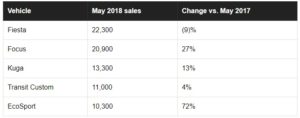
Here are the results for Ford’s five best-sellers in Europe in May.

DATA SOURCE: FORD MOTOR COMPANY. SALES TOTALS ARE ROUNDED TO THE NEAREST THOUSAND.

Fiesta sales are off a bit from a year ago. That might seem surprising for a brand-new model that has been in high demand, but consider: Ford has an all-new Focus coming to Europe in a few months, and its dealers are clearing out stocks of the outgoing model. I bet more than a few customers who walked into a European Ford dealership last month intending to buy a new Fiesta in May ended up with a good deal on a one-size-up Focus instead.

Ford’s smaller crossover SUVs also did well in May, a good sign for Ford’s second-quarter profits. The European EcoSport isn’t quite all-new, but it received a significant update for 2018, and sales are up sharply from 2017 levels. The Kuga, the European version of the compact Escape, also had a strong month.

Another positive sign for profitability: Demand for higher-trim Fords is up. While Europeans tend to favor smaller vehicles than Americans, they also tend to order them in plush trims, which give Ford more profit than you’d expect on something like a Fiesta or Focus. Ford said that what it calls “high-series” vehicles made up 69% of its passenger-car sales in the Euro 20 last month, up 6.9 percentage points from May of 2017.

What isn’t working: Ford’s larger vehicles are struggling

While Ford’s Fiesta, Focus, and smaller crossovers are all doing well in Europe, its larger models are struggling.

DATA SOURCE: FORD MOTOR COMPANY. SALES TOTALS ARE ROUNDED TO THE NEAREST THOUSAND.

American readers will be familiar with the Ford Edge, which is the same two-row midsize crossover that Ford sells here in the U.S. What are the others?

  • The Mondeo is the European version of the midsize Fusion. In Europe, it’s offered in wagon and hatchback versions in addition to the familiar sedan. (But you’d recognize all three of them right way.)
  • The S-Max is a tall wagon based on the Fusion. (You probably know the C-Max, a tall wagon based on the Focus. The S-Max is that, one size up.)
  • The Galaxy is closely related to the S-Max, but it’s a little bigger, with three rows of seats to the S-Max’s two. It’s essentially a minivan, but scaled down a bit for Europe. (And it’s not related to the old Ford Galaxie sedan, of course, except in spirit — it’s a big kid-hauler, just as the 1960s Galaxie wagons were.)

Why are sales of all of these vehicles down? Part of the answer may have to do with their drivetrains: All are offered with both diesel and gasoline engines; diesels have become a tougher sell in Europe in the wake of Volkswagen’s emissions-cheating scandal; and the gasoline engines use more fuel per kilometer than the diesels.

Another part of the answer probably has to do with the same big trend we’ve seen in the U.S. and China: More buyers are choosing crossover SUVs. The Kuga’s recent success could be coming at the expense of the S-Max and Mondeo to some extent.

The upshot: On balance, things are looking pretty good

Ford’s first-quarter result in Europe was mixed, in large part because of the Fiesta. The all-new version of Ford’s European best-seller drove an improvement in net pricing, but sales were down because supplies were still tight.

More broadly, that trend away from diesel engines, which in Ford’s lineup tend to be part of higher-profit packages, and unfavorable exchange-rate movements didn’t help, either. The upshot was a $90 million drop in profit in the first quarter, to $119 million.

We still don’t know how the diesel issue will affect Ford on an ongoing basis, and we don’t quite know how the exchange-rate story will play out in the second quarter. But within the things Ford can control, the signs are good: Sales of the new Fiesta continue to be strong, and more buyers are choosing higher-profit trims.

Assuming those trends continue in June, Ford has a good chance of improving on the $88 million in profit it earned in Europe in the second quarter of last year.

This article originally appeared on Motley Fool.

Retired? 2 Stocks You Should Consider Buying

If you’re retired, you’ve likely shifted from building your nest egg to trying to live off of your savings. That means you’ll want to look at stocks that are relatively safe and pay a generous dividend. Investors have punished the stocks of giant U.S. utility Southern Company (NYSE:SO) and packaged-food specialist General Mills (NYSE:GIS) for what are likely to be near-term problems, leading to big dividend yields.

Although each has some issues to deal with, the real risks are less than they appear for investors willing to think long term. Both should interest retired investors today.

1. A giant, high-yield utility

Southern is one of the largest electric and natural gas utilities in the United States. The stock is down 20% from the highs it reached in mid-2016. The yield is a robust 5.1%, more than twice the yield offered by an S&P 500 Index fund. And Southern’s beta, a measure of relative volatility, has been extremely low over the past five years, with the stock at times moving in the opposite direction of the overall market.

IF IT’S TIME TO LIVE OFF OF YOUR HARD-EARNED SAVINGS, THEN HIGH-YIELD STOCKS ARE A GOOD PLACE TO START. IMAGE SOURCE: GETTY IMAGES.

There are a few headwinds facing Southern today. First, rising interest rates have helped push the shares lower this year, but that’s an industrywide issue that Southern can’t do anything about. Second, Southern has a major nuclear power project, known as Vogtle, that hasn’t been going very well. It was over budget and missing key construction deadlines when its contractor Westinghouse declared bankruptcy last year.

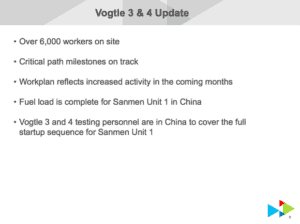
But Southern has taken greater control of the project and switched to a new contractor. Since this change, the project has been hitting its key milestones.

The third issue is funding the company’s over $30 billion in capital spending plans, which notably include the nuclear power plants. This spending is expected to drive 4% to 6% earnings and dividend growth, but only if Southern can pay for it. On this front, the utility ended the first quarter with $6.2 billion in liquidity. It since has agreed to sell assets or interests in assets to raise additional cash, including a Florida utility and a piece of its solar business.

These moves should reduce debt and leave ample cash for capital projects once they’re consummated. Fears over massive dilutive stock sales, which have been hampering the shares lately, are unlikely to come to fruition.

SOUTHERN’S FIRST-QUARTER UPDATE ON ITS VOGTLE NUCLEAR POWER PLANT. IMAGE SOURCE: THE SOUTHEN CO.

Essentially, Southern has been addressing the issues it can control — funding investment plans and righting the Vogtle nuclear project. With the utility’s yield at the high-end of its range over the past decade, it would make a good addition to a retirement portfolio as it begins to deal with some of the concerns that have led to its relatively low share price.

2. A big deal, but risk is priced in

Next up is General Mills, the iconic packaged-foods company that owns name brands like Cheerios and Betty Crocker. Don’t look at the company as a food maker, however, because it’s really a brand manager. In fact, at a recent conference, CEO Jeffrey Hardmening made sure to point out that the company uses its global distribution system, product development skills, and advertising heft to support a collection of leading brands… that change over time.

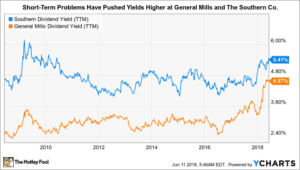
The stock is down 40% from its 2016 highs and lower by nearly 30% in 2018 alone. That’s pushed the yield up to a very generous 4.4%. That’s at the high end of the historical range for General Mills’ dividend yield, making it worth a deep look from retired investors.

SO DIVIDEND YIELD (TTM) DATA BY YCHARTS.

General Mills is facing three main issues. First, changing consumer tastes have led to weak sales for packaged-food makers. However, the company has been taking steps to adjust, and fiscal third-quarter sales were up 1% year over year. Not a great showing, but a solid one.

The second issue is profitability, which has been hampered by increasing costs, notably for transportation (profit margin fell 1.2 percentage points year over year in the quarter, to 15.7%). General Mills is planning on pushing through price increases to address this issue.

The third problem dragging General Mills shares lower today was the recent roughly $8 billion acquisition of fast-growing premium pet-food maker Blue Buffalo. This deal will push General Mills’ debt higher at a time when profitability is being constrained by rising costs. However, the company has stated that it’s committed to maintaining the dividend at the current level, with plans to focus on debt repayment over the next few years. That’s likely to include non-core asset sales.

With regard to integrating this new business, General Mills has a successful track record of taking on new brands, like Annie’s, and using its scale to broaden the acquired brand’s product lineup and distribution. The cost was material here, but the potential to leverage General Mills’ business strengths is huge.

The worst-case scenario is that the deal is a dud. But giant General Mills, despite notable leverage (long-term debt was around 60% of the capital structure before the Blue Buffalo deal), likely has the financial strength to muddle through such an outcome and keep rewarding investors with a hefty dividend. With such a large stock price decline, however, even this risk appears to be priced in today. Retired investors willing to take a long-term view of the situation should be taking a close look at General Mills.

Short-term thinking is your friend

Benjamin Graham is famous for saying that the stock market is a voting machine over the short term and a weighing machine over the long term. That’s a nice way to say that investors often get caught up in short-term issues that aren’t likely to have a major long-term impact on a company, pushing the shares lower temporarily. Southern and General Mills both appear to be dealing with short-term thinking today, creating a high-yield opportunity for investors willing to think long term.

This article originally appeared on Motley Fool.