Archives for March 31, 2018

Look How Important the Bundle Is to Pay-TV

More and more people continue to cut the cord, ditching pay-TV in favor of stand-alone streaming services or other forms of entertainment. The biggest reason for cutting the cord is price. Seventy percent of consumers feel they simply pay too much for the value they receive, according to Deloitte’s Digital media trends survey.

One way pay-TV operators can make the price more digestible is through bundling — most commonly bundling video with high-speed internet. Nearly 70% of Comcast (NASDAQ: CMCSA) customers bundle multiple products from the company. AT&T (NYSE: T), meanwhile, added 160,000 video subscribers in the fourth quarter through bundling with its wireless service — practically all of its net additions in video.

Both companies say bundled customers exhibit lower churn rates than those subscribing to a single service. Indeed, 56% of Americans say one of the top three reasons for keeping their pay-TV subscription is the fact that it’s bundled with their home internet bill, according to Deloitte’s survey.

A man and woman sitting on a couch watching television.

Competitors without a bundle do much worse

As customers leave pay-TV, the industry has seen a significant amount of consolidation. One company, however, remains largely a stand-alone pay-TV provider: Dish Network (NASDAQ: DISH).

Dish has seen its satellite TV subscriber count fall by about 2.2 million over the last two years. Its over-the-top Sling TV offering has helped offset most of those losses, but at a much lower value per customer.

In the same period, AT&T lost 1.3 million subscribers when you don’t include DirecTV Now customers. Comcast’s subscriber base has managed to stay relatively flat during that period, but it lost 151,000 subscribers last year.

There’s clearly some credence to the idea that bundling helps attract and retain customers.

Getting aggressive with bundling

As AT&T and Comcast look to hold onto more video customers, they’ve gotten more aggressive with their bundling packages.

AT&T notably offers a steep discount on DirecTV Now for customers on its unlimited wireless data plans. It also bundles HBO access with those plans. Management has said it’s going to look for more bundling opportunities in 2018.

Comcast hasn’t been quite as aggressive, but it introduced its own wireless phone service last summer exclusively for customers that already subscribe to its internet or video service. Xfinity Mobile, as it calls the service, has already racked up 380,000 subscribers. Management said, “We believe Xfinity Mobile is a big opportunity to continue to drive the bundling strategy of the cable business,” during the company’s fourth-quarter earnings call.

But all this bundling has had a negative impact on margin. AT&T’s entertainment group EBITDA margin fell from 22.1 % in the fourth quarter of 2015 to 19.1% in the fourth quarter last year.

Comcast’s margin has held up fairly well. Its adjusted EBITDA margin has been relatively stable over the last two years, but the percentage of customers bundling services has also declined, and it’s done a better job holding onto video customers. Still, investors should expect Xfinity Mobile to hurt profit margin going forward. It already had a negative $480 million impact on EBITDA in 2017, and management expects that loss to climb higher in 2018.

As bundling becomes more integral to pay-TV operators like AT&T and Comcast, investors should expect to see pressure on profit margin. Still, it beats the alternative of losing customers altogether like Dish Network.
Inside Intel Corp.’s Interesting Collaboration With Spreadtrum

Chip giant Intel (NASDAQ: INTC) tried but failed spectacularly to become a significant player in the market for mobile applications processors. Mobile applications processors combine the key processing elements that a smartphone requires (CPU, graphics, audio, image processor, etc.) along with — in most cases — a cellular modem.

Though Intel didn’t succeed in the mobile applications processor market, its cellular modem business did find a significant degree of success in winning contracts to supply stand-alone modems to Apple for the iPhone.

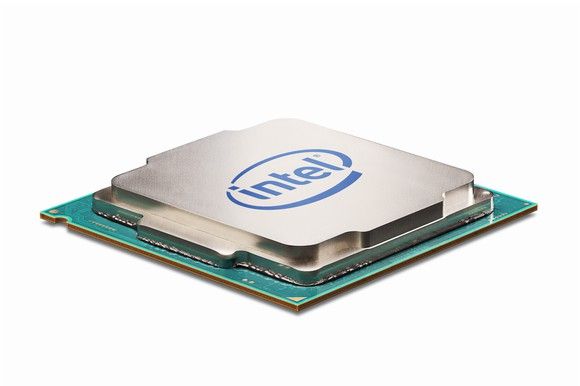
An Intel desktop processor.

Unfortunately for Intel, which is expected to win the entirety of the modem orders in the iPhone models that will launch later this year, the market for stand-alone cellular modems is pretty limited — Apple is the only smartphone vendor left that uses stand-alone solutions.

In light of that, if Intel wants to grow its business beyond Apple, it needs to find a way to re-enter the market for smartphone applications processors that integrate both the processing elements and the modem.

Apparently, Intel is going to go about this in a quite interesting way — through its partnership with China-based smartphone chipmaker Spreadtrum.

Partnering on a mobile platform

Back in February, Intel announced that it would be working with Spreadtrum — a company that’s known mainly for developing and selling processors for low-end and midrange smartphones — in a “long-term collaboration on 5G.”

Here’s what they’ll be working on, specifically: “Integrating Intel’s strong technical expertise in modems with Unigroup Spreadtrum & RDA’s solid experience in chipset design, the companies will collaborate on 5G and develop Spreadtrum’s first Android-based high-end 5G smartphone solution utilizing an Intel modem and Spreadtrum’s application processor technology.”

What this sounds like, then, is that Spreadtrum and Intel will co-develop a mobile processor for high-end Android smartphones that’ll effectively be a Spreadtrum applications processor but with an Intel modem inside instead of a Spreadtrum-developed modem.

A match made in heaven

Spreadtrum has shown itself to be a competent applications processor developer, and with support from key ecosystem partners like Arm (which does a lot of the heavy lifting with respect to processor, graphics, and multimedia intellectual property designs), it shouldn’t be too hard for Spreadtrum to whip up an applications processor (again, sans the modem) that’s competent enough to vie for high-end smartphone spots.

The hard part would, of course, be the modem. Spreadtrum’s modems tend to lag significantly behind those from other high-end smartphone makers, and the shift to 5G technology would likely only increase the barrier to entry for Spreadtrum in the high-end smartphone processor market.

This is where Intel comes in: Intel’s modem technology has gotten increasingly competent over the years, going from barely passable to good enough to potentially power every one of Apple’s new flagship smartphones in 2018. Moreover, since Intel seems to be investing aggressively in future modem technology, the odds seem good that Intel will continue to build competitive, high-end modems.

Marrying that modem technology with Spreadtrum’s applications processor technology and leveraging Spreadtrum’s business relationships with key smartphone makers could lead to significant mutual financial benefit for Spreadtrum and Intel.

It’s not clear who will be manufacturing the chips that come out of this collaboration, but if Intel is able to manufacture them, then this could be a win for Intel’s nascent contract chip manufacturing arm as well (which, unfortunately, has seen minimal success to date).

All told, this is a smart collaboration that has the potential to get Intel back into the mobile applications processor market in a thoughtful, minimally risky way. It should also allow Spreadtrum to attack portions of the smartphone processor market that it couldn’t otherwise access without Intel’s modem technology.

Brain scans and A.I. confirm that dogs are great at recognizing our emotions

What dog lover hasn’t looked at his or her trusty mutt and tried to figure out what they’re thinking? Researchers from Mexico have demonstrated that brain reading could help with that.

What dog lover hasn’t looked at his or her trusty mutt and tried to figure out what they’re thinking? Researchers from National Autonomous University of Mexico in Mexico City have gotten a bit further toward answering that question than most. Or, at the very least, the team appears to have gained some insight into why dogs seem to understand us so well.

In a recently published research paper, the team demonstrates that it’s possible to work out what a dog is looking at by analyzing a scan of its brain. Using functional magnetic resonance imaging (fMRI) technology, the researchers scanned the brains of four border collies, trained to sit on a scanner without moving. The dogs were shown happy, sad, angry and fearful facial expressions — all made by people they were unfamiliar with — and had their brain patterns recorded.

Analyzing these patterns using machine-learning algorithms allowed the researchers to figure out which face the dog had seen. The most distinctive brain pattern was associated with a happy face, which triggered a particular activity in the temporal cortex of the brain, used for processing complex visual information.

Interestingly, the study mirrors findings from a more human-centric experiment staged earlier this year. In that case, researchers in Japan were able to get an A.I. to caption images describing what a person had seen, based solely on an fMRI brain scan image. Accurate captions included the likes of, “A dog is sitting on the floor in front of an open door” or “a group of people standing on the beach.”

While the researchers in this latest experiment limited their study to only a few emotional states to identify, it certainly suggests an impressively high level of human emotional recognition on the part of our dogs. Now if only someone could figure out how to convert this into some kind of portable brain-reading tech so we can see more information about how dogs interpret the world around them on a daily basis!

A paper describing the work, titled “Decoding Human Emotional Faces in the Dog’s Brain,” is available to read online on scientific paper repository bioRxiv.

Watch NASA’s Mars InSight Lander Arrive at Its California Launch Site

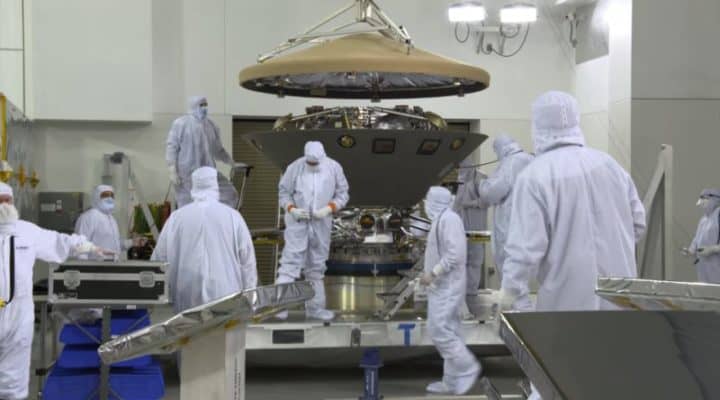
NASA’s Mars InSight lander arrives at Vandenberg Air Force Base in California on Feb. 28, 2018.

NASA’s InSight lander is one step closer to the Red Planet since arriving at its launch site, where final preparations are underway for liftoff in May.

InSight arrived at Vandenberg Air Force Base in California on Feb. 28 aboard a C-17 cargo plane, and a new video from NASA’s Jet Propulsion Laboratory captures its landing and unloading at the Astrotech payload processing facility.

The mission, whose name is short for “Interior Exploration using Seismic Investigations, Geodesy and Heat Transport,” is expected to launch during a five-week window that opens May 5. InSight will be carried into space aboard a United Launch Alliance Atlas V rocket. If all goes according to plan, the spacecraft will land near the Martian equator in November. [Mars InSight: NASA’s Mission to Probe Red Planet’s Core (Gallery)]

A number of tests are now underway at Vandenberg to ensure that the spacecraft safely survived its trip to California and is ready to launch in May. After removing InSight from its shipping container, engineers and technicians will load updated flight software and perform mission readiness tests involving the entire spacecraft flight system, the associated science instruments and the ground data system, NASA officials said in a statement.

InSight was built and shipped from the Lockheed Martin Space Systems facility in Denver. The mission will probe the deep interior of the Red Planet to gain a better understanding of the processes that helped shaped rocky planets like Mars and Earth.

“InSight will be the first mission to look deep beneath the Martian surface, studying the planet’s interior by listening for marsquakes and measuring its heat output,” NASA officials said in a separate statement. “It will be the first planetary spacecraft to launch from this west coast launch facility.”

The lander will be equipped with a seismometer to detect “marsquakes” — earthquakes on Mars — and meteor strikes. The seismic energy of these phenomena will be used to study material deep beneath the Martian surface. InSight will also have a heat probe that will hammer itself about 16 feet (5 meters) underground.

The mission is expected to last one Martian year, or approximately two Earth years. Data collected by InSight could prove useful for future crewed missions to the Red Planet, officials have said.

SF Motors busts out intelligent EV tech to share, plus two branded EVs

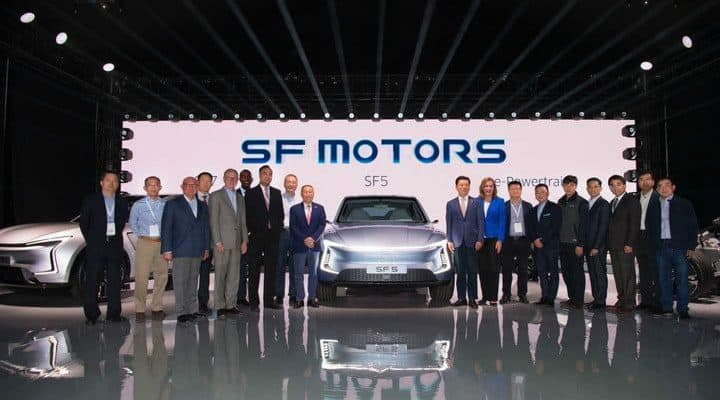
SF Motors Launch with SF5

Santa Clara-based SF Motors didn’t hold back this week. Claiming a global role supplying core tech for “intelligent” electric vehicles with advanced driverless systems to future partners, the EV manufactuer trumpeted bold announcements.

The most eye-popping claim was an electric powertrain SF Motors says generates a walloping 1,000 horsepower to propel a car from zero to 60 miles per hour in under 3 seconds. If the SF design nails that benchmark, it would join a select group including Tesla’s Model P100D, which was tested to 60 in 2.2 seconds, and the new Tesla Roadster, which Elon Musk claims can do the deed in 1.9 seconds.

Casting itself as a uniquely capable global company in the EV space, SF Motors has research and design centers in Germany, China, Japan, and the U.S. According to the SF Motors press release, it is the “Only pure EV company today capable of independently building and selling EVs in two of the world’s largest markets — the U.S. and China — using Industry 4.0 manufacturing standards.”

SF Motors’ existing industry partnerships include Bosch, Dürr, and Siemens. The University of Michigan, another SF partner, itself claimed a major role in self-driving tech when it opened Mcity, an autonomous vehicle testing center on the university’s Ann Arbor campus.

In the competitive automotive industry, the challenges of simultaneous dual emerging technologies — autonomy and electrification — have prompted new alliances. SF Motors leads with the concept of shared technology toward a worldwide goal.

“Our mission is to transform human mobility — and perhaps our planet — through intelligent EVs,” John Zhang, SF Motors founder and CEO said at the company launch event.

“To do this, we can’t follow the same path as every other EV company,” Zhang continued. “We aim to be the company that shares integrated technology solutions and provides the manufacturing expertise to make more EVs a reality. We believe everyone wins with the wider adoption of EV technology.”

SF Motors has taken the unique course of developing all technologies in-house, including proprietary batteries, a patented battery pack system, and a liquid-cool thermal battery management system.

The company’s vehicle design platform can use from one to four electric motors, with peak power from 100 to 400 kWh. A range-extending high-power onboard generator can ease range anxiety, SF Motors claims.

On the “intelligent technology” side of the business, SF Motors’ terminology for autonomous driving, the company buzz word is “protective autonomy.” The design focus is Lidar-based computer vision systems with deep neural networking monitoring to ensure safety for all involved with limited human input.

Production at manufacturing facilities at a former AM General plant in Indiana and in Chongqing, China will begin later this year. The factories have a joint 200,000 vehicle annual production capacity goal.

SF Motors introduced two branded vehicles this week, the SF5 and SF7. According to the announcement, the SF5 will be available for pre-orders in late 2018 with delivery beginning in 2019. No specific information is available for the SF5 at this time.

This robot can mimic your hand gestures and whoop you at rock-paper-scissors

From smart speakers like the Google Home and Amazon Echo to the Roomba autonomous vacuum cleaner, there are a growing number of smart A.I.s and robots we can call on to perform different tasks in our homes. A new collaboration between innovation studio Deeplocal and Google’s Internet of Things (IoT) framework Android Things wants to add another robotic helping hand to the mix — and we mean that quite literally.

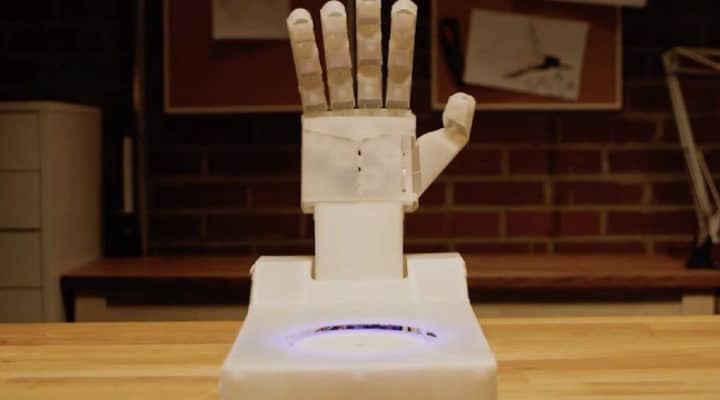
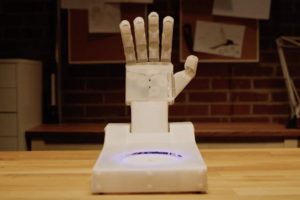
Called HandBot, it’s a D.I.Y. robotic hand which can recognize your hand gestures and mimic them back to you, or compete against you in a classic game of rock-paper-scissors. To do this, it uses some smart machine learning-based image recognition, courtesy of an built-in camera that feeds it images of your movement.

“We teamed up with Deeplocal to build a series of demos to help inspire and show what developers can build by harnessing the power and potential of Android through the ease of the Android Things platform,” Melissa Daniels, a program manager at Android Things, told Digital Trends. “These demos also demonstrate the on-device processing power that makes Android Things unique.”

The HandBot robot is built using the Android Things developer kit, servos, and some custom cut acrylic. The palm of the hand contains five servos which move the fingers, and one servo for the wrist. The base, meanwhile, contains two more servos for forearm movement and other electronics such as an LED ring, PicoBoard, and the camera.

If you’re interested in creating a HandBot of your own, you can access all the open-sourced code on github and hackster.io, along with instructions for building it. The parts should set you back around $490, plus the price of an Android Things starter kit. The estimated build time is around seven hours, meaning that — provided you’ve got all the pieces — you should have no trouble building this over a weekend.

Sure, it’s probably not going to be the most useful gadget you’ve got on your shelf, but it’s a pretty neat way to dust off your engineering skills, while learning a bit of Tensorflow machine learning in the process. You can’t say fairer than that!