
Archives for March 31, 2018

Meet the 80-year-old behind one of Toronto’s oldest Good Friday parades who plans to keep at it till he’s 110

At 80 years old, Joe Maneli has been the director of one of Toronto’s oldest Good Friday parades for over five decades, but despite his age, he isn’t quitting any time soon.

Maneli handles everything from casting the actors to making sure everything runs smoothly for the three-hour event.

And while this was his 53rd year organizing the the annual St. Francis of Assisi Church procession, he wasn’t just overlooking his actors.

As as the guards reenacted pushing Jesus to the ground, Maneli watched as a passionate spectator, moved by the scene.

“It’s too emotional, it just gets your breath away,” said Maneli.

A tradition over 5 decades in the making

The sky was fittingly grey as hundreds of religious spectators gathered in Toronto’s Little Italy neighbourhood to reflect on Good Friday, believed to be the day of Jesus’s death.

For Christians, the day is one of fasting, penance and solemn service, and precedes Easter Sunday.

The procession running through Little Italy is a longstanding tradition known for its poignant reenactment of Jesus’s last moments. Volunteers dress in traditional garb, as Jesus and the Twelve Apostles reenact the Stations of the Cross.

The 56-year-old reenactment in Toronto’s Little Italy community symbolizes the path Jesus is believed to have walked before being crucified.

The commemoration is a combination of religion and tradition. Some members of the St. Francis of Assisi Church community have been participating in the procession’s annual reenactment for decades.

Portraying Jesus at the annual procession was Joseph Rauti. He’s worn the same wig since 1968, acting as Jesus for some 50 years.

With a heavy brown cross weighing on his back, Rauti portrayed solemnly carrying the sins of his followers for three kilometres.

For three days leading up to procession, Rauti fasted.

Rauti’s reenactment doesn’t stop at the streets of Little Italy. He brings his performance to the elderly spectators inside the St. Francis of Assisi Church who can’t endure a three hour parade.

“When I come inside the church, I fall on the floor,” said Rauti of the modified reenactment he performed for those inside.

Little Italy’s first procession began more than five decades ago at St. Agnes’ Parish by Grace Street and Dundas Street West.

For the last 53 years, Maneli has been its director and he says he plans to keep directing until he’s 110.

“They don’t want me up there,” he joked, lifting his hands to the sky.
Giant record sale brings Edmonton music lovers together

Giant record sale brings Edmonton music lovers together

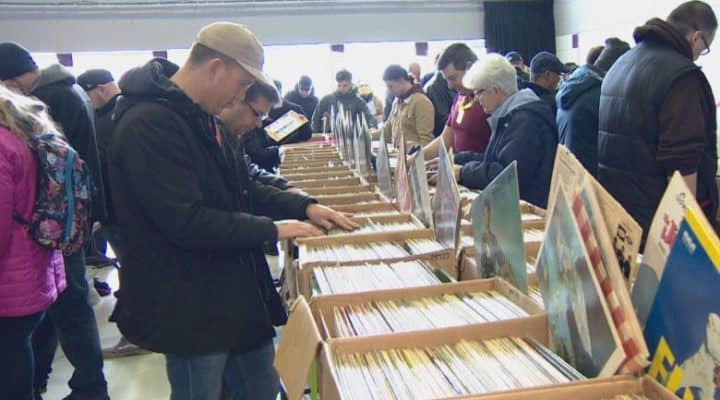
For two days, a community hall is transformed into a busy collector hotspot, a testament to Edmonton’s vibrant vinyl record scene.

More than 1,000 music lovers are expected at the Dead Vinyl Society’s fifth Super Mega Records Garage Sale.

The sale runs Friday and Saturday, from 10 a.m. to 6 p.m. at the Kenilworth community hall in southeast Edmonton.

Organizer Yuri Wuensch, who co-founded the Dead Vinyl Society, said Edmonton is a great place for music collectors.

“We have done this sale on an annual basis, there’s monthly record swap meets that we host,” said Wuensch.

“Edmonton has a very, very strong vinyl collecting community.”

Wuensch hadn’t planned on hosting the sale this year, but managed to pull together the required inventory with the help of about 10 vendors, who are collectors themselves.

“When you collect, you tend to get a lot of extra things that you don’t necessarily need, you often get duplicates,” explained Wuensch.

“Sometime you get things that aren’t quite in the condition that you would like, but they are still very playable and collectible.”

The offerings include everything from LPs to 45s, 78s, 12-inch singles, compact discs, eight-tracks and cassettes.

With items priced at $3 or less, people can flip through hundreds of boxes to find hidden treasures.

Wendy Parkinson has been collecting records since her youth. She said the hunt is part of the fun.

“You can order anything on Amazon, but if you can find it in a yard sale or somewhere like this, it’s all worthwhile.”

Parkinson said she loves the nostalgic feel of a vinyl record. “It’s what I grew up on, and the sound is warmer.”

She adds that each record sleeve is a unique creation. “When you play a record and put up on a shelf, it becomes art.”

Carson Mills said he became a record collector to impress his girlfriend at the time, who is now his wife. He estimates that they have a collection of over 1,000 records.

For Mills, nothing beats the thrill of unearthing a one of a kind record.

“Finding that one you never thought you would find, and then, ‘Oh, my gosh, it’s five bucks!’ That’s the joy for me.”

These days, he’s looking for country and jazz albums. He admits that collecting can also lead to disappointment, like discovering a coveted album covered in scratches.

“There’s a tease element to it, too,” said Mills, with a laugh. “So far it’s been a lot of tease, and no payoff.”

Alberta’s low electricity costs to shoot up in April

Alberta’s low electricity costs to shoot up in April

Electricity rates are set to jump significantly in April for Albertans, but the spike will only be reflected on some customers’ bills.

Electricity costs are set to jump by nearly 50 per cent between March and April for customers of Enmax Energy, Direct Energy and Epcor Energy, according to rates set by the Alberta Utilities Commission.

Enmax’s residential electricity rate will be jumping from 5.11 cents per kilowatt-hour in March to 9.28 cents in April.

The last time the utility company saw prices that high for residential customers was in May 2014.

“This has been coming. Power prices that feed into these regulated rates are based on trades in the forward market. So if you’ve been paying attention to that, which I know most people would not, you’ve been able to see this coming since at least January, if not December of last year,” said Matt Ayres, an executive fellow with the School of Public Policy at the University of Calgary.

Many customers won’t see the impact of the hike, thanks to the government’s regulated rate option cap, which is set at 6.8 cents.

RRO cap will lessen the blow

Customers on fixed-rate plans, or plans with floating rates that follow the regulated rate option with the cap, wouldn’t see their bills increase past the cap, said Blake Shaffer, a PhD candidate in economics at the University of Calgary, and the former director of trading at TransAlta.

“If prices rise above 6.8 cents then you’re on what’s called the RRO rate, which is a floating month-to-month rate which about half of Albertans are on. The difference though is going to have to be made up by the government,” he said.

The cap was set by the provincial government in June 2017, but April will be the first time rates have been high enough for it to kick in.

Prices have only jumped higher than 6.8 cents a handful of times in recent years before the cap was enacted, but pre-2014, rates regularly exceeded 10 cents.

The money to protect Albertans from the price swings comes from the carbon levy. It will be in place until 2021, when the province’s capacity market is set to be fully operational, which the province enacted in hopes of bringing more revenue certainty to the market for generators and consumers alike.

“It definitely means that there will be money coming from the government to make up the difference between the capped prices and the approved regulated prices,” Ayres said.

But customers paying variable rates, like those on Enmax’s floating index electricity plan, would be impacted by volatility in the province’s electricity market.

The utility company sent out an email warning customers about the potential for surprises on their bills and giving them a chance to review their options.

An Enmax spokesperson said only a small percentage of customers would be impacted.

Ayres said the price volatility is a good reminder for customers to ensure they understand what they are paying on their energy bills.

“If you’re not sure, you grab a copy of your bill, you can call the provider and you just want to work out, ‘Well, what kind of terms and conditions have I signed up for?'” he said. “In my experience most people don’t actually know what rate they’re paying or what the terms of conditions actually are.

“You have to think about what’s your tolerance for prices changing again in the future. As best I can guess at the moment, prices for May will be lower than the cap. Not much lower than the cap. Prices in June and July look like they’ll be higher again.”

Doubled rate doesn’t mean bill will double

He said it’s important for customers to understand that the electricity rate is only reflected on part of their total bill, and if the price of electricity is set to double it doesn’t necessarily mean their bill will double.

As for why the prices are increasing, it’s something that was predicted in a January yearly report by energy consultants EDC Associates.

The firm cited subdued demand, a weak economy and power purchase agreements returned to the province’s Balancing Pool for the collapsed prices leading up to this year. They also predicted that an increase in natural gas prices, growing demand coming out of the recession and the increased carbon tax for the predicted spike.

In 2016 at the height of the recession, prices hit a 20-year low.

The 30-day average pool price for electricity in Alberta was $31.35 as of March 1, 2018, up from $17.34 on the same day in 2016.

Every bit of exercise counts in reducing risk of early death: Study

‘It’s the total physical activity that matters,’ says cardiologist and researcher William Kraus

People are encouraged to take the stairs whenever there’s the opportunity, because every bit of exercise helps, according to a new study. (Shutterstock)

There’s a lot of conflicting advice out there about how much exercise is enough to stay healthy. Should you exercise three to four times a week, run a marathon or do a seven-minute workout with an app from the comforts of your living room?

It turns out they all work — even ditching the elevator for the stairwell — to help reduce your risk of disease and premature death, according to new research from the United States.

“Everything counts,” said William Kraus, a cardiologist at North Carolina’s Duke University School of Medicine and senior author of a new study published last week in the Journal of the American Heart Association.

The epidemiological study looked at the relative benefits of “bouted” versus sporadic moderate-to-vigorous physical activity (MVPA) on the mortality of 4,840 people who participated in the National Health and Nutrition Examination Survey from 2003-06.

Participants in the study wore accelerometers (pedometer equivalents) to measure their daily physical activity and exertion. The researchers determined 4,140 of them were still alive in 2011, while 700 had died.

Three measures of MVPA were counted: total minutes of activity, five-minutes or more of activity and 10 minutes or more of activity. And researchers analyzed mortality associations by quartiles for the three measures.

“Does it matter whether that total physical activity was in bouts or not bouts?” Kraus said. “And we found out it didn’t matter whether it was in bouts or not bouts. It’s the total physical activity that matters.”

The findings are good news for most Americans, who are becoming more sedentary and could break that up with short bouts of physical activity, he said.
“Take the stairs when there’s the opportunity. Walk to the coffee shop instead of taking the drive-thru. Because that will all help you prevent bad health outcomes,” he said. “Everything counts so take every opportunity.”

The study also found that participants who got less than 20 minutes of MVPA each day had the highest risk of early death, while those who did 60 minutes a day cut their risk of premature death by more than half. Those who did at least 100 minutes a day cut their risk of early mortality by 76 per cent, according to the study.

Current federal guidelines both in the U.S. and Canada recommend at least 150 minutes of moderate aerobic exercise each week, or 75 minutes of vigorous aerobic exercise for adults.

Those guidelines recommend they should exercise in bouts of 10 minutes or more, but the study indicates this may not be necessary.

Kraus said, “It’s enough we hope to kill that part of the recommendation.”