
Archives for March 31, 2018

3 Practical Tips for Eating Organically on a Budget

Whether or not organic food is better for you is a hotly debated subject. Is the extra money we spend actually worth it? The general consensus seems to be, essentially, “Yes, but only sometimes.” We spoke to a few experts to see how you can best work organic into your budget without spending a fortune.

Packaged, processed foods are one example of how organic food may not be better for you. Junk foods like ice cream, pizza, and French fries can be made with organic ingredients. “Buying something organic does not necessarily mean buying healthy,” says Colin Zhu, DO. “At the end of the day, ‘organic’ is just a label.”

That label can sometimes hike up the price on certain items, and figuring out when it’s worth splurging can be confusing. Katrina Trisko, MS, RDN, CDN, a registered dietitian based in NYC, says that your best bet is to consider organic on an “individualized basis.” This means that not every item you put in your cart needs to be organic in order for you to get the most nutrients.

What matters above all is that you’re getting the most servings of fruits and vegetables that you can, whether they’re conventional or organic. “If you want the healthiest option, don’t get caught up if whether or not your veggie or fruit is organic,” says Amanda Sauceda MS, RDN,CLT. “Eating your fruits and veggies is more important than the label.”

When it comes to the most cost-effective option for eating well, there are work-arounds to simply buying organic food that are just as environmentally friendly and fresh.

Grow your own produce or join a community garden. “It’s expensive to buy organic, but it’s not expensive to grow organic,” says Zhu. Joining a community garden can be a great way to not only get tasty, organic produce on the cheap, but you’ll be contributing to the bigger picture of health in your neighborhood. “I have to vouch for homegrown tomatoes, because they taste a million times better than anything in the store,” says Sauceda. If you’re not ready to commit to an entire garden, community or otherwise, start with an herb box for your kitchen. You can have fresh, organic herbs for all your cooking right in the window, and it’s a low-risk way to test out your green thumb.

Shop local. “In terms of cost, you also have to pay attention to food mileage,” says Zhu, who points out that the farther a food has to travel out of the soil or off the vine, the lower the nutritional value becomes. Even if it doesn’t have an organic sticker on it, your fruits and veggies that came from a farm an hour away versus a farm across the country are going to be better for you.

Follow The Dirty Dozen. If you’re really passionate about buying organic produce, follow the Environmental Working Group’s (EWG) Dirty Dozen guide. The EWG lists the 12 produce items that generally have the highest amount of pesticides in them and would therefore be the most beneficial if bought organically. Strawberries are currently number one, and potatoes are number 12. Basically, if it has an outer peel or thick skin that you’ll remove, you don’t really need the organic sticker. Produce that you eat whole, skins and all, could be more beneficial if bought organic.


6 Lessons From the First Year of Retirement

Once you get through the first year of retirement, you probably think you can coast for the next 30 years. That’s not necessarily true. This is not the time to get comfortable. Things are never that simple in retirement. As you head into year two, it’s the perfect time to assess what you’re doing right and what you may be doing wrong.

“Five years before you retire and five years after are the most important,” says Reid Abedeen, managing partner at Safeguard Investment Advisory Group in Corona, California. “If you have everything in line, you are able to do certain adjustments. There is a big difference between doing them because you want to and doing them because you made mistakes.”

Your circumstances will change throughout retirement, and your finances will need to adapt to those changes. Consider making these updates for year two of retirement:

1. Determine what’s working, what’s not and what needs to be changed.You may need to make changes to your investment strategy, budget and lifestyle. “Things change economically,” Abedeen says. “The markets over the last year have changed dramatically.” Compare your retirement income to your spending, and determine if you need to make any lifestyle adjustments.

2. Meet with a financial advisor. If you spent more than you should during the first year of retirement, it might be time to seek professional assistance. A financial advisor can help you make a budget and identify expenses that can be reduced or eliminated. “Most people need to have someone who is a planner or [an] advisor who is a sounding board and will be honest,” says Jeff Speight, a certified financial planner and wealth advisor at Tanglewood Total Wealth Management in Houston. “They need someone who will pat them on the back if they are doing well and nudge them if they are overspending.”

3. Examine your spending patterns. You must track how much you spend in order to make sure your savings will last the rest of your life. “A lot of people say, ‘I spend $4,000 a month,’” says Elijah Kovar, co-founder of Great Waters Financial in Minneapolis, Minnesota. “I look at their Social Security [income] and pension, and I say you get $5,700 a month. Where is that $1,700 a month going?”

Look carefully at your retirement expenses. Begin with your last 12 months of bank statements. Add the total debits for 12 months, and divide by 12. “That tells you what you are really spending, and it takes into account emergencies like when the furnace needed to be repaired and things like that new car, and even gifts,” Kovar says. “I’ve seen people put $50 in the gift category, and they have 12 grandchildren.” Take a close look at your actual expenses, not what you think they should be.

4. Consider lifestyle changes. Your finances aren’t the only part of your retirement that will need adjustments. Some people enjoy the extra free time in the first year of retirement, while others struggle. For example, one of Kovar’s clients was bored with hobbies after the first year and began doing volunteer work. Another client, a retired engineer, said he lost his purpose when he left his job.

Some retirees even contemplate returning to work. A retirement job is less about making money and more about finding something to do. “It’s doing what you are good at and social interaction. It’s keeping your mind sharp,” Kovar says. “You have to get a reason to get out of bed.”

5. Correct financial mistakes or miscalculations. Speights says retirees can sometimes be overgenerous with their children or grandchildren at the beginning retirement. They might do something like give $10,000 to a grandchild for college, not realizing that they are barely getting the retirement income they need. “Leave it for four or five years down the road,” Speights says. “If we are on track, we can think about giving meaningful but muted gifts.” Keep in mind that the investment results you saw recently will not be the same every year. “If you are up 5 percent, that doesn’t mean you can spend 5 percent more,” Kovar says.

6. Figure out a Social Security strategy. Take care when deciding when to claim Social Security. Kovar says having the correct Social Security strategy is the “single, most impactful thing in retirement.” The age you sign up for Social Security will affect the size of your monthly payments for the rest of your life, and married individuals can coordinate their claiming decisions to maximize payments as a couple. Your other sources of retirement income will influence whether your Social Security income will be taxed. So, remember to consider taxes when making retirement account withdrawal and Social Security claiming decisions. “It’s one of the most overlooked parts of retirement planning,” Kovar says. “But it’s absolutely essential before you claim.”

Make Sure Your Money Advisor is a ‘Fiduciary’

If you care about your money, you should memorize the word “fiduciary.” It’s critical if you hire someone to help with your finances. And with the Fiduciary Rule on the chopping block, it’s up to you to make sure your financial advisor acts in your best interest.

A Certified Financial Planner® once asked me to make sure I identified her as such for a story. “With the registered trademark and everything,” she said. I asked why that was so important, and she told me CFPs take a fiduciary oath to act in a customer’s best interest. When your CFP is a fiduciary, you know she’s there to help, not just sell you sub-par financial products.

Here’s the deal: non-fiduciary financial and retirement planners might suggest investments or other financial products that they get a kickback from, and that don’t perform very well. As we’ve told you before, the White House’s Council on Economic Advisers says that non-fiduciaries cost retirement investors $17 billion per year. CFPs aren’t the only financial service pros who take a fiduciary oath, though. Registered Investment Advisors (RIAs) are fiduciaries, too, for example. If you’re not sure, ask.

The bottom line: if you hire anyone to watch over your money, ask them one simple question: are you a fiduciary? If the answer is not a clear yes, it’s time to move on. While they might offer some legitimately good money advice, chances are, their primary objective is to sell you some kind of investment product, even if it’s not good for your wallet.

Also, keep in mind: some banks, credit unions, and investment services might offer you free financial help, too (as in the case of this Redditor, for example). The takeaway is the same—ask if they’re a fiduciary.

How to cut your cancer risk and save money at the same time

Bad news for your caffeine habit: coffee can cause cancer.

Brewed coffee has high levels of acrylamide, a chemical shown in some studies to cause cancer — and now coffee chains in California must warn their customers, a Los Angeles judge ruled on Friday.

“Cancer warning labels on coffee would be misleading,” the National Coffee Association, which is considering an appeal of the decision,said in a statement. “The U.S. government’s own Dietary Guidelines state that coffee can be part of a healthy lifestyle.”

The ruling came in response to a lawsuit filed in 2010 by the Council for Education and Research on Toxics (CERT). Starbucks Corp SBUX, -0.02% previously tried to fight the allegations in court but failed to show its brewed coffee had safe levels of acrylamide. Studies on whether acrylamide causes cancer have been inconclusive in the past, according to the American Cancer Society.

Next, the judge will decide what penalties will be levied against companies that don’t warn of cancer risks. CERT has requested fines as large as $2,500 per person exposed to chemicals. Starbucks has 2,800 locations in California, and the average Starbucks store serves more than 500 customers a day.

Coffee isn’t the only form of refreshment seeing its health effects put on trial. Going out to eat at restaurants in general increases the amount of health-harming chemicals called phthalates in the body, a study released Wednesday found. People who eat more restaurant and fast food had phthalate levels that were 35% higher than people who prepared and ate their own store-bought food, the report, published by the Milken School of Public Health at George Washington University found.

This is the first study to investigate this previously under-recognized source of exposure to such harmful chemicals, said Ami Zota, an author on the study. Phthalates are a chemical used as a binding agent and to make plastics more flexible, and can be found in everything from household cleaners to cosmetics and food containers. The chemicals can disrupt hormones and have been connected to fertility problems, childhood obesity, and cancer.

“Preparing food at home may represent a win-win for consumers,” adds Zota. “Home cooked meals can be a good way to reduce sugar, unhealthy fats and salt. And this study suggests it may not have as many harmful phthalates as a restaurant meal.”

It’s also much easier on the wallet to eat at home. Americans spend an average of $53 a week (or $2,746 per year) on lunch, and more in expensive cities like New York. Millennials in particular are more likely to splurge on meals out: 54% of people ages 18 to 26 eat out more than three times a week and 30% say they buy coffee three times a week or more. Brewing coffee at home can save hundreds of dollars a year. Or you could cut the habit completely to save your health and your wallet.

3 Outperforming Retailers Bucking the E-Commerce Threat

One of the big narratives in investing today is the rise of e-commerce’s disruption of traditional brick-and-mortar retail. According to a recent analysis by Business Insider, over 6,400 retail stores closed in 2017, with another 3,600 closings projected for this year.

And yet, there are a handful of retailers that have not only been surviving the e-commerce disruption, but actually thriving. Here are three — Burlington Stores (NYSE: BURL), Dollar General (NYSE: DG), and Best Buy (NYSE: BBY) — that have bucked the e-commerce onslaught, and the secrets to their success.

a young woman shops for clothes in a mall-like setting.

Burlington Stores

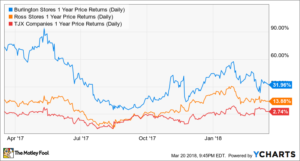
Growing up, I remember the TV commercials for Burlington Coat Factory, which is now Burlington Stores. The former coat and winter-wear specialist has transformed itself into a full-assortment off-price retailer, and over the past 12 months, its stock has surged nearly 35%, compared with the S&P’s 14.3%.

Burlington is riding the off-price wave in retail, a trend that emerged in the wake of the 2008 recession, and the value-conscious approach to apparel shopping has persisted even though the economy has recovered since then.

Off-price retailers typically purchase closeout branded merchandise from retailers that hasn’t sold at full price. Then the goods are sold for a big markdown in off-price stores. In addition, off-price retailers have a fun “treasure hunt” atmosphere about them, another lure to go to their physical stores. Over the past few years, these discount retailers have taken away share from middle-income, mall-based department stores such as Macy’s (NYSE: M).

Burlington has outperformed even its off-price peers, like TJX Companies (NYSE: TJX) and Ross Stores (NASDAQ: ROST). The company has made a big effort to diversify from its core winter wear, becoming a more comprehensive “all weather” retailer like these rivals. Furthermore, Burlington has a smaller footprint at only 629 stores, compared with 4,070 for TJX and 1,622 for Ross, so Burlington could have more growth ahead of it as the company increases its store count.

BURL one-year price returns (daily) data by YCharts.

Dollar General

Sticking with the off-price theme, Dollar General has capitalized on a similar trend, operating roughly 14,500 dollar stores across the country, with many of them in rural and suburban neighborhoods within a few miles of its customers. Dollar General offers cleaning products, refrigerated and packaged food, household products, apparel, automotive products, and seasonal items. It does so at rock-bottom prices, due to its low-cost operating model, small-store format, and fast in-and-out layout.

The small-store format and convenient locations differentiate dollar stores from big-box discounters like Walmart (NYSE: WMT) and Costco (NASDAQ: COST), and they also cater to a population that may live far from city centers and don’t want to lay out the extra cash for an Amazon (NASDAQ: AMZN) Prime subscription.

Capitalizing on this profitable niche, Dollar General grew sales approximately 8.8% on the back of 2.7% same-store sales growth for the full year 2017, and its stock is up 35% over the last 12 months.

Best Buy

In addition to the rise of off-price, another dominant theme over the past decade has been the increasing importance of smartphones, laptops, and the connected home. Of course, not everyone is a technical expert, and many shoppers may find the task of selecting these important, big-ticket items a bit intimidating.

Best Buy, under the leadership of CEO Hubert Joly, has done a great job of filling the needs in this niche. Reacting to the threat of Amazon’s rising electronics business, Best Buy embarked on a well-executed transition around price-matching, consolidating the store base into a showcase-and-ship footprint, and improving the in-store experience with branded kiosks to lure top retailers. The company also benefited from bankruptcies of rivals HH Gregg, Circuit City, and Radio Shack, becoming the leading brick-and-mortar electronics specialist.

Today, Best Buy is rolling out new services under its Best Buy 2020 strategy, which will include high-touch services such as Total Tech Support for households for $19.99 per month (or $199 for the year), as well as free in-home consultations to design home systems.

Providing specialized service on high-dollar, somewhat complicated products has set Best Buy apart in an e-commerce world. Last quarter, Best Buy delivered a huge 9% comparable-store sales increase (and that was adjusted for an extra week), accelerating over the beginning of the year, and smashing analyst expectations of 3%. Its stock is up 58% in the past 12 months.

Well-executed niche strategies

Burlington’s low-priced treasure hunts, Dollar General’s small-store convenience and value, and Best Buy’s niche expertise have allowed these companies to weather the e-commerce storm. Each company also has top-notch management that was able to execute on discrete plans to amplify each company’s strengths, and their shareholders are now reaping the benefits.

3 Attractive Dividend Stocks Whose Dividends Could Double

Good deals on dividend stocks are hard to find in today’s market. Valuations have gotten stretched due to years of low interest rates, as conservative income investors have moved their money out of the bond market and into stocks in search of better returns. While quality high-yield stocks may be difficult to come by in this kind of environment, there is an alternative: Focus on growth. For long-term investors, attempting to pick growing dividend payers may be a better strategy for outperforming the market.

Below are a few dividend growth stocks that I view as worth considering.

A messy pile of coins

1. Starbucks

Since it joined the ranks of dividend payers in 2010, Starbucks (NASDAQ: SBUX) has raised its quarterly payout by 20% or more in each subsequent year. Over that time frame, the coffee giant’s quarterly dividend has tripled from $0.10 to $0.30; if you had bought Starbucks stock back then, you would be raking in a dividend yield of nearly 10% based on its price at the time and its current payout. For buyers today, its dividend yield is 2.1%.

There’s also good reason to think those aggressive dividend hikes will continue. The company should have considerable growth ahead of it as it expands in China, focuses on premiumization with its Reserve roasteries and cafes, and leverages its digital platforms with its Starbucks Rewards program and mobile order and pay option. At the company’s most recent shareholder meeting, management said they expected earnings per share to grow by 12% annually over the long term as they focus on those initiatives. Assuming that forecast is accurate, Starbucks should be able to boost its dividend by at least 12% a year — as its payout ratio is still a relatively low 55% — and still have enough capital to reinvest in the business as needed.

2. Costco Wholesale

Few brick-and-mortar retailers are executing as effectively today as Costco Wholesale (NASDAQ: COST). The membership-based warehouse giant has consistently put up comparable-store sales growth in the high single-digit percentages, is opening new stores, and is delivering strong e-commerce growth after initiating a free two-day shipping deal with a $75 order minimum last year for non-perishables, and partnering with Instacart to deliver perishables.

Costco began paying a quarterly dividend of $0.10 in 2004, and has lifted it by 10% or more each year to $0.50 a share today. In addition, the company has paid out special dividends of between $5 and $7 a share three times since 2012, meaning it’s been much more generous than its 1.1% regular dividend yield would indicate.

The chain should be able to keep delivering solid profit growth as its membership model and price advantages help protect it from competitors like Amazon and Walmart. But what income investors should consider is that its payout ratio is still a low 30%, meaning it has plenty of room for dividend hikes. If Costco continues raising its dividend by 11% a year, it will double in less than seven years, and investors could benefit from further special dividends, too.

3. Nike

With the exception of two Great Recession-era years, Nike (NYSE: NKE) has raised its dividend by 10% or more every year since 2004. The Swoosh has been a top-performing stock over the last generation as it grew into global sportswear empire, though more recently, it has struggled with declining profits and sales in North America.

However, the company has made a number of moves that should set it up for long-term growth. In North America, the upheaval in the retail industry that bankrupted Sports Authority and several of its peers has presented challenges, but Nike’s plan to speed up innovation and build out its direct-to-consumer selling channels seems to be paying off. The company forecasts that its sales in North America will start growing again soon, and internationally, the brand remains strong.

The company offers a modest dividend yield of 1.2%. However, based on its track record of raising its dividend, its quarterly payout should double within seven years. With a payout ratio of just 35%, the company will have plenty of room to raise that dividend even if profit growth lags.

Like Starbucks and Costco, Nike has a strong brand and a history of executing effectively. Those qualities should help fuel its dividend growth over the years to come.