Archives for March 15, 2018

Solar energy saves Summerside thousands over winter

System has produced 93,000 kWh of electricity
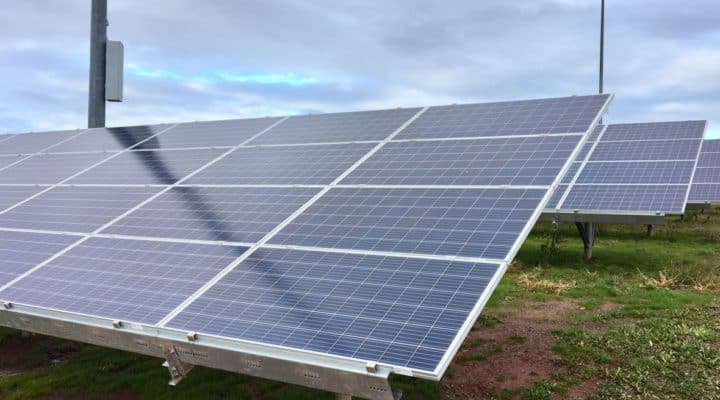
The solar panels will create more electricity as the days get longer and the sun gets stronger. (Tom Steepe/CBC)

A solar energy system at Credit Union Place in Summerside, P.E.I., has been performing well since it officially came online at the beginning of November, says the city’s director of community services.

J. P. Desrosiers said the solar farm has been easy to care for.

“Solar panels are almost no maintenance at this point in time,” said Desrosiers.

“They pretty much hang out there and do their thing and generate electricity for us.”

Better operation in summer

The system has produced 93,000 kWh of electricity and saved the city more than $16,000 in electricity costs so far.

The four months the solar farm has been operating, November to February, are the worst months of the year for solar generation, so the city expects those numbers will improve.

“We’re right on par with where we should be, and we’ll continue to grow and build on that as we get more daylight hours and more stronger sun as we move in toward the spring and the summer months,” said Desrosiers.

The system is forecast to pay for itself in 10 years.

Desrosier said sport arenas are big energy users, and any way that can be mitigated in an environmentally-friendly way is a good thing.
A recipe for success? Charlottetown establishing a food council

The City of Charlottetown is hoping a new working group will address food-related issues in the capital city.

The idea is to establish a food council made up of public and private stakeholders who work collaboratively on identifying and improving barriers to good, healthy food.

“We have a lot of different organizations working in Charlottetown on different food initiatives,” said Ramona Doyle, a sustainability officer with the city.

“It’s an opportunity to bring those organizations together around common goals and work together on a collaborated approach on how to address our food system.”

A resolution was passed during Monday night’s council meeting to establish a food council. The city intends to put the call out soon for applicants who might want to be a part of the group.

Input from those who work in agriculture, retail, distribution, nutrition, and beyond is what the city hopes will help better support both residents and visitors to Charlottetown.

Doyle hopes the food council will help break down the walls between different organizations.

“It’s an opportunity to bring people together,” she said. “Collaboration is where you get the best solutions, so we’re hoping that that comes true for our food council as well.”

Recipe for success

The group’s first task will be to draft a “Food Charter” — a document of intended actions to address food-related issues. It would be considered a guide and non-binding for the city council.

Food insecurity is one of the largest problems facing the greatest population of residents, according to Mike MacDonald of the Upper Room Hospitality Ministry.

“There’s too many people turning to food banks and soup kitchens across the city and across the province,” MacDonald said.

“But there’s a number of other people who are very close to having to use services like that. It’s a huge problem and I think a hidden problem at that.”

Collaboration key for food security

MacDonald said his soup kitchen serves up approximately 3,500 meals per month and more than 500 Charlottetown-area families rely on the food bank every month.

“Those are just the people walking through our doors, other organizations are helping other individuals as well.”

MacDonald is keen to learn more about the council and its mandate. He hopes the initiative will help streamline supports and services for anyone facing food insecurity.

“You have to start somewhere and hopefully it will grow into something that makes a difference in the lives of the residents of Charlottetown.”

Free transit for kids 12 and under may be coming to Edmonton

With an idea to make Edmonton a more family-friendly place, city council is considering a plan to let children under 13 ride transit for free.

The qualification is that the kids would have to be accompanied by an adult or an older teen. Councillors were concerned that opening up free transit rides for all kids under 13 — accompanied or not — would have overbearing costs.

Mayor Don Iveson was pleased to hear at a community and public services committee Wednesday that the initiative would cost a few hundred thousand dollars, an amount “I think we can absorb,” he said.

The initiative was an election promise for the mayor.

“Mostly just looking forward as a parent with my own young kids, to not be fumbling around for tickets,” he said. “And being able to just take them to the art gallery, take them to an Oil Kings game, take them to the park.”

Currently, children under age five ride for free. A book of 10 tickets costs an adult $26.25 while a youth between ages six and 17 pays $23.

Anyone getting on the bus and paying with cash pays $3.25.

Councillors agreed to send the proposal to a future meeting where they’ll have to approve the funding in a supplemental operating budget for 2018.

Iveson said they aim to have the free rides for kids in place by the fall, but added “We’re driving to have this in place by summer festival season.”

Booze and science on tap for Brain Awareness Week

The University of Windsor’s faculty of science has paired booze and science together for brain awareness week.

About 70 students gathered at Craft Heads Brewing Company Wednesday for an evening of mini-talks by University of Windsor brain researchers.

“It’s an idea to help people get to know about their brain and all the amazing things it does. It’s a really beautiful and incredible organ,” said Kirsten Poling, biological sciences professor at the University of Windsor.

Students and professors conducted several demonstrations about how the brain and senses work, including a discussion on the effects drinking has on hearing.

“It’s kind of a neat way to think of science differently. Instead of boring scientists hanging out in the lab we want to show people that we’re human and we like to have fun,” said Poling.

The event is part of Science On Tap, an outreach initiative that encourages members of the community to meet and interact with university researchers.

The theme “boozy brains” is in conjunction with brain awareness week, a global campaign to increase public awareness of the progress and benefits of brain research.

“We’re just people here trying to make a difference in the world. There are also things we are really interested in which we want to get across to the community,” said Suzie Eren, a fourth-year student studying behavioural science.

The science department at the university is also hoping to bridge a relationship between the university and the greater Windsor community by bringing their research to a downtown bar.

“We want people to know science doesn’t have to be scary. Science is part of who we are and what we do. It’s a really exciting opportunity to share what we love with everybody,” said Poling.

The Next Science On Tap event takes place on March 26 at Walkerville Brewery.

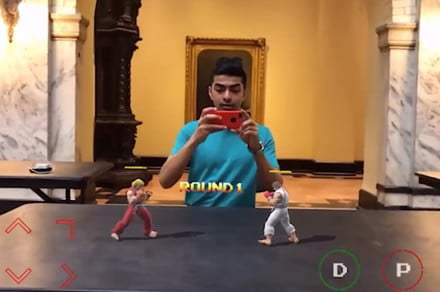
One developer can play ‘Street Fighter II’ anywhere with his AR port

While the mainstream applications of augmented reality have been pretty limited, there has been a bevy of tech demos showcasing what the technology could do with better support. One example was the AR version of Super Mario Bros. that a few folks tried out in 2017. But now, developer Abhishek Singh has made something of a sequel, this time with an updated Street Fighter II AR port.

We included a video above. It shows Singh playing the game all over the city including in parking ramps, indoors, and even on the city streets themselves. It’s powered by Apple’s nearly released ARKit for iPhone, but it’s not currently an official app, nor is there anywhere to download it for yourself. Even so, it’s a remarkably well-executed concept that Singh claims was a tribute to his younger years.

“I loved playing this game on an actual arcade as a kid with my sister and wanted to experiment with multiplayer shared AR experiences, and this kinda just popped in my head,” Singh told CNET. “Also realized the linear motion would work well in this kind of shared experience and I also thought it would look cool.”

Even better, perhaps, is that the whole thing even has multiplayer support — a rarity for AR games.

“One player sets up the stage by pointing their phone at any flat surface (streets, tables, etc.), the stage automatically adjusts for smaller surfaces and then the second person points their own phone at the same surface and joins in,” Singh said. He describes it as digital gladiatorial combat wherever you want it.

“I hope to release it publicly but need to figure out copyright issues with Capcom before doing anything,” Singh told Digital Trends in an email. “I enjoy AR, think it has a lot of potential to create amazing experiences and bring experience to life in our world, so while I am bullish on it’s future, only mass consumer adoption can guarantee that and we aren’t quite there yet.”

The Game Developer’s Conference as well as its companion, the Virtual Reality Developer’s Conference, take place in San Francisco next week. The two conferences should bring a wave of new game announcements and similar projects that could prove to be pretty compelling in their own right. But for now, this is perhaps one of the more impressive implementations of the technology.

Using broken glass, this camera can capture any wavelength, from visible to IR

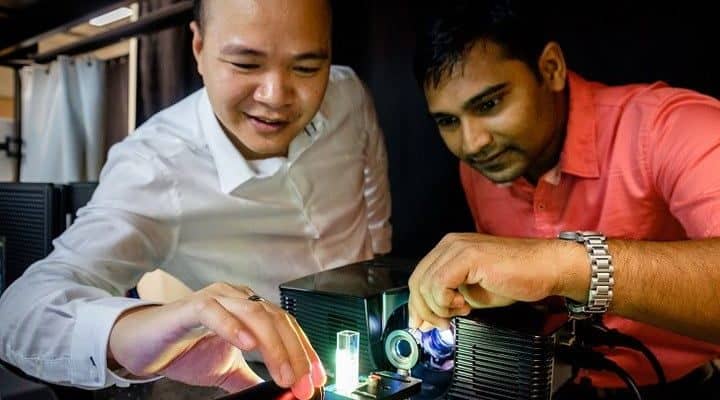
The camera inside your smartphone uses a lens and a red-green-blue filter to capture color images, but researchers have just developed a tiny camera that doesn’t have a lens or a colored filter, yet can take not only colored images, but infrared and ultraviolet images too. A group from Singapore’s Nanyang Technological University recently announced the development of a lensless camera capable of recording visible, infrared and ultraviolet light all inside one camera.

The typical camera uses a colored filter and a lens — and switching over to another wavelength requires an entirely different camera (or an infrared filter that requires extreme long exposures). That’s not the case with NTU’s new development. The camera’s trifecta of unique capabilities comes from a design that replaces a lens with ground glass.

The crushed glass inside the mini-camera will scatter each wavelength of light differently. Using algorithms programmed for each type of light, the researchers were then able to reconstruct the image. Because the different wavelengths each have its own unique scatter pattern, the researchers were able to apply one algorithm to get the traditional visible light image, but another to get an infrared image and still more to capture ultraviolet.

The design also allows the camera to use a monochrome sensor and still take colored images. A traditional camera sensor uses a random pattern of red, green, and blue filters in order to capture color, called a Bayer array. The ground glass essentially serves the same purpose as the colored filter, only requires the library of data on how each wavelength is scattered to reassemble the image.

Along with essentially creating a visible, infrared and ultraviolet camera in one, the camera is also compact. The lens-free design means eliminating the bulkiest part of the camera. The research isn’t the first lensless camera — including research from MIT and Caltech — but the NTU camera offers the unique ability to capture any wavelength.

Lensless cameras like the one developed by NTU could help create smaller cameras, such as making slimmer smartphones, for example. Steve Cuong Dang, the assistant professor leading the research group, says the camera’s design could also be used in medical and scientific applications, among others. Infrared and ultraviolet photography is used for medicine, surveillance and astrophysics, he said. The different wavelengths could potentially also be used to detect bacteria on food or even in criminal forensics.

Lensless camera research has been ongoing for years without yet seeing a consumer product, but the ground-glass design adds another layer in the ongoing research to create smaller cameras by ditching the traditional lens.