
Archives for March 15, 2018

Cross a John Deere with a Roomba, and you get this crop-monitoring robot

Farms are a hotbed for automation. Robots, drones, and artificial intelligence have been assisting in agriculture for years and 2017 showed they could farm an acre and a half of barley, from planting to tending and harvesting, without a human stepping foot on the field.

Now there is a small but robust robot that could take care of the more tedious agricultural tasks. It’s called TerraSentia and the four-wheeled robot developed by engineers at the University of Illinois boasts a variety of sensors that can monitor and transmit crop data in real time. It won’t take full autonomy over a farm but is designed to serve as a little cog in a bigger machine.

“TerraSentia is a small, ultra-compact autonomous robot that can go through plots of crop and determine which plants are doing better than others,” Girish Chowdhary, an agricultural biological engineer at the University of Illinois who designed TerraSentia, told Digital Trends. “It has great utility for breeders who are trying to differentiate between different genotypes of plants. Using this robot, they can determine which variety of plants are doing better for a given environment. Currently, this is all done manually but TerraSentia augments that manual labor to not only get things done quickly but at a higher quality, to keep all of that data available to the breeders.”

TerraSentia is just over a foot wide and weighs in at 24 pounds, making it lightweight enough to traverse a field without seriously damaging crops. With its sensors, the robot monitors plant health by looking at things like growth rate and coloration. Its sensors are also designed to be flexible and customizable to suit the needs of the breeder and growers alike.

“Different people have different requirements,” Chowdhary said. “We’re trying to make the robot teachable so that people can teach it things that they care about. To begin, at the university we’ve taught it to count corn and estimate the width of plants. … The idea is that it can do other things over time, such as disease detection and detection of pests.”

Currently, the robot can cover an 80-acre field in about a day. As such, Chowdhary hopes TerrSentia can offer a “scale neutral” technology that can offer a small-sized solution for work on farms both big and small. The more land that needs to be covered, the more robots to do the job.

The robot is available for $5,000 through Chowdhary’s company, EarthSense.

Twins prove space travel changes your genes

Research by NASA on identical twins has revealed that being in space changes human genes.

Scott Kelly spent 340 days on the International Space station, while his brother Mark remained on earth as a control subject.

On his return, tests showed that parts of Scott’s chromosomes, which contain DNA in which gene information is stored, had altered in shape.

Most of the changes, due to factors such as oxygen deprivation stress, increased inflammation and a restricted diet, returned to their pre-flight state.

However 7% of Scott’s genes, the so-called space genes, pointed to possible longer term changes related to his immune system, DNA repair, mitochondria and bone formation.

In its report NASA said: “Whole-genome sequencing showed each twin has hundreds of unique mutations in their genome, more than expected, and some were found only after spaceflight, circulating in the blood as “cell-free DNA.

“This is thought to be from the stresses of space travel, which can cause changes in a cell’s biological pathways and ejection of DNA and RNA.

“Such actions can trigger the assembly of new molecules, like a fat or protein, cellular degradation; and can turn genes on and off, which change cellular function.

“Significant responses were found for at least five biological pathways in Scott during his time in space. These responses are important for future missions.”

Identical twins come from one fertilised egg, containing one set of genetic instructions, or genome, formed from combining the chromosomes of mother and father.

However recent research has shown that identical twins are rarely genetically identical. Regions of the genome can have differing numbers of a gene.

These variations could explain why differences in susceptibility to specific diseases, for example, have been found in twins.

So the Kelly brothers might not have been genetically identical to start with, but after Scott’s time in space they are even less like each other.

Why Cloud Company Stocks Are Soaring

The technology sector has reigned supreme over the last year. With sectorwide returns of 24%, it outperformed the next best sector, industrial goods, by 10 percentage points.

But within tech, it’s the rise of cloud computing that’s stolen the spotlight.

Cloud computing uses remote servers to store, deliver, and manage data and applications over the Internet. It eliminates the need for local servers and oftentimes the cumbersome installation involving an IT department.

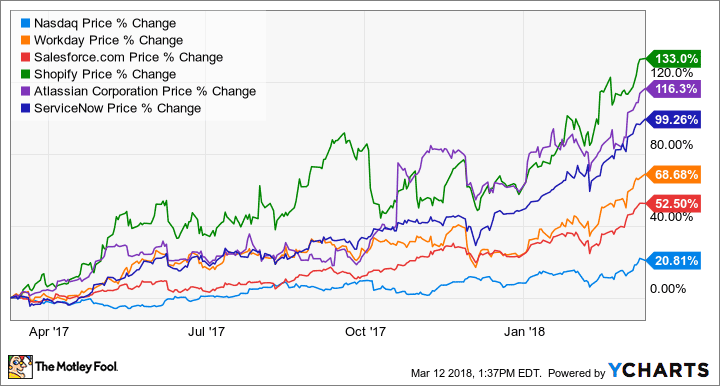
Over the last year, the largest pure-play cloud companies have left the Nasdaq behind. The slowest-growing of that group has more than doubled the tech industry barometer; the fastest has quintupled the index’s returns:

NDAQ data by YCharts

So what’s been driving cloud company stocks ever higher? And can it continue? Let’s take a closer look.

For starters, the wave of enthusiasm for tech stocks in general has provided a tailwind. Consider that today, the four largest companies in the world are all tech: Apple, Alphabet, Amazon, and Microsoft. Each of these is invested in the cloud, too, but largely through storage; none of them are pure cloud businesses. This differs from the software-as-a-service companies that I would consider pure-play cloud companies.

The biggest players solely focused on the cloud are the ones shown below, in order of market capitalization:

Cloud Company                Market Cap

Salesforce (NYSE: CRM)               $89.7 billion
ServiceNow (NYSE: NOW)           $29.8 billion
Workday (NASDAQ: WDAY)        $28.5 billion
Shopify (NYSE: SHOP)                  $14.1 billion
Atlassian (NASDAQ: TEAM)        $13.7 billion

There are three reasons these companies have seen their market caps balloon recently, and here’s what they boil down to.

1. Eye-popping growth rates that stick

Cloud companies have tremendous advantages over companies that make physical things or provide high-touch services. When software is packaged as a service (SaaS), it can be rolled out to customers incredibly quickly. It can require minimal direction interaction with users. Early on in the life of a SaaS company, sales growth rates of 70%, 80%, even up to 100% are not unheard of.

The cloud-based commerce platform Shopify, for example, has a five-year average annual sales growth rate of 95%. Shopify provides a suite of products that helps primarily small-to-medium businesses connect potential customers to their merchandise online and through social media.

While we’ve witnessed these growth rates before — like during the early 2000s for Salesforce — what we’re seeing for the first time is how sustainable some unusually high growth rates can be in the cloud. Salesforce today is a 19-year-old company. Yet its average annual sales growth rate over the last five years has been 30%. If that were to persist, sales would double in roughly 2.5 years.

A $10 billion company like Salesforce doubling sales in less than a few years is hard to wrap your head around. But Salesforce — even at its size — is all about speed.

It has a lock on big clients because it makes their sales teams more effective while minimizing IT upgrades. Salesforce’s cloud creates a seamless connection between salespeople and key corporate decision-makers. Its products can better anticipate needs though a data-driven feedback loop and introduce customers to new products as their businesses change. This short cycle is unique to the cloud, it compounds over time, and it’s a key reason the market’s willing to pay up for shares.

2. High switching costs and network effects

Cloud businesses are capable of ramping up new users in a hurry. And they’re increasingly finding ways to ingrain these users with their products. The type of user will depend on the cloud business: Salesforce tends to serve businesses, whereas a cloud business like Intuit’s serves individuals.

Users of all sizes can be more quickly integrated into an ecosystem in recent years due to the rise of one key tool: application programming interfacing, or “APIs.” If it sounds complex, it’s not. What APIs do is facilitate communication between data sources and software.

When software can rapidly be integrated, customers get more functionality. It also allows the cloud business to collect more data on, say, your financial habits. As a result, two effects occur: the more users, the better the data; and the more integration, the more embedded the users become. These things build on one another rapidly. This is how cloud companies build what investors call an “economic moat” at a pace we’ve never seen before.

In this case, the economic moat consists of high switching costs and data-driven network effects. Again, investors look at a cloud business and see how fast it’s growing and that its business is becoming more durable by the day. Paying 10 times sales doesn’t seem that ridiculous.

3. Rapid ecosystem creation

Building on the above, growth of a single and highly functional product is not sufficient in this market. Cloud companies are adding products in rapid-fire fashion — building an ecosystem of products in a handful of years, a process that used to take decades.

Apple’s ecosystem took years to create. The iPod came out in 2001, the iPhone debuted six years later, and then the iPad took another three years. Building an ecosystem of physical products takes time. Of course, Apple is also a software company, so it was hooking users into its universe in that way, too.

Cloud companies have proved that they can both acquire and build products rapidly. And they can take a user from uninitiated to ingrained rapidly, too. Think of a new Intuit customer going from Mint to QuickBooks Online to TurboTax (all Intuit products) in the course of a single tax season.

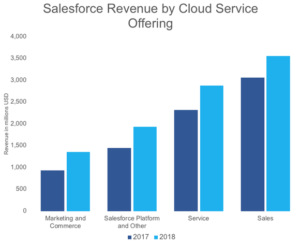
Salesforce can perform the same feat at an enterprise level, so its suite of $1-billion-plus clouds has now grown to four:

A graph showing Salesforce’s growth.

Investors see the creation of an ecosystem and think of the success that companies like Alphabet and Apple have had with theirs. That’s a long-term trend that makes the market salivate, only now it occurs at an even faster pace.

The ascension of the cloud

This is a unique time for companies running cloud-only businesses. The first reason they’re soaring is their growth rates — primarily in new users and sales. Earnings, in fact, are usually scarce early on in a cloud business’s existence.

But their success will depend on the No. 2 and No. 3 reasons listed above. Whether long-term investors should be willing to pay up for a given cloud business should come down to signs of an emerging economic moat. High switching costs and network effects could be worth a premium. Those companies without them could fall as quickly as they rise.

Fitbit Releases 2 Follow-ups to the Ionic Smartwatch

Fitness wearable maker Fitbit had a forgettable end to 2017. The year was being billed as a transition period, but its long-awaited entry into the world of smartwatches — the Ionic — failed to deliver during its holiday shopping season debut. Now, 2018 will extend Fitbit’s attempted rebound, and the company didn’t waste much time in admitting last year’s effort wasn’t good enough.

Two new lower-cost devices just became available for pre-order and are expected to begin shipping in April and May.

Lower prices and new demographics

Fitbit’s two new wearables, the Versa and the Ace, carry lower price points than previous models. With the Ace, the company is going after a new demographic: kids. This isn’t the first wearable designed with a younger audience in mind, but it’s the first for Fitbit. Ace tracks steps, active

The Fitbit Ace fitness tracker for kids, a thin band in purple with a digital display in the center.

minutes, and sleep; has up to five days of battery life; and is showerproof. The idea is to keep kids active, and Ace will try to do so by gamifying activity. Parents will also be able to monitor their children and keep track of whom they connect with in the Fitbit app. The device rings up at $99.95.

As for the Versa, the company is making some concessions in light of the popularity of devices like the Apple Watch. The Ionic’s starting price is $299.95, just $30 less than Apple’s latest offering. Apparently that wasn’t cheap enough, and many consumer reviews complained about the chunky design. Thus a second smartwatch, this one priced at only $199.95. The Versa smartwatch will tote nearly all of the features the Ionic has, less built-in GPS and mobile payments (except in special edition models).

The Versa on the left and Ionic on the right. Versa is slightly smaller and has rounded corners, displayed in pink. The Ionic is in gray and has a brown leather wristband.

The Versa is pictured on the left, the Ionic on the right. Image source: Fitbit.

That doesn’t mean the Ionic is dead. In fact, a new Adidas edition began selling in March. However, with the launch of the cheaper and smaller-framed Versa with a near-identical list of features, this looks like it will be Fitbit’s new flagship watch for the time being.

Why the Versa was needed

It seems like Fitbit forgot it was a small company in a fast-growing and ever-changing industry. Innovation dried up a few years ago, and its wearable fitness trackers steadily lost market share to more advanced smartwatches like the aforementioned Apple Watch and Alphabet’s Android devices. Overseas, the market has been flooded with low-cost options like those from Chinese manufacturer Xiaomi.

As a result, Fitbit’s sales have been in a year-over-year downward slide for a while now. According to industry research group IDC, the one-time champion of the wearables industry fell to third place in device shipments behind Apple and Xiaomi during 2017.

Company 2017                Market Share
Apple                                    15.3%
Xiaomi                                  13.6%
Fitbit                                     13.3%
Chart by author. Data source: IDC.

The good news for Fitbit is that IDC sees annual sales of wearables nearly doubling from 115 million devices last year to over 220 million by the year 2021. If that proves to be the case, the minimum Fitbit needs to do is hold on to its current market share of about 13%, and sales should rebound.

With the smartwatch gaining in popularity the last couple of years, Fitbit is right to try to capture the possibilities in that trend. The Ionic was too close in price to the Apple Watch, but the Versa — at more than $100 less — could be the ticket. Add to it the Ace fitness tracker for kids, and Fitbit may finally have that winning combination it needs to right its course.

3 Things Salesforce Management Wants You to Know

A man presenting at a conference.

Salesforce (NYSE: CRM) reported another quarter of record financial results last week, including annual revenue of $10.5 billion and a soaring backlog of customer orders.

Looking ahead, management expects to double its revenue to $20 billion by 2022. Here’s why that looks less like pie in the sky, and more like an achievable target after this impressive quarter.

1. Ballooning backlog

Two key metrics investors will want to follow as Salesforce aims toward $20 billion in revenue are “deferred revenue” and “unbilled deferred revenue.” The former refers to payments from customers where the work hasn’t been completed yet. The latter refers to work that is contracted but unbilled and therefore does not yet qualify as deferred revenue. Keep in mind the latter is a non-GAAP measurement that Salesforce discloses to provide visibility into future sales.

These two categories of deferred revenue are often referred to in tandem as “backlog.” And management was abuzz about the company’s growing backlog on the 2018 fourth-quarter earnings call.

While revenue for the quarter and year was up 24% and 25% year over year respectively, deferred revenue was up 28%. Meanwhile, unbilled deferred revenue was up an eye-popping 48% when compared to the prior year-end. That compares quite favorably to growth of 25% and 27% in the prior two fiscal years.

When combined, this backlog figure implies that Salesforce has visibility into $20.4 billion in future revenue.

Management addressed deferred revenue a dozen times on the conference call, with president and CFO Mark Hawkins noting the significant uptick was largely due to the “expanded and deeper relationships that the customers are driving.” A deeper relationship means customers are becoming more engaged with Salesforce’s ecosystem of products, which means their switching costs — a key indicator of an “economic moat” for Salesforce — will get higher as well. It’s also a good sign for Salesforce’s costs because it’s cheaper to upsell an existing customer than acquire a new one.

2. Doubling down on big customers

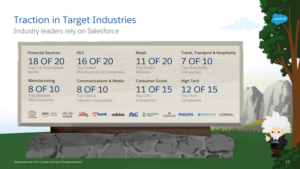
Building on the statement above, management discussed some of the key industries it focuses on and how Salesforce was capturing the big brand-name players in each. The following slide from Salesforce’s presentation shows eight major global industries Salesforce is pursuing. As shown, the company claims it is working with 55% or more of the largest corporations in each of these business verticals:

A slide showing a list of major industries.

This is important because it shows Salesforce is competing well with the likes of enterprise players that include SAP, Oracle, and Microsoft. Salesforce is small in terms of revenue when compared to those companies, but it’s still three times larger than the No. 2 pure-play cloud company.

Salesforce can go after the big fish and reel them in, too. As vice chairman Keith G. Block noted, this recent year witnessed Salesforce “doubling the number of $20 million relationships” it has versus 2017.

3. Optimizing with AI

From a technology perspective, the latest conference call was all about the artificial intelligence (AI) platform Salesforce refers to as “Einstein.” It (or he? hmmm …) was referenced 17 times, and Block stated that there are a “billion interactions and insights that are provided on a daily basis” through the platform. When pressed by analysts on how the company would monetize Einstein over time, CEO Marc Benioff provided some clarity on how the product is used: It allows Salesforce to be “differentiated” from the competition and to provide a tool aimed at “enhancing human performance.” For now, it’s a way to make customers better and ideally improve their retention.

Going forward, Einstein will have implications across each of Salesforce’s cloud offerings, but it could prove particularly fruitful in the area Salesforce refers to as Analytics. The most recent data from industry research firm Gartner shows this category to be Salesforce’s second-largest market vertical opportunity. Analytics opens up a window to a $14 billion industry, of which Salesforce has less than 1% of the market share. By comparison, Salesforce has anywhere between a 4% and 38% share in the other five markets it is pursuing.

The takeaway for investors

Overall, management said steady corporate spending and tax cuts provided a tailwind as companies were more willing to open their wallets. Salesforce was prepared to capitalize on this trend by securing big clients and widening the customer relationships at the same time. This led to the substantial backlog, which puts Salesforce in a solid position as it aims to double its revenue.

3 Stocks That Look Like Apple in 2008

Woman in suit drawing a line indicating exponential growth.

When it comes to generating life-changing wealth, few companies have done so as effectively as Apple in recent years. To be sure, those who bought and held Apple stock just 10 years ago have watched the value of their investment soar nearly 1,000%, including dividends.

Of course, it’s easy to see now how Apple accomplished the feat. The tech giant had only just launched its first iPhone in mid-2007, effectively changing the way the world would think about smartphones and mobile computing in the coming years.

That raises the question: Are there any companies on the market today that look like Apple did in 2008? We asked three top Motley Fool investors to weigh in. Read on to learn why they think Pandora Media (NYSE: P), Cannabis Wheaton Income Corp. (NASDAQOTH: CBWTF), and Atlassian Corporation (NASDAQ: TEAM) fit the bill.

The sweet sounds of long-term gains

Steve Symington (Pandora Media): When Pandora announced stronger-than-expected quarterly results a few weeks ago, at first the market rejoiced by driving shares of the streaming music specialist up more than 10% in after-hours trading. But the happy music didn’t last; the stock instead dropped nearly 8% the following day as the market digested Pandora’s underwhelming revenue guidance for the current quarter.

However, I think the fall presents an opportunity for long-term investors. Much in the same way that Apple was fostering its relatively new iPhone line — a product that would go on to be more successful than virtually anyone on Wall Street had predicted — Pandora is only starting to see the first fruits of its new subscription-based music services.

To be sure, Pandora’s $9.99-per-month on-demand streaming service, Pandora Premium, was launched almost exactly a year ago. So it should come as no surprise that subscription revenue last quarter soared 63% year over year to $97.7 million. But that’s less than a quarter of Pandora’s total sales, leaving a long runway for incremental sales growth. To that end, Pandora’s subscriber growth is accelerating, with Plus and Premium subscribers increasing 25% year over year last quarter to 5.48 million.

That’s also not to mention other opportunities that Pandora’s new CEO, Roger Lynch, formerly the head of Sling TV, sees for the company to drive growth. More specifically, Lynch believes the company can expand into new content such as podcasts, spoken word, and traditional radio; capitalize on expanded distribution partnerships such as connected home and automotive; use more rewards-based ads to drive free users to upgrade; improve its advertising technology; and more aggressively leverage partner marketing to lower subscriber acquisition costs.

“Many of our growth initiatives are still in the early stages,” Lynch teased during this quarter’s conference call, “and their impact will build over the course of 2018.”

For investors willing to bet that’s he’s correct in that prediction, I think Pandora stock could be poised to deliver outsize gains for years to come.

A cannabis industry disruptor? You bet!

Sean Williams (Cannabis Wheaton Income Corp.): Innovation has been Apple’s driving force over the past decade, and it’s the primary reason behind the company’s 800% increase in share price, inclusive of dividends, since 2008 began. While it’s difficult to say that any company can follow in its footsteps, I’d toss Cannabis Wheaton Income Corp. into the ring as one possibility.

As the name suggests, Cannabis Wheaton is involved in the marijuana industry, which most folks wouldn’t exactly describe as an “innovative” industry. Sure, it’s been constrained by regulations in most countries, but cannabis isn’t often viewed as game-changing. However, Cannabis Wheaton does bring something unique to the table that the industry hasn’t yet seen: a pot-based royalty model.

Growers, especially in Canada, which is considering legislation that would legalize recreational weed by this coming summer, are aggressively looking to expand their production capacity. Unfortunately, few if any growers are generating much in the way of operating cash flow. This leaves Canadian growers critically underfunded at a time when demand is set to explode. Furthermore, most financial institutions won’t lend to cannabis businesses for fear of violating federal law.

To obtain his much-needed capital, they turn to a company like Cannabis Wheaton. In return for up-front cash that growers can use to expand their production capacity, Cannabis Wheaton receives a percentage of crop yield at a well-below market rate. The company can then take the product it received at a below-market rate and sell it at market rates, thus pocketing the difference as profit. By its own estimate, it should have an internal rate of return of 60%, on average, for its 15 deals.

The cannabis royalty model also provides instant geographic and product-based diversification for investors, meaning a production slowdown at one or two facilities isn’t enough to completely disrupt Cannabis Wheaton’s business.

Though it may not be an innovator in the traditional sense of the word, it’s very much a disruptor like Apple. With 230,000 kilograms of cannabis expected to be delivered by 2019, placing it among the largest sellers of weed in Canada, this small-cap stock should be on aggressive investors’ radars.

The next big software company

Maxx Chatsko (Atlassian Corporation): It’s one thing to beat out competitors and gobble up market share, but it’s another thing entirely to accomplish that in an industry that’s growing hand over fist. A company has to grow incredibly fast to gain market share in an expanding market. Yet Atlassian has continued to do just that, notching year-over-year revenue growth of 43% in the most recent quarter. That’s even more remarkable when you consider that it’s a $13 billion company.

Atlassian provides communication, collaboration, and productivity software for small teams, small businesses, and even some of the largest companies on the planet. That market had an estimated value of $16 billion in 2016, but it’s expected to nearly double to $28 billion by 2020, according to a 451 Research market report. The company has absolutely dominated the market, captured an outsize portion of the industry’s expansion, and shows no sign of stopping. In fact, it’s on pace to deliver $1 billion in revenue in the next 12 months. It had just $215 million in revenue for all of 2014.

It’s worth pointing out that the software leader has forgone profitability in the present to focus on hypergrowth. While that could be a red flag to some investors, Atlassian’s losses have been mostly driven by large increases in R&D expenses (i.e., new product development). But it hasn’t affected the company’s cash flow, which has added gobs of cash to the coffers. Total cash and cash equivalents tallied $679 million at the end of 2017, while there was no debt — or dilution — to speak of.

Something else that’s important to me as an investor is that Atlassian is a no-nonsense company that’s serious without taking itself too seriously. That — along with a set of core values — has created an enviable company culture, which is the lifeblood of any business. It may not show up in the financial statements, but it certainly goes a long way toward enabling the hypergrowth shareholders have enjoyed so far.