Archives for March 9, 2018

Bike map aims to help St. John’s cyclists steer clear of trouble

Cyclists can share information about collisions, near misses, and road hazards on app

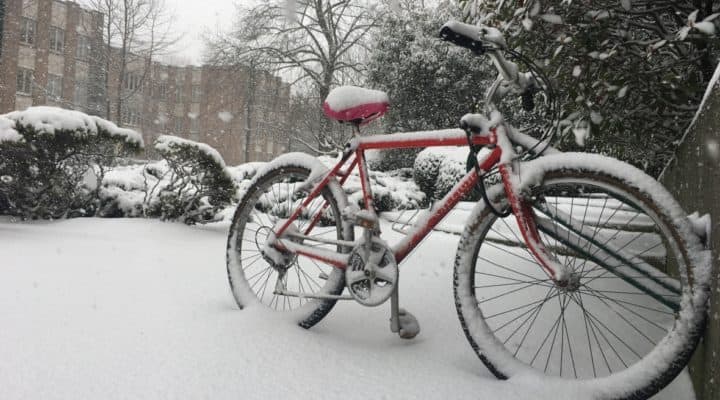
Winter cyclists are uncommon in St. John’s but the number of people using bikes grows when the weather improves. (David Horemans/CBC)

Navigating the streets of St. John’s on a bike can be challenging.

Some parts of the city, such as Kenmount Road and Allandale Road, can be downright frightening on two wheels.

But a Memorial University assistant professor is working to change that.

Daniel Fuller is gathering incident reports to help cyclists and city planners make pedalling around St. John’s safer.

Close calls and potholes

Fuller is asking people to report incidents by using an app called bikemaps.org

“It’s a citizens science project where we ask community members to report their cycling incidents,” said Fuller, a Canada Research Chair in Population Physical Activity at Memorial’s School of Human Kinetics.

“They can report collisions, close calls, road hazards like pot holes, and bike thefts. Basically to give us an idea of where people are cycling and where possibly dangerous places are and where good places to cycle are.”
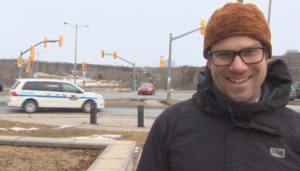
Daniel Fuller at the intersection of Allandale Road and Prince Philip Drive, an area that strikes fear into the hearts of city cyclists. (Mark Quinn/CBC)

Fuller said the map will be useful for individuals who want to plan a safe bike route and it may also help city planners figure out where cycling infrastructure should go.

“Where to put bike lanes. Where risky places are. Where we might need to add intervention to make cycling safer,” he said.

The interactive St. John’s area map has only been promoted for less than a year and so far only a few dozen incidents have been reported.
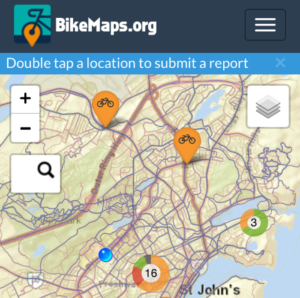
Bikemaps.org’s map of St. John’s flags collisions, near misses, and road hazards. (bikemaps.org)

Fuller hopes that will change and he’s encouraging cyclists get the app and add their reports.

“We have a cluster of incidents around the university,” he said.

“This is probably because lots of people cycle to the university but also the university is bordered by lots of busy streets and intersections, and that means there is potential for collisions. So, so far, that tends to be where incidents have happened getting on or off of campus.”

Planning bike paths

Fuller hopes that as more people add their incident reports, the map will give city planners more information about where bike infrastructure should go.

He said we can also learn from what other Canadian cities have done. Many have built bike lanes that are separated from roads by a barrier.

“The key message that we always give out as researchers is that separated cycling infrastructure is the safest and the most convenient for cyclists. It’s also helpful for reducing motor vehicle collisions because it encourages cars to slow down too.”

In December, a committee — which includes city representatives and members of the public — was formed in St. John’s to look at what might work and then make recommendations to the city. There is no firm date on when the report will be finished.


Montreal’s long-awaited Blue line extension could soon, finally, be a reality. Here’s why

Plante administration hopeful province, feds move quickly to get project off ground

Extending Montreal’s Blue line has been talked about for years. It may actually happen soon. (Charles Contant/CBC)

The much-discussed, long-awaited extension of the Metro’s Blue line could finally be closer to becoming a reality.

You’ve probably heard that before (it’s an idea that’s been bandied about since 1979), but there’s reason to believe this time it may actually happen.

Here are a few reasons why.

For one, Quebec Transport Minister André Fortin promised it will be “one of the next major announcements” of the Couillard government, which is preparing for a fall election.

“We are working with the federal government to ensure the funding formula,” Fortin said Wednesday at a news conference detailing the Transport Ministry’s upcoming investments on the island of Montreal.

The federal government, meanwhile, is rolling out the second phase of its flagship infrastructure plan, worth $33 billion. Ottawa is hoping to sign new funding agreements with the provinces by the end of the month.

The types of projects that will qualify, and the percentage each level of government will contribute, still has to be determined, but all signs point to the province and the city making the project a priority in its discussions with Ottawa.

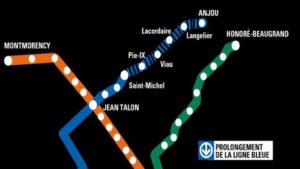
The Blue line extension would include five new stations in Montreal’s east end. (Radio-Canada)

In January, at his first official meeting in Montreal with Mayor Valérie Plante, Premier Philippe Couillard spoke of Quebec’s “unwavering commitment” to the the Blue line extension.

As well, Quebec now has several properties on reserve for expropriation along Jean-Talon Street, between Pie-IX and des Galeries d’Anjou boulevards.

The reserves expire in April — and legally, cannot be renewed.

“We are truly going to find out in April 2018 whether this Metro goes ahead or not,” Frank Cavaleri, owner of a building at the corner of Jean-Talon and Lacordaire boulevards which houses a Pharmaprix and a medical clinic, told CBC News earlier this year.

The extension would include five new stations in Montreal’s east end, extending all the way to Anjou.

Privately, city frustrated with delays

In a statement to Radio-Canada, Plante said Fortin’s comments are “very encouraging.”

“We are looking forward to the conclusion of the agreement between Quebec and Ottawa so that this long-awaited project can be launched quickly,” she said.

Plante also cautioned that extending the Blue line would put more pressure on the “already-saturated Metro system and we must plan for network growth beyond this extension.”

Privately, though, elected officials in Montreal have expressed frustration at the delays in the funding announcement, according to an administration source.

Let’s see shovels in the ground, advocate says

François Pépin, president of Trajectoire Québec, an association that advocates for more public transit in the province, said the announcements are a step “in the right direction.”

“For the first time, we feel the unanimity of all stakeholders,” he said.

However, he wants to see construction start soon on the Metro extension, with completion in 2025.

“We must now move toward a final business plan and a first shovel of earth,” said Pépin.

Christine Fréchette, president of the chamber of commerce for Montreal’s east end, echoed that perspective, saying the extension would be a boon to a part of the island that’s been underserved by public transit.

“We are more and more impatient,” she said.

“We are ready to receive this investment that will be made for the benefit of workers, the population and economic development in the east.”

60 years later, scientist says work on polio vaccine topped his career

“Nothing I have done since can match that,” Alex Kanarek wrote on Facebook

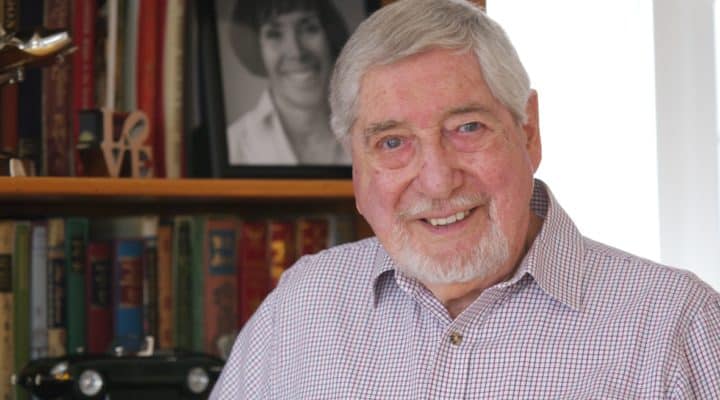
Alex Kanarek was a virologist living in England when the polio vaccine was being mass produced, but now he is retired and living in Rockwood, Ont. (Melanie Ferrier/CBC)

Sixty years after he helped mass produce the polio vaccine in England, a Rockwood, Ont. man is celebrating news from the World Health Organization that the disease could soon be a thing of the past.

In February, Alex Kanarek came across a WHO statement that said reported cases of polio were at “an all-time low in 2017,” and that we are “closer to polio eradication than ever before.”

That news prompted him to write the following message on his Facebook page:

“In 1958, exactly 60 years ago, the British government started vaccinations against polio with vaccine manufactured by two British companies, Glaxo and Burroughs, Wellcome. I was a member of the Wellcome team that developed and produced the vaccine… Nothing I have done since can match that in terms of my direct effect on children’s health.”

Mass production

Kanarek’s story began in 1954, when he was hired by Burroughs Wellcome to find a way to produce enough polio vaccine to vaccinate all the children in the United Kingdom.

American medical researcher Jonas Salk had just announced that his vaccine against polio worked, but no one knew how to make the vaccine on a large scale.

“It soon became obvious that the methods that we were using were not going to be adequate,” Kanarek told CBC News. “Until then, people had been working with test tubes and little bottles, you see what I mean? We were now talking about 100 litres tanks.”

What needed to happen, Kanarek said, is that the process of manufacturing vaccines needed to be industrialized, and it fell to him and his small team of scientists and technicians to sort out what that would look like.

“We were learning on the job,” he said. “Every day we had another problem to solve, and that was the exciting part.”

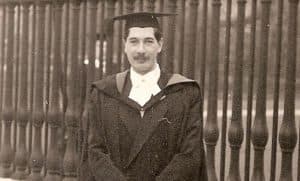
Alex Kanarek was only 24 years old when he was hired by Burroughs Wellcome. Only a few months earlier, he had graduated with his PhD in virology research from Cambridge University. (Alex Kanarek)

In the end, Kanarek helped to design a three-storey building on the Burroughs Wellcome campus in Beckenham, just south of London, where the polio vaccine was produced.

When the building opened in 1958, a local newspaper ran the following photo of Kanarek and one of his technicians standing beside one of the stainless-steal mixing tanks he designed.

When the reporters left the building, Kanarek said the real work began. They closed the doors, fired up the system and started producing the vaccine.

He said they produced 3 million doses of polio vaccine over the next three or four years — 3 million doses that protected children from a deadly disease.

“That was a wonderful achievement, not just for me, of course, but for the whole team that did that job,” he said.

The first building was constructed between 1954 and 1958 on the Burroughs Wellcome campus in Beckenham for the production of the polio vaccine. (Alex Kanarek)

But then, in 1961, another American researcher — Albert Sabin — created a new vaccine, one that was much easier to produce and administer.

Burroughs Wellcome phased out its production of the Salk vaccine and started producing the new Sabin one instead.

Kanarek was still working for the company, but had moved on to other viruses and vaccines. So, when he thinks about polio, it’s the early days that he remembers.

“What I remember most is that we were young, we were so enthusiastic,” he said. “We were right at the beginning of this enormous achievement, which now — 60 years later — it’s just something everybody expects.

“We have vaccines against all these different virus diseases and they work and they’re safe, but back then we were right at the beginning of it and that was very exciting.”

Free naloxone nasal spray coming to Ontario pharmacies

‘For those of us who are in high risk situations, why not?’ says funeral home director

When sprayed up a person’s nose, Narcan nasal spray can quickly deliver a life-saving dose of the opioid antidote nalaxone through nasal membranes. (Adapt Pharma Canada)

Free naloxone nasal spray is coming to certain Ontario pharmacies, according to the Ministry of Health and Long-Term Care.

The newly-available spray will be of interest to those who aren’t comfortable with needles, as well as businesses that work closely with first responders and whose employees could be at possible risk of fentanyl exposure—for example, funeral homes.

London pharmacist Scott Coulter said he’s fielded requests from them before.

“In the unfortunate circumstance where someone passes away and the coroner’s called, when the coroner’s finished the next person that’s called is the funeral home, and it’s the funeral home’s employee’s responsibility to respond and be exposed,” said Coulter.

“From a safety point of view, it’s about making sure that your employees are protected.”

Injectable naloxone too dangerous in some workplaces

Funeral home director Joseph O’Neil keeps naloxone nasal spray in his embalming room as a safety precaution. He says he’d ultimately like to see the spray available in any business that deals with the public. (Submitted)

O’Neil Funeral Home managing director Joseph O’Neil already keeps naloxone spray in his embalming room for just that reason. He said it’s hard to tell if a person’s body has fentanyl, fentanyl patches or other drugs on it, and that it could be dangerous for embalmers to use the injectable naloxone.

“You don’t want anything that breaks your own skin, because you’re never sure what kind of pathogens a person might have,” said O’Neil.

Although O’Neil has a unique need for the naloxone spray, he thinks that all businesses should eventually carry it as part of their first-aid equipment.

“I don’t care if you’re a coffee shop, you’re a funeral home, you’re a restaurant, you’re a department store… It’s just going to become standard operating procedure for everybody to have one of these,” he said.

Free spray part of broader strategy

Injectable naloxone kits are already available for free in Ontario pharmacies, and naloxone nasal spray is available for free via the Middlesex-London Health Unit. Over the counter, the spray version costs ‘in the neighbourhood’ of $200, said Coulter.

Ontario’s Ministry of Health and Long-Term Care announced the free nasal spray yesterday as part of a broader expansion of overdose prevention programs.

Spokesperson David Jensen said the ministry will begin funding the spray by the end of March.

Clarifications

According to Health Canada, skin exposure to fentanyl is extremely unlikely to cause immediate harm. Transferring fentanyl from skin to mucous membranes such as the eyes, nose or mouth is the most common kind of incidental exposure.