Archives for February 26, 2018

‘I’ve got the sun above me’: How to power your home with renewable energy

Financial savings, carbon footprint reduction are just some of the reasons people install renewable systems

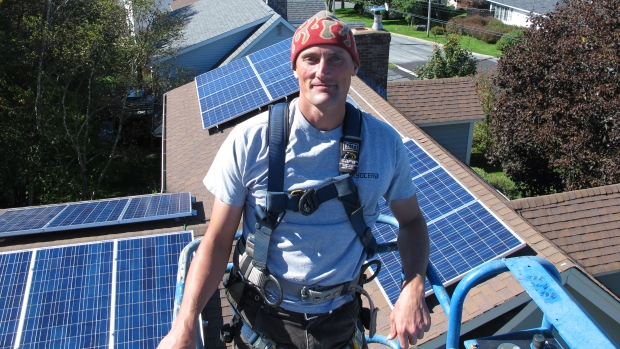
Rob Sedgwick says it’s too cost-prohibitive to build an off-grid energy system that powers a home’s electrical, cooling and heating needs. (Submitted by Rob Sedgwick)

For homeowners looking to break free from the grips of Nova Scotia Power and its occasional outages, there are options.

To truly cut the cord, a homeowner would have to install an off-grid power system that would use renewable energy forms like wind, solar or hydro to provide power, as well as a battery backup system.

A solar system, which is most common, could cost between $10,000 and $50,000, experts told CBC News.

However, an off-grid system on its own won’t be able to meet all of a typical homeowner’s energy needs.

“Any type of electric heating is simply not sensible.… I don’t care how big it is, so, electric clothes dryers, electric stoves, electric water heating, that stuff’s out the window,” said Rob Sedgwick, the president and co-owner of Sage Energy, a Nova Scotia company that does off-grid and grid-tied installations.

How an off-grid system usually works

Under an off-grid power system, the common approach is to have the system provide electricity and lighting for the home, but things like heating, stoves, dryers and water heaters would be powered by propane or natural gas.

“Propane is attractive because it doesn’t go bad. A lot of things run on propane,” said Brian Rose, the president of Appleseed Energy, a solar and wind energy installation company.

Natural gas is more appealing because it’s cheaper, but you have to live in a place where gas lines are in place to provide a steady supply of it. The places where it’s available in Nova Scotia only represent a fraction of homes in the province.

Heritage Gas is the natural gas distributor in the province. If all of the homes were converted to natural gas where lines are currently available, the company would have about 11,000 residential customers, said spokesperson Alice McCarron. The company has just over 3,800 customers.
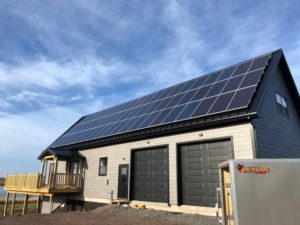
This 60-panel solar system was installed on a home in Bayfield, N.S., which is near Antigonish. (Submitted by Brian Rose)

Sedgwick said even if somebody has deep pockets, building an off-grid system that could handle a home’s heating and electricity needs just isn’t feasible.

“It would just be absolutely cost-prohibitive,” he said.

The ideal power consumption for an off-grid home is up to 10 kilowatt hours per day, which works out to 3,650 kilowatt hours a year, Sedgwick said.

According to Nova Scotia Power, the average residential customer uses about 10,000 kilowatts of energy a year.

Because of the demanding energy needs most people have, going off-grid is probably not an option for them.

How net metering works

Another option is to enrol in Nova Scotia Power’s net-metering program (also known as being grid-tied), but with some modifications.

Under net metering, a homeowner uses renewable energy to meet their own electricity needs. If they produce more than they need, the extra energy is put on Nova Scotia Power’s grid and the homeowner is credited for that. If they use more energy than they produce, they are billed for the additional energy.

There are about 450 Nova Scotia Power customers who use net metering, and more than 80 per cent use a solar-power setup, documents filed with the Utility and Review Board show.

Homeowners must apply and sign a legal agreement with Nova Scotia Power, although one lawyer cautions that the agreement is “unreasonable” and “one-sided” in favour of the company.

Experts say a net-metered solar system will cost somewhere between $12,000 and $40,000, and will depend on factors like how many solar panels are installed and how much energy the system can produce.

“It’s actually probably less expensive than it was six years ago,” said Rose.

He said the payback period is around 11 years for a net-metered system.

Financial incentives?

Programs are available to provide financial incentives. Halifax offers a program called Solar City that provides property owners with a loan to pay for the project. The money is repaid over 10 years and comes with a fixed interest rate of 4.75 per cent.

Once his home is built, Gordie Weddleton will be using a net-metered system — and he’s using Solar City to pay for the solar installation. The Musquodoboit Harbour man is building a net-zero home, meaning it will produce as much energy as it consumes. The home is ultra energy-efficient, with triple-glazed windows, upgraded insulation and passive solar design.

These homes near Inverness each have 30 solar panels on their roofs and use a net-metered system. (Submitted by Brian Rose)

Weddleton said he feels he has a duty to produce power and not just take it from the grid.

“I’ve got the sun above me, I’ve got all Mother Nature has to offer. Why shouldn’t I be a little bit more responsible for generating a little bit of power?” he said.

With net metering, if there’s an outage, a homeowner will lose power unless their system has “special transfer and isolating capabilities installed,” says Nova Scotia Power’s website.

Company spokesperson Tiffany Chase said it’s not known how many customers have a setup like this.

Battery backup system

However, a battery backup system could be installed to kick in once there’s an outage. Depending on the size of the system, it could provide power for up to a couple of days. It would likely cost between $10,000 and $30,000.

Rose said this approach would be preferable to using a generator.

“You don’t have the fuel costs and the noise and the maintenance of a generator,” he said.

Sedgwick said some people simply refuse to use a generator.

“They just don’t want any tie to a hydrocarbon fuel or they want complete autonomy,” he said.

Nova Scotia Power is expecting big growth in its net-metering program, with another 150 customers expected to sign up for it this year.

Islander turns living room into pop-up art and thrift market

Market featured more than a dozen vendors selling art, jewellery, vintage clothes and books

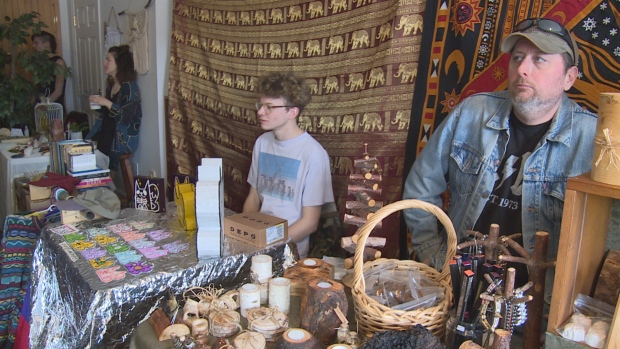
There were 13 Island-based vendors who set up shop in Doucette’s living room, selling art, jewellery, books and records. (Brittany Spencer/CBC)

An Island art enthusiast transformed her Charlottetown apartment into a pop-up art market and thrift shop this Sunday to give local vendors a free space to showcase their work.

Doing the ‘side hustle’: Islanders tap into their creative sides
Danielle Doucette said she came up with the idea after she and several friends noticed a lack of free spaces for artists to meet and network on the Island.

“Usually you have to pay for a table or there’s places where you have to pay to get in,” Doucette said.

Doucette said while there are plenty of pop-up events and markets on the Island, vendors and customers usually have to pay a fee to enter, which can be difficult for new artists or small business owners to afford.

“I figured it would be cool to just open up a space where people could just gather and hang out,” she added, “not feel pressure to buy anything or pay to get in or have to pay for a table.”

Less pressure to make sales

There were 13 Island-based vendors who set up shop in Doucette’s living room selling art, jewellery, books and records.

“We actually have a really diverse group,” Doucette said. “We have a lot of different art, paintings and illustrations and crafts, woodworking, embroidery— a lot of different stuff.”

There were 13 Island-based vendors who set up shop in Doucette’s living room, selling art, jewellery, books and records. (Brittany Spencer/CBC)

Doucette also opened a space next to her kitchen for people to sell vintage clothing and shoes.

Karen Younker, co-owner of DK Original, was one of the vendors at the living room market, selling handcrafted woodwork and jewellery.

She said she and her partner have set up booths at the Charlottetown Farmer’s Market and at the Charlottetown Farm Centre in the past, but that pop-up events are a good way to promote their business during the off-season and quieter winter months.

“We definitely can use a lot more of them,” Younker said.

She said the opportunity to showcase work at a market without having to pay a $40 dollar vendor’s fee takes off the pressure to make sales.

“When you do come in and there’s no fee, it makes you feel like, okay I can do this. I don’t have to worry if I don’t make a sale or not,” she added. “When you make a sale it’s even better.”

Hopes to host again

Doucette said more than 70 people came through her pop-up market and she was excited to see how quickly her home was transformed into a busy space full of art and creative people.

‘I figured it would be cool to just open up a space where people could just gather and hang out,” Doucette says. (Brittany Spencer/CBC)

“I have the space and it’s the perfect size,” Doucette said.

“It’s nice to get together and just talk about your art and swap and just have the freedom of not feeling like you’re going shopping but you’re just coming to hang out.”

“Seeing how popular this one has been and seeing how it goes I hope to have more in the future, for sure.”

City collaborates with MLSE Foundation to give kids ‘taste’ of hockey

City collaborates with MLSE Foundation to give kids ‘taste’ of hockey

Children take part in celebration day for Hockey in the Neighbourhood program at the Malvern Community Recreation Centre in Scarborough. (CBC)

Dozens of children were given an opportunity on Saturday to play hockey with the likes of Toronto Maple Leafs alumni Nik Antropov, as the City of Toronto partnered with MLSE Foundation to host a celebration day for the Hockey in the Neighbourhood program.

Funded by MLSE Foundation, Tim Hortons and the Toronto Maple Leafs Alumni Association, Hockey in the Neighbourhood aims to encourage participation in hockey through hands-on training.

Antropov said it was a delight being a part of Saturday’s program at the Malvern Recreation Centre in Scarborough.

“It’s a great thing to do [to] help out the kids [and] make sure they do a lot of sports no matter what it is,” he told CBC Toronto.

Antropov emphasized the importance of the program, noting that most families can’t afford to get their children into hockey.

Coach Ahsan Ahmad agrees and adds no child with an interest in the sport should be left behind because they cannot afford it.

Nik Antropov was among Toronto Maple Leafs alumni who took part in both on and off-ice programming run by Leafs hockey development coaches. (CBC)

“Hockey is a big thing in Canada. Anywhere you go you see people talking about hockey,” Ahmad told CBC Toronto.

He said the program is for kids who are beginning hockey and involves simple drills to get them into the game.

“It’s for kids that want to get into the sport that Canada plays but they don’t really have the financial aid. It’s to give them a little jump start.”

Ahmad, who said he got his first taste of the sport when he was 10 in the Hockey in the Neighbourhood Program, now runs two rinks with 40 and 60 kids respectively.

Ahmad, who said he got his first taste of the sport when he was 10 in the Hockey in the Neighbourhood Program, now runs two rinks with 40 and 60 kids respectively. (CBC)

He explained that while it might not seem like a lot, it is important that the rinks are not too packed, so kids could get “one-on-one help.”

Meanwhile, Jess Vella, a forward for the Toronto Furies who also participated in Saturday’s program, pointed to the importance of giving back to the community and demonstrating the importance of hockey.

“It’s a great opportunity for children to come out here, learn what it’s like to play hockey,” she told CBC Toronto. “It’s a great character builder, and I think they have a lot of fun out here.”

Vella said the program also gives kids the opportunity to try hockey to see if they like it.

“I think hockey is one of those sports that everyone really enjoys and would like the opportunity to play,” she added. “There is support from a lot of different organisations and people to give them the opportunity to play.”

Introduced in 1999, the Hockey in the Neighbourhood program has used hockey as a tool of engagement for more than 5,000 children and youth.

Increased workplace accessibility would result in economic benefit: paralympian Rick Hansen

‘If you’re not accessible, you’re losing that market,’ says Hansen

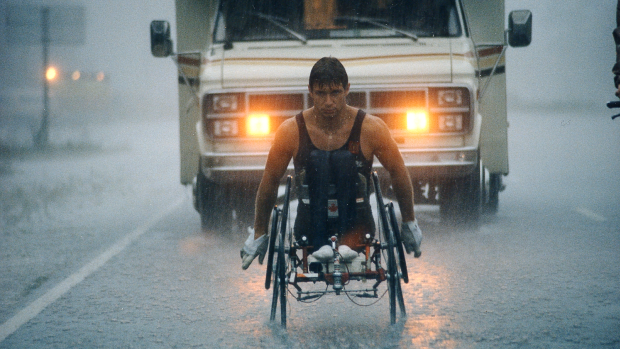
Rick Hansen, once a paralympian, has moved into philanthropy and advocacy for those with disabilities. (Rick Hansen Foundation)

Making workplaces and communities accessible to those with disabilities will have a positive impact on Canada’s economy.

That’s the finding of a report released Friday by the Rick Hansen Foundation in partnership with the Conference Board of Canada.

B.C. paralympian Rick Hansen said there isn’t enough emphasis on the economic benefits of increased accessibility.

His foundation teamed up with the conference board to conduct research into the issue.

“No one speaks to the opportunity,” said Hansen during CBC Radio One’s The Early Edition.

Living with disability

The report showed that 2.9 million Canadians live with a physical disability that impairs either their vision, mobility or hearing and that the number will increase by 1.8 per cent annually over the next 13 years.

The report stated that in 2017, Canadians with disabilities contributed to the country’s economy by spending $165 billion dollars as a whole.

The conference board obtained data for the report by surveying Canadians with disabilities and and assessing how they interact with their communities.

The report showed that since the number of Canadians with disabilities is expected to increase annually, total real spending of this group will rise to $316 billion by 2030, increasing from 14 per cent to 21 per cent of the total consumer market.

Accessibility affordability

To tap into that population growth, Hansen said investments in workplace accessibility need to be made, so Canadians with disabilities can participate more fully in the workforce.

“If we made the workplace more accessible we would have a massive gross in GDP,” said Hansen.

Hansen said the cost of any government investments toward workplace accessibility would be a drop in the bucket compared to the report’s finding of a GDP increase of $16.8 billion by 2030.

“About a half a million people …have a potential to work longer and obviously become employed, it has a huge net gain to our country,” said Hansen.

“It’s time governments and the private sector really accelerate their attention to this because who would want to leave that on the table?”

Hansen called the growing population of Canadians with a disabilities a pool of untapped potential.

Hansen says as more people with a disabilities are able to work, the more they will give back to local economies.

“They want to go out and be part of a restaurant experience, they want to go to retail stores, they want to travel just like anyone else,” said Hansen.

“But if you’re not accessible you’re losing that market, and they’re going other places or they’re not going at all.”

5 tips to keep your 2018 savings goals on track

Everyone kick-starts a New Year with a resolution to get a better handle on their finances. Unfortunately, the majority of people find that, one month in, saving money and increasing wealth is more difficult than it first appears. And by the end of February, a large number of people give up on the idea altogether – simply resigning themselves to the fact that they’re going to have to muddle on for a little longer with a less than satisfactory financial situation.

The thing is, it doesn’t need to be this way. Saving money can be done, even in a city as expensive as Dubai, without changing your lifestyle too much. Of course, if you’re really in bad financial shape, things get a little more difficult – and you should seek professional advice. But if you’re simply looking to get a better handle on your finances and grow your wealth, you just need a little discipline. We’re now one month into the New Year, and many UAE residents may, by this point, be worrying that it’s too difficult to keep on track with their savings goals. If that sounds like you, try these simple tips that’ll save you money and help you to stick to your financial resolutions.

Try the ‘no-spend month’ challenge

The idea behind this challenge is about only paying for the essentials. Bills still have to be paid and there should still be food in your fridge. Technically, you’ll be spending money during the no-spend month, but your money will only be going towards the things you need. That means no dining out, no clothes shopping and no trips out during the weekend. This savings tactic is intense but effective.

Use a spend-tracking app

There are a ton of smartphone apps available that offer handy tips and tricks to help you manage your money better. One of my favourites is Spending Tracker. Available on iOS and Android for free, the app lets you track your money weekly, monthly or yearly, depending on how much help you need with money managing. It produces reports with graphs and charts to help you visualise where your money goes. There is a ‘budget mode’ so you can set a fixed budget amount to help you meet your spending targets. Once you can see your main areas of spending then you can easily adapt your spending habits.

Think about moving house

If you live in Dubai, you’ll have noticed that rental rates have fallen pretty dramatically over the past 18 months. Unfortunately, according to a survey that we carried out last year, a lot of long-term residents in Dubai aren’t actually seeing the benefits of this. Long-time landlords often carry on at the same price, and it isn’t until you move to a new house with a new landlord that you can take advantage of lower rents. But given that rates are so low in some areas, there’s a real case to be made for moving now. Do a quick search and you’ll be amazed at what you can get for your money if you’re willing to relocate to a new area.

Think about debt consolidation

Debt consolidation, or re-financing as most banks like to call it, is a loan you take out in order to pay off several other loans – even if they are from different banks. You can combine multiple debts into a single, larger debt usually with more favourable pay-off terms like a lower interest rate, or lower monthly installments. The theory behind consolidating all your debt is that one monthly payment for everything is easier to manage. Plenty of banks in the UAE offer debt consolidation loans, so if you find that you’re struggling to pay off multiple debts, it may worth investigating this route.

Use a comparison site

There are comparison sites for everything these days. Whether you’re looking at school fees, car insurance policies, or telecoms packages, you’ll find a local site that’ll allow you to compare products. Use these sites to your advantage when you’re looking at making a big expenditure, or signing on to a new contract. By doing this, you’ll get a better understanding of what’s available in the market, and you’ll be more likely to find the product that’s right for you – and at the right price.

State Farm Shares Travel Tips for Spring Break Trips

Pack up the car, print out the boarding tickets and stash easy-does-it clothes in your suitcase: It’s spring break travel time. But before you lock up and wave goodbye to your home for a week (or even a weekend), brush up on your spring break travel safety prep.

Don’t broadcast your plans on social media

Of the more than 2.5 million burglaries that happen each year, about two-thirds of them are home break-ins. If potential thieves have access to your spring break travel plans, they may target your home or your car when you’re gone. Forgo the social media posting until after you return. Consider setting your lights on timers and asking a trusted friend or neighbor to pick up your mail. And arrange for someone to check on your house while you’re gone.

Notify card companies before you leave

Make a quick call to both your bank and your credit card companies to alert them of your travel plans, particularly if you’re going out of the country. This helps ensure that neither puts a hold on your account because of perceived suspicious activity. You’ll also be able to check on potential fees for charges and withdrawals. You may even be able to notify your bank of your travel plans through its mobile app.

Know your rental car insurance coverage details

Contact your auto insurance agent to verify coverage based on your existing policy and your destination. If you’re traveling in the United States, you may not need additional coverage — and if you charge the rental, your credit card may offer rental car insurance. However, many domestic vehicle insurance policies do not cover cars rented abroad, so you may need additional in-country coverage.

Have your insurance information handy

Health insurance is similar to rental car insurance: If you’re traveling domestically you’re probably covered, but a call to your agent is a good way to double check what’s covered and what’s not. The latter is especially the case if you’re headed out of the country, where you may need a secondary health policy. In addition to carrying your health insurance card, download the State Farm mobile app so your finance and insurance info is always at the ready.

Check the news for your destination

If you’ve booked your trip with a travel agent, ask for any insider updates on weather or local events that may impact your plans. If you’ve booked the trip yourself, find the local newspaper online for information. And if you’re going out of the country, always check the U.S. Department of State Travel Warnings website and plan accordingly.

Get your car road trip ready

Visiting the next town over or the next state? Then your timely oil and fluid changes probably cover you. But for longer road trips, arrange for a once-over by your mechanic to check tire pressure and wear, brakes, fluid levels and conditions, and wiper blades. Stock your car with a car charger and portable jump-starter, as well as emergency supplies. And make playlists or check out e-books from the library so you have what you need to help pass the miles before you ever pull out of the driveway.