
Archives for February 26, 2018

Money-saving tips to make your kid a millionaire – it’s as simple as putting £5.50 away every day

A FINANCIAL expert has revealed the money saving tips you need to know to make your kid a millionaire.

It could be as easy as simply putting £5.50 aside in a pension fund every day until your child reaches the age of ten.

Over time and due to compound interest and tax breaks, the money will grow and grow.

Rob Gardner, 39, says that if you put the sum aside every day from the day they are born until your child reaches the age of 10, this can grow into a £1million pension pot by the time they reach 65.

The £5.50 is essentially the same as contributing £6.88 a day due to tax breaks.

By the time the child reaches 10 years old, the pot will have grown by £50 a week, or £2,500 a year – making a total of £25,000.

With the help of wise investments, the pension pot could have grown to between £35,000 to £40,000 by that stage.

If simply left alone, this pot will roughly double every decade due to compound interest, growing to a million by the time your child is 65.

Mr Gardner, who is chief executive of pensions consultancy firm Redington, has described the money saving tip as the “one thing” parents should leave their children.


Will more money free you?

Many people think more money will give them freedom. However for some of us, money becomes a trap. More money is not a bad thing, but being able to enjoy it or grow it follows mental freedom first. You cannot peg your existence on it.

Ken thinks more money will sort him out and given his situation it is understandable: Ken is in a lot of debt. He has been spending beyond his means for years. Even his wife does not know exactly how much he owes.

Ken is in top management at an advertising firm and for a long time, he has lived up to the image he was expected to have. There has been pressure to drive the right car, join the right clubs, live in the right neighbourhood, associate with the right people, etc. He earns a very good salary but like most people in this situation soon find out, there is always more to buy. Ken slowly started using his credit card to finance drinks for his team on Friday evenings. Then he would take personal loans from the banks and saccos. Then he got into salary advances. When that was not enough he got a second credit card. He now needed an annual top up on his loan to pay for his car insurance. If Ken got a windfall today, nothing would change unless he loses the shackles of his social status and image that he is imprisoned by.

Let’s look at William. He runs a very successful business and he makes enough money to sustain his lovely lifestyle. Unlike Ken, he doesn’t need to borrow to keep up with the Joneses, but like Ken, his entire identity is wrapped up in how much money he has.

If you had the unfortunate incident of sitting next to him for 20 minutes you come away knowing how much he makes in a month, how much he spends on his holidays, how much school fees he pays, and so forth. He will never discuss his business plans and progress: What’s important to him is that you know how much he spends.

William could stop working and still live comfortably for a while, but he is not free. He is still imprisoned by approval. He tells people about his money to get validation. Ken and William are in two different situations but victims of the same disease.

The truth shall set you free. The truth about us is never in how much money we make or don’t make. Our identity is not money. That’s a very insecure place to be. It is good to have but it can come and go. Both Ken and William need to realise that their power lies beyond the debt they have and the money they make. They both need to change their mindsets.

Ken will only get out of debt by understanding that he doesn’t need to buy social approval. He is enough. William will be at peace with himself when he realises that he doesn’t need to validate himself at every opportunity.

It’s getting harder to do this in our society. There is a lot of noise about what people have or own and less about their values, character, experiences and the process. You can make a lot of money and still be in a cage. Many people have found true freedom when they did not have money, e.g. losing their source of income. This is because it forces you to ask and discover who you are with or without the money. Then you truly find your identity without the inauthentic layering that society demands. So as you seek to manage money, create wealth, run business and so forth, remember to hang on to the truth of who you really are. That will keep you free.

One-hour money-saving hacks

A recent survey shows that more than half of Americans have less than $1,000 in their savings account, and 39% have no savings at all.

Dedicating just one hour to change your bad financial habits can add up big savings.

Shane Eighme with Shane and Shane Financial offered advice ahead of America Saves Week, which begins Monday.

1. Get Organized
• Take one hour each day this week to get both your finances and your home in order.
• By cutting out clutter, you may find extra things around your house to sell. You might also find duplicate items like batteries or lightbulbs that you can now take off your shopping list.
• It’s also important to organize your finances by taking inventory of your accounts. A lot of people have multiple accounts or even use multiple banks.
• You should make a list with the type of account, information on how to access it, the account holder and the contact information.
• If you’re married, review this list with your spouse. I also recommend my clients who are in retirement go over that list with their adult children.

2. Create a Budget
• You know how much money is coming in every month, so you need to know how much is going out.
• Use one hour of your day to write down every expense you have for the month. Include big bills like your rent or mortgage and your utilities. It’s also important to include how much you are spending on food and entertainment.
• After you balance your finances, you can then determine how much money you are able to put into a seperate account and save each month.
• I have a budget worksheet on my website, shaneandshanefinancial.com, to help you get started.

3. Automate Your Savings
• I recommend my clients put 10-15% of their paycheck into a retirement account like a 401(k).
• After determining how much money you are able to save, set up automatic withdrawals. The best way to do this is to take the money right from your paycheck and put it into your retirement account.
• You can take it a step further by setting up automatic transfers from your checking account to a savings account or emergency fund.
• By automating your savings, you won’t forget to set money aside each month. If it’s coming directly from your paycheck, you likely won’t miss it.

4. Deal with Debt
• The average U.S. household with credit card debt owes nearly $16,000.
• It’s easy to feel overwhelmed by debt, so it’s important to get organized and make a plan to pay it off. Start by organizing your debt by account, total amount due, interest rate and monthly payment.
• Then attack the lowest balance first while making minimum payments on the rest.
• Once you get that first account paid off, move to your card with the second lowest balance. By watching your debt disappear, you’ll gain momentum to keep going.
• By taking care of your debt and the interest you pay on it, you will save yourself money and stress down the road.

Saving Money on Your Flights

Going on vacation can be a wonderful and exciting experience but it can also be costly. Depending on where you are going, one of the biggest expenses is often the flights. Naturally, this can eat into your holiday budget and leave you with less money for spending or to spend on accommodations.

These days, we can compare the cost of everything from a local storage unit to the latest gadgets simply by going online. Therefore, it makes sense to use the same method to try and bring down the cost of your flights when you are planning your trip. You will be surprised at the amount that you can actually save on flights if you shop around.

Tips to help you save:

No matter where you are travelling to, you should always take the time to compare flight prices in order to save money. You will find various ways in which you can help to cut the cost of your flights, and this can make a big difference to the overall cost of your trip. Some tips that can help you to get the best deal on flight prices include:

  • Compare different airlines: The cost of flying can vary quite widely between airlines, so you need to compare different fares. Sometimes this is the result of a special sales event or in some cases it can be due to the fact that the flight takes longer due to more stopovers. However, as long as you are willing to put up with that inconvenience, you could make a big difference to the cost of your flights.
  • Book a deal: You will often find that booking a hotel and flight deal makes the cost of both the travel and accommodation much cheaper compared to booking a separate flight and hotel. Therefore, you should always make sure that you compare the cost of individual booking with the cost of booking your flight and accommodation as part of the same package.
  • When you travel: The cost of flights can vary based on when you travel. If you travel in peak times such as school holidays, the cost of your flights can be very high. However, if you travel off season, the cost of flying to the same destination is slashed. The days on which you travel can also affect the cost of the flight, so be as flexible as you can in terms of when you travel, as this could equate to big savings.

One more thing to remember is that some airlines charge for a wide range of extras such as seat reservations and luggage. Make sure you check to see what the extra charges are before you book, as otherwise you could end up paying a lot more for the flight.

Will Fiat Chrysler Automobiles Out-Earn Ford in 2018?

A 2017 Jeep Compass, a compact SUV, on a winding road.

Will Fiat Chrysler Automobiles (NYSE: FCAU) beat out old rival Ford Motor Company (NYSE: F) in 2018?

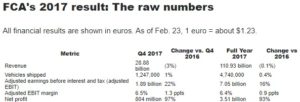
FCA had a good 2017. It said on Jan. 25 that its adjusted pre-tax profit rose 16% in 2017, to 7.05 billion euros ($8.67 billion), on profitability gains related to improvements in product mix. Revenue of 110.93 billion euros ($136.38 billion) was down slightly from its 2016 result.

But as good as 2017 was for FCA, CEO Sergio Marchionne expects a better year in 2018. He even thinks FCA’s operating profit could beat Ford’s this year.

FCA’s 2017 result: The raw numbers
All financial results are shown in euros. As of Feb. 23, 1 euro = about $1.23.


Data source: Fiat Chrysler Automobiles. FCA’s expression of “adjusted EBIT” excludes one-time items from the standard calculations. Vehicles shipped include totals from FCA’s joint ventures with Chinese automakers and are rounded to the nearest thousand. “Ppts” = percentage points.

An all-new and much-improved Jeep Compass helped boost FCA’s margins in 2017. Image source: Fiat Chrysler Automobiles.

FCA’s margin continues to improve

FCA beat Ford on one front in 2017: Its adjusted EBIT margin of 6.4% was significantly improved from a year ago and came in ahead of Ford’s 5.5% pre-tax result for the year.

But FCA still has some way to go to catch the profitability of its largest global competitors. General Motors (NYSE: GM) reported a margin of 8.8% for 2017 on a similar basis; Volkswagen AG reported a margin of 7.4% for 2017, also on a similar basis; and Toyota (NYSE: TM) had an 8.1% operating margin for the three quarters ended Dec. 31, 2017, the first three quarters of its fiscal 2018.

How FCA’s business units fared in 2017

All income numbers for FCA’s individual business units are presented on an “adjusted EBIT” basis.

NAFTA: FCA’s North American business unit earned 5.23 billion euros in 2017, up 1.8% from its year-ago result. Its EBIT-adjusted margin of 7.9% was up 50 basis points (half a percentage point) from 2016. Shipments were down 7%, a drop that FCA attributed to a planned reduction in sales to fleet customers, partially offset by increased sales of Ram pickups and the Jeep Cherokee and Compass SUVs.

LATAM: FCA’s Latin America unit earned 151 million euros in 2017, up from just 5 million euros the year before. Its margin of 1.9% was 1.8 percentage points better than in 2016. Shipments increased 14% year over year, to about 521,000, on improving economic conditions as well as strong sales results for the all-new Fiat Argo and Jeep Compass.

APAC: FCA’s Asia, Pacific, Australia, and China unit earned 172 million euros in 2017, up 64% from 2016. FCA’s consolidated shipments in the region, excluding output from its Chinese joint ventures, fell 7% to about 85,000 — but its total shipments, including the China JVs, rose 24% to about 290,000. The explanation: FCA reduced imports of Jeeps to China after increasing local production. That also explains the region’s 11% decline in revenue, to 3.25 billion euros: Results from FCA’s joint ventures in China aren’t consolidated into its overall results; they’re reported as equity income.

The region’s adjusted EBIT margin increased to 5.3% from 2.9% in 2016.

EMEA: FCA’s Europe, Middle East, and Africa unit earned 735 million euros, up 36% from its year-prior result, on a 5% increase in shipments to about 1.37 million vehicles and improvements in product mix. The key drivers: strong demand for the new Jeep Compass and Alfa Romeo Stelvio SUVs.

The region’s adjusted EBIT margin rose 70 basis points from 2016, to 3.2%.

Maserati: FCA reports results for its luxury Maserati brand on a global basis. Maserati earned 560 million euros in 2017, up 65% from 2016, on a 22% year-over-year increase in shipments to about 51,500 vehicles. Revenue rose 17% to 4.06 billion euros. Maserati’s margin in 2017 was a healthy 13.8%, up from 9.7% in 2016.

Components: FCA’s components subsidiaries — Comau, Teksid, and Magneti Marelli — together earned 536 million euros in 2017, up 20% from the year prior. Revenue rose 5% to 10.12 billion euros, and the unit’s margin was 5.3%. FCA attributed the year-over-year gains to higher sales volumes and manufacturing cost improvements, mainly at Magneti Marelli.

A dark red 2019 Ram 1500, a full-size pickup truck, parked next to a farm field.

FCA expects the all-new 2019 Ram 1500 to help boost its profit and margin again in 2018. The new Ram is expected to begin arriving at U.S. dealers next month. image source: Fiat Chrysler Automobiles.

CEO: We could beat Ford in 2018

Marchionne was upbeat about FCA’s chances of hitting some key milestones in the year ahead.

I think we’re looking forward to finally, hopefully, walking into this meeting in Q2 and telling you that we no longer have [net industrial debt]. That’s something that [CFO Richard Palmer] has taken on as a personal sort of objective to beat everybody into a cash delivery mechanism in the second quarter of this year to make sure that we can shed this debt or history that we’ve had now for quite a while. So I think it’s going to be a big day here when we get there.

I’ve looked at, by the way, the guidance coming from our competitors in Detroit. I think there’s a very strong likelihood that we will outperform Ford in terms of operating earnings in 2018. And that’s something that if I told any of us in the room here that would have been doable five years ago, nobody would have believed us.

Looking ahead: FCA’s guidance for 2018

For the full year, FCA expects:

  • Net revenue of roughly 125 billion euros.
  • Adjusted EBIT of at least 8.7 billion euros.
  • Adjusted net profit around 5.0 billion euros.
  • Net industrial cash (rather than debt) of around 4 billion euros.

Simply put, FCA expects solid year-over-year gains driven by launches of key new products, including all-new versions of the Jeep Wrangler SUV and Ram 1500 pickup, as well as a revamped Jeep Cherokee SUV

Australia Doubles Down on Tesla

Hand holding a lit light bulb whose top has dissolved into interconnected points of light.

Elon Musk shocked the world when he had Tesla (NASDAQ: TSLA) build a 129-megawatt power storage facility for Australia last year — and did it in just 100 days. (Sort of.) But if you thought that was impressive, just wait.

Musk’s latest plan to help solve Australia’s perennial power crisis involves roping 50,000 South Australian homes together to form a 250 MW “virtual power plant” that will both create electricity and store it for when it’s needed. When complete, this latest Tesla initiative will create a power plant that is practically invisible, because it won’t need a large facility to house it.

Here’s how he plans to do it:

Virtual power plants — real power

The state of South Australia describes the plan thusly: In phase 1 of the project, Tesla has already begun installing 5 kilowatt solar panel systems and 13.5 kWh Tesla Powerwall 2 batteries (to store the electricity generated by the solar panels) in 1,100 Housing Trust rental properties across the state. This phase will run through 2019, at which point phase 2 will begin.

In phase 2, which will take a further two and a half years to complete, the project will be rolled out to another 24,000 Housing Trust properties. It will double in size in phase 3, encompassing a total of 50,000 households — Housing Trust and otherwise — across the state. Installations in privately owned homes will begin in 2019.

The idea is for each household to generate and store “a significant proportion” of the power needed to run itself, drawing upon the grid to cover any temporary shortfalls. At the same time, any excess power generated would be “centrally controlled” and available “to meet the needs of the grid” as a whole.

Once complete, the virtual power plant should be capable of meeting “around 20% of South Australia’s average daily energy requirements,” and sufficient to power about 75,000 homes — which you’ll note is 50% more than necessary to cover the homes that will participate, providing a wide margin of safety.

Real power, and real savings

Participants in the program will pay no up-front fees. Rather, the electricity generated by their panels will be sold to generate revenue to pay for the project’s costs. Thus, the business model envisioned resembles the original model of Tesla’s SolarCity subsidiary. South Australia is also putting plans in place to permit homeowners to purchase their solar panels and Powerwall batteries outright.

A study by consulting firm Frontier Economics estimates that Tesla’s new virtual power plant will save South Australian households 30% of their current electricity costs. (That’s measured against an estimated average cost today of AU$0.40 per kilowatt-hour, or $0.31 U.S., with the Australian dollar worth $0.78 U.S.)

To accelerate these savings, the South Australian government is subsidizing the program’s estimated AU$800 million total cost with an AU$2 million grant and an AU$30 million loan, and relying on investors to cover the rest of the cost.

What it means to Tesla — and Tesla investors

South Australia will contract with a third-party retailer to manage the program and to handle billing once the equipment has been installed. Tesla will produce both the panels and the batteries for this project, and will also handle installation. With no need to build a big facility to host its solar panels or batteries, moreover, it appears that the vast majority of the AU$800 million cost of this project will be going to Tesla.

That’s more than half the annual revenue that Tesla’s Energy Generation and Storage division produced last year — all from just one project. It’s more than 5% of all revenue that Tesla generated last year, including from the company’s flagship electric car business — again, all from just one contract.

While it remains to be seen how profitable (if at all) this project will be, the revenue growth potential alone makes Tesla’s latest contract from Australia a big win for the company — and a great way for Tesla to kick off 2018.