
Archives for February 13, 2018

Exclusive: Amazon paid $90 million for camera maker’s chip technology – sources

FILE PHOTO: Amazon boxes are seen stacked for delivery in Manhattan, New York, U.S., January 29, 2016. REUTERS/Mike Segar/File Photo

SAN FRANCISCO (Reuters) – Amazon.com Inc paid about $90 million to acquire the maker of Blink home security cameras late last year, in a secret bet on the startup’s energy-efficient chips, people familiar with the matter told Reuters.

The deal’s rationale and price tag, previously unreported, underscore how Amazon aims to do more than sell another popular camera, as analysts had thought. The online retailer is exploring chips exclusive to Blink that could lower production costs and lengthen the battery life of other gadgets, starting with Amazon’s Cloud Cam and potentially extending to its family of Echo speakers, one of the people said.

Amazon views its in-house devices as key to deepening its relationship with shoppers. The Cloud Cam and Echo currently need a plug-in power source to operate. Blink, which says its cameras can last two years on a single pair of AA lithium batteries, could change that.

Amazon declined to comment on the acquisition’s terms or strategy.

The deal so far has drawn little attention. The camera maker announced its takeover by Amazon with scant details in a Dec. 21 blog post. Analysts have viewed Blink as part of the retailer’s strategy for Amazon Key, a new program where shoppers can set up a smart lock and surveillance camera so delivery personnel can slip packages inside their homes when they are away. Amazon also sees opportunity in the security camera market as smart-home technology expands.

But Blink was not merely a camera business. Its little-known owner, Immedia Semiconductor, was started in Massachusetts by old hands from the chip industry. Chief Executive Peter Besen and two of his co-founders came from Sand Video, which had designed chips in the early 2000s that decoded a new and improved video standard.

In 2004 they sold Sand Video to Broadcom Ltd and remained there as executives, according to an Immedia website. The group left in 2008 to create Immedia, aiming to design chips for video conferencing, and later targeting laptop makers as potential customers.

Dan Grunberg, a co-founder who left Immedia in 2016, said that plan fell through. Laptop makers were unwilling to pay $1 per chip when cheaper options were on the market. So Immedia pivoted.

“If we make our own camera, we don’t have to sell a hundred million” chips, he said. Grunberg declined to discuss Immedia’s sale to Amazon.

The Blink security camera, which hit the market in 2016, did not require a power cable like many rival products, making it easier to place around users’ properties. It was cheaper, too, starting at $99. Amazon’s wired Cloud Cam launched at $119.99, while Netgear Inc’s wire-free Arlo cost more still. Netgear said last week it plans to spin off its Arlo business.

“Battery life is a big issue in connected devices,” said Scott Jacobson, a former Amazon devices manager and now managing director of Madrona Venture Group. “Always-on cameras that last for months and don’t require a wired connection or an electrician to install could be game-changing.”

As Blink’s sales rose on Amazon’s website, the retailer took notice, sources said, leading to talks with the camera maker about a deal.

Flybridge Capital Partners, Comcast Ventures, Baker Capital, Dot Capital and some suppliers were investors in the company.

Amazon’s regulatory filings show it spent $78 million on acquisition activity in the quarter ended Dec. 31. Sources said the bid was competitive, and that compensation and incentives offered by Amazon pushed the deal’s value to about $90 million.

Madrona’s Jacobson, who had no knowledge of the acquisition’s details, speculated that Amazon might apply the Blink team’s expertise to cameras in drones or in its new checkout-free stores.

The chips could give Amazon other advantages, too.

The proprietary chip design will make it harder for rival retailers to copy Amazon’s devices, said Matt Crowley, chief executive of Vesper, a sensor and semiconductor company that makes microphones.

And now that Amazon owns its own chips, it can go straight to the manufacturers, cutting out middlemen chip designers such as Ambarella Inc, which has powered GoPro Inc products. Amazon has a division called Annapurna Labs that makes an unrelated kind of chip, and it was not clear which supplier it uses for chips that primarily process video.

“Vertical integration reduces cost,” Crowley said. Digital video chips “are one of the more expensive components” in a camera.
Teaching robots to understand their world through basic motor skills

Robots are great at doing what they’re told. But sometimes inputting that information into a system is a far more complex process than the task we’re asking them to execute. That’s part of the reason they’re best suited for simple/repetitive jobs.

A team of researchers at Brown University and MIT is working to develop a system in which robots can plan tasks by developing abstract concepts of real-world objects and ideas based on motor skills. With this system, the robots can perform complex tasks without getting bogged down in the minutia required to complete them.

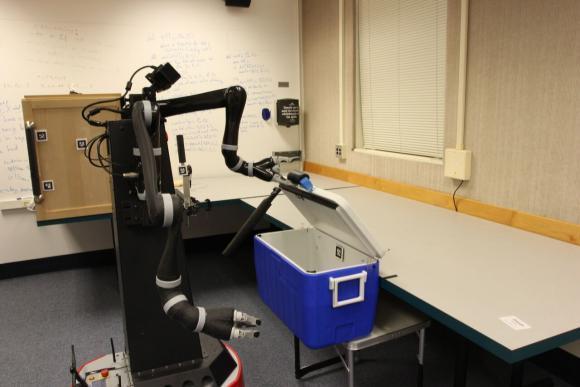
The researchers programmed a two-armed robot (Anathema Device or “Ana”) to manipulate objects in a room — opening and closing a cupboard and a cooler, flipping on a light switch and picking up a bottle. While performing the tasks, the robot was taking in its surroundings and processing information through algorithms developed by the researchers.

According to the team, the robot was able to learn abstract concepts about the object and the environment. Ana was able to determine that doors need to be closed before they can be opened.

“She learned that the light inside the cupboard was so bright that it whited out her sensors,” the researchers wrote in a release announcing their findings. “So in order to manipulate the bottle inside the cupboard, the light had to be off. She also learned that in order to turn the light off, the cupboard door needed to be closed, because the open door blocked her access to the switch.”

Once processed, the robot associates a symbol with one of these abstract concepts. It’s a sort of common language developed between the robot and human that doesn’t require complex coding to execute. This kind of adaptive quality means the robots could become far more capable of performing a greater variety of tasks in more diverse environments by choosing the actions they need to perform in a given scenario.

“If we want intelligent robots, we can’t write a program for everything we might want them to do,” George Konidaris, a Brown University assistant professor who led the study told TechCrunch. “We have to be able to give them goals and have them generate behavior on their own.”

Of course, asking every robot to learn this way is equally inefficient, but the researchers believe they can develop a common language and create skills that could be download to new hardware.

“I think what will happen in the future is there will be skills libraries, and you can download those,” explains Konidaris. “You can say, ‘I want the skill library for working in the kitchen,’ and that will come with the skill library for doing things in the kitchen.”

‘Monsters Inc’ is the next Pixar world coming to ‘Kingdom Hearts 3’

Pixar’s presence in Kingdom Hearts 3 won’t be limited to the Toy Story crew. Square Enix and Disney have revealed that Monsters Inc will play a role, too. You’ll see Boo, Mike and Sully (minus the famous actors, of course) as well as settings from the classic CG movie, such as the door vault. There’s even the chance to wield weapons themed around the movie… including Mike, apparently.

The addition guarantees KH3 will be even more of a Disney lovefest than before, and it’s good news for those who were hoping Square Enix would embrace Disney’s expanding universe. However, there’s still a glaring omission: a release date. The developer has yet to commit to more than “2018,” so it could be a while before the long-in-development title reaches your PS4 or Xbox One.

Experience the 2018 Winter Olympics in virtual reality

Toronto based House of VR is giving sports enthusiasts a new way to experience the Olympics

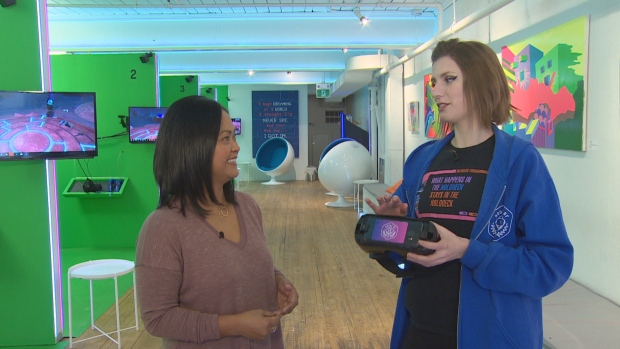
Assistant Manager of House of VR Sappho Hansen-Smythe explains to CBC Toronto’s Marivel Taruc how the app works. (CBC News)

If you are on the list of people who wanted be in PyeongChang, South Korea to see the XXII Olympic Winter Games but could not make it, all hope might not be lost.

Toronto based House of VR is providing live virtual reality coverage via its VR app and Assistant Manager Sappho Hansen-Smythe says it is “unbelievably easy” to use and you don’t need to be a techie to be part of the experience.

“This is one of the easiest VR apps I’ve used in my entire life. You don’t even need to press any buttons,” Hansen-Smythe told CBC Toronto.

“There are lots of experiences where you can see through the athletes’ eyes almost and see what they are going through,” she says, adding that “there are also a few experiences where you can get to know the athletes.”

When users put on the goggles, they can enjoy a fully interactive and immersive experience which Hansen-Smythe describes as intimate and beautiful.

Tessa Virtue and Scott Moir lead Team Canada into the stadium during the Opening Ceremony of the 2018 Winter Olympics in Pyeongchang, South Korea. (Jason Ransom/Canadian Press)

Goggles are available free of cost at House of VR and at the welcome centre of the Canadian Broadcasting Centre on Front Street, which users can collect and enjoy the virtual reality coverage in the comfort of their homes.

“There’s nothing more intimate and beautiful than stepping into a world that someone else created. You can hop from venue to venue to venue and see a bunch of different experiences and it’s also possible to stream live,” Hansen-Smythe said.

“You can get right up close to the mascots in the ceremony. It’s stunning. And seeing it in this new intimate way is really special. The Olympics are all about boundary pushing and innovation so we are bringing that to tech.”

Explaining how the VR app works, Hansen-Smythe said when users put on the goggles they will see a circle with the name of the event that they want to see, stare at it for three seconds and be teleported there instantly.

The 2018 Winter Games started on Thursday, February 8 and run until Sunday, February 25

Canada Steps Up To Host Pride House At 2018 Winter Olympics

Canada is continuing its tradition of creating safe spaces for LGBT Olympians at this month’s Games in South Korea.

Canada House will also serve as Pride House during the PyeongChang Games after South Korean organizers failed to raise enough money to open a standalone LGBT centre in the Olympic village, CBC News reported.

This will be the first Pride House in Asia, according to The Georgia Straight. An opening for fans was held on Saturday.

This is also the first time a Pride House is directly affiliated with a national Olympic committee.

“We recognize that diversity is our greatest strength. Inclusion is the very foundation of what makes the heart of Team Canada. By hosting Pride House in our Canada Olympic House, we are extending our warmest welcome to all from every corner of the world to celebrate ‘Be Olympic’,” Chris Overholt, CEO and Secretary General of the Canadian Olympic Committee (COC) said in a press release.

Why Himax Technologies Looks Strong Going Into Q4 Earnings

A die with buy, hold, and sell written on three faces placed with dollar bills.

Himax Technologies (NASDAQ: HIMX) had a mostly banner year in 2017, delivering delectable gains thanks to two big partnerships. First, Apple (NASDAQ: AAPL) decided to use Himax solutions for enabling Face ID in the iPhone X. Then, Qualcomm chose it as a partner for developing 3D sensing solutions for smartphones and automobiles.

But Himax’s dream run came to a screeching halt in December after short-seller Citron Research accused the company’s management of fraud. The unsubstantiated tweet sparked a sell-off even as the company denied allegations of fraud and said Citron’s accusation had no credibility.

Himax stock hasn’t recovered yet, but the company has an opportunity to boost investor confidence when it releases its fourth-quarter results on Feb. 13. Will it be able to deliver? Let’s see:

The headline numbers

Wall Street analysts on average expect $0.14 per share in earnings from Himax on revenue of $185 million. By comparison, the company reported $0.03 per share in earnings in the year-ago quarter on $203 million in revenue. The consensus estimates are in line with the company’s guidance issued in November, so it shouldn’t have much difficulty meeting them.

Moreover, investors shouldn’t get hung up on the estimated 9% drop in Himax’s revenue. The company is facing a tough year-over-year comparison because of the phaseout of one of its customer programs. And Himax is calling for a sharp rise in earnings thanks to an improving product mix that’s leading to margin expansion.

An increase in sales of touch and display driver-integration products, as well as a bump in shipments of 3D sensing chips manufactured using Himax’s wafer-level optics technology, is positively impacting its gross margin profile. The improvement in the company’s product mix helped it boost its Q3 gross margin by 170 basis points sequentially to 25.6%, 70 basis points above the original guidance.

In Q4, Himax expects its gross margin to witness a sequential drop of 1% because of seasonality. But it will still be way better than the 19.1% gross margin reported by the company in the prior-year period, leading to a massive pop in earnings year over year. More important, the chipmaker’s improved margin profile should give a nice boost to profitability as its top-line growth is expected to start picking up this year.

The outlook should be strong

Himax bears might worry that the company will issue tepid guidance because of Apple’s mediocre outlook for the quarter including March. But one shouldn’t forget that Himax wasn’t an Apple supplier a year ago, so the chipmaker will gain even if Cupertino slashes its production during the current quarter because of seasonal patterns.

There is a lot of speculation around iPhone X production. Certain outlets report that Cupertino could slash production by as much as 50% over the next two quarters because of weak demand, before eventually discontinuing it in the second half of the year. But such a move from Apple seems highly unlikely given the popularity of the iPhone X and its impact on Apple’s sales.

The iPhone X pulled up Apple’s average selling prices during the holiday quarter. This boosted iPhone revenue by 13% year over year in spite of a 1% drop in iPhone shipments during a quarter. What’s more, Apple’s guidance for the quarter including March calls for a 17% year-over-year growth in revenue.

So I’m not putting much weight in the speculation that Apple could stop the production of its best-selling iPhone model. And there are reports that key Apple suppliers expect just a 10% drop in component orders this quarter, similar to what was done last year.

More important, Apple isn’t the only catalyst for Himax. As already mentioned, the chipmaker has a partnership with Qualcomm for making 3D sensing chips for smartphones and automotive applications.

The good news is that their jointly developed 3D sensing solution will start contributing to Himax’s revenue and profit from the first half of 2018. Himax said in the previous conference call that its SLiM 3D sensing solution for Android devices “will be ready for mass production and shipment by the end of the first quarter of 2018, with an initial capacity of 2 million units per month.”

Himax will gradually expand its capacity based on demand, and this should pave the way for long-term growth because use of 3D sensing modules in smartphones is expected to increase at a massive compound annual growth rate of 209% through 2020. Analysts expect Himax’s revenue to grow almost 30% in fiscal 2018 after an estimated 14% decline last year.

All in all, Himax looks ready to kick-start its turnaround with a strong Q4 report and a sunny guidance.