
Archives for February 13, 2018

Canada to launch new border security app that could go global

The federal government is embarking on a new pilot program that will allow people to cross borders faster if they create a digital profile filled with their personal information on their mobile devices.

The Known Traveller Digital Identity is a joint venture between the governments of Canada and the Netherlands, and will be tested first on travellers going between those countries. The plan is to have it ready for a wider global rollout by 2020.

The project announcement was made at the Davos World Economic Forum last month but has mostly flown under the radar.

According to the World Economic Forum document outlining the program, international traveller arrivals are expected to jump from 1.2 billion in 2016 to 1.8 billion by 2030. This will increase risk and security requirements for the aviation and travel and tourism sectors.

Much like other trusted-traveller programs — such as Nexus, which allows people quicker movement between Canada and the U.S. — the Known Traveller Digital Identity program will ask travellers for detailed personal information for pre-screening, including university education, bank statements and vaccination records.

Border expert Bill Anderson said security officials are keen to get people screened well before they pack their bags for a trip.

“The prevailing paradigm in border management is that we need to have risk assessment, and we need to identify those people who are very, very low risk so that you can focus your resources on the ones that you haven’t identified as low risk,” said the head of the Cross-Border Institute at the University of Windsor.

The pilot program will also make use of biometrics like retina and facial recognition for quicker traveller identification.

Technology company Accenture is helping develop the program. It said user information will be safeguarded and users will be able to decide whom they want to share their information with, and when, on a case-by-case basis.

Data would be protected, says Accenture

Accenture said keeping users in control of their data will be critical.

“No personal information is stored on the ledger itself, ensuring that personal information is not consolidated in one system, which would make it a high value target for subversion,” the company said in a statement to CBC News.

In addition to providing personal information before travelling, user profiles would be automatically updated as they move around the world. The more borders they cross, the more trusted they will become, said Anderson.

In some ways, the program takes a page from private tech companies such as Google and Facebook that have become experts in creating profiles about their users.

“It’s a crazy world where, you know, Google is able to provide information to people in e-commerce that’s more detailed about you than what these security agencies have,” said Anderson.

Two-tiered travel?

Anderson says critics argue the advanced screening programs create a two-tiered travel system, with those not signed up ending up in longer lines and getting poorer service.

Nina Brooks is the director of security for Airports Council International, which represents nearly 2,000 airports.

Her organization supports the development of these new technologies, but also wants a system that creates a similar experience for all travellers.

“In the long term, I think we’re looking for the use of some of those concepts for the broader audience, for all travellers, and actually expediting travel for everybody, rather than a specific group of trusted travellers,” she said.


Canada wins figure skating team event gold at Pyeongchang Olympics

GANGNEUNG, Korea, Republic Of — It was a golden idea that sprouted on their flight home from the Sochi Olympics.

Canada had just settled for silver in the inaugural team event at those 2014 Games, and it didn’t sit well with a team that boasts some of the world’s greatest skaters.

So Patrick Chan, Tessa Virtue and Scott Moir, and Meagan Duhamel and Eric Radford vowed to do one better. Gold in the team event in Pyeongchang would be theirs. And what better way to close their illustrious careers than standing on the podium as one?

Four years later, they did exactly that.

The mighty figure skating team captured Canada’s first gold medal at the Pyeongchang Olympics with a performance that was so utterly dominant, victory was already in their grasp before Virtue and Moir even took the ice in the final event.

“What a thrill to share this with the rest of our Canadians,” Virtue said. “We’re such a skating country, how great is it that we get to bring home the gold medal for everyone.”

Canada won gold with 73 points, well ahead of Olympic Athletes from Russia (66), and the Americans (62).

Monday morning at Gangneung Ice Arena unfolded in dramatic fashion. A first place in the pairs free skate Sunday by Duhamel and Radford had sent Canada into Day 3 with a huge six-point lead.

Chan, who’s struggled all season, took the ice first for Canada and could have crumpled under the pressure. Instead, skating to Jeff Buckley’s haunting “Hallelujah” the 27-year-old from Toronto laid down a performance that all but clinched gold for the Canadians, landing two huge quadruple jumps en route to earning a first-place score of 179.75 points.

“Incredible,” Radford said. “I was so proud of him. Those first two quads were amazing. When I watched him I didn’t move. I just sat there like a statue. I didn’t even know what to think. His skate was one of the most important for the competition.”

Chan spoke with gratitude about a quiet talk with Radford in the dining hall the day before. The 33-year-old Radford told Chan: You owe us nothing. Whatever you do, we’ll still love you. We’ll always be there for you.

“That’s the best thing a teammate can say,” Chan said through a wide grin. “Because it’s my moment as much as it is the team. When we step on the ice it’s our moment, and we need to enjoy it, and then we get off and enjoy it as a team.”

Chan became Canada’s first male singles skater to win an Olympic gold. It was also a long time coming for the man who’s been the face of Canadian skating for a decade, but suffered Olympic heartbreak in Sochi when he finished second.

An American reporter asked: can a team medal make up for missing individual gold?

“At the end of the day, a medal’s a medal and I’m going to hold this medal tight to me and it’s going to be as good as the individual event,” Chan told him. “I’m sorry, that’s how I’m going to see it, that’s how I’m going to enjoy it, and that’s for me to decide.”

Gabrielle Daleman of Newmarket, Ont., who Canada subbed in for the long program after Kaetlyn Osmond of Marystown, N.L., handled the short, skated to Gershwin’s “Rhapsody in Blue,” and her third-place performance mathematically guaranteed Canada gold.

“Of course I was nervous, I didn’t want to let my team down. I just skated with all my heart and just was in the moment completely,” said Daleman.

Then Virtue and Moir anchored Canada home. Already decided, it was like star sprinter Usain Bolt taking the baton with no other teams in the race.

Virtue said they learned before arriving at Gangneung Ice Arena that Chan had “nailed it,” and strategized on the bus ride over about how to skate when there was nothing left on the line.

“We also needed to deliver a message and prove that we’re ready and trained,” Virtue said. “We were committed to this, we wanted to be an integral part of the team, we wanted to contribute as best we could. We approached it as if it all came down to us.”

Message delivered. Their passionate performance to music from “Moulin Rouge” earned them 118.10 points — and countless goosebumps in the crowd.

“We weren’t very happy with our approach in Sochi and we wanted to change that,” Moir said. “We thought that this was a serious event that we needed to take just as seriously. We’re proud of ourselves that we set our goals and committed to that.

“And I guess this is where it gets you.”

Even Hollywood producer and director Baz Luhrmann, who won a Golden Globe for Moulin Rouge tweeted: “Moulin Rouge on ice! It’s moving to see so many champions skating their way to @pyeongchang2018 to the music from #MoulinRouge, including @TeamCanada’s @tessavirtue & @ScottMoir.”

Canada arrived in South Korea as the world’s No. 1-ranked team, and is the only country balanced across all four disciplines.

Chan, Virtue and Moir, and Duhamel and Radford are all competing in their final Olympics and were determined to go out on a golden high. Chan took a year off after Sochi, while Virtue and Moir took a two-year hiatus.

The gold was Canada’s first in Olympic figure skating since Virtue and Moir won in 2010 in Vancouver.

CP NewsAlert: Snowboarder Blouin comes back from injury to win Olympic silver

CP NewsAlert: Snowboarder Blouin comes back from injury to win Olympic silver

PYEONGCHANG, Korea, Republic Of — Canadian snowboarder Laurie Blouin has won a silver medal in the women’s slopestyle at the Pyeongchang Olympics.

Sporting a black eye after a nasty crash in training a few days ago, Blouin overcame high winds to nail a clean second run for 76.33 points.

The reigning world champion from Stoneham, Que., Blouin was second behind American Jamie Anderson, who scored 83.00 on her first run.

Enni Rukajarvi of Finland took bronze with a score of 73.91.

Brooke Voigt of Fort McMurray, Alta., finished 21st and Spencer O’Brien of Courtenay, B.C., was 22nd.

The start of the competition was delayed for about 75 minutes due to the conditions at windswept Phoenix Park.

High winds forced the cancellation of the qualification on Sunday. Organizers decided to instead allow all competitors direct entry into the final.

Blouin took a hard fall Friday when her board got stuck in a crack after she landed a double jump. She resumed full training Sunday.

Canada won two medals in the men’s slopestyle competition on Sunday. Max Parrot of Bromont, Que., won silver and Regina’s Mark McMorris took the bronze.

Alphabet Makes Another Stab at China With Tencent’s Help

An artist’s rendition of data on the internet, being accessed all over the globe.

Alphabet Inc. (NASDAQ: GOOG)(NASDAQ: GOOGL), parent of Google and YouTube, recently announced a patent licensing deal with China’s tech giant Tencent Holdings (NASDAQOTH: TCEHY). The goal is another attempt at entering the most populous nation, where Google is all but irrelevant due to regulatory restrictions on the company’s search engine and other services. Google has made similar agreements with companies in the past, but this is its first with a major Chinese business.

The problem with not being Chinese

The list of U.S. corporations that have failed in China is lengthy. Since the country opened up to foreign investment in the 1970s, the pull to set up shop there has been strong. China has nearly 1.4 billion people — four times the U.S. — and has a fast-growing middle class. That’s a powerful combination businesses can’t ignore, but a failure to understand the diversity of China’s population, culture, and consumer preferences is a leading cause of failure.

And then there’s the political and regulatory environment, a trait of the country that has been Google’s thorn since its first venture in the early 2000s. The problem is the government’s censorship requirements, which Google will not allow on its sites. That effectively amounts to a self-imposed exile from the country, and as a result, services like Google search, the app store, and Gmail are banned. So Chinese search engine Baidu (NASDAQ: BIDU) holds sway over the country.

A new strategy

Google still wants a slice of the pie, but this time a local ally is being enlisted. Thus the deal with Tencent, which is an agreement to share patents and intellectual property across a wide range of technologies. Details were sparse, but it’s an initial step toward building new services and deeper collaboration between the two.

Though the agreement is an obscure one to decipher, what Tencent is (and what Google’s owner Alphabet is) provide some hints about the objective. Tencent is the holding company for China’s largest social media and mobile payment platform, WeChat. Other market-leading subsidiaries develop mobile games, video and entertainment, and cloud computing services. The company recently crossed the $500 billion valuation mark, putting it in a class with American tech giants like Alphabet.

Thus Tencent and Alphabet have a little, but not too much, overlap in what they do. Both companies are also growing but have mounting competition in the world of high tech. For Tencent, its Chinese rivals like Baidu, Alibaba, and NetEase.com. For Alphabet, the list includes Facebook, Amazon, and Apple. That competitive landscape was especially evident in Alphabet’s latest earnings report, which showed the company still growing, but with growing headwinds.

The angle on this deal, then, looks like a way for Google to finally make some inroads in China. It’s also a way for both businesses to bolster their defenses against their other technology platform competition. In the end, the new relationship between Google and Tencent sounds like a good one for investors.

Intel Corp. Reportedly Wins Entirety of 2018 Apple Inc. iPhone Modem Orders

According to a new report from KGI Securities analyst Ming-Chi Kuo (via MacRumors), Apple (NASDAQ: AAPL) plans to source the cellular modem chips that will power its upcoming iPhone models exclusively from chip giant Intel (NASDAQ: INTC).

Apple had sourced cellular modems from Qualcomm (NASDAQ: QCOM) for the iPhones that launched between 2011 and 2015, but added Intel as a second source with the release of the iPhone 7 series in 2016. Apple continued its practice of dual-sourcing cellular modems with the 2017 iPhone models.

The modem that will reportedly power Apple’s upcoming iPhones is Intel’s XMM 7560. The XMM 7560 includes support for cellular networks that support the CDMA wireless standard. CDMA support is a critical addition that makes it possible for Apple to even consider using Intel as a sole source for cellular modems.

Let’s go over the implications for both Intel and Qualcomm if this report is true.

Another surge in Intel’s cellular modem business

Today, Intel is believed to have minority modem share in Apple’s iPhone 7 series, iPhone 8 series, and iPhone X smartphones. It currently has no share in Apple’s iPhone 6s series smartphones, nor in Apple’s lowest-cost iPhone SE model.

If it’s true that Apple will use Intel’s XMM 7560 exclusively in all of the new iPhones that it introduces later this year, then this should mean significant cellular modem revenue growth for Intel by virtue of share gains in the latest iPhone models. That revenue growth should kick in during the second half of 2018 and persist through the current iPhone product cycle.

Additionally, since Apple’s iPhone 6s models are likely to be discontinued in the coming product cycle while the iPhone 7 series and iPhone 8 series seem likely to remain as the lower-cost options in Apple’s lineup, Intel should gain some share at the lower end of Apple’s lineup.

Finally, while Kuo cites Intel’s competitive pricing as a reason that it was able to sweep the 2018 iPhone modem orders, I think that Intel’s XMM 7560 — by virtue of its improved competitiveness compared to Intel’s prior modems — will sell for more than what the company’s previous modems did. A potential increase in average selling prices could help not just Intel’s revenue but profitability as well.

Uncertainty around Qualcomm’s stand-alone modem business

In the near term, Qualcomm should still sell cellular modems to Apple for the older, discounted models. Qualcomm is certain to suffer a large drop in its stand-alone cellular modem sales, but sales won’t go to near-zero — yet.

Stand-alone modem sales to Apple don’t make up the bulk of Qualcomm’s chip revenue, but I’d imagine that the annual revenue from such chip sales to Apple is still solidly north of $1 billion (assuming 130 million chip shipments per year at an average price of $15). Losing this revenue won’t cripple Qualcomm, but it’ll definitely sting.

A rendering of a Qualcomm Snapdragon processor.

Longer term, the viability of Qualcomm’s stand-alone modem business will depend on its ability to win back share at Apple, since Apple is the only major smartphone vendor left that still uses stand-alone modems.

MacRumors’ dissemination of Kuo’s note did contain the following tidbit: “Kuo added that it’s too early to tell if Intel will be able to maintain its position of exclusivity in the future, as Apple typically prefers to diversify its supply chain. He adds that Apple may give orders to Qualcomm again in exchange for concessions in the ongoing lawsuit between the two companies.”

If Qualcomm can win back orders in future iPhone models, then that’d probably be enough to keep Qualcomm’s stand-alone LTE modem business going. If it can’t, then I’d expect Qualcomm to reduce its investments in such chips and focus even more on building integrated cellular modem and applications processor parts.

Ford revs up large SUV production to boost margins, challenge GM

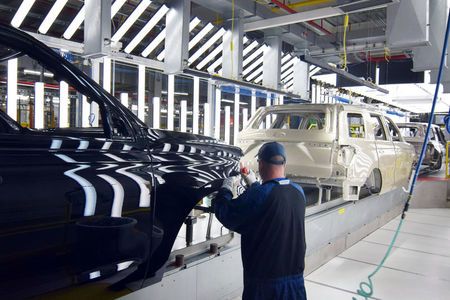
A Ford worker inspects paint work on the body of a Ford Expedition SUV at FordÕs Kentucky Truck Plant as the No. 2 U.S. automaker ramps up production of two large SUV models in Louisville, Kentucky, U.S., February 9, 2018.

LOUISVILLE (Reuters) – Ford Motor Co said on Monday it will boost production targets for two large sport utility vehicles by 25 percent this year to challenge rival General Motors Co’s hegemony in a highly profitable U.S. market segment and boost its own anemic profit margins.

“We can sell every single vehicle we can produce here,” Ford global operations president Joe Hinrichs said ahead of the announcement during a tour of the company’s Kentucky Truck Plant in Louisville, Kentucky where the new generation of Ford Expedition and Lincoln Navigator SUVs went into production last fall. “These are high-margin vehicles, so that is very meaningful.”

The Expedition and Navigator are two of the highest-priced vehicles Ford sells, and the production increase at the Kentucky Truck factory comes as investors are growing restless as Ford’s automotive profit margins have shrunk to 3.7 percent in the fourth quarter of 2017 from 5.7 percent a year earlier. The company’s margins have fallen behind rivals General Motors Co and Fiat Chrysler Automobiles NV.

Even before recent market volatility, Ford’s shares were slumping. Year to date they are down 14.7 percent while shares in No. 1 U.S. automaker GM, which is seen by analysts as having a clearer vision and better operational focus, are up 1.2 percent.

The average price for a Navigator in January 2018 versus January 2017 jumped 38 percent, or $21,300, to $77,400 while the price for an Expedition rose nearly $8,000 to $57,700. Both are well higher than the industry average vehicle selling price of $33,100, according to data cited by Ford.

GM is outperforming Ford financially in part because it dominates the U.S. large SUV segment with models such as the GMC Yukon and Chevrolet Suburban. Ford sold a little shy of 3,500 Expeditions and 1,300 Navigators in January. GM sold more than 19,000 of its large SUVs during the month.

“There is a big dog in the segment,” Hinrichs said. “We aim to get out there and challenge them with vehicles with better fuel efficiency and driving dynamics.”

Ford said it will add $25 million in investments at the plant to support the production target hike, bringing its total investment there to $925 million. Upgrades at the plant, which also produces the company’s popular Super Duty pickup truck, have included 400 robots, a centralized data analytics center and a 3D printer to save time and a lot of money on parts and tools.

Ford is playing catchup to GM in the large SUV market in part because of past decisions to focus investment on smaller vehicles at a time when high oil prices and stiffening federal fuel economy rules threatened big trucks like the Navigator. This is the first complete makeover for the Expedition and Navigator since the late 1990s.

Stable, relatively low oil prices have since encouraged Americans to shun passenger cars in favor of higher-margin SUVs and pickup trucks. In 2017, passenger car sales in the United States fell to 36.8 percent of total light vehicle sales.

To improve mileage, the new Expedition and Navigator models have aluminum bodies, as do the Ford F-series pickup models with which they share many components.

That change required “the greatest technological transformation” at the Louisville plant – one of two Ford has in the city – since the 1980s, said electrician Chuck Billingsley, a 33-year veteran worker at the automaker.

However, Ford has warned investors that its overall vehicle profit margins are threatened this year by rising prices for commodities such as steel and aluminum prices, even as most other automakers say those increases are manageable.

Ford says steel is its biggest problem, but analysts say its decision to switch to aluminum bodies for pickup trucks to reduce weight and boost fuel economy has cost it as aluminum prices spiked.