
Archives for January 22, 2018

A blind Facebook engineer is helping to solve one of the biggest problems on the internet

Facebook’s engineers are using artificial intelligence to see images, which may be able to give computer insight into context of pictures and video.

A Facebook team led by a blind engineer may hold the key to one of the most pressing problems on the internet: Screening images and videos for inappropriate content.

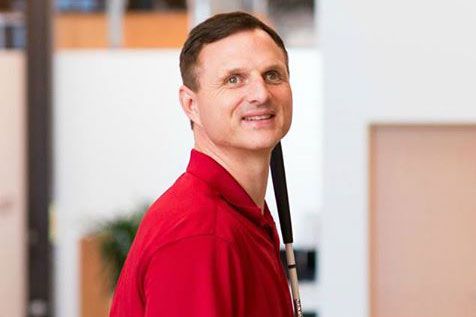
“More than 2 billion photos are shared across Facebook every single day,” Facebook engineer Matt King said. “That’s a situation where a machine-based solution adds a lot more value than a human-based solution ever could.”

King’s team is building solutions for visually impaired people on the platform, but the technology could eventually be used to identify images and videos that violate Facebook’s terms of use, or that advertisers want to avoid.

King’s passion stems in part from his own challenges of being a blind engineer.

He was born with a degenerative eye disease called retinitis pigmentosa. As a child King could see fine during the day, but could not see anything at night. Soon that progressed to only being able to read with a bright light, then with a magnification system. He used a closed circuit TV magnification system to finish his degree.

By the time he went to work at IBM as an electrical engineer in 1989, he had lost all his vision. King started volunteering with IBM’s accessibility projects, working on a screen reader to help visually impaired people “see” what is on their screens either through audio cues or a braille device. IBM eventually developed the first screen reader for a graphical interface which worked with its operating system OS/2.

One of the lead researchers noticed King was passionate about the project, so he asked him to switch to the accessibility team full time in 1998. He eventually caught the eye of Facebook, who hired him from IBM in 2015.

“What I was doing was complaining too much,” King said. “I just wanted things to be better.”

King is used to making the world adapt to him. The avid cyclist competed in the Atlanta, Sydney, and Athens Paralympic games, and plays the piano. On the request of his wife and two children, his family remained in Bend, Oregon after Facebook hired him. To get to Facebook’s Menlo Park office, King hitches a ride with friend with a pilot’s license who works at Google.

Automated alt-text

King’s IBM work revolved around creating the Accessible Rich Internet Applications standards, what he called “the plumbing for accessibility on the Web.”

Now he works on features to help people with disabilities use Facebook, like adding captions on videos or coming up with ways to navigate the site using only audio cues.

“Anybody who has any kind of disability can benefit from Facebook,” King said. “They can develop beneficial connections and understand their disability doesn’t have to define them, to limit them.”

One of his main projects is “automated alt-text,” which describes audibly what is in Facebook images.

When automated alt-text was launched in April 2016, it only available for five languages on the iOS app, and was only able to describe 100 basic concepts like whether something was indoors or outdoors, what nouns were in the picture, and some basic adjectives like smiling.

Today it is available in over 29 languages on Facebook on the web, iOS and Android. It also has a couple hundred concepts in its repertoire, including over a dozen more complex activities like sitting, standing, walking, playing a musical instrument or dancing.

“The things people post most frequently kind of has a limited vocabulary associated with it,” King said. “It makes it possible for us to have one of those situations where if you can tackle 20 percent of the solution, it tackles 80 percent of the problem. It’s getting that last 20 percent which is a lot of work, but we’re getting there.”

Using artificial intelligence to see

Though automatic alt-text is configured for blind and low vision users, solving for image recognition issues with artificial intelligence can benefit everyone.

In December 2017, Facebook pushed an automatic alt-text update that used facial recognition to help visually impaired people find out who is in photos. That technology can also help all users find photos of themselves they were not tagged in, and identify fraudsters who use a person’s photo as their profile picture without permission.

Allowing technology to “see” images may also help identify if content is safe for all users or if it’s okay to advertise on. Content adjacency — or the images and videos that ads appear next to — has become a big issue for advertisers after reports showed ads running next to inappropriate content on YouTube .

The issue arises because it’s not easy for computer programs to understand context, said Integral Ad Science (IAS) chief product officer David Hahn. Software has a hard time telling if an image of a swastika is on a Wikipedia page about the topic, part of a story on Nazism or on a flag being marched around in a protest, he said. It gets even more complicated when advertisers and their needs are involved: they amy want to advertise against a movie trailer that contains violence but not next to real-world violence from a protest.

Most image recognition tech relies on terms called metadata, which are tagged to the image called, metadata and other clues like text or audio on the page, Hahn said. Video is typically analyzed by taking a random sample of still images from the clip and examining them to determine if it’s the video is okay overall.

“There are varying degrees of accuracy and sophistication,” Hahn said. It takes a lot of different treatments on images or text. There’s not one source or one perspective that should be taken as gospel.”

Facebook’s automated alt-text still relies on a staff of people telling the technology what certain images are, Facebook’s King explained. But the machine’s algorithms and recall rate — the frequency with which images are positively identified — is improving. And as it begins to understand more about context, it’s getting closer to a day where it will need little to no human help.


Disney Parks’ Most Coveted Jobs, According to Cast Members

According to cast members, these are the best jobs you can have at Disney Parks. (Disney)

There’s so much you can learn from an Ask Reddit thread, especially if you’re a Disney fan. Users on a subreddit were asked what the best job at a Disney park is, and many park insiders had some advice for prospective applicants.

It may come as a surprise, but the top comment on the thread, provided by user Susurrations, answered that the best job in the park isn’t as a character or ride operator — it’s as the park’s electrician.

The Reddit user wrote that their brother works this job at a Disney park: “Most of the year he drives around in a little golf cart all day and fixes stupid simple quick-fix type stuff… Part of the year he helps with attraction renovation which is harder work but he loves getting to see behind the scenes of big rides and such.”

The user added: “Also, apparently his golf cart goes the perfect speed for hatching eggs in Pokemon Go.”

Not a bad gig.

Some other intriguing career paths mentioned in the thread included working in Animal Kingdom (because it closes the earliest), being a “face” character, like a Disney Princess, and working as a server at VIP Club 33 (because of the tips).

According to one user, who said they worked at Disney’s California Adventure for four years, everyone wants to work on the “red triangle rides,” which results in slightly higher pay. “The ride people wanted in my area was screamin or grizzly,” they said.

Get your pens ready and fill out those applications. Summer is just around the corner.

This Beaten-Down Oil Stock Got Even Cheaper This Week — Is It a Buy or a Value Trap?

Shares of Canadian oil producer Pengrowth Energy (NYSE: PGH) fell about 14% this week, more than erasing its gains for the year. The stock is still down more than 40% over the past year, even though oil is up nearly 25%. That underperformance makes it seem like this beaten-down oil stock might be a good value.

However, there’s a reason the stock has sold off, with the announcement of its 2018 plan driving its latest downdraft. While the forecast shows that the company is slowly getting back up on its feet, it still has a long way to go before it’s on solid ground. That puts it well behind rivals that are already firing on all cylinders.

Drilling down into the plan

Pengrowth Energy announced that it plans to spend 65 million Canadian dollars ($52 million) on capital projects this year. That gives the company enough money to complete projects that will increase production 25% by the end of the year compared to where it was at the end of 2017. While that sounds excellent, it’s a bit deceiving.

That’s because Pengrowth was only producing about 19,000 barrels of oil equivalent per day (BOE/D) at the end of last year, which was a fraction of the 53,000 BOE/D it produced during the first quarter of 2017. Fueling the plunge was the sale of nearly CA$1 billion ($800 million) of assets last year to shore up its balance sheet. As a result, it has slimmed down to just two core assets that it hopes to grow in the coming years.

The biggest growth driver will be the company’s Lindbergh heavy oil assets in Canada. Pengrowth expects to boost oil production from that facility up to 18,000 barrels per day (BPD) by the end of this year, an increase from 14,500 BPD during the third quarter. The company hopes to further boost output up to 40,000-50,000 BPD in the future, as it continues expanding that facility. That said, it’s still working on a comprehensive strategy for the next phase of development. The company would also like to split future expansions into smaller, more manageable stages. However, it needs to do that without impacting returns, which at an estimated 20% at $55 oil are less lucrative than what other oil companies can earn on their growth projects.

“Price is what you pay; value is what you get”

While Pengrowth’s stock price has gotten cheaper, its value proposition hasn’t improved. That’s because the company still can’t match the value-creating ability of rivals. For example, Encana (NYSE: ECA) has a five-year plan to grow its cash flow at a 25% compound annual growth rate. Furthermore, Encana’s strategy would produce a cumulative $1.5 billion of excess cash flow over that time frame at $50 oil, which is money it could return to investors via dividends or share repurchases. The reason Encana can grow shareholder value at such a rapid pace is that its investments earn a minimum 35% return at $50 oil, thanks to its top-tier positions in some of North America’s top shale plays. Those higher returns at a lower oil price give Encana the fuel to grow shareholder value much more quickly than Pengrowth can achieve by investing in its project.

ConocoPhillips (NYSE: COP), likewise, can deliver value-creating growth for investors. The company’s three-year plan would see it grow cash flow at a 10% compound annual growth rate, increase its 1.8%-yielding dividend each year, and buy back billions of dollars in stock. ConocoPhillips only needs oil at $50 to achieve that plan, largely because it has pushed production costs down while increasing investment returns. Meanwhile, as oil prices rise above that level, ConocoPhillips can return more cash to investors, which is something Pengrowth won’t be able to do for quite some time.

Don’t fall into this trap

While Pengrowth’s stock price is down, it’s still not worth buying. That’s because it doesn’t have the resource base of rivals like Encana and ConocoPhillips, which can earn higher investment returns and generate more cash flow, enabling them to grow investor value faster. That’s why they are among the top oil stocks to buy.

Edmonton’s Ice District skates towards construction milestone

Edmonton’s Ice District skates towards construction milestone

From Glen Scott’s corner office on the 22nd floor of the Bell Tower, he has a front row seat to the progress in Edmonton’s Ice District.

“As you can see we’re inching along out there,” said the president of Katz Group Real Estate.

Outside his window construction continues on a mixed-use skyscraper, which includes the new JW Marriott hotel and the residential condo part of the development above called Legends Residences, which is still being completed.

Scott says by the end of January or first week of February they hope to have a topping off ceremony for the skyscraper.

Next door, at what will be the tallest building in Western Canada, Scott is ready to mark another construction milestone.

Work on the Stantec Tower is moving to the residential portion of what will be a 66-floor building, which will now be growing by about a floor per week.

“It’s pretty exciting, we’re making some pretty good progress,” Scott said.

When Kathleen McCabe, vice president of global real estate for Stantec, tours what will be the building’s daycare, main lobby and massive food hall, she can see that progress. The company will be able to consolidate the design firm’s 1,500 local employees from three locations into one.

“There are all kinds of amenities for food options and groceries and theatre, and housing options and hotel. There’s just no other location like it in Edmonton,” said McCabe.

McCabe is eyeing October of this year to start moving in.

Sporting a hard hat, Steven Walton is already touring potential clients through his space over at the JW Marriott. The director of sales and marketing expects the hotel will open in January of 2019.

Walton says he has already inked deals for the first conferences at the site for next April and is booking summer weddings into their grand ballroom.

“Eleven thousand square feet, 21-foot ceilings, wrapped in windows, no pillars, pretty exciting, it will be by far the most beautiful space in Edmonton,” Walton said with a smile.

For more from Ice District you can tune into Our Edmonton on Saturday at 10 a.m. Sunday at noon and 11 a.m. on Monday on CBC TV.

Eight Retro Gadgets That Got Modern Updates

Kodak’s Super 8 reboot is just one example of tech’s love affair with nostalgia.

Even as we flirt with Jetsons-style bathrooms hooked up to digital assistants and breakneck races of flying “cars,” one thing remains clear: Despite ever-improving technology, our nostalgia-tuned minds remain glued to the rear-view mirror. Last week at CES, Kodak made that abundantly clear when it revealed footage from its hotly-anticipated reboot of the Super 8 camera, which revolutionized amateur filmmaking when originally released in 1965.

It’s part of a movement that Kodak describes on its website as an “analog renaissance.” The film-format camera—Kodak’s first since 1982—will cost from $2,500 to $3,000, have a 3.5-inch LCD screen, variable speed control, and C-mount lens support. If you’re wondering where the heck you’re going to get the film developed, Kodak has you covered: An online platform will let you purchase film, processing, and shipping. You’ll mail the goods to Kodak, which will process the film and scan it digitally before sending the files to your Darkroom account.

“Just as vinyl is making a comeback in music, film is being embraced by more and more amateur and professional filmmakers,” Brian Cruz, Eastman Kodak Co.’s vice president and general manager of consumer products, told Bloomberg. “There are many digital solutions out there. We aspire to balance the best of both worlds: the ease of capture and editing afforded by digital, with the luxurious color and texture offered by real film.”

Kodak isn’t alone in its throwback pursuit. Maybe it’s all the Stranger Things-inspired ’80s nostalgia floating around, but now more than ever, consumers seem to be looking toward retro tech. One national movie theater chain is even renting VHS videos. Who knows, maybe smartphone-assisted 18th century chandeliers are just around the corner.

Here are seven additional retro gadgets that are coming back, stronger than ever.

Ultra Game Boy

We hope you saved all your old Game Boy cartridges. Gaming outfit Hyperkin.com plans to unveil its revamped version of the classic hand-held system late this summer with a price point under $100. Housed in aluminum, the scratch-resistant Ultra Game Boy will have a backlit LCD display with full RGB spectrum capability, a pair of stereo speakers, left and right audio-out connections, and a USB-C charging port. No need to bother with AA batteries that always seem to die when you’re finally about to crush a crucial game level: This baby has a built-in six-hour battery.

Polaroid OneStep 2

On the occasion of its 80th birthday in September, Polaroid Corp. unveiled the OneStep 2, a new, $99 “instant analog camera” that shoots re-engineered classic Type-600 and i-Type film. It’s part of a rolling effort started by the Impossible Project—now called Polaroid Originals—to bring back instant photos in all their offline glory. Just don’t “shake it like a Polaroid picture,” because that won’t help at all.



Nokia 3310

Nokia 3310

Last year, Finnish company HMD Global Oy brought us back to the early days of the new millennium with the re-release of the Nokia 3310, a lower-cost phone that first hit shelves back in September of 2000. The 49 euro ($60) throwback comes in four colors—and yes, you can play the Snake.

BlackBerry KeyOne


Not to be left behind (again), BlackBerry Ltd. finally decided to grant Kim Kardashian her dream of the phone’s comeback with the launch of its KeyOne phone in April 2017. BlackBerry has since been tinkering with the wrapping: In August, the company announced a “Black Edition” and last month unveiled a bronze colored model to be made available in overseas markets. The phones, which cost more than $550, all have 4 gigabytes of memory and 64GB of internal storage, plus that signature keyboard Kardashian is so fond of.

NES and SNES Classic Editions


First there was the NES Classic Console, a re-imagining of the hit gaming platform, which launched in 2016 to great fanfare. Loaded with 30 classic games (among them Super Mario Bros., The Legend of Zelda, and Donkey Kong Jr.), the console has the look and feel as the original with one key difference: It’s been shrunk to miniature size for your gaming convenience. Then, in September of last year, another hit—a mini, revamped version of the SNES preloaded with 21 games. The $80 consoles are so popular, they sell out everywhere almost immediately, so keep your eyes peeled.

Luciano Speaker

Luciano SpeakerSource: Newblack

There may be few living people nostalgic for the phonograph, but that didn’t stop the innovators at New Black from inventing a ceramic bluetooth speaker inspired by one. Constructed in the Italian town of Nove, famous for a ceramic industry dating to the 1700s, the Luciano speaker includes components normally found in hi-fi stereo systems. They’re not cheap, with most models going for 590 euros. And if money is no object, you can always splurge on the 24 carat, gold-plated version for 1,390 euro.

Lofree Four Seasons Retro Mechanical Keyboard

Lofree Four Seasons Retro Mechanical KeyboardSource: Lofree

Love the clack-clack-clack of a classic typewriter? Keyboard maker Lofree wants you to enjoy that sound with its Four Seasons Retro Mechanical Keyboard without sacrificing Mac compatibility. At $74, these are cheaper (and more reality-based) than a time machine. Still in the final stage of development, the product is estimated to commence shipping in April.

How Dubai is Rebranding Itself Into a Family Friendly Property Paradise

Lindsay Lohan revealed last week that she is in talks to design one of the isles in The World Islands, the much-delayed man-made archipelago off the coast of Dubai, designed to look like a flattened globe. The American actress has said that she moved to the Middle Eastern city for its “silence and focus”, but it’s not just wayward celebrities who are making the Emirates their home.

“Dubai has become a destination,” says Jason Hayes, managing director of Luxury Property, an estate agency that specialises in the area. “Most buyers are looking to stay long-term and the flippers have gone.”

Hayes is talking in particular about Volante Tower, a residential project that has just been finished by the boutique developer Xtreme Vision. In 2007, Xtreme built Le Reve, a development that overlooks Dubai Marina and the Palm Jumeirah; it was designed by Atkins, the consultancy behind the sail-shaped Burj Al Arab, the most-photographed hotel in the world, and its owners are reported to include Roger Federer, the tennis star, and Fernando Alonso, the Formula One champion.

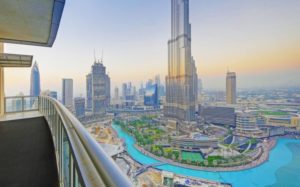
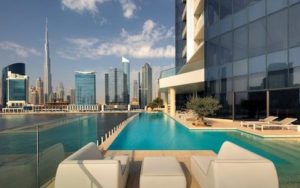
A decade on and Xtreme’s latest project is in the centre of a newly fashionable area known as Business Bay. Volante Tower has sold well, mostly to owner-occupiers. Only seven apartments and a penthouse remain in the 35-storey tower, which has fabulous views across the new Dubai Water Canal towards the Opera House and the Burj Khalifa, the world’s tallest tower.

Royal Atlantis Residences has 231 apartments from $1.9million with Knight Frank

Despite its name, Business Bay is becoming a thriving residential area thanks to the growing popularity of downtown living. Miles of paths and cycleways have been created in the area, which allow residents to ditch the car and stroll or cycle through the shops, bars and restaurants during the cooler months from November to April. “At Volante you have waterfront living without having to drive for ages,” says Andrew Lemon, development director of Xtreme Vision. “Moreover we have purchased two adjacent sites, which will ensure that the waterside views are not obscured.”

Volante also has something that the Damac and Emaar-branded towers that surround it don’t offer: Dubai’s first (and so far only) private members’ club in a residential tower. It has all that you might expect – a business area for work, and a pool, gym, spa and 25-seat cinema for play. The penthouse suite, which measures 10,785 sq ft and has five bedrooms, reception areas and terracing, is priced at £6.5 million – but it represents good value in comparison with many cities. According to a 2016 report by Knight Frank, that sort of space in prime central London would cost on average £35 million, and nearly double that amount in Monaco.

New legal frameworks to protect buyers are another step in the right direction. Freehold titles for foreign owners throughout the Emirates have been available since 2014 in designated free trade zones, which offer exemptions on income, import, export and corporate taxes. In Dubai, these areas include Burj Khalifa, Business Bay, Palm Jumeirah, Emirates Hills and Dubai Marina.

Leasehold laws have also been developed for areas where freeholds are not available; these are modelled on Australian rather than British laws and are for a term of 99 years. “New Dubai is about security and laws are being developed to satisfy international buyers,” says Tim Walmsley of the Dispute Resolution Authority. There are now more than 30 free trade zones in Dubai – including an Auto Zone, Design District, Healthcare City and Silicon Oasis – and they are major contributors to GDP. There has been an explosion of educational facilities taking advantage of the Academic City and Knowledge Park zones.

Prices at Volante Tower overlooking the Burj Khalifa, start from £4million

With many British families settling permanently in Dubai (10,000 people make the move every year), finding a school has become part of the property buying process. Dubai College, where half of the pupils are British passport holders, says that 28 per cent of its leavers go on to attend the top one per cent of universities. Michael Lambert, its headmaster, is confident that the college will expand in the coming years: “We don’t yet have the numbers for Brexit but we see fewer people leaving for the States thanks to Trump.”

High-end detached villas in the Dubai neighbourhoods of Arabian Ranches and Emirates Hills remain the preferred choice for wealthy expats with families, according to local estate agency Core Savills; Arabian Ranches now has its own English-speaking school, known as JESS. A sprawling, five-bedroom house with 8,000 sq ft of living space on a plot overlooking the golf course at Arabian Ranches will cost around £2.5 million. In the Meadows, a popular but more affordable residential area near Emirates Hills, a four-bedroom detached house can still be found for around £800,000.

The Dubai skyline at sunset

The burgeoning cultural scene in Dubai is helping to improve the city’s offering for long-term residents and families. Art fairs and film festivals are bringing swarms of international dealers, critics, curators and buyers to the Emirates. Dubai Opera, which opened in August 2016, has been a huge success, while the launch of the Louvre Abu Dhabi in November – rapidly followed by the news that it will display Leonardo da Vinci’s painting, Salvator Mundi – set the stage for a region that plans to compete culturally on a global stage. This is a big step not only for the capital of the Emirates, but for Dubai, just an hour away and already welcoming tourists keen to see the Jean Nouvel-designed museum. There’s no doubt that Dubai is entering a new phase. “A lot of buyers ask when it will all be finished in Dubai – there’s no answer to this at present,” says Lemon.

It is true that property prices in Dubai are well off their 2008 heights – down by 45 per cent in some cases – but the chances of another recession of this scale seem remote. Unlike its oil-dependent neighbours, the UAE continues to create wealth; the Emirati super-rich spend their estimated $1.4 trillion wealth in Dubai and according to a report by Cluttons, the property consultancy, it remains the most popular property investment spot in the Gulf area.

On a cul-de-sac in the Emaar-developed neighbourhood is this six-bedroom family villa. It has a private pool and large landscaped gardens. Guide price: £1.88 million Agent: Savills (00971 43 883 339; savills.com) Credit: Rodney Miranda

The Emirates is said to be researching proposals to create an artificial mountain that could increase clouds and therefore rainfall in the arid area. A spokesman for the National Centre for Atmosphere Research in the US confirmed that it was “evaluating the effects on weather through the type of mountain, how high it should be and how the slopes should be.” Some locals believe they have spotted diggers moving earth for the project. An urban myth? In Dubai it is hard to say, but with a population predicted to rise to five million by 2030, life here is changing as dramatically as the landscape.