
Archives for January 22, 2018

How to Save $500,000 in 15 Years

If you haven’t begun saving for retirement, you’re not alone. More than half of Americans have less than $10,000 saved for their golden years, according to a 2017 GOBankingRates study.

However, being so far behind in savings does not doom you to poverty. Even if you are relatively far along in your work life — maybe you’re 55, or even 60 — all is not lost. It still is possible to save $500,000 between now and the age of 70 or 75.

Let’s say you are starting today with nothing saved for retirement. Here is how much you must squirrel away to reach your goal of $500,000 over 15 years based on various rates of return for your investments:

Without a doubt, amassing that $500,000 in such a short time frame is going to be a challenge. But keep in mind that the S&P 500 has averaged an annual return of nearly 10 percent since 1928.

Of course, there are no guarantees the market will continue to rack up such large gains going forward. John Bogle — the founder of the Vanguard Group investment firm, and one of the most respected names in the world of investing — has estimated that returns are likely to be muted over the next decade, perhaps as low as 4 percent annually.

Others disagree. But in truth, you cannot control market return. On the other hand, you have much greater control over how much you save and spend.

Get started on your retirement nest egg

If you are just starting to invest for retirement, take the advice of Money Talks News founder Stacy Johnson. He urges you to skip those online retirement calculators and to avoid overthinking your savings plan. Instead, simply save and invest as much as you reasonably can:

At the end of the day, the amount we should all put aside for retirement is the most we can. You don’t need a calculator to tell you that’s the sole determinant of the quality of retirement you’ll have and when it will begin.

Of course, changing your saving habits will take time. Just as you can’t go from a couch potato to a marathoner in a few weeks, you need to gradually transition to your new, more financially responsible lifestyle.

In “Resolutions 2018: Save More Money Using 5 Fun Tricks,” we outline several ways that you can slowly add fuel to your savings strategy. One is known as the “52-week savings challenge.”

The idea is simple: Each week, save an amount of money based on the week of the year. So, the first week of the year, you put $1 aside; the second week, it’s $2; and the last week of the year, you save $52.

Obviously, you’ll need to supercharge this strategy if you hope to reach your goal in 15 years. But any step in the right direction is a good one. As the well-worn — but true — axiom goes, “A journey of 1,000 miles begins with a single step.”

If you are getting a late start, check out “Ask Stacy: How Do I Invest for Retirement Without Risk?” In this video, Stacy offers tips to investors in their 60s who are trying to build a nest egg while earning “decent returns without indecent risk.”

And if you doubt your ability to save — and need a little inspiration — read “How I Wiped Out $37,000 of Debt in One Year.”


Could These High-Flying Tech Stocks Start Paying a Dividend?

Many investors, young and old, love their dividends. And in the age of low-interest rates, many older investors are no doubt turning to dividend stocks for both income and growth.

One area in which these investors may have a difficult time investing is the tech space. In the tech industry companies can be reluctant to commit to a dividend payment because the industry often requires having the capital available to adapt to the latest technological advancement or trends quickly, while also facing a constant threat of disruption. Steve Jobs had a no-dividend-ever policy while he was running Apple (NASDAQ: AAPL), but after Apple’s cash ballooned to over $100 billion after his death, the company began paying a dividend in 2012.

Unfortunately for yield-only investors, much of the broader market gains over the last few years have come from these cash-hoarding tech companies. Over the last three years, the NASDAQ has shot up 73%, compared with the S&P’s 38%. In addition, the prospect of reduced repatriation taxes in the new tax bill means these companies may have more options for their cash than they know what to do with. In that case, here are some A-list tech stocks that could follow Apple’s lead and start paying a dividend in the next few years.

Alphabet

Alphabet Inc.’s Google (NASDAQ: GOOGL) (NASDAQ: GOOG) absolutely dominates the online search industry, leading to a whopping 42.4% market share of the U.S. digital advertising market, according to eMarketer. Moreover, the digital advertising industry is growing 16% per year, so there is still room for this leader to grow. In addition to search, Google continues to roll out more video offerings like YouTube Red and skinny over-the-top bundle YouTube TV, along with a push into more premium video content. Google’s dominance of the digital advertising space has fueled a massive growth in earnings from roughly $11 billion five years ago to $21 billion today.

Of course, Alphabet also has its “Other Bets” segment, where it aims to use its artificial intelligence chops to incubate new business lines. Several of these bets, especially Google Cloud and self-driving car unit Waymo, may become cash generators sooner than you might think.

Add all of that to an enormous $100 billion cash position, and there you have a recipe for some sort of capital return program for shareholders. While buybacks may make sense for Alphabet, its P/E ratio is still rather high at 37 times earnings, which may make share repurchases less attractive, so a cash return could very well take the form of dividends in the years ahead.

Facebook

The aforementioned digital advertising space is becoming more and more of a duopoly (at least outside of China), with Google’s “Coke,” competing with Facebook’s (NASDAQ: FB) “Pepsi.” With its core Facebook, Instagram, and WhatsApp brands, Facebook has a huge 21% market share in U.S. digital advertising and is forecast to grow that share in the years ahead.

Facebook has posted astounding earnings growth, from only about $1 billion at the time of its IPO to more than $15 billion over the past year. The company has one of the very best returns per employee, leading to robust operating margins of almost 50% and a $38 billion-plus cash hoard.

Facebook doesn’t have as many capital-intensive “Other Bets” as Alphabet does, and, given a similarly high P/E ratio of 37, it’s not crazy to envision a Facebook dividend coming down the pike.

Adobe

One of the best-performing stocks over the past few years has been Adobe (NASDAQ: ADBE). Its transition to a cloud-based, software-as-a-service model and prime execution has made its Creative Cloud Suite a must-have for visual artists of all types. Since the company exited that cloud transition in 2014, its earnings per share have more than quadrupled.

That stunning turn of events has also resulted in a strong $4 billion net cash position and a sky-high P/E ratio of 55. In that light, it’s always possible Adobe could start devoting some of its shareholder return program — which currently comprises repurchases — toward dividends.

So for income-oriented investors looking to add some growth and tech names to their portfolios, Alphabet, Facebook, and Adobe — each of which could begin paying dividends in the years ahead — may fit the bill.

Alberta Students Innovate at Edmonton Robotics Competition

Alberta students innovate at Edmonton robotics competition

Robots and Lego make for a killer combination — one that hundreds of students made use of Saturday to put their problem solving skills to the test.

About 500 students from across Alberta gathered at NAIT for the First Lego League robotics competition, where they were tasked with building and designing robots to take on table-top challenges.

“The robots that we use here are fully autonomous,” said Melvin Stocking, one of the tournament directors. “They’re not remote-controlled at all. So the students have to plan ahead and really problem-solve.”

Groups of innovators from Grades 4 to 9 worked together to complete a series of challenges, where they moved their robots across a map to perform various functions.

The goal of the program is to get kids interested in science and technology, while giving them the ability to troubleshoot and work in teams, said Stocking.

“Lego’s not the focus, really. It’s problem solving, science technology, and engineering,” Stocking said. “Lego’s just … a platform that most students can use, but the program that they’re doing is very high quality.”

Isaac Winter, 11, said he enjoys competing and checking out the robots made by other teams.

“It’s just a fun learning experience,” he said. “You get to build a robot, you get to program it, you get to hang out with your friends.”

Solving real-world problems

Competitors did more than build robots.

“The students need to investigate a topic or problem that they see in our world today, come up with a solution, and they develop it and present it at our tournament,” Stocking said.

This year, the focus was on problems associated with water. Winter’s team developed a rubber tube attachment that helps people fill their bottles at water fountains.

“They absolutely stun me with the solutions they can come up with and the energy they have to do it with,” Stocking said.

More than 60,000 teams across the world take part in the program, he added.

The winners of the Edmonton tournament get the opportunity to compete in California or Texas.

Computers are Getting Better Than Humans at Reading

The robots are coming, and they can read.

Artificial intelligence programs built by Alibaba (BABA) and Microsoft (MSFT) have beaten humans on a Stanford University reading comprehension test.

“This is the first time that a machine has outperformed humans on such a test,” Alibaba said in a statement Monday.

The test was devised by artificial intelligence experts at Stanford to measure computers’ growing reading abilities. Alibaba’s software was the first to beat the human score.

Luo Si, the chief scientist of natural language processing at the Chinese company’s AI research group, called the milestone “a great honor,” but also acknowledged that it will likely lead to a significant number of workers losing their jobs to machines.

The technology “can be gradually applied to numerous applications such as customer service, museum tutorials and online responses to medical inquiries from patients, decreasing the need for human input in an unprecedented way,” Si said in a statement.

Alibaba has already put the technology to work on Singles Day, the world’s biggest shopping bonanza, by using computers to answer a large number of customer service questions.

In a tweet, Pranav Rajpurkar, one of the Stanford researchers who developed the reading test, called Alibaba’s feat “a great start to 2018” for artificial intelligence.

The Stanford test generates questions about a set of Wikipedia articles.

For example, a human or AI program reads a passage about the history of British TV show Doctor Who and then answers questions like, “What is Doctor Who’s space ship called?” (Spoiler alert: It’s the TARDIS, for non-Doctor Who fans out there.)

Alibaba’s deep neural network model scored 82.44 on the test on January 11, narrowly beating the 82.304 scored by the human participants. A day later, Microsoft’s AI software also beat the human score, with a result of 82.650.

“These kinds of tests are certainly useful benchmarks for how far along the AI journey we may be,” said Andrew Pickup, a spokesman for Microsoft. “However, the real benefit of AI is when it is used in harmony with humans,” he added.

Facebook (FB), Tencent (TCEHY) and Samsung (SSNLF) have also previously submitted AI models to the Stanford project.

Artificial intelligence is already causing disruption in industries around the world — replacing warehouse workers with robots, operating self-driving cars and even helping farmers grow better crops.

Russian President Vladimir Putin predicted in September that whoever becomes the leader in artificial intelligence “will become the ruler of the world.”

China is making a big push to be a dominant force.

Beijing said it wants the country to be a leader in artificial intelligence by 2020. In July, government officials set out goals to build a domestic artificial intelligence industry worth nearly $150 billion in the next couple years.

Lexus US Execs Want the LF-1 Limitless Concept or Something Like it

Many years ago, Mercedes-Benz counted many blue moons debating about and then hinting at a full-sized SUV, before the GLS-Class arrived in 2007 (known then as the GL-Class). After that, Audi and BMW each grabbed a gilded handle on The Waffler’s Cup, equivocating for years about a Q8 and an X7, respectively; both of those luxurious load-haulers are expected in showrooms soon. Having seen the Lexus LF-1 Limitless Concept at the Detroit Auto Show, we wonder if Lexus intends to hoe that same row – dodging years of questions about a production version of the LF-1 Limitless before finally committing.

Lexus US general manager Jeff Bracken hopes that’s not the case. His address to the unveil audience at the NAIAS included the appeal, “We have to build this vehicle,” aimed at his boss, Lexus global chief Yoshihiro Sawa. Bracken stoked the flames of his own desire after the reveal, telling journalists, “We couldn’t be happier if we turned this into a production vehicle,” and, “We clearly have a gap at the high-end premium cross-utility segment.”

We’re certain plenty of his colleagues share the sentiments, and why wouldn’t they? A Lexus LS-based family functionary begs the question, “Why isn’t this already a thing?” The LF-1 Limitless does fierce, futuristic service to its Ghost in the Shell design philosophy of “molten katana,” and Lexus needs a proper three-row crossover. Not the three-row RX, nor the opulent, cretaceous GX and LX SUVs, but a unibody crossover to challenge the aforementioned German rivals. If Lexus really does “want to be the brand which is emotionally connected with the customer,” it would do well to begin its courtship with this rose-copper gem.

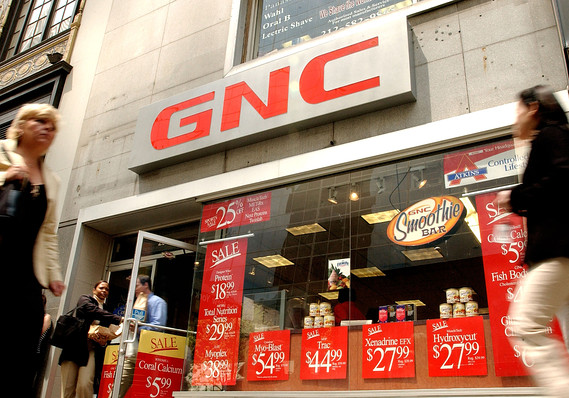
GNC Shares Soar 50% After Bullish Outlook, But Analysts Have Reservations

GNC gave an upbeat profit outlook, sending shares soaring.

GNC Holdings Inc. shares soared an eye-popping 51.6% in Thursday trading after the company gave a premarket profit outlook that exceeds expectations. But Deutsche Bank analysts warn that there could be trouble ahead for the health and performance-products chain.

“GNC continues to face structural challenges, including greater competitive pressure within the vitamin/supplement category from both bricks-and-mortar and online players,” wrote Shane Higgins.

GNC GNC, -9.13% expects fourth-quarter adjusted earnings per share in the range of 24 cents to 25 cents, up from 7 cents last year. Same-store sales for domestic company-owned stores, including the website, are expected to be up 5.7%.

The $80 billion fitness industry sees huge growth in this demographic
GNC announced in December that it had hired Goldman Sachs to explore business alternatives. GNC said Thursday that providing preliminary fourth-quarter financial results is part of the process.

“Our business is no longer as reliant on promotions and discounts as a means of driving traffic, which we believe is very important as we continue to position GNC for the long term,” said Kenneth Martindale, GNC’s chief executive, on the company’s October 2017 earnings call, according to a FactSet transcript. He went on to say that the company’s e-commerce business is growing, along with the GNC store on Amazon.com Inc. AMZN, +0.10% .

In 2018, the company will continue to focus on e-commerce, as well as other areas of the business, Martindale said in the Thursday release.

“We continue to expect GNC to generate positive free cash flow in fiscal 2018, but are concerned that creditors may be reluctant to extend credit, or may impose onerous terms on any refinancing, which could significantly squeeze GNC’s cash flow and flexibility,” wrote Deutsche Bank’s Higgins.

Deutsche Bank rates GNC shares hold with a $4 price target.

GNC’s outstanding junk bonds, the 1.500% notes that mature in August 2020, were trading at 60.30 cents on the dollar Thursday to yield 22.786%, according to trading platform MarketAxess.

GNC stock is down 52.8% for the past year while the S&P 50 index SPX, +0.44% is up 23.2% for the period.