Editor

2 Buy-and-Hold Canadian Dividend Stocks for Your TFSA in 2018

Canadian investors are searching for top dividend stocks to put inside their TFSA portfolios.

The strategy makes sense for young Canadians who have not yet reached their top salary range. Using the TFSA to start a retirement fund allows millennials to reserve RRSP contribution room for the coming years when they will likely be in a higher tax bracket.

Retirees can also take advantage of the TFSA to earn tax-free income to complement their pension payments.

Which stocks should you buy?

The best companies tend to have long track records of dividend growth supported by rising earnings.

Let’s take a look at Fortis Inc. (TSX:FTS)(NYSE:FTS) and Toronto-Dominion Bank (TSX:TD)(NYSE:TD) to see why they might be interesting picks.

Fortis

Fortis owns natural gas distribution, power generation, and electric transmission assets in Canada, the United States, and the Caribbean.

The company has grown over the years through strategic acquisitions, with the biggest investments occurring in the United States. Fortis spent US$4.5 billion in 2014 to acquire Arizona-based UNS Energy and bought Michigan-based ITC Holdings in 2016.

Management says the assets are performing as expected, and Fortis intends to raise the dividend by at least 6% per year through 2022. The company has increased the payout every year for more than four decades, so investors should feel comfortable with the guidance.

At the time of writing, the stock provides a yield of 3.8%.

TD

TD has also spent billions to build up its U.S. presence, with a branch network that now runs from Maine all the way down to Florida. In fact, TD operates more branches in the United States than it does in Canada.

The U.S. business generates more than 30% of TD?s net income, so the American operations provide a nice hedge against any potential weakness in the Canadian economy.

Rising interest rates could put pressure on some homeowners in the coming years, but TD’s mortgage portfolio is capable of riding out a downturn in the housing sector.

On the whole, higher interest rates tend to be a net benefit for the banks.

TD’s compound annual dividend-growth rate is about 10% over the past 20 years, and investors should see the distribution continue to rise in step with earnings growth.

The stock currently provides a yield of 3.2%.

Is one a better bet?

Both stocks are reliable dividend-growth picks and give investors nice exposure to the United States. At this point, I would probably split a new investment between the two companies.

Young investors can invest the distributions in new shares to take advantage of the power of compounding. Retirees can watch the return they get on the initial investment rise with each dividend increase.
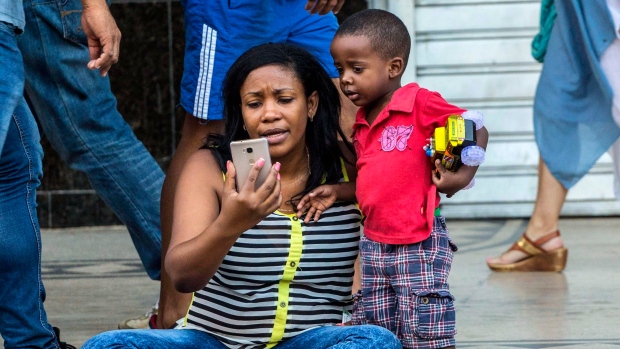

The Internet Can be a Powerful Tool for Good, but Only if Everyone Can Get Online

In this Jan. 6 photo, a woman with her child uses a public wifi hotspot in Havana, Cuba. A new report from UNICEF found that women and children in the developing world lack critical access to the internet and the opportunities it holds.

One of the internet’s greatest attributes is its potential to be a democratizing tool. As the most powerful networked technology ever created, by design, every user can have a platform and a loudspeaker.

Unlike previous communication technologies, like radio or television, which broadcast one message to the masses, with the rise of the internet came the ability for individuals to not only be part of an audience but broadcasters in their own right.

This has had implications on everything from entertainment and how a star is born, to politics and how a revolution is organized.

But when it comes to this great virtue of the net, there is one simple truth that is often overlooked, especially by those of us westerners in the privileged position of scrolling through articles like this one on our smart phones: For the internet to be truly democratizing, everyone needs to have access to it, and currently, too many people don’t, including women, children, marginalized people and Indigenous populations.

This was a central theme in Children in a Digital World, a recent report published by UNICEF, which says that “digital access is becoming the new dividing line, as millions of the children who could most benefit from digital technology are missing out.”

The premise of the report is that the advantages of the internet are plentiful: Digital technologies offer opportunities to learn, giving children not only access to information on issues that affect their communities, but the capacity to help solve them. Additionally, the internet provides economic opportunities by creating new kinds of work, and by providing new training opportunities and job-matching services.

But to reap those rewards, you need access, and according to UNICEF, approximately 346 million individuals — almost a third of youth world-wide — are not online.

According to UNICEF, approximately 346 million individuals — almost a third of youth world-wide — are not online.

So, who are the young people without access? The same social divides that plague life offline creates barriers to online connection as well. Children in low-income countries are the least likely to have access to digital technology.

“This digital divide directly exacerbates the education divide already created by unequal access to quality education, or education at all, based on an individual’s geographic location, gender, and economic status,” says Children’s media researcher Colleen Russo Johnson, co-director of the Children’s Media Lab at Ryerson University.

According to Saadia Muzaffar, tech entrepreneur and founder of TechGirls Canada, it is essential that this issue be addressed. “We need to look at this divide with the same level of urgency as we would look at gender or race-based segregation in 2017 and beyond — as something that creates foundations of inequity that are insurmountable in these children’s lifetimes,” she says.

But this also represents an incredible opportunity, since the tools and technology exist to bring information and education to those who haven’t previously had it; it’s just a matter of access. “For the first time in human history, the barrier for entry to provide knowledge and education to millions — regardless of where they are — is actually within our reach,” says Muzaffar.

The gender gap

According to UNICEF, digital divides “mirror broader social-economic divides,” which means that in addition to those between rich and poor, and those with education and those without, there is also a notable and troubling gender gap.

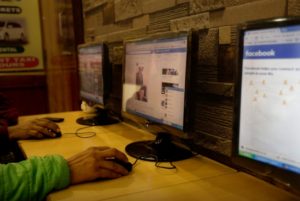
An Indian man surfs a Facebook page at an Internet cafe in New Delhi, India, Tuesday, Feb. 9, 2016. In India, less than one-third of internet users are female.

Globally, 12 per cent more men than women used the internet in 2017. In India, less than one-third of internet users are female.

Digital literacy is an essential tool for children growing up in a world powered by technology, but as Muzaffar explains, social biases impact not only who has access to digital technologies, but how they use and understand them. “Girls, especially racialized girls, and children with disabilities are pushed to the bottom of the pyramid of access.”

Considering women are the primary caregivers and community nurturers in most developing nations, “keeping access to knowledge from them has a direct impact on the financial security, health, and well-being of their families and communities,” says Muzaffar.

Tech equality at home

So, what impact does this have on Canadians?

For people living in our urban centres, it may be hard to imagine that not everyone in Canada has easy access to the internet. But as Muzaffar points out, that couldn’t be further from the truth.

“Even in a developed nation like Canada, our remote and on-reserve Indigenous communities, refugees and new immigrant families are severely underserved when it comes to equitable access to the internet,” she says.

Access is a luxury we often take for granted as we engage with the world around us from behind our screens. As the UNICEF report acknowledges, the internet can be a tool for good, offering opportunities to learn and share knowledge. But for it to reach its true potential to level playing fields around the world, first, we need to ensure that everyone gets to play.

‘Weird’ Interstellar Asteroid Yields No Alien Signals, Resembles Worlds Beyond Neptune

‘It moves like a piece of driftwood on the tide,’ astronomer says

This artist’s impression shows the first interstellar asteroid: ‘Oumuamua. It was discovered on Oct. 19 by Canadian astronomer Robert Weryk using the Pan-STARRS 1 telescope in Hawaii.

Shocked astronomers had never seen anything like it: a bizarrely shaped rock ejected from another stellar system, just passing through ours.

So strange was the discovery back in October, astronomers around the world turned their telescopes toward the cigar-shaped asteroid in the hope of uncovering its mysteries — including even listening for signs of alien life.

Breakthrough Listen, one arm of an international project dedicated to searching for signs of intelligent life in the universe, started eavesdropping earlier this month using a telescope in West Virginia. But the group says it has found no evidence of artificial signals coming from the rock known as 1I/2017 U1 ‘Oumuamua, which means “messenger from afar who arrived here first” in Hawaiian.

The organization says it continues to listen across other radio frequencies and analyze the collected data.

Other stars, other worlds

Michele Bannister of Queen’s University Belfast says the chance to study something that came from another solar system can provide scientists with crucial information to test their theory of planetary evolution.

“We can do stuff here that we simply can never do in detail for other systems. And then a piece of one comes visiting!” said Bannister, the lead author of a new study about ‘Oumuamua that was accepted for publication in the journal Earth and Planetary Astrophysics.

“We can actually connect the theory to the reality.”

‘Oumuamua, which is about 400 metres long and 40 metres wide, raises many questions Bannister would love to answer.

“I would like to know what its home star system looked like,” she said. “I want another one. I want to know this object isn’t unusual. Is it statistically a reasonable example of what we expect to see wandering the cosmos?”

This is ‘Oumuamua, circled, as seen by the 4.2m William Herschel Telescope on La Palma, Spain.

She says with more and more telescopes dedicated to sky surveys, the chances of discovering more rocks drifting from other solar systems are increasing.

“That’s something that I’m really looking forward to: the launch of the new field of interstellar asteroid research,” she said. “[‘Oumuamua is] going to have friends.”

‘Weird’ rock

Astronomers have discovered ‘Oumuamua resembles worlds in our outer solar system, beyond the orbit of Neptune, which helps shed some light on planetary formation.

‘Oumuamua, for example, has a significant carbon content. Astronomers believe that carbon-rich material, together with cosmic ray bombardment, should colour an object like an asteroid bright red.

But this didn’t happen with ‘Oumuamua.

“This object has been travelling between stars for millions, perhaps billions of years, so it would have had a lot of cosmic bombardment,” Bannister said. “So [you’d expect] maybe it would be ultra-red. But it’s not.”

Instead, the colour is a more neutral red, similar to what you’d find on objects in the Kuiper Belt — the outer region of our solar system, home to icy worlds — such as Pluto and its largest moon Charon.

The moon Charon is seen here in a mosaic of photographs taken by the New Horizons spacecraft during its approach to the system from July 7-14, 2016. A study found that Pluto is constantly ‘spray-painting’ Charon’s poles red due to its escaping atmosphere and a reaction with solar radiation.

“This object is very much similar to 15 per cent of the outer solar system,” Bannister said. “It’s a little weird, but it’s familiar.”

Bannister, who worked as a post-doctoral researcher at the NRC’s Herzberg Centre in Victoria, said her study wouldn’t have been possible without the work of a Canadian-led study called Colours of OSSOS, which has been mapping the objects in the outer reaches of the solar system.

Another surprise

When ‘Oumuamua was first discovered, astronomers believed it was likely a comet. That’s because as stellar systems form, most of the objects thrown into space are comets, leftover bits made up of water and dust. Asteroids, on the other hand, are mostly rocky remnants and much less common.

But as ‘Oumuamua neared the sun, the familiar tail that comets produce didn’t appear, an indication that it’s mostly rock.

As ‘Oumuamua makes its way out of the solar system at roughly 38 kilometres a second, tumbling from end to end, researchers still aren’t sure exactly where it came from.

“It moves like a piece of driftwood on the tide,” Bannister said. “It’s really celestial driftwood.”

Taxing Meat Could Help Offset Environmental, Health Problems, Activists Say

Some groups want to see animal products taxed similarly to tobacco, sugar, and carbon

Meat consumption has been linked to greenhouse gas emissions, deforestation, global obesity and cancer, and the debate is heating up on whether animal products should be taxed like other harmful commodities like sugar, tobacco and carbon.

The steep climb in global meat consumption has environmental interest groups debating a “sin” tax on animal products.

Meat consumption grew by more than five times between 1992 and 2016 and has contributed to greenhouse gas emissions, global obesity, rising rates of diabetes and cancer, soil degradation and deforestation, according to the Farm Animal Investment Risk & Return (FAIRR) Initiative.

The British activist group argues meat should join products like tobacco, sugar and carbon, which are often taxed because they are harmful to people’s health and the environment.

“We’ve seen an increasing trend toward intervention, especially in Europe, this idea of looking at sin taxes,” said Lauren Compere, managing director at Boston Common Asset Management, an environmentally minded investment group. She listed Denmark, Sweden and Germany as countries considering legislation toward a meat tax.

Part of the solution

Compere told CBC’s B.C. Almanac host Michelle Eliot that such a tax is part of a group of incentives that could to address the problems associated with increased meat production.

“Even marginally decreasing the consumption of meat increases health cost savings and also reduces environmental degradation,” she said.

A similar tax imposed on sugar in Mexico generated revenue that was used to install drinking fountains and accessible clean water in depressed and lower-income neighbourhoods, Compere said. That, in turn, reduced the amount of sugar these residents consumed because they were no longer drinking as much soda or juice.

Revenue generated by a meat tax could be spent on improving consumer education on nutrition and plant-based diets, which could also help reduce meat consumption, Compere said.

More people, more food

But Kevin Boon, general manager of the B.C. Cattlemen’s Association in Kamloops, isn’t convinced that the money from a meat tax would go toward changing the industry. He said that pointing the finger at one commodity is too narrow a view.

He argues that the world’s expanding population is creating more demand for food, including meat.

“If we’ve got to produce more food for more humans, we’re going to need more animals, more plants, more everything else to do it.”

“To put a tax on a food product of any kind that is recognized in the Canadian Health Guide as an essential part of a balanced diet, then we need to really take a very close look at what we’re doing,” he said.

Compere argues that production needs to be matched with consumer needs — and she sees increasing trends toward veganism along with global demands for sustainable practices.

“Understanding the sustainable practices, where it’s produced, how it’s produced and by whom, is actually becoming pretty standard in terms of consumers wanting to know where their food is produced,” she said.

Rising Price of Oil Helps TSX, U.S. Markets Climb Higher

Health-care stocks also gave the TSX a boost, with shares of licensed marijuana producers closing up


Traders work on the floor of the New York Stock Exchange shortly after the opening bell in New York on Tuesday.

Rallying oil prices helped push Canada’s main stock index and its U.S. counterparts into record territory on Wednesday, while the loonie lost ground.

The S&P/TSX composite index advanced 61.56 points to 16,371.55, with energy shares up 1.5 per cent as the February crude contract surged US$1.26 to US$61.63 per barrel.

Oil prices are at two-and-a-half-year highs and are still rising. One reason is that investors are concerned that a pipeline bombing in Libya last month and protests in Iran could reduce oil supplies.

“I didn’t think oil could go any higher,” said Allan Small, a senior investment adviser at Holliswealth. “There’s a lot of things causing positive momentum for the price of oil which in my opinion is not sustainable.”

Health-care stocks also gave the TSX a boost, with shares of licensed marijuana producers such as Canopy Growth Corp. and Aphria Inc. up 10.91 per cent and 6.29 per cent, respectively, at the closing of markets.

South of the border, technology companies once again led U.S. stocks higher on Wall Street, with software-maker Oracle advancing 2.5 per cent and IBM adding 2.7 per cent.

The Dow Jones industrial average gained 98.67 points to 24,922.68. The S&P 500 index added 17.25 points to 2,713.06 and the Nasdaq composite index was up 58.63 points to 7,065.53.

In currency markets, the Canadian dollar closed at an average trading value of 79.79 cents US, down 0.10 of a U.S. cent.

Elsewhere in commodities, the February natural gas contract gave back five cents to $3.01 US per mmBTU.

The February gold contract was up $2.40 US to $1,318.50 US an ounce and the March copper contract was down two cents to $3.26 US a pound.

City says Moss Park Armoury to Open Monday as Winter Respite Centre

100 beds to be available for 2 weeks starting Monday morning, as province looks for long-term solutions.
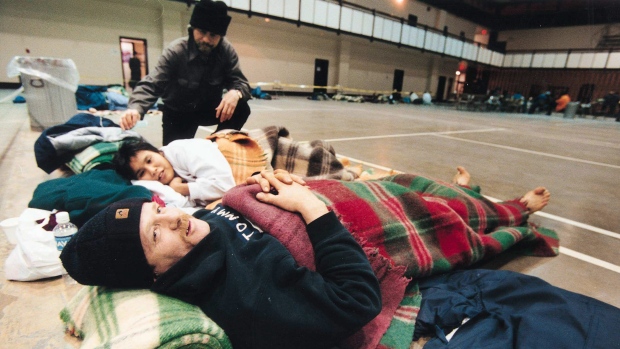
Some members of Toronto’s homeless community bedding down at Moss Park Armoury on January 14, 1999, during an infamously snowy winter that saw temperatures dipping down to as low as -24 C.

The federal government has accepted the city’s request to temporarily make the Moss Park Armoury a winter respite centre, providing up to 100 new spaces for the city’s homeless.

The armoury will open Monday morning, Paul Raftis, head of the city’s shelter system, said on Friday evening, citing necessary preparation time.

“We need this weekend to be able to set up and to serve a hundred people at this location,” he told reporters.

Environment Canada is forecasting a low of –25 C in Toronto Friday night, while temperatures are expected to rise to 1 C on Monday.

Anyone using the city’s newest warming centres, which opened Thursday night at Regent Park Community Centre and Metro Hall, will be moved into the armoury on Monday, Raftis said.

The two warming centres sheltered 15 and 13 people, respectively, overnight on Thursday.

When it opens, the armoury will be available 24 hours a day for two weeks, according to the Ministry of Public Safety.

Approval to use the armoury as a temporary shelter falls to the federal government, who received an official request from the province earlier this week.  “There is a protocol,” said Adam Vaughan, MP for Spadina–Fort York.

The federal government said the province will confirm a longer-term solution.

“While our immediate priority is to keep people safe, we also working to address the systemic issues that lead to this problem through historic federal investments in affordable housing,” Vaughan said.

“This has got to stop. Nobody should be tolerating 5,000 people a day in and out of shelters. It’s a solvable problem.”

Opening nearby building may be next step

Ontario Housing Minister Peter Milczyn said in a statement Friday evening that the province is “fully committed to providing a longer-term solution to meet the city’s need for a seventh 24/7 respite centre.”

He added that the province would know more “very soon” after meeting with the city and the Ontario health minister.

Mayor John Tory also issued a statement Friday evening suggesting the city may open a shelter in a nearby building after the armoury’s two weeks are up.

The province indicated the location “could be prepared as a winter respite site for the duration of the winter months, while the armoury is used as a temporary measure,” he said.

On Thursday, Tory called for a longer-term solution.

“What is needed is not just permanent shelter beds, but supportive housing,” Tory said, calling the current landscape a “crisis.”

Armoury has opened before in extreme weather

In a news conference on Thursday, Mayor John Tory said the city is currently operating six winter respite centres. The armoury would provide up to 100 new spaces.

Tory has faced mounting criticism for his previous refusals to open the armouries as shelters run at near-capacity. He voted against exploring the use of the armouries in a motion presented to council on Dec. 6, 2017.

Although MP Adam Vaughan originally said the armoury could open Friday evening, city officials later announced the building wouldn’t be ready until Monday morning.

The armoury at Moss Park was previously used as a shelter during a particularly brutal winter over 20 years ago, in 1996.

It opened again as an emergency measure in January of 1999, when nearly a metre of snow was dumped on the city in just two weeks.

The building now houses a military regiment, which uses the location for training.

A spokesperson for the Canadian Armed Forces told CBC Toronto that those using the armoury to stay out of the cold should have access to bathrooms and showers in the facility, as well as a large gymnasium.