
Archives for October 21, 2018

One-day exhibition tackles ‘profound questions’ about modern technology

The Canada Science and Technology Museum is hosting a single-day exhibition Oct. 20 that explores the intersections between art and technology. (Canada Science and Technology Museum)

Heart rate cameras, robots featured at Canada Museum of Science and Technology

A one-day exhibition in Ottawa is exploring the crossroads between science and art through immersive 3D projects designed to challenge how people think and feel about the latest technology.

The first-ever Galatecha event is taking over the Canada Science and Technology Museum Saturday. It presents the works of local and international artists who’ve been exploring everything from augmented and virtual reality to monitoring and surveillance devices.

“We are really hoping we can inspire people to start thinking about how tools like virtual reality or surveillance equipment even or wearable technology can influence … how you connect with each other,” organizer Thomas Radford told CBC Radio’s In Town and Out Saturday morning.

“[I hope people] leave with some profound questions about where they think we’re going.”

From robots to heart rate cameras

One installation features a collection of scrap-metal sculptures made from broken machines and discarded technology. Another showcases a collection of fine glassware created using manufacturing equipment.

The exhibition will also feature a space where people can dance and their moves are then projected as works of art, as well as a demonstration of a beach-cleaning robot designed in Ottawa.

Researcher Lee Jones is presenting an installation of “calm technology,” including a camera-equipped device that can visualize a person’s heart rate as water.

“[It] can measure heart rate from a distance so you don’t need to be plugged in,” Jones told In Town and Out. “You just walk by and it can read your heart rate.”

Jones said her aim is to explore the risks associated with this sort of technology, and hoped people will think about whether they feel comfortable with a device that can publicly monitor heart rates.

“Art is a great way to like communicate the research that’s going on, so people can really see how this camera is reading you — and get creeped out by it in a way that you wouldn’t with other research,” she said.

Galatacha takes place at the museum from 8 p.m. until midnight.

Aging and technology: Digital games improve seniors’ health, SFU research finds

Technology can be a tool to help seniors with social engagement and health, the SFU research found. (Sean Gallup/Getty Images)

Seniors are fastest growing group of computer users, says lead researcher

Playing games on an iPad or console is sometimes painted as a waste of time, but according to research out of Simon Fraser University, digital games can bring big health benefits to seniors.

David Kaufman, who led the SFU research team, found there are benefits across the board from promoting mental stimulation to helping senior make friends.

“We’re focusing not only on slowing down the mental decline but we’re focusing on what we call social connectedness,” Kaufman said.

“We know that for seniors, that is a critical thing.”

Technology as a tool

Kaufman, who specializes in education and gerontology, drew a link between feelings of social isolation, loneliness and depression.

Technology can be a tool to address that, he said.

“Seniors are the fastest growing group of computer users right now and there are so many possible uses for computers for seniors,” Kaufman said.

He’s presenting his research at the 2018 AGE-WELL conference this week in Vancouver which brings together Canadian experts on aging and technology.

Social isolation is a critical issue for seniors, says Kaufman.

Promoting social play

Kaufman said that nearly all of the 1,200 seniors his research team surveyed played online versions of games from their childhood like Scrabble, Mahjong, chess and solitaire.

“A game that has a bit of strategy in it will bring cognitive benefits, it will help slow down the mental decline of seniors,” he told Stephen Quinn, the host of CBC’s The Early Edition.

“Other games, like Angry Bird, they will help with reaction time and things like that.”

The draw to online games, compared to more traditional versions, is that anyone can play them at any time.

“They get a lot of benefits when they play together but our survey showed in fact that only about 30 per cent of seniors play with others,” Kaufman said.

“So our job is to try to promote social play amongst seniors.”

Bowling from a wheelchair

For one part of the research project, teams of three to four seniors were set up at 14 long-term care facilities for a Nintendo WII bowling tournament, using a game console.

“It became a huge social event in many of the centres,” Kaufman said.

Using the game console meant that the tournament was accessible to more people, he added.

“We had one woman who was holding onto her walker when she was playing, one woman was bowling from her wheelchair,” he said.

“It was really a very heartwarming thing.”

Wages for the 1% just reached their highest level ever

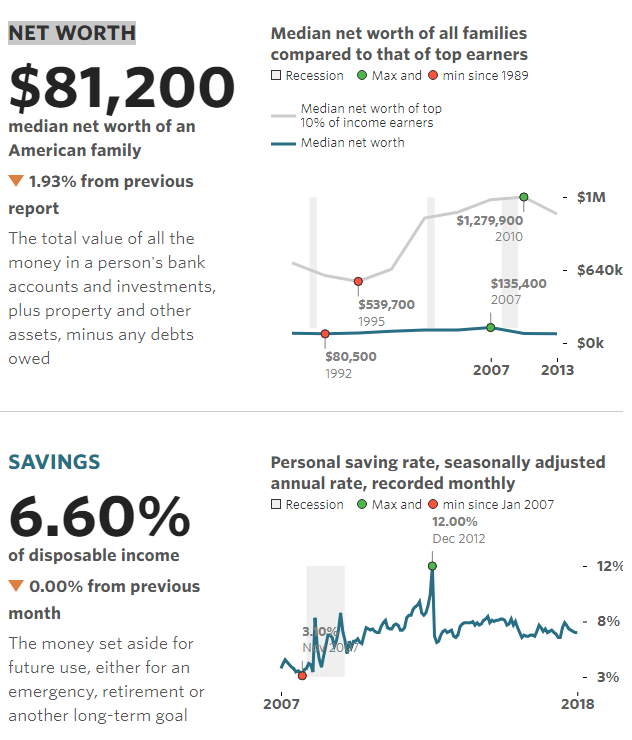
The top 1% of households as measured by income have median savings of $1.1 million, a new report finds. The bottom 20% of Americans have no money saved for a rainy day, by the same measure.

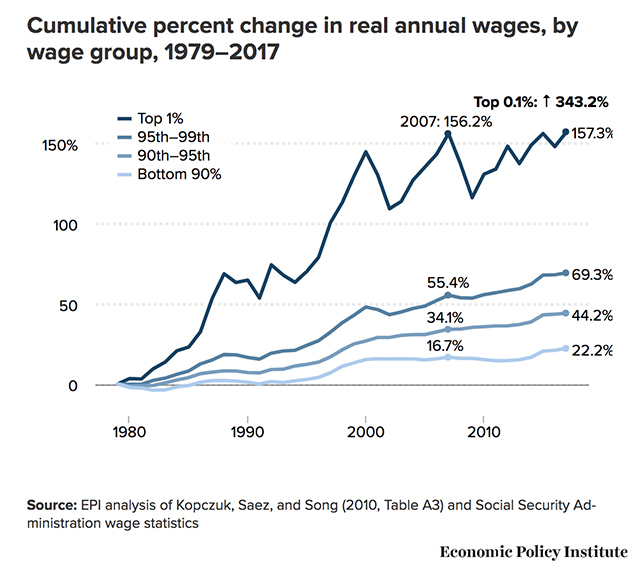
Salaries for the top 1% grew nearly four times the rate of those in the bottom 90% of earners

The 1% has never had it so good.

The average wage for the top 1% of income earners hit $719,000 per year in 2017, up 3.7% on the year, exceeding their peak of $716,000 per year just before the Great Recession, according to a report released Thursday by the Economic Policy Institute, a progressive, nonprofit think tank, citing data from the Social Security Administration. The average wage for the top 0.1% reached $2.7 million in 2017, the second-highest level ever, just 4% below their level in 2007. However, wages for the 0.1% rose 8% on the year in 2017.

Income inequality has soared in the U.S. over the last five decades, despite increases in worker productivity, the report said. “Incomes for most Americans have been stagnant for four decades,” according to a separate report released earlier this year by the staff of Keith Ellison, a Democratic congressman for Minnesota. “Instead, this increase in income inequality was almost entirely driven by soaring compensation levels for the top 1% of income earners.”

Average wage growth for most working Americans continues to flat line in 2018, the EPI said. “Some of this real wage stagnation can be explained by an uptick in energy prices, but even the underlying pace of nominal wage growth has yet to pick up in the way it historically has as labor markets tightened,” it said. (The median household income was $61,372 in 2017, up 1.8% after accounting for inflation, according to the U.S. Census Bureau.)

For most U.S. workers, real wages have barely budged in decades, the Pew Research Center said in August. “On the face of it, these should be heady times for American workers. U.S. unemployment is as low as it’s been in nearly two decades,” the Washington, D.C.-based think tank said. “In fact, despite some ups and downs over the past several decades, today’s real average wage — after accounting for inflation — has about the same purchasing power it did 40 years ago.”

The State of the American Wallet

Investors weigh whether to ditch stocks for bonds as yields finally offer an alternative

Time to underweight stocks?

Yields still not attractive enough to justify underweighting equities: UBS

Farewell, TINA?

TINA is the acronym for “there is no alternative,” a market mantra that reflected the frustration of investors who saw no alternative to stocks in a post-financial crisis world dominated by ultralow government bond yields as the Federal Reserve and other global central banks embarked on asset-buying programs and other forms of extraordinary stimulus.

A selloff in Treasurys has seen longer-dated yields rise quickly in recent weeks, playing catch-up with a long-running rise in shorter-dated yields. Yields and debt prices move in opposite directions.

Indeed, the rise in the 10-year Treasury yield TMUBMUSD10Y, +0.42% to a more-than-seven-year high above 3.26% on Oct. 9 was blamed by some investors for a subsequent U.S. stock-market selloff that turned into a global rout. That selloff, in turn, sparked a flight to traditional haven assets, like Treasurys, pulling yields back down. But they began to creep back up, with the 10-year yield ending Friday near 3.195%.

The question for investors is whether the yield on Treasurys and other lower volatility alternatives is attractive enough to justify shifting money out of stocks. For one money manager, the answer is, not yet.

“While investors now have some fixed income alternatives to equities, we do not consider them attractive enough yet to warrant underweighting equities relative to fixed income. The backdrop for equities remains sufficiently supportive, valuations are favorable relative to historical norms, and upside risks at least partly offset the downside risks we continue to monitor,” said Mark Haefele, chief investment officer at UBS Wealth Management, in a note.

It comes down in part to the reason that yields are rising. In the view of Haefele and stock market bulls, it’s because the U.S. economy remains robust rather than because investors fear a surge in inflation that would hurt stocks.

Haefele sees no evidence so far that the Federal Reserve’s rate increases are unduly tightening financial conditions despite President Donald Trump’s criticism of policy makers as “crazy,” “loco,” and running “wild.”

Also, while 10-year yields have been on the rise, “this has been more than offset by rising earnings, and the equity risk premium, a measure of equity valuations relative to bond valuations, still exceeds its historical average,” he said.

Haefele said he’s maintaining a “modest” overweight position in global equities. While equity performance has been dominated by the U.S. so far in 2018, “risks are present around the world” and “diversification is the best approach to control portfolio volatility.” U.S. equities are no longer immune to selloffs, he said.

Relative to cash, however, UBS is overweighting U.S. Treasurys. Haefele said argued that investors have largely priced in the full rate-hiking cycle, which UBS expects to peak with a fed-funds rate of 3.25% to 3.5% in late 2020, meaning the 10-year yield is unlikely to rise significantly — and that Treasury prices shouldn’t fall much further either. He’s also overweight dollar-denominated, emerging-market sovereign bonds, arguing that the 6.5% yield on a popular index is attractive, despite current uncertainty surrounding emerging markets.

For U.S. equities, the past week was a mixed bag as earnings season picked up steam, largely delivering positive results. Stocks continued to see volatile trading but major indexes managed to stabilize, with the exception of the Nasdaq Composite, which continued to suffer as investors continued to dump once popular tech shares.

The S&P 500 SPX, -0.04% eked out a fractional gain for the week, while the Dow Jones Industrial Average DJIA, +0.26% rose 0.4%, breaking a three-week losing streak. The Nasdaq COMP, -0.48% meanwhile, fell 0.6% for its third straight weekly decline.

On the earnings front, 17% of companies in the S&P 500 have delivered third-quarter results so far. More companies are beating estimates than average, but the magnitude of the beats is smaller than average, said John Butters, senior earnings analyst at FactSet.

Earnings next week include construction-equipment maker Caterpillar Inc. CAT, -2.68% and McDonald’s Corp. MCD, +0.41% on Tuesday, Northrop Grumman Corp. NOC, -0.17% and Microsoft Corp. MSFT, +0.15% on Wednesday, and Twitter Inc. TWTR, -1.57% and Chipotle Mexican Grill Inc. CMG, -0.74% on Thursday. See:MarketWatch Earnings Calendar

Smoking is bad, but sitting around doing nothing is even more deadly, study shows

Smoking is bad for your health. You don’t need an oxygen tank by your bedside to tell you that. Diabetes and heart disease, obviously not great, either.

But what isn’t so obvious is that a sedentary lifestyle is actually worse than all three, according to a new study led by the Cleveland Clinic’s Dr. Wael Jaber.

“Being unfit on a treadmill or in an exercise stress test has a worse prognosis, as far as death, than being hypertensive, being diabetic or being a current smoker,” he said. “We’ve never seen something as pronounced as this and as objective as this.”

The results are particularly troubling in the U.S., where we’re certainly grappling with a fitness problem. The average body mass index for an American male is 28.6, up from 25.1 in the 1960s. Anything over 24.9 is considered overweight and over 30 is deemed to be entering obese territory.

Jaber explained that being unfit, at this point, should be treated like a disease that, fortunately, has a prescription: Exercise! He told CNN that researchers now face the task of conveying the risk — getting no exercise can have a severe impact on longevity — to the general population.

These results were not drawn form a small group, either. Researchers retrospectively studied 122,007 patients who underwent exercise treadmill testing between 1991 and 2014.

“People who do not perform very well on a treadmill test,” Jaber said, “have almost double the risk of people with kidney failure on dialysis.” In fact, the risk associated with death is 500% higher for people with sedentary lifestyle than top exercise performers.

“If you compare the risk of sitting versus the highest performing on the exercise test, the risk is about three times higher than smoking,” Jaber explained.

So what are you sitting around reading this for? Get out there!

86% of 2017 ICOs are now in the red, Ernst & Young study finds

Nearly one-third if ICOs launched in 2017 have lost all their value

If you invested in an initial coin offering (ICO), a crowdfunding tool for crypto-related ventures, in 2017, there’s a very good chance your portfolio has been shredded, according to research from professional services firm Ernst & Young.

In an Oct. 19 report titled “ICOs, The Class of 2017—one year later” Ernst & Young said in the first six months of 2018, 86% of the leading ICOs that listed on a crypto exchange in 2017 are below their initial listing price. Furthermore, a portfolio of these ICOs is down by 66% since the peak of the market.

A lack of investor due diligence and poor understanding of the nascent, and often disingenuous market, drove ICO valuations to extreme levels, creating a severe case of FOMO (fear of missing out), which eventually popped, the report said. “Despite the past year’s hype around ICOs, there appears to be a significant lack of understanding around the risks and rewards of these investments,” said Paul Brody, Ernst & Young global innovation leader, Blockchain, in the report.

“While ICOs are an entirely new way to raise capital, those participating should understand that there are factors—such as the slow progression toward working product offerings—that can introduce greater risk in ICO investing.”

This excessive risk taking saw the total value of all cryptocurrencies soar to more than $800 billion in January before nose-diving below $600 billion as the price of major cryptocurrencies like bitcoin BTCUSD, +0.84% and Ether ETHUSD, +1.61% lost more than half their value.

Furthermore, Ernst & Young estimate that 30% of all ICOs have lost “substantially all their value.” This follows a February survey from news.Bitcoin.com that said 46% of all 2017 ICOs failed at either the funding or business stage.

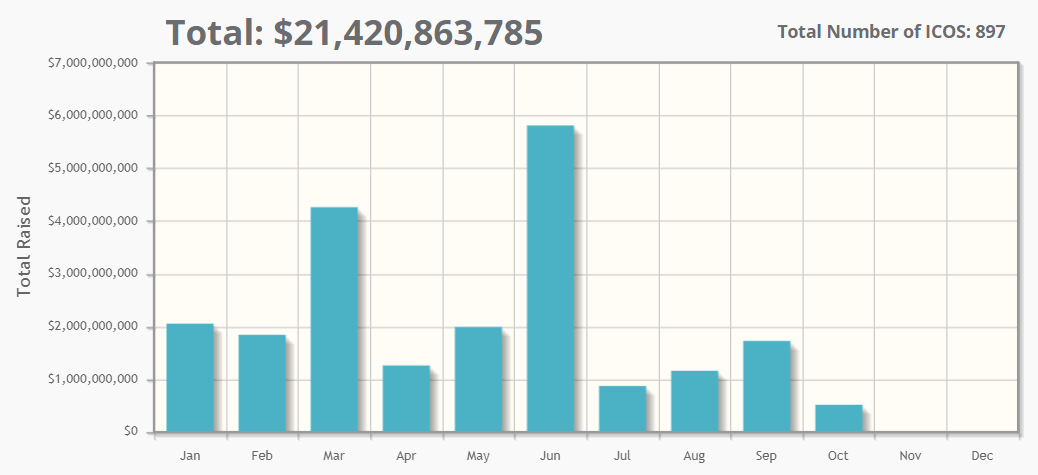
But investors look to be wising up. Whether it’s growing regulatory oversight or documented failures, the deluge of money to the alternative crowdfunding tools is on the decline. Of the $21.4 billion raised in 2018 to-date, $17.2 billion was in the first six months. July, August and September were three of the five slowest months, according to data from CoinSchedule.

Even so, Brody said those contemplating a dabble in the ICO market should tread with caution. “At the moment, the level of reward in this market doesn’t look like it justifies the risks involved,” he said.

The survey collected data on projects that have conducted ICOs and performed a detailed analysis of the top 141 projects, which collected 87% of all ICO proceeds, between January 2018 and September 2018.