Archives for October 14, 2018

Walmart bares all in buy

Walmart says it’s buying online lingerie retailer Bare Necessities, the latest acquisition in its niche-brand buying spree.

Walmart declined to disclose how much it’s paying for Bare Necessities, but says the deal will help deepen its expertise in the world of bras, swimwear and shapewear.

The company said Friday that Bare Necessities will remain as a stand-alone site. As part of the acquisition, Noah Wrubel, CEO and co-founder of Bare Necessities, will lead the intimates area for both Walmart.com and Jet.com, while also continuing to run Bare Necessities.

Walmart is aiming to attract younger, more affluent shoppers with its string of acquisitions. Two years ago, it bought Jet.com for more than $3 billion and since then it’s been buying smaller online brands including Bonobos and Moosejaw.

How to retire early – very early

Retiring comfortably in yours 60s or 70s can seem a high-wire act, so how are some people pulling it off without a wrinkle in their face?

The FIRE (financial independence, retire early) movement is growing, with more and more people parting from their careers in their 30s and 40s. CNBC spoke to some of these young retirees to figure out how they did it.

“I think it should be possible for everyone,” said Karsten Jeske, who retired this year at 44. “It’s conceptually extremely simple to do.”

People should keep in mind the risks of forfeiting a paycheck, said Nick Foulks, a lead advisor at Great Waters Financial in Minneapolis.

“People are living longer, and our dollars today have to last longer than they ever have before,” Foulks said. Particularity young retirees might find a lackluster Social Security check waiting for them, since the monthly amount you receive is based on an average of your working years.

Joel Jonathan, retired at 34

Space Coast, Florida

Joel Jonathan was 29 when he decided he was done with work.

“I was longing for the ability to have time to take long walks, work on my personal fitness, cook a nice meal, without always being at work in a cubicle,” he said. (He requested CNBC only use his first and middle names, as he was disclosing so many financial details.)

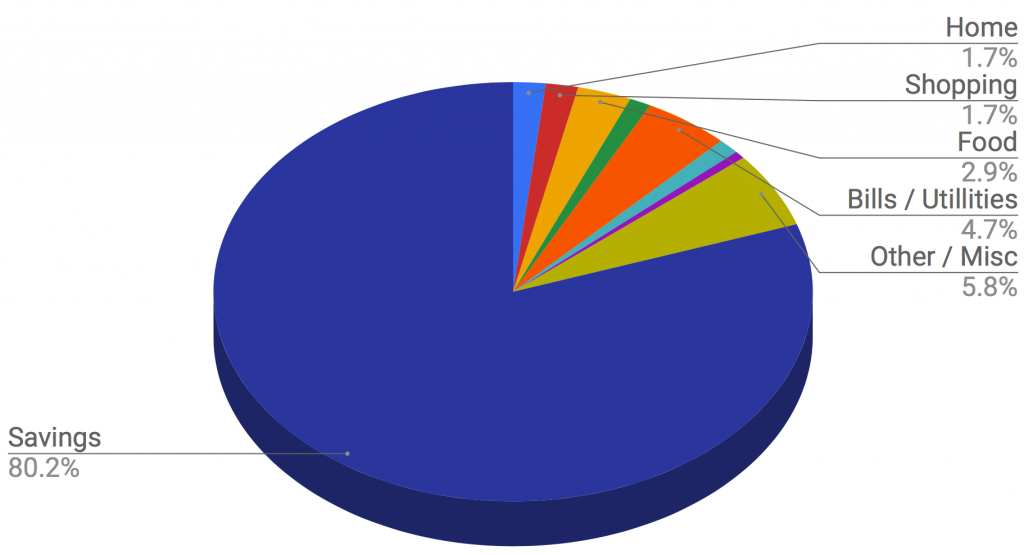
Joel was working 60 hours a week as an engineer when he began his journey to financial independence. He and his wife, Alexis, each made around $80,000 a year. They reduced their overhead until they were socking away 80 percent of their income, including money in their 401(k) plans and heath saving accounts. He invested in low-cost, total market index funds.

How did they actually save so much?

They moved in with his wife’s parents for a while and rented out their house. They downgraded from two cars to one, and carpooled to their jobs.

“[My wife] works about three miles from my old work location, so I dropped her off at work and then continued on to mine,” he said.

Additionally, they almost never ate out.

Here’s a chart of his budget.

They lowered their Internet speed, and found they didn’t notice a difference.

“We were paying more money for no reason,” he said. His wife cancelled her gym membership, but soon regretted it. “After a few months, she was like, ‘I want to go back to my spin class,'” he said. So, she did.

“To us, it’s an experiment in going out of our comfort zone,” he said.

After five years, at 34, he was able to leave his job. He now spends his days blogging about his financial journey, and working on a book about FIRE. He also writes music.

“None of it needs to produce any profit,” he said. “I can just enjoy [life] and work at my own pace.”

His wife still works, though he said he’s trying to get her to quit and join FIRE with him. For now, he uses her health insurance but when she retires they’ll switch to an Affordable Care Act subsidy.

They don’t have children, but they did include a line item in their budget for college costs one day.

“If we decide not to have kids, then that just becomes extra safety margin for ourselves,” he said.

His directions to FIRE: Save at least half of your income, until your savings are 25 times your annual expenses. He said this should take 10 to 15 years for most people.

Make sure those savings are invested in low-cost, passive total stock market funds. Quit your job (only if you’re ready) and then withdraw 4 percent of your portfolio per year, forever.

Karsten Jeske, retired at 44

San Francisco, California

Karsten Jeske said his path toward early retirement began in 2008, when the Great Recession taught him that there is no absolute financial stability.

The former economist at the Federal Reserve says that he’s part of fatFIRE, those who can afford to retire with more frills. For a decade, he saved 50 percent of his salary, which was in the mid-six figures.

(FatFIRE is the the pursuit of financial independence and/or early retirement on at least an upper-middle class lifestyle.)

“People say, ‘You work in finance. You must have some special sauce,'” he said. “No, I didn’t. I just invested in broad-based U.S. and international equity index funds.”

He said most people will probably not be able to retire early by putting their money in savings accounts or a certificate of deposit.

“Most people I know did this with equities,” he said.

Even though he was lucky to have a high salary, he said people who earn far less should be able to retire early, too.

“With $60,000 a year, you could live on $25,000, and you’re saving more than half,” he said.

He said every dollar you don’t spend helps you in two ways: “You put it in your savings so your nest egg grows faster, but also every dollar you don’t spend conditions you to consume less so your retirement budget is lower.”

He plans to live off around $80,000 a year in retirement. He has a 529 college savings plan set up for his 5-year-old daughter, Kati. He’s considering joining a health insurance ministry, in which members pay for each other’s medical expenses as they come up each month.

So far, his retirement has been spent travelling the world with his wife, Kristal, and daughter.

“I don’t think I’ll get bored,” he said, of the decades to come. “Even travelling now is like a full-time job.”

And if there’s a recession? Jeske said he isn’t worried.

“We’d just scale back from fatFIRE to FIRE and live in peace,” he said.

Tanja Hester, retired at 38

North Lake Tahoe, California

When Tanja Hester retired she was 38, and her husband, Mark Bunge, was 41.

She says people should save for early retirement and traditional retirement in different accounts.

Most regular retirement accounts come with required minimum distribution rules around when you can withdraw from them anyway. But also, Hester said, if you have all of your money in one account, it’s more risky.

“We know if we mess up, and spend too much money in our early years, we’re not going to jeopardize our older years,” Hester said.

She and her husband call their early retirement “phase one,” and their later retirement “phase two.”

They also have different expectations for their different retirements, young and old. Now, they don’t mind sleeping in tents and cheap motels. But, she said, “We might not want to rough it when we’re 70.”

It took them six years to reach early retirement. They both were earning six figures as political consultants, and saved 70 percent of their net income. They maxed out their 401(k) plans and they paid off their mortgage and bought a rental property.

“The absolute biggest thing that helped us was banking every raise and not letting our lifestyle inflate,” Hester said.

She also recommends automating your savings and investing.

“We looked at what we had in checking and it didn’t look like very much, and so that’s what we felt like we had to spend,” she said.

Hester feels that not everyone can retire early.

“It’s about looking at what is possible,” she said. “If you apply these principles and just translate that into a secure retirement, you’re already ahead of the majority of people.”

Does It Ever Pay to Take a Demotion?

Most employees have the goal to work their way up at their respective companies. And while that can certainly take time, the idea is to generally be progressing in an upward fashion. Getting demoted, therefore, is usually considered a major career setback and one we’re mostly advised to avoid.

But in some situations, getting demoted actually isn’t all that detrimental. It could, in fact, end up helping your career in the long run.

When getting demoted works out

It’s often the case that when you get demoted, you don’t really get a say in the matter. Rather, you’re told that to remain employed, you have no choice but to accept a lesser role.

But not all demotions work that way, and you could come to find that you’re in a position in which your demotion is more voluntary in nature. How might that come about? Let’s say you were promoted six months back and have been struggling in your role ever since. If you were doing well in your former position, you might proactively ask to go back to it until you’re able to boost your skills or increase your knowledge base to better perform at the next level up.

In that sort of situation, getting demoted might actually help you grow as an employee and maintain a good reputation within your company. After all, you’re better off excelling at a lower level than failing at a higher one.

Another reason to consider a demotion? When you’re unhappy with your work–life balance. It’s generally the case that the higher you climb on the corporate ladder, the more time you spend chained to your desk. If taking a step back helps you better manage your family- and household-related responsibilities, all the while preventing full-fledged burnout, then it’s a worthwhile move to make.

Remember, too, that as your personal life evolves, you’ll have more opportunities to grow professionally. But if, say, you currently have young children who need you around a lot, you might be better off reverting to a less time-intensive role and pursuing a promotion when things calm down on the home front.

See the sliver lining

Of course, it won’t always be the case that you get a say in a demotion. If your performance isn’t up to par, or if your manager notices that you’re consistently struggling to manage your workload, your boss might suggest taking a step backward. And demoralizing as that might be at first, recognize that it could end up being a good thing for your career — especially if it prevents you from getting fired for failing to meet expectations.

All of that said, getting demoted could mean taking a hit on salary, so you’ll need to run some numbers to see what an income reduction might mean for you and take steps to work around it. On the other hand, your company might agree to take away some responsibilities but leave your earnings intact, and if that happens to you, it’s not such a terrible position to be in.

Tax Cuts May Not Be Boosting Wages, but You Can Still Take Steps to Earn More

The massive tax overhaul implemented earlier this year was designed to accomplish a number of key goals, one of which was to put more money back in Americans’ pockets. And while an almost universal lowering of tax brackets might indeed help workers retain more of their earnings, the thought was also that companies would take their tax savings and pass some of it on to their employees. New data, however, confirms that the latter isn’t actually happening. Rather than use their tax savings to boost workers’ wages, most businesses are instead looking to reinvest that money or use it for things like expansion and acquisitions.

On the one hand, that’s not totally bad news for workers. Building stronger, more robust businesses can lead to better job security, and there’s something to be said for that. On the other hand, if given the choice, most workers would rather see some extra money in their paychecks.

Still, that doesn’t mean that you, as an individual, need to give up on the idea of a salary boost. If your company hasn’t offered one thus far, here are some steps you can take.

1. Know your worth

It’s one thing to want more money, but it’s another thing to prove, with data, that you deserve to be earning more. So invest some time in digging up salary data and figure out how your earnings stack up. If you find that the average person in your area with your job title is making $5,000 more than you are, that’s data you can take to your manager.

2. Speak up

Asking for more money means subjecting yourself to a potentially uncomfortable conversation. But if you’re serious about boosting your earnings, that’s something you’ll have to get over. Surprisingly, 56% of workers have never asked for a raise, or so reports job site CareerBuilder. But of those who have had that discussion, 66% were successful in boosting their earnings to some degree.

That said, don’t just approach your boss on the fly and demand more money. Rather, schedule a time when you can present the data you’ve gathered and make the case for a pay boost. And be strategic about when you hold that meeting, too. The week before a major project deadline isn’t necessarily the right time to take up a chunk of your manager’s day.

3. Keep building your skills

The more value you add to your company, the greater your chances of growing your compensation over time. And that’s why it always pays to focus on building your skills, whether they’re the ones that are specific to your job or those that apply universally. Keep in mind that when it comes to skill boosting, your colleagues and superiors can be a tremendous resource, so don’t hesitate to enlist their help or observe the things they’re doing right.

Will employees benefit from the recent tax changes as much as big businesses will? That remains to be determined. But if you’ve yet to hear the word “raise” uttered in your presence, don’t just sit back and wait to receive one. Instead, be proactive about boosting your pay — because chances are your company can afford it.

Does stock-market volatility make CDs tempting? Read this first

Certificates of deposit might be thought of simply as a safe haven for cash. But they can pack a punch in the right circumstances.

Since 1967, certificates of deposit (CDs) have outperformed the stock market about 30% of the time on the basis of a 1-year return period, said Brian Karimzad, co-founder and senior vice president of research at MagnifyMoney, citing an upcoming research report from the personal-finance website. The longest period when that occurred was in the early 2000s after the dot-com bubble burst.

That lesson might be of some comfort to investors right now. The Dow Jones Industrial DJIA, +1.15% shed 831 points Wednesday amid the worst sell-off since the market correction that took place back in February. On Thursday, stocks continued their descent, prompting concerns of another correction before regaining positive ground on Friday.

Rate of return notwithstanding, CDs carry another benefit that can make them more attractive than bonds: The deposits are FDIC insured. You can’t lose the money you initially put into a CD, even if you withdraw early. Whereas when selling a bond before it matures, an investor does run the risk of losing some of their principal depending on the market’s conditions at that time, Karimzad said.

Meanwhile, rates on CDs have benefitted from the Federal Reserve’s interest-rate hikes over the past year, making them a more attractive tool for consumers seeking a safe haven for their money.

But that doesn’t mean people should necessarily jump on the CD train just yet. “The lesson isn’t to go and put all your money in CDs when the stock market declines,” Karimzad said. “It shows that you need to have a balanced portfolio.”

In short-term CDs can be advantageous, but they are no replacement for long-term stock market investments. Pulling money out of stocks now would only seal losses in. And funds ear-marked for long-term goals such as retirement are still better off in stocks — if anything, investors can get a bargain by putting money in the market now.

“Putting new cash into a CD in response to short-term market volatility is a little bit like yelling, ‘Look out!’ to someone right after they’ve been run over by a truck,” said Ben Birken, an advisor with Woodward Financial Advisors in Chapel Hill, N.C. “You look to reduce risk before things get bad, not after.”

But when the dust settles on this sell-off, consumers should turn their focus back to CDs, depending on what their investing goals are.

How CDs stack up today

Many online and community banks and credit unions are now offering 12-month CDs with rates at or above 2.50%.

Whether a CD is a worthy investment vehicle will depend on what the money is being used for. For consumers who need easy access to their money, a high-yield savings account or money-market account from an online bank is a better bet, even though their interest rates are lower.

After putting money into a CD, consumers are penalized if they may early withdrawals — they won’t be charged on the principal they initially deposited, but will be docked some of the interest accrued. Penalty-free CDs exist, but come with lower, less competitive rates.

However, CDs are becoming more competitive with bonds. “For all the gnashing of teeth over the stock market, the stock market is still positive for the year, but the bond market is not,” said Greg McBride, chief financial analyst for personal-finance website Bankrate US:RATE “So for a lot of investors, their perceived safe-haven is in the red. That’s what makes cash an appealing vehicle for diversification.”

The yield on a 1-year Treasury bill TMUBMUSD01Y, -0.32% currently stands at 2.672%. Meanwhile, online bank VirtualBank has a 12-month CD that carries an annual percentage yield of 2.68%. And other banks’ CD rates are not far behind.

Not all CDs are created equally

While CDs have become more competitive, some are still worth skipping.

Large, national brick-and-mortar banks generally do not offer competitive rates on CDs — because they don’t have to. “They don’t have to pay higher returns on deposits because they already have a pile of deposits,” McBride said.

Consumers should also consider holding off on longer-term CDs, including 3-year and 5-year CDs, even though they offer a slightly better rate of return than shorter-term ones.

“The worry with CDs is that with interest rates going up in the near term, so will CD rates,” said Ashley Foster, a financial adviser at Nxt: Gen Financial Planning in Houston. “You do not want to lock yourself into a long term CD if you anticipate rates to go higher.”

A CD ladder can help consumers reduce their risk

With the Fed expected to raise interest rates as many as four times over the next year, there is a risk of locking in a low interest rate even with 1-year CDs. That’s where ladder strategy can come in handy, said Arielle O’Shea, an investing specialist at personal-finance website NerdWallet.

Set aside a chunk of cash and then deposit it into a number of CDs with varying term lengths. As they mature, the consumer can then re-deposit them into a new CD at hopefully a higher rate.

Consumers can also consider bump-up and step-up CDs as opposed to traditional CDs that carry a fixed rate. Bump-up CDs allow depositors to opt to adjust their interest rate (typically once) during the term, while step-up CDs will move the rate higher at set intervals depending on the market conditions. The drawback: They typically come with lower introductory rates than the average 2- or 3-year CD.

Ultimately, when choosing a CD term, it comes down to one question, O’Shea said: “Is that 0.5% premium worth giving up access to your money for a year?”