Archives for May 23, 2018

Charter Communications: Time to Panic Over Cord-Cutting?

Charter Communications (NASDAQ: CHTR) has fallen on hard times recently. Following the company’s first quarter earnings report, the company plunged double-digits to 52-week lows, as broadband customer growth slowed and video subscriber losses accelerated. In Q1, the company shed 122,000 video subscribers, an acceleration over the 108,000 video sub declines in the year-ago quarter.

That seems like a big whiff, as CEO Tom Rutledge predicted last fall back that Charter could potentially grow video subscribers in the future, due to new packaging and products. That obviously hasn’t happened, and considering Charter gets over 40% of its revenue from video subscribers, the acceleration of cord-cutting has put shareholders in full-blown panic mode.

But should shareholders follow the cord-cutters and part ways with Charter? Here’s why I’d say no.

One way or another

While Charter did lose video subscribers in the quarter, it still grew overall video revenue by 5.3%, due to price increases (in fact, increasing prices may have been a reason for so many customer defections). Content costs continued to rise 8% per subscriber in the quarter, so Charter wasn’t doing this precipitously, and its primary competitors are also in the same boat.

CFO Chris Winfrey insinuated the company may also begin raising broadband prices on customers who don’t sign up for the video bundle: “I think the ARPU [“average revenue per user”] headwinds that we’d had through the initial SPP migration should be less going forward… If we can get more of that for customers unwilling to take video, we will.”

In other words, if you think you’re outsmarting the cable companies by cutting the cord and going streaming-only, you may be in for a rude awakening: your broadband costs may rise, not to mention the rising costs of streaming services themselves. In fact, Charter rival Comcast (NASDAQ: CMCSA) has already found a subtle way to increase prices. According to ARS Technica, Comcast is increasing its broadband speeds, and has made those speeds free to its current subscribers… provided they also subscribe to Comcast’s video bundle. But if you refuse video, you’ll probably have to pay, and if you’re streaming-only, you’re going to want those higher speeds.

Speaking of “frenemy” Comcast, the two companies have just recently teamed up to offer mobile phone services, licensing Verizon’s (NYSE: VZ) network. Adding mobile services should not only help offset video subscriber losses, but could help retain customers in the video product via attractive “bundles.”

Finally, the cable product is a actually lower-margin business than the core broadband offering, which is really an indispensable service. So, even if Charter continues to lose video customers, it wouldn’t hurt profitability as much, as the higher-margin broadband business is still growing healthily.

The bottom line is, with the repeal of net neutrality by the Ajit Pai-led FCC under the Trump administration, cable providers should have the means to get their share of profits from us lowly customers, whether we like it or not.

Upping customer service

Another reason that subscriber losses were greater than expected was due to the continuing integration of the Time Warner Cable and Brighthouse assets under Charter (Charter acquired both Time Warner Cable and Brighthouse in 2016).

The ongoing “in-sourcing,” of customer service efforts back to the U.S. from the Phillipines has caused disruption, according to management, and brought higher levels of customer churn last quarter. Charter is currently in the process of merging 13 different billings systems into four, which will later become two, and this ongoing process caused hiccups customer qualification and the collection of bad debt (people not paying their bills). Still, management was confident that once integration is complete, customer satisfaction (where Charter hopes to differentiate from rivals) will go up and churn will go back down.

The need for speed

Not only is the company upgrading service, but Charter is also still in the process of heavily investing in its network, with all-digital set-top boxes and higher speeds. Management expects to have one gigabit capability over its entire footprint by the end of this year, up from only 45% in the first quarter. The company already raised minimum speeds to 200 megabits per second in select markets last quarter.

All of these network upgrades have resulted in elevated costs, which is why capital expenditures skyrocketed 40% over the year-ago quarter, which also may be spooking investors. However, once the network is fully upgraded, management expects capital expenditures to be “a materially lower amount” in 2019. So, while increased costs may leave investors rattled today, they should ease once the integration is further along.

Getting one-gigabit capability should also help win more high-margin broadband customers, putting Spectrum on par with main rival AT&T (NYSE: T), which offers one-gig capability virtually everywhere. That being said, AT&T plans often include data caps and higher pricing for those speeds, whereas Charter’s Spectrum plans are unlimited. Getting speeds up to snuff over its entire footprint will likely help Spectrum take some share away from its big rivals as the year goes on.

Valuation

If management is right, and both customer churn and network investments decrease next year, you may be getting a deal: Investors are only paying roughly nine times next year’s Enterprise value to EBITDA (earnings before intrest, taxes,depreciation and amortization), a much lower valuation than Charter has garnered in the recent past:
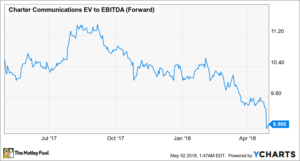
CHTR EV to EBITDA (Forward) data by YCharts

Thus, while investors saw an ugly combination of increasing costs and slowing subscriber additions last quarter (along with video subscriber declines), Charter’s ability to raise prices, offer new bundles with mobile, and decrease capital costs next year makes the company worth a look after its post-earnings drop.
Is Intel Overstating Its Growth Opportunities?

During Intel’s (NASDAQ: INTC) most recent shareholder meeting, CEO Brian Krzanich talked about how the company is on track to dramatically grow its silicon-related total addressable market (TAM) from around $45 billion in 2013 to approximately $260 billion by 2021 — a figure that’s up by around $40 billion from what the company said it was back at its 2017 investor meeting.

Of course, it’s not hard to see why Intel would want to advertise such a large TAM — the bigger a company’s TAM, the more growth it can potentially generate should it successfully gain share within it.

Intel Core processor badges.

Although some of the TAM claims that Intel makes look reasonable, I think a large portion of the TAMs that Intel cites isn’t actually addressable by the company. Here’s why.

Breaking down the TAM

Here’s how Intel breaks down its claimed $260 billion total addressable market:

  • PC and adjacencies. This consists of Intel’s PC processors, cable gateway chips, Optane solid-state drives, artificial intelligence components, and virtual reality parts (this is likely code for high-performance stand-alone graphics processors). Intel pegs the total opportunity here at $60 billion.
  • Data center. This consists of Intel’s traditional data center server processors, processors sold into the networking chip market, 3D XPoint-based memory modules, silicon phonics products, and its artificial intelligence efforts. The total opportunity here, according to Intel, is $70 billion.
  • Non-volatile memory. Intel says that its Optane 3D XPoint memory technology as well as its 3D NAND flash memory (both technologies that can be used in storage drives for both PCs and data center applications) represent a $55 billion opportunity.
  • Mobile. Intel says that the mobile processor market is a roughly $40 billion opportunity.
  • Internet of Things. Intel’s Internet of Things opportunity, according to the company, includes automated driver assistance systems (ADAS), industrial applications, video, retail, and artificial intelligence. Intel views this as a $30 billion opportunity.
  • FPGA. In 2015, Intel acquired programmable logic specialist Altera for $16.7 billion. It’s now called Intel’s programmable solutions group, or PSG. Intel says that the total addressable market for PSG’s products is $7 billion.

Many of these opportunities are real, but the problem I have is that while Intel is quoting large TAM figures in some areas, its serviceable addressable markets (SAMs) — that is, the portions of the TAMs that Intel can actually go after — are dramatically smaller than the TAMs.

The mobile problem

The most egregious cases of large mismatches between Intel’s quoted TAMs and the SAMs within those TAMs are the mobile and memory figures. Let’s go over those two.

Intel says that the market for mobile processors — that includes both stand-alone cellular modems as well as integrated applications processors for tablet and smartphone use — will be worth around $40 billion by 2021. That figure, in itself, is reasonable, but the problem is that Intel can’t actually serve a large portion of that TAM because it doesn’t yet build mobile applications processors that companies can buy. It only builds stand-alone modems and has just one major smartphone customer for those modems — the only smartphone maker that still uses stand-alone modems.

Now, some evidence has emerged that Intel is trying to enter the broader smartphone processor market after it failed to do so in the 2010-2014 time frame, but I think that until Intel formally discloses its ambitions and strategy around that market, putting out a large TAM figure for investors to salivate over (without also including a SAM figure) doesn’t seem like the right way to go.

How big is the memory opportunity?

Intel has been talking a lot about its opportunity in the non-volatile memory market. The company hopes to capitalize on both the secular transition from hard disk drives to faster, more reliable solid-state drives in areas like personal computers, as well as major data centers.

As mentioned above, Intel sees a $55 billion memory opportunity ahead that it plans to go after with its 3D NAND flash-based storage drives as well as its 3D XPoint — a type of non-volatile memory that’s much faster than NAND flash but is also more expensive — products.

While, again, I don’t think the $55 billion figure is inaccurate, I do think that number incorporates sales of 3D NAND flash technology into segments of the market that Intel doesn’t participate in, like smartphone/tablet storage. So Intel’s actual opportunity is more restricted than the TAM figure would suggest.

A proposal to Intel

I do think that Intel has broadened its total addressable market significantly over the years and the company should advertise that to its current and potential stockholders. After all, more opportunity is clearly better, right?

What I think would be more useful to investors, though, is for Intel to publish SAM numbers. Since the SAM is the portion of the TAM that a company can actually address with its current and future product portfolios, such figures can give investors a much more realistic view of the opportunities ahead of the company.

I think Intel’s SAM numbers would still be quite large (albeit smaller than the TAM figures) and would probably still be enough to keep investors interested in the Intel story.

5 Reasons Alibaba Is Just Going to Go Up From Here

Alibaba (NYSE: BABA) has reported over 50% revenue growth in the past eight quarters.

The Chinese e-commerce giant just won’t stop growing, and investors are taking notice. Alibaba’s stock has gone up about 122% in the past two years, including a 63% climb in just the past year to a still relatively cheap $196.61.

But despite the run-up, Alibaba still has plenty more room to run. For the upcoming fiscal year, the company is guiding for another impressive year of revenue growth of 60%. And while Alibaba still relies on its e-commerce platforms for the bulk of its revenue, its other projects are showing healthy growth and will contribute more and more in the coming years.

Alibaba founder Jack Ma celebrate onstage during Alibaba’s annual party

1. Alibaba’s revenue growth is strong

Alibaba’s revenue growth has been the highlight of the past two years, with each of the eight quarters showing over 50% growth.

Its annual revenue gives a better picture of how the company’s growth has really taken off in the past two years. For the past four fiscal years ended in March, Alibaba has reported revenue growth of 45%, 33%, 56%, and 58%, respectively. As you can see in the chart below, that means Alibaba’s revenue has more than doubled since 2015 from $19.5 billion to $40 billion.

Fiscal Year                      BABA Revenue                Growth BABA Revenue
2015                                              45%                        $19.5 billion
2016                                               33%                      $15.7 billion
2017                                               56%                         $23 billion
2018                                               58%                        $40 billion
2019 (expected)                           60%                          TBA
Data source: Quarterly earnings press releases.

And Alibaba is expecting revenue growth to continue this exciting trend with 60% growth for fiscal 2019. If you were to exclude the consolidation of food delivery platform Ele.me and logistics network Cainiao, revenue growth is still expected to be over 50%.

But even 50% growth might be a low estimate, because Alibaba tends to be cautious with forecasts. For the 2018 fiscal year, Alibaba originally guided for 45% to 49% revenue growth before revising it to between 55% and 56% growth and, ultimately, hitting 58% growth. And for the 2017 fiscal year, Alibaba originally guided for 48% growth but ended up hitting 56% growth. So as high as 60% and even 50% revenue growth might seem for 2019, they may actually be low estimates.

2. Alibaba’s New Retail initiatives are taking off

Alibaba executive chairman Jack Ma believes he can help save brick-and-mortar stores by giving them a “New Retail” makeover that combines the best of offline and online shopping. This is important for Alibaba’s growth because e-commerce still only accounts for 20% of shopping in China, while offline accounts for the other 80%, according to eMarketer. So Alibaba needed a way to gain access to those brick-and-mortar sales it had been missing out on.

By helping physical stores move online, Alibaba is attempting to digitize all of China’s retail market, Alibaba executive vice chairman Joe Tsai said on the latest earnings call. If the project continues as planned, Alibaba’s total addressable market (TAM) will one day be all of China’s $5 trillion retail market, according to Tsai. This presents a huge growth opportunity for Alibaba to expand its TAM.

Right now, Alibaba’s main New Retail projects include Hema supermarkets, Intime department stores, and Tmall Import. For the last quarter, Alibaba said its China commerce retail segment’s 56% revenue growth to $6.4 billion was largely a reflection of the growth in its New Retail projects.

3. Alibaba’s international growth is heating up

Another area that holds huge growth potential for Alibaba is international markets. For the past fiscal year ended in March, Alibaba’s international commerce retail revenue shot up 94% year over year to $2.3 billion.

Alibaba is using its Lazada business to aggressively pursue the Southeast Asia e-commerce market. In the past quarter, Alibaba announced that it would invest $2 billion in the business, bringing its total investment into Lazada to about $4 billion. And Alibaba’s other main international business, Tmall Global, is the top cross-border e-commerce platform in China, according to Analysys.

4. Alibaba still has plenty of room to run in China

With a population of 1.4 billion people who are still gradually moving to online shopping, China still holds big potential for Alibaba. Last year, China as a whole saw an increase of 32.3% in online sales to $1.1 billion, according to the China Ministry of Commerce. And Alibaba’s Tmall platform that operates in China already claims 51.3% of all those online sales in China, according to eMarketer.

But with New Retail, Alibaba stands to benefit even more from China’s retail economy. The country’s total retail sales are expected to grow 10% annually to reach $7.2 trillion by 2020, according to the Ministry of Commerce. If Alibaba believes that whole market — both online and offline — can become its TAM, then that’s a lot of growth potential in the near future.

5. Alibaba’s cloud segment is on fire

Alibaba’s cloud segment has shown year-over-year revenue growth of over 100% in 10 of the past 12 quarters. For the year ended this past March, Alibaba Cloud’s revenue was up 101% to $2.1 billion.

Alibaba is currently the IaaS market leader in China, claiming 47.6% market share, but it’s also expanding internationally. This past quarter, Alibaba added a cloud data center in Indonesia, which brought its global cloud-computing presence to a total of 18 countries and regions.

The company has plenty of room to run here as well. Alibaba Cloud is the No. 3 worldwide IaaS provider but has just 3% of the market, compared to Amazon’s (NASDAQ: AMZN) 44.2% and Microsoft’s (NASDAQ: MSFT) 7.1%, according to Gartner estimates. But Alibaba Cloud is crushing both companies in revenue growth, which is a good indication that it’s working on taking away market share from these two leaders.

PayPal Challenges Square With $2.2 Billion European Acquisition

Last week, PayPal Holdings Inc (NASDAQ: PYPL) announced it would be acquiring the European-based payment-processing company iZettle for $2.2 billion in an all-cash deal. The money represents about one-third of PayPal’s $7.8 billion war chest.

iZettle may be best known for introducing the world’s first mobile attachment capable of accepting EMV chip-embedded credit cards and is sometimes referred to as the “Square of Europe.” At first glance, the two companies have a lot in common. Like Square Inc (NYSE: SQ), iZettle not only provides payment-processing services to small- and medium-sized businesses but also offers a more robust commerce platform that acts as a sticky ecosystem.

iZettle is expected to generate revenue of about $165 million this year while processing approximately $6 billion in total payment volume. Though that might seem to make PayPal’s $2.2 billion bid expensive, iZettle has grown revenue at a 60% annualized rate since 2015, and as a stand-alone entity, it was expected to be profitable by 2020. The acquisition is expected to be finalized in the third quarter.

Front of PayPal corporate headquarters

Two peas in a pod

In the press release announcing the deal, PayPal CEO Dan Schulman said, “iZettle and PayPal are a strategic fit, with a shared mission, values and culture — and complementary product offerings and geographies … With nearly half a million merchants on their platform, Jacob de Geer and his team add best-in-class capabilities and talent that will expand PayPal’s market opportunity to be a global one-stop solution for omnichannel commerce.”

Schulman definitely seems to be right in that PayPal and iZettle appear to be a “strategic fit” with complementary offerings and markets. For starters, the acquisition immediately gives PayPal an in-store payment-processing presence, where it previously had none, in no less than 11 markets: Brazil, Denmark, Finland, France, Germany, Italy, Mexico, Netherlands, Norway, Spain, and Sweden. It also will tremendously accelerate PayPal’s omnichannel growth in the Australia and U.K. markets — (not so) coincidentally, two geographic areas where Square recently launched.

iZettle also has a much stronger presence in point-of-sale payment processing and merchant services than it has e-commerce services. Combined, the two entities will immediately be able to offer an impressive suite of omnichannel tools and a true global presence to merchants that competitors such as Square will be hard-pressed to match.

Exactly what PayPal was looking for

PayPal made it known it was on the hunt for possible acquisitions when it sold off its consumer credit portfolio to Synchrony Financial last fall. At the time, pursuing merger and acquisition opportunities was one of the reasons it gave for looking to free up the capital that lending directly to consumers involved.

In February, at the Goldman Sachs Global Technology and Internet Conference, COO Bill Ready revealed what PayPal was looking for in potential acquisition targets. Though I didn’t connect the dots at the time, iZettle was almost certainly in Ready’s mind as he said:

You don’t really have to buy as much if you’re really good at building and partnering. We’ve been great at both of those, but we certainly look at what might we go buy. And the things that we would tend to think about are things that could be great enablers of new commerce experiences … [T]he most differentiated part of what we do is that there’s something that can enable new types of commerce, those things are interesting, new geographies are interesting. Those are the types of things that we tend to look at. We would be less interested in things that are sort of traditional payments, some of the commoditized aspects of payments, those kinds of things … but the things that would light up new buying experiences or light up new geographies those are definitely things that we think a lot about.

iZettle seems to perfectly fit the bill for the type of acquisition PayPal has been looking for since at least jettisoning its credit portfolio last year. The company gives PayPal access to new markets while supplying it with new tools and platforms to offer merchants at the point-of-sale.

Given PayPal’s already impressive market share of e-commerce and mobile commerce, this grand entrance into the traditional retail world in new markets looks like another winning hand played by PayPal.

Progressive groups want FTC to split Facebook into multiple companies

Today, Axios reports that progressive groups will launch an advertising offensive aimed squarely at Facebook. Their mission? To convince the FTC to break up the company. They also want users on competing social networks to be able to communicate with one another, as well as the implementation of stronger privacy rules.

“Facebook is in a competitive environment where people use our apps at the same time they use free services offered by many others,” a Facebook spokesperson told Engadget. “The average person uses eight different apps to communicate and stay connected. People use Facebook, Instagram, WhatsApp and Messenger because they find them valuable, and we’ve been able to better fight spam and abuse and build new features much faster by working under one roof. We support smart privacy regulation and efforts that make it easier for people to take their data to competing services. But rather than wait, we’ve simplified our privacy controls and introduced new ways for people to access and delete their data, or to take their data with them.”

These ads will run online, and the groups (which include the Open Market Institute and MoveOn Civic Action) are putting six figures of spending power behind them. They will run on both Twitter and Facebook, as well as as more traditional display units on websites.

The groups believe that the new FTC chairman, Joe Simons, might be amenable to taking on a big tech company. While some commissioners might be sympathetic, Axios notes that no commissioners have come out in support of breaking up any American tech giants.

Facebook has certainly been in some hot water recently over fake news and privacy issues, and it’s become popular to cry for more regulation of the social networking service from both the left and the right (who claim that Facebook shows liberal bias). But this feels like a stretch. There are multiple options when it comes to social networking and messaging apps. Facebook doesn’t operate all, or even a majority, of them. While stricter privacy controls would be welcome news, breaking up the company doesn’t seem like the answer to that problem.

This article originally appeared on Engadget.

Why AI is the next frontier of medicine

During Google’s (GOOG, GOOGL) massive developers conference in early May, CEO Sundar Pichai took the stage to detail how its latest research in artificial intelligence could one day help doctors detect heart disease. What’s more, the AI system, which based its findings on scans of patients’ retinas — a method known to provide clues to a person’s heart health — was nearly as accurate as traditional blood tests.

It was an impressive reveal that drew an enormous round of applause from the audience at Shoreline Amphitheatre in Mountain View, Calif. But it’s only a small piece of a larger body of research the technology and medical communities are quickly piecing together in their quest to create AI systems that could eventually save countless lives — including your own.

An AI heart test

“To me, it seems obvious that this is the next natural step in which medicine should head,” said Dr. Sanjay Desai, director of the Osler Medical Training Program at Johns Hopkins School of Medicine.

Google’s eye test used a form of AI called machine learning, which attempts to teach a computer system how to make decisions by feeding tons of data into an algorithm.

To do that Google fed its algorithm images of both normal retinas and those of people who show signs of heart disease, an approach called computer vision. After training the algorithm, it was able to look at individual images of retinas and determine whether they belonged to healthy patients or those who may have heart disease.

Diabetic retinopathy can be identified via computer vision technology.

Google previously used machine learning to prove it can identify individuals at risk of diabetic retinopathy, a disease that can cause irreversible blindness if left untreated. After training its algorithm, the search giant said its machine learning system was as accurate as trained ophthalmologists in identifying signs of the disease. Another machine learning algorithm identified tumors in breast tissue.

Moving beyond photos

Computer vision technology can be incredibly useful in imaging, but it’s far from the only way researchers are using AI in the medical field.

At the Stanford University School of Medicine, Dr. Josh Knowles is using patients’ electronic health records (EHRs) to identify previously undiagnosed individuals with familial hypercholesterolemia (FH), a genetic heart condition that affects 1 in 250 people and results in a high chance of early onset heart disease and heart attacks if left untreated. According to Knowles, about 1 million people in the U.S. have FH, but just 10% have been diagnosed.

Dr. Josh Knowles is helping to use AI and machine learning to identify potential cardiac patients. (Source: Norbert von der Groeben/ Stanford School of Medicine )

“The idea behind the project is that we know there’s a lot of FH patients out there … that have not been diagnosed. But if we found them, we could treat them,” Knowles explained.

FH is an autosomal dominant disease, which means if you have it, you’ve inherited it from your parents and can pass it on to your children. So identifying one patient could allow doctors to help multiple family members.

To determine if someone had FH, Knowles said Stanford researchers fed entire medical records of individuals with and without FH, including text notes, prescriptions, diagnostic tests and medications into a classification algorithm that used the data to identify a pattern consistent with FH patients.

“It’s like analogous to your email system learning what spam is,” Knowles explained. “You just show it a bunch of examples of spam, and it knows what spam is.”

Knowles said researchers then pulled the charts of those individuals the algorithm identified as likely having FH and found the system performed about as well as a human in diagnosing patients.

“You could imagine this happening for … many potentially important conditions, not just FH,” Knowles said.

Predicting patient reactions

At the Cleveland Clinic researchers and doctors are using machine learning to predict the wellbeing of certain patients.

“We’re doing things to help us identify high-risk patients,” explained Cleveland Clinic’s Executive director of enterprise information management and analytics Chris Donovan. “So what patients are at risk of being admitted, what patients are at risk of deterioration in their care, or in their clinical condition and how do we intervene on those patients proactively.”

The hospital is also looking into using machine learning to determine if certain patients are good candidates for a specific type of surgery.

“Through 20 years of research and multiple randomized control trials where you isolate all of the variables except for one and follow that variable out over to time to see does this have an impact or does it not, we still know that we’re not very good at choosing who’s going to have a good outcome, or discerning is a better word, who’s going to have a good outcome and who is not,” Donovan said.

Guiding treatments

At Johns Hopkins, Desai says, work is being done with The Human Diagnosis Project to determine how physicians make decisions and treat patients. The project, according to its website is, “a worldwide effort, created with and led by the global medical community, to build an open intelligence system that maps the steps to help any patient.”

“What we’re working on now is trying to understand how physicians make decisions in today’s environment with all of the data they have,” Desai explained. “We try to sit with people who are considered master clinicians and actually talk through and try to learn how they solve cases.”

Ultimately, such a project could give doctors around the world a better understanding of how to successfully treat patients with any kind of ailment.

An artificial doctor?

Despite what research has shown, it’s important to note that doctors aren’t actively using AI or machine learning to diagnose patients in the real world. Instead, they’re testing to see how well the technology can be used in the future to inform doctors’ decisions. In other words, don’t go into your local doctor’s office asking for a machine to diagnose your runny nose.

“I think there is a ton of potential; I think there’s still a long way to go,” Donovan said. “I think there is a lot of hype. You know the idea that you can use AI to cure cancer today is really overblown. But to improve how we’re doing our work is huge.”

When the technology is fully fleshed out, though, will we say goodbye to our flesh-and-blood physicians? According to Knowles, that scenario is highly unlikely.

On a practical level, these algorithms are designed with a single goal in mind: identifying a condition or treatment method for one very specific issue. They don’t have the level of institutional knowledge a real-life doctor has amassed through years of study and training.

And on a more human level, there’s the ability for doctors to discuss problems and empathize with their patients.

“There is much more to medicine than diagnosing radiological images. It’s really the doctor patient relationship, or the provider patient relationship,” he said. “It’s more about, you know, values and understanding what people want and need, and emotional connection and things, and I don’t think that computers are going to take the spot of us.”

AI will certainly become a part of our lives in the future, similar to how computers are now a major part of our lives — but don’t expect it to replace your family physician anytime soon.