Archives for May 23, 2018

ESPN+ is essential for the cord-cutting sports fan

There are a lot of options for people looking to cut the cord these days, but live sports remains a big hurdle to getting rid of cable. Sure, the likes of Sling TV and others offer streaming access to sports on a range of networks. Those services can cost $30 or more a month, and don’t allow you to reap one of the major benefits of not having cable: saving money. A month ago, ESPN extended sports fans an olive branch in the form of ESPN+. While the standalone service doesn’t have it all, it’s well worth the $5 monthly fee.

First, let’s chat a bit about what ESPN’s WatchESPN streaming option offers cable subscribers. It’s basically an all-access pass to live streams across ESPN’s networks, including archived replays and events from ACC Network, SEC Network and a lot of streaming-only (ESPN3) live action. Like the new ESPN+, WatchESPN stuff is tucked into the main ESPN app for easy access, but there’s really no overlap between the two services.

With ESPN+, you basically get live and archived streams from a group of regional networks that ESPN has locked in deals with. Well, so long as the event isn’t blacked out in your area. This time of year, that means a lot of baseball — both MLB and NCAA (softball, too) — with a side of soccer tossed in. For me, the best part about ESPN+ is the availability of MLS matches that used to be inaccessible without adding another pricey subscription.

Before ESPN+, the options for streaming MLS matches were pretty much limited to whatever the match of the week was on ESPN or Fox — unless you were willing to pay for an additional service. And to watch those, you needed a cable plan (or someone’s log-in) to get them on WatchESPN or Fox Sports Go. Thankfully, I live close enough to Atlanta that a lot of Atlanta United’s matches were picked up by Fox Sports South and thus streamable. Other than that though, I was lucky to be able to watch two, maybe three MLS games a week. And almost never any mid-week games carried by local/regional stations. Over the last month though, I could’ve streamed every MLS match that wasn’t televised on an ESPN or Fox network with ESPN+.

Icon Sportswire via Getty Images

This is partially due to the fact that the annual MLS streaming plan, MLS Live, is now wrapped into ESPN+. What soccer fans used to pay $80 a year for now costs them just under $60 annually — and there’s access to a lot more than just footy. The old price was too much for this closet MLS fan, but the lower cost and the fact that there’s more on the table besides soccer makes ESPN+ a much better deal. If you prefer European soccer, ESPN+ also offers access to England’s second tier, the EFL Championship. That will come in handy in a few months if you follow the recently relegated West Brom, Stoke City or Swansea.

ESPN+ isn’t only handy for soccer fans, that’s just how I’m using it most right now. There are regional MLB broadcasts as well as a whole host of college sports. It’s probably also going to be useful during college football season, especially when your team is either a) playing a cupcake early in the season or 2) not in the upper echelon of the sport. The only real trade-off not having access to what you’d watch on ESPN’s TV channels — namely its studio shows. For me, that’s not really a deal breaker since only one, maybe two, of those hour-plus chunks of “analysis” are worth my time. What can I say, I’m not a fan of Mike Golic or Stephen A. Smith.

(Billy Steele/Engadget)

There some ESPN+ exclusives and there are sure to be more in the future. Right now though, the most interesting item on the list is a deep-dive NBA show hosted by Kobe Bryant. And while there’s no live access to ESPN’s flagship SportsCenter, the network recently announced a daily curated version of the show inside the ESPN app. They aren’t exclusive to ESPN+, but the 30 for 30 documentaries are also available with the $5 monthly plan.

ESPN has also done well to get its standalone option on as many platforms as possible from the jump. It’s available on iOS and Android as well as Apple TV, Chromecast and Roku (and the web, if you must). And as I mentioned already, tucking it inside the main ESPN app was a great move. It wasn’t too long ago you needed multiple pieces of software on your phone to keep up with news and live sports. But like it did with WatchESPN in 2015, ESPN made ESPN+ easily accessible inside its main app.

Unsurprisingly, given ESPN’s experience with streaming, there haven’t been any major hiccups in the first month. In fact, the only issues I’ve encountered were network problems, not anything to do with the app. If you have a cable plan and opt for ESPN+, access to WatchESPN is easy to find in the network’s app under the same “Watch” tab. There are also handy ESPN+ previews so you can see exactly what’s going on before you tap to stream. Or if you just want to take a quick peek at a score without wading in further, you can do that too. It’s a small thing, but I’ve found quite handy when I’m just browsing. I’m less likely to casually flip on an MLB game that’s already a blow out, and this helps with the decision making.

ESPN+ won’t completely cure your live sports withdrawal if you’ve already cut the cord. However, that doesn’t mean it isn’t a great deal. In fact, you get a lot of live action for $5 a month. It will also be interesting to see how other broadcasters react to it. Fox, for example, has a group of regional networks it could wrap into a similar standalone service. NBC is already doing it for Premier League soccer games it doesn’t show on its networks. Of course, that means you have to pay extra to watch any match that isn’t broadcast on an NBC channel, which is infuriating. It also means paying more for what used to be included with a cable plan. For me, that just meant I watched a lot less Premier League this year and didn’t get to see my club (Everton) play every week. NBC offers similar “Gold” subscriptions for motocross, track and field, rugby and cycling. With Disney’s big streaming push, the company could decide to offer a pricier ESPN option with access to that content you really want. But, that’s still a big bargaining chip for cable providers, so I wouldn’t hold my breath.

What ESPN+ will do is give you a respectable amount of sports at a price that doesn’t require careful planning. Disney was clear it’s a complement to ESPN and WatchESPN rather than an alternative. But that doesn’t mean there isn’t value to it being your sole method of streaming live sports. For me, that means I’m watching a lot more MLS while the European leagues are off for the summer — and it’s worth every penny.

This article originally appeared on Engadget.

Apple now has more than 50 autonomous cars on the road

Apple has more than doubled the number of its self-driving cars, the California Department of Motor Vehicles (DMV) has confirmed. Since obtaining a permit to test autonomous vehicles, Apple’s fleet size has steadily risen — from a scant three test cars, to 27 in January, and now, 55 intelligent machines. Should the program remain on course, consumers could be chilling out in the driver’s seat by 2019.

The intake is accompanied by 83 drivers who will be testing the vehicles. At this stage, Apple hasn’t been authorized to test self-driving cars independent of human supervision; for that, the company will need to submit a separate permit to the DMV — something Waymo did last month. The DMV also revealed that a second unnamed company had requested approval to begin driverless testing, but hasn’t parted with any additional details.

We do know that the autonomous car scene is heating up — Tesla and Drive.Ai are lagging behind Apple, but fellow California-native GM Cruise leads the pack with 104 vehicles with self-driving capacity. Still, one of the biggest issues inherent to automated technology is safety. The recent fatal accident involving one of Uber’s self-driving prototypes — apparently due to misaligned software — couldn’t be stopped by the test driver in time.

This indicates a margin of error that’s worth considering before rushing into fully self-driving trials; before the public can accept autonomous cars as a reliable alternative, companies need to gain its trust. There’s always a risk of mechanical failure, and human error can’t be ignored, either. but if companies identified problems and developed adequate prevention measures in advance, the number of accidents could experience a remarkable drop. That might push back release schedules, but autonomous safety should be top priority.

This article originally appeared on Engadget.

Rescuers helped injured B.C. landslide victims through waist-deep mud, debris

Gabe Rosescu and Sheri Niemegeers were injured when a landslide pushed their vehicle off a B.C. highway

Saskatchewan couple Gabe Rosescu and Sheri Niemegeers survived when a landslide swept their vehicle off the Kootenay mountain pass in B.C. on Thursday. (B.C. Transportation/CBC )

Gabe Rosescu remembers waking up hanging from his seatbelt, groaning and barely able to see.

Before he blacked out, he was travelling down a B.C. highway with his partner, Sheri Niemegeers.

“I just remember the hill, the slide falling, like the side of the mountain falling, trees and this big mud falling,” said Rosescu from a Kelowna hospital bed on Monday.

“I tried to swerve out of the way and couldn’t make it, and then just waking up in the vehicle, windows are all smashed and I’m bleeding.”

Rosescu seriously injured

Rosescu, from Regina, and his partner, Sheri Niemegeers, from Weyburn, Sask., had been driving from Saskatchewan to Nelson, B.C., to visit friends for the long weekend.

But their trip came to an abrupt halt when a wall of mud and trees came crashing down the mountain, sweeping their car off Highway 3 west of Creston.

Highway 3 west of Creston was closed for three days while crews cleaned up after Thursday’s landslide. (B.C. Transportation)

“I remember waking up in the vehicle, piece of skin hanging off of my forehead,” said Rosescu.

Although Rosescu doesn’t remember it, the pair managed to get out of the car and climb back up the slope.

But the mud was waist-deep and Niemegeers had a broken ankle, making it impossible to make it back to the highway.

The well-travelled road is perched on the side of a mountain in the province’s Southern Interior region, which has been ravaged by flooding in recent weeks.

Off-duty firefighter Marty Bowes came across the trees and mud piled high on the road shortly after the slide.

Off-duty firefighter hears calls for help

He and his co-worker were travelling from Castlegar to Cranbrook to fly back to Saskatchewan after a work trip.

Mud was still sliding down toward the highway when they arrived, and they had a brief conversation before deciding it was safe enough to search the debris.

Bowes heard Rosescu calling for help and was shocked when he saw the extent of his injuries.

“I’ve been on the fire department for 20 years now and I’ve never seen an injury as bad as Gabe — it was like something out of a horror movie,” said Bowes.

Other rescuers arrived and were able to help Rosescu back to the highway. They used one of the fallen logs to help Niemegeers “scooch” up the slope without causing further damage to her broken ankle.

Bowes lost track of the couple after they were rushed to hospital by emergency services. He was worried Rosescu might not have survived, so he was relieved when he saw a news story saying the two were recovering in hospital.

Rescuer calls Rosescu in hospital

Bowes found a phone number for Rosescu’s family and called him at the hospital.

“I just said, ‘I’m so thankful you’re alive. I’ve seen a lot of injuries and I didn’t feel very confident you were going to make it,” said Bowes.

Niemegeers has a broken sternum and ankle, while Rosescu suffered bruising of the brain, broken orbital bones, broken nasal bones, broken cheek bones, a fractured jaw and vision damage.

Rosescu said Monday he doesn’t know how he managed to survive the crash, but he thinks someone was looking out for him that day.

“I’ve had a lot of good people pass away so I’m confident that they were part of us being here today.”

Excitement, concern for latest Carlington mountain bike park plans

2 community consultations this week for project approved in 2016

Sharon Boddy (left) and Linda Landry stare out at the Ottawa skyline from the top of Carlington Park. The pair are members of a group that’s concerned about plans to build an outdoor mountain bike facility on the park’s plateau. (Trevor Pritchard/CBC)

Carlington residents will soon get a look at plans for an outdoor mountain bike facility at a local park — and there’s both excitement and trepidation about what they’ll see.

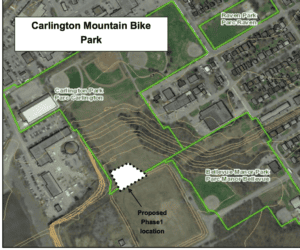
In September 2016, Ottawa city council approved a proposal put forward by the Ottawa Mountain Bike Association (OMBA) to build the facility on top of a former ski hill in Carlington Park.

That proposal involved creating a circuit of small hills and jumps called a “pump track” along a plateau at the top of the hill, with a nearby area for mountain bikers to practice their skills.

Now, more than a year and a half after council gave the go-ahead, the OMBA will be presenting its latest vision later this week at a pair of community consultations arranged by River ward Coun. Riley Brockington.

“There’s a lot of experienced hands and eyes that have looked at this, designed it, and did some modifications to it,” said Jim Winkel, a Carlington Community Association member who’s part of a working group involving the mountain bike project.

“So I’m pretty excited to see this draft coming out.”

In September 2016, city council approved the Ottawa Mountain Bike Association’s plans to go ahead with an outdoor mountain biking facility on a plateau of Carlington Hill. (City of Ottawa)

Could start work this summer

The initial plan was to install the tracks and jumps in 2017, but that was delayed to both spread word about the facility and apply for funding, said OMBA member Marc Brulé, the project’s volunteer coordinator.

Last fall, the OMBA received a grant from the City of Ottawa that would match the association’s contributions to the project up to $153,000.

City staff initially said the project would not receive municipal funding.

The association is now in the midst of a fundraising drive, Brulé said.

An online crowdfunding campaign had raised roughly $3,500 as of Monday afternoon.

Both Brulé and Winkel said Carlington Hill makes perfect sense for the outdoor, free-of-charge facility, given its proximity to bike trails and public transit and the fact it’s in the middle of an inner city suburb with a large number of young people.

“I think that this will give a good venue to one of Ottawa’s more challenged neighbourhoods,” said Brulé.

“So I view it as a good thing.”

Park ‘a real gem’

Carlington Hill, however, is already a popular spot for people to walk their dogs, exercise, and commune with nature — and some users would prefer it stay that way.

“I see this as a real gem. I’m an amateur naturalist. I’m a forager. This is one of my living labs. And it has been for almost my entire life,” said Sharon Boddy, part of the Friends of Carlington Hill community group.

The group has about 70 “core members,” Boddy said.

It has multiple concerns about the project, including whether it will block off existing pedestrian pathways and how significant its ecological impact might be.

We don’t see in OMBA’s plans how they’ve given consideration to [fitting] in to the existing community in a harmonious way.
– Linda Landry, Friends of Carlington Hill

Both Boddy and Linda Landry, another Friends of Carlington Hill member, said they felt basic details about the project haven’t been forthcoming — such as how garbage will be hauled away from the site or whether it will be fenced off.

They both hope they’ll get answers at this week’s meetings.

“People here do a lot of different things. They’re running up and down the hill, they’re biking through, they’re playing games with their friends,” said Landry.

“All of that’s going on, and it’s working very well. And we don’t see in OMBA’s plans how they’ve given consideration to [fitting] in to the existing community in a harmonious way.”

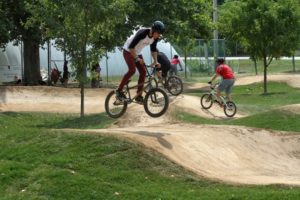
A pump track, like this one at a park in Hamilton, consists of a continuous loop with small bumps and turns. It would be a key element of the outdoor facility the Ottawa Mountain Bike Association plans to build at the top of Carlington Hill. (Kelly Bennett/CBC)

Small footprint

The first consultation takes place Friday afternoon at the Carlington Recreation Centre, while the second is scheduled for the next morning at the Bellevue Community Centre.

Brulé said the city-allocated land for the project would only cover a “small percentage” of the park.

“I think that we’re not looking at things that will take away all of [the park’s] space,” Brulé said.

“We’re going to share the park.”

While pump tracks built in other communities have been fenced off — typically to protect them from being damaged when it rains — Brulé said that’s not part of OMBA’s plans.

He said it would be “a real shame” if people dug their heels in over the facility.

“From what we have seen [in] a number of other places that have put in bike parks, there’s not a lot of conflict once the bike parks are in,” Brulé said.

“It’s really amazing how you see people from all walks of life, all ages, all ability levels in the same area. It really works well.”

Blue carbon is the billion-dollar resource you’ve never heard of

Mud and plants along the Bay of Fundy soak up 3-5 times more carbon than trees

“Blue carbon” is the term coined by scientists to describe carbon dioxide that is stored in coastal vegetation and soil. (Brett Ruskin/CBC News)

The Bay of Fundy may soon be known for more than its powerful tides.

Instead, the plants and mud in the coastal ecosystem have the potential to hold hundreds of millions of dollars worth of carbon-offset credits.

Environment and Climate Change Canada is studying how much “blue carbon” is stored along the Bay of Fundy coastline. It has hired a team to measure the bay’s potential for carbon sequestration.

“Blue carbon” is a term coined by scientists to describe carbon dioxide stored in coastal plants and soil.

On land, forests capture carbon dioxide and produce oxygen. Coastal ecosystems do the same — but they’re much better at it.

Anything trees can do, ‘blue’ can do better

“Coastal ecosystems can hold three to five times more carbon than the equivalent area of forest,” said a federal government document published online in February.

Carbon dioxide and other greenhouse gases have been linked to global warming and climate change.

Forests release their carbon every few hundred years, due to fire, tree mortality or human harvesting. By comparison, coastal marshes maintain their carbon for thousands of years.

“It just stays there and gets buried,” said Gail Chmura, one of North America’s foremost experts in blue carbon research. She is an associate professor in the geography department at McGill University.

She’s studying a marsh in Dipper Harbour, N.B., that has been soaking up and locking in carbon dioxide for 3,000 years. Many others are even older than that.

Making green off blue carbon

The financial value of blue carbon comes from its potential for carbon emission credits.

The Canadian government is gradually introducing a carbon levy. Various industries will have to pay a fee based on their carbon emissions.

That fee will increase annually until 2022, when it will be $50 per emitted tonne of carbon dioxide.

On the other hand, if a company removes carbon from the atmosphere, it could generate revenue by selling offset credits.

According to government documents, “carbon stored in tidal salt marshes in the Bay of Fundy could have an estimated value of $202 million.” That would equal $1 billion in 2022.

It’s not clear how blue carbon will fit into the national carbon emissions strategy. It could be used as an offset to meet international targets.

Coastal communities could also be allowed to protect or rehabilitate wetlands to generate carbon credits.

“So, for example, you take a flight and you feel guilty, you can buy those offset credits,” said Chmura. “You could offset your flight. But no one has yet taken advantage of that to restore a salt marsh in Canada.”

Officials with Environment and Climate Change Canada declined an interview request until the work to calculate the Bay of Fundy’s blue carbon potential is complete. That is expected to be later this year.

Blue carbon recipe: just add water

An experiment that began in 2010 has proven how easy it is to generate blue carbon.

Two sections of drained farmland in Aulac, N.B., were allowed to flood. The sections totalled approximately the size of three CFL-sized football fields.

Scientists, including Chmura, monitored the site to see if vegetation would grow and carbon-rich mud would accumulate.

“Within six years, up to a metre of mud accumulated in that area that was opened up,” Chmura said. “That’s an astounding amount of mud and that mud is very carbon rich.”

The newly created marshland captured 2,493 tonnes of carbon, according to a scientific report published in the online journal Plos One. That carbon sequestration could be valued at up to $124,650 under Canada’s new carbon levy regime.

This type of land is also available for a bargain. The study estimated the marsh would have cost approximately $25,700 to purchase.

While regulations aren’t in place for communities to make money on blue carbon projects like these, the Aulac experiment shows the potential for this type of work.

“You can make money off it, you get all the ecosystem services, you get the habitat that salt marshes have been cherished for, and you get the carbon storage out of the atmosphere,” said Chmura.

How a Montreal music duo ended up making it big in Britain

Banx & Ranx make electronic Caribbean music for the likes of Sean Paul and Diplo

Zoke, left, and KNY, right, of Banx & Ranx are putting Montreal talent on British music charts. (Jono White)

Banx & Ranx, a Montreal beat-making duo, couldn’t have predicted the success of their latest track, Answerphone.

Released in March, it’s now made a major splash in Britain.

The song debuted on the BBC Top 40 at #19 and cracked the top 10 after nine weeks. The video has over 7 million views on Youtube.

“We had no idea,” said Zacharie Raymond, also known as Soké.

“But, we were really confident in the record. We’re proud of it,” added Yannick Rastogi, aka KNY Factory. “And then, it just happened.”

Raymond and co-producer Rastogi make up the band Banx & Ranx, offering up electronic music that makes listeners sway and bounce.

The hit song, featuring British pop stars Ella Eyre and YNG Bane, took only one day to write.

But they didn’t do it alone.

In a studio session in London, Banx & Ranx, worked through drum patterns, chords, melodies and lyrics with Ella Eyre.

Parlophone labelmate, Jacob Manson of the British group Blonde contributed, as well as singer and songwriter Shakka.

They were fans of YNG Bane, and he agreed to add his lyrical touch.

The song has all the characteristics of the Afro-beat-caribbean trap music that is essential for any great dance party these days — think Drake and Wizkid collaborations, or Justin Bieber’s hit song “Sorry”.

For their particular style, Banx & Ranx call the genre ECM: Electronic Caribbean Music.

Both of them are based in Montreal, but met online in 2014, and realized they had the same musical goals.

“We both wanted to make a hybrid — bring Caribbean music to a different sphere,” explained Raymond.

But they weren’t just trying to be on trend.

Rastogi was a solo artist performing as KNY Factory and producing dancehall trap and hip hop music when he came to Montreal from the French-Caribbean island of Guadeloupe.

So his connection to Caribbean music was unavoidable, even though is he of French-Canadian and Indian heritage.

“If you love what you do, and you’re 100 per cent confident in what you do, no matter your colour skin, no matter where you come from,” Rastogi explained about the question of having to prove that they can create this kind of music.

“If you embrace the culture and you respect everyone else’s culture [then it’s not harder for you].”

Raymond, who is originally from Ottawa, was trying to carve out a space in a non-existent reggae-dancehall scene in Montreal as a vocalist and electronic music producer.

He said he’s always loved reggae music. Eventually he developed an even deeper connection to Jamaican culture, being a part of a West-Indian family, raising kids who are half-Jamaican.

“Even though we’re considered two white boys from the North, we have so much respect for the music and the codes,” he said. “You can’t master it, if you don’t.”

But despite flying to England once a month to write, produce and record songs — since signing two years ago with Parlophone, one of the largest and oldest record labels in the country — Banx & Ranx want to stay on this side of the Atlantic.

They see Montreal as the next Toronto, offering new music to the world in many languages as a result of the eclectic nature of the city and, of course, the mix of people who call the city home.

“We invest in local artists and writers. We still keep time and energy for people over here.”

They are, however, disappointed with the slow pace of change in the music industry in Quebec, a model they call “old-fashioned,” where the approach is still “too conservative and too white.”

Parlophone has been making sure that the Banx & Ranx sound grows, getting them to write and produce music for the top talents out there.

Now artists and labels are requesting to have their songs remixed by the Montreal team.

Before the end of this month and leading into summer, expect to hear some new Sean Paul music produced by Banx & Ranx.

They also worked on the dancehall star’s “Mad Love” release with David Guetta, and were called back to contribute to more singles.

“It’s all about having fun with people. This is how you get the best of anyone,” said Rastogi.