Archives for May 2, 2018

Better Buy: Johnson & Johnson (JNJ) vs. AbbVie (ABBV)

This big drugmaker faces challenges in the future for its top-selling product, a highly successful immunology drug. But it also has one of the fastest-growing cancer drugs in the world in its lineup and a promising pipeline. In addition, the company pays a solid dividend that many investors love.

What company am I talking about? Johnson & Johnson (NYSE: JNJ), of course. But I’m also referring to AbbVie (NYSE: ABBV). Each of the statements applies to both of these big pharma companies.

AbbVie has been the better stock over the last few years, but which is the better pick for long-term investors? Here’s how AbbVie and J&J compare.

Woman holding palms facing upward in front of chalkboard drawing of scales

Growth prospects

AbbVie appears to have the stronger growth prospects over the next several years. The company should enjoy a few more years of growth for its top-selling drug Humira. Although Humira will see challenges from biosimilars in Europe later in 2018, it should keep biosimilar rivals at bay in the more lucrative U.S. market until 2023.

Meanwhile, AbbVie recently announced a monster first quarter, with tremendous sales growth for cancer drug Imbruvica. The biggest story in Q1, though, was the big sales jump for new hepatitis C virus (HCV) drug Mavyret.

AbbVie also has a pipeline loaded with potential winners. Upadacitinib and risankizumab could be worthy heirs to Humira in the immunology arena. The company hopes to win FDA approval for elagolix in managing endometriosis within the next couple of months. AbbVie also has several oncology programs that could pay off, despite a significant setback in March for experimental lung cancer drug Rova-T.

Johnson & Johnson has a more immediate challenge for its top-selling drug Remicade. Biosimilar competition already is taking a toll on sales for the immunology drug. Sales also are falling for other drugs in J&J’s current lineup, including Concerta, Invokana, and Risperdal Consta.

However, J&J does have several growth drivers. Immunology drugs Simponi and Stelara continue to enjoy strong momentum. Sales for J&J’s cancer drugs Darzalex, Imbruvica (which it co-markets with AbbVie), and Zytiga are growing briskly. Its pulmonary hypertension franchise, acquired from Actelion, is also contributing to the company’s overall growth. J&J also recently won Food and Drug Admnistration (FDA) approval for promising prostate cancer drug Erleada.

J&J’s pipeline includes several late-stage programs seeking additional indications for already-approved drugs such as Xarelto, Invokana, Simponi, Stelara, Imbruvica, and Tremfya. The company also has some new drugs that could be on the way, notably including esketamine for treating depression.

Overall, though, Johnson & Johnson likely won’t grow as quickly as AbbVie. One reason is that much of the company’s growth in the first quarter came from acquisitions, especially the buyout of Actelion. In addition, J&J’s growth is held back somewhat by its consumer healthcare and medical-device segments.

Dividend

Johnson & Johnson claims one of the best track records for dividends, with 56 consecutive years of dividend increases. The company’s dividend currently yields 2.57%.

AbbVie’s dividend history isn’t too shabby, either. It’s increased its dividend by 140% since being spun off from Abbott Labs in 2013. AbbVie’s dividend yield currently stands at 4.2%.

Valuation

Probably the best way to compare these two companies’ valuations is to look ahead. Johnson & Johnson stock trades at a little under 15 times expected earnings. That’s relatively inexpensive considering the stability of the company.

AbbVie, however, looks like a bargain. The stock trades at only 11 times expected earnings. Factoring in its growth prospects makes AbbVie stock look even more attractive.

Better buy

I have long believed that Johnson & Johnson is one of the premier blue-chip stocks on the market and still hold that view. Because of its wide range of businesses, J&J gives investors exposure to multiple areas within the healthcare sector by buying only one stock. So is J&J the better buy? I don’t think so.

As much as I like Johnson & Johnson, I think there’s a more compelling case for AbbVie right now. The stock is oversold, in my view, because of the Rova-T clinical failure mentioned earlier. AbbVie has better growth prospects than J&J and claims a more attractive dividend yield. While the company can’t afford another major pipeline setback, I like the overall value proposition for AbbVie right now.


When Investing, Sometimes Boring Is Beautiful

The past nine years have truly been incredible for long-term investors. Sure, we endured the steepest bear market decline we’d seen since the early 1930s, but we also subsequently witnessed an approximate quadrupling in the iconic Dow Jones Industrial Average and broad-based S&P 500 over this nine-year stretch.

Yet as investors, we also know that nothing goes up forever. Both the Dow and S&P 500 underwent their first corrections — i.e., a loss of at least 10% from a recent high — in two years in February. What’s more, the Federal Reserve is in the midst of tightening its monetary policy. In plainer terms, interest rates are on the rise, which has a tendency to slow down demand for the relatively cheap loans that have been fueling corporate expansion and acquisitions. A rising rate environment has historically been bad news for the stock market, more often than not.

Boring stocks can make for great investments during turbulent times

So, what’s this mean for investors? It suggests the possibility that higher-growth, buzzier stocks, such as the FANG stocks, which have been go-to investments for years, might struggle to outperform if the U.S. economy slows or the stock market stalls. If a slowdown in growth is on the way — and make no mistake, peaks and troughs in the economic growth cycle are inevitable — the most lucrative investments could turn out to be “boring stocks” with time-tested business models.

What makes a stock boring? Ultimately, that definition is fluid and up to each individual investor. I’d personally define a boring business model as one that lacks flash and surprises. You as the investor know exactly what to expect year in and year out, with slow but steady growth being delivered on the top and bottom lines. Boring stocks also tend to offer above-average dividend yields, since their businesses are mature and often lack the ability to grow beyond the mid-single-digits from one year to the next, even with substantial reinvestment.

These boring stocks are often forgotten when the stock market is off to the races as their returns struggle to match the numbers from buzzier names like Facebook or Amazon, which offer a stronger growth rate. Yet, boring stocks tend to be less volatile during corrections and bear markets thanks to their steadier business models and predictable cash flow. They’re arguably the truest examples of set-it-and-forget-it investments.

Two teenage girls texting on their smartphones.

Are these time-tested stocks right for you?

Right now, four of these so-called boring stocks are valued at fundamental levels we haven’t seen in years. Might these stocks be the key to thriving during the next bear market?

AT&T

Telecom and content provider AT&T (NYSE: T) dove more than 4% — a big move for this low-volatility stock — last week after its first-quarter results modestly missed expectations. While the company has been adding postpaid wireless subscribers and grown its DirecTV streaming service, it’s still witnessed a small decline in linear video subscribers as telecom peers have looked to undercut its pricing.

Yet, following its post-earnings decline, AT&T’s forward P/E of 9.5 would be its lowest level since 2010. It’s also now sporting a delectable and sustainable 6% dividend yield, which is close to three times the average yield of the S&P 500. Reinvesting this dividend, assuming a static share price, would double your money in about 12 years.

AT&T certainly doesn’t offer flash, but it controls about a third of domestic wireless market share, and it has worked to grow DirecTV’s streaming business following its acquisition of the satellite content provider in 2015. Further, investments being made in next-generation 5G wireless networks could provide the next long-term growth spark for AT&T.

An assortment of Procter & Gamble’s global brands.

Procter & Gamble

Procter & Gamble (NYSE: PG), the company behind Tide detergent and Crest toothpaste, among dozens of other owned brand-name consumer products, has struggled in recent quarters as online competitors like Amazon eat into traditional brick-and-mortar businesses and pressure the pricing of brand-name goods. As a result, P&G’s forward P/E of 16.2 is a low point over the past two years, while its price-to-sales ratio is now at a five-year low. It’s also sporting a superior 3.8% yield.

But don’t think this king of consumer goods is sitting idly by while sales grew by 1% on an organic basis in the recently reported third quarter. The company plans to focus on cost-cutting initiatives that’ll allow it to be price-competitive with online retailers, as well as on emphasizing the quality of its brands. This shouldn’t be too difficult given that no company spends more on annual advertising than Procter & Gamble.

The company also recently announced the acquisition of Merck KGaA’s Consumer Health Care business. In doing so, it’ll add faster-growing over-the-counter healthcare products, while at the same time broadening its geographic reach. There’s nothing flashy about P&G’s business model, but it certainly is consistent.

A young man smoking a cigarette.

Philip Morris International

Another brand-name company that recently went up in smoke is tobacco products maker Philip Morris International (NYSE: PM). The company suffered through its worst day in history two weeks ago after describing sales of its iQOS heated-tobacco system in Japan as having “plateaued.” With traditional tobacco product sales challenged in a number of developed markets, this heated-tobacco system has been viewed as a next-generation growth driver for Philip Morris International.

Following the company’s worst single-day performance since its split from Altria in 2008, it’s now valued at a forward P/E of 15.4 and a price-to-sales ratio of 4.3, both of which are lows not seen since 2010. Further, its dividend yield of 5.2% more than doubles the average yield for S&P 500 stocks.

While slowing iQOS growth in Japan isn’t something investors should overlook, it’s also important to keep in mind that Philip Morris International sells its tobacco products in dozens of countries around the globe. Even if it’s facing growth concerns in developed markets, emerging markets like India and China offer channels for traditional combustible tobacco product growth. When added to the potential to expand iQOS into other developed countries (beyond just Japan), as well as Philip Morris’ tobacco pricing power, it becomes evident that this tobacco giant isn’t going anywhere anytime soon.

IBM

Even IBM (NYSE: IBM) could find itself in the “boring is beautiful” discussion. IBM’s latest quarterly results sent its shares tumbling after its full-year guidance, which called for at least $13.80 in full-year EPS, failed to impress Wall Street, which is already calling for $13.83 in full-year EPS.

IBM has been weighed down for years by its legacy systems, which have ceded way to mobile and cloud computing. As a result, the company’s forward P/E of 10.6 is about as low as it’s been since 2015. The recent decline has also pushed IBM’s dividend yield back above 4%.

What’s important for investors to realize, here, is that IBM has placed a lot of emphasis on next-generation technology. The company’s cloud segment generated $17.7 billion in sales over the trailing-12-month period, up 22% year over year, and it now represents more than 20% of total annual revenue. It’s also been a leader in blockchain development, which could be a major growth driver within the next five years. Once again, IBM offers little to no pizzazz, but it does bring consistent cash flow and a healthy dividend to the table.

All four of these businesses may be boring, but they just might hold the keys to outperforming in a turbulent market.

Helmerich & Payne’s Earnings Improve at a Frustratingly Slow Pace

Helmerich & Payne’s (NYSE: HP) earnings have been a bit peculiar over these past few quarters. Even though rig counts have risen considerably since their nadir back in May 2016 and its fleet utilization numbers have grown, the oil rig lessor is still posting net losses each quarter. Considering how much better other oil services companies are doing lately, especially those with a large concentration in U.S. shale, it seems odd that Helmerich & Payne’s results have been so slow to recover.

Let’s examine the company’s most recent quarterly report to see what is going on with this string of losses and what it will take for it to get back to turning a profit.

Drilling rig and pumpjack at sunset.

By the numbers

Metric                        Q2 2018                    Q1 2018                              Q2 2017
Revenue                   $577.5 million               $564.1 million             $405.3 million
Operating income ($1.2 million)               $3.5 million                      ($65.6 million)
EPS (Diluted)              ($0.12)                           $4.55                            ($0.45)
Free cash flow            $26.7 million              ($58.5 million)               $7.8 million
Data source: Helmerich & Payne earnings release. EPS = earnings per share.

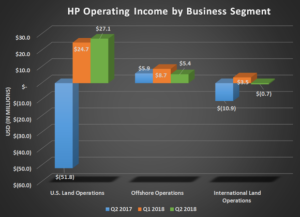
One thing that has been noticeable lately has been the slowdown in revenue growth we saw in the prior quarters. While producers are still adding rigs for their drilling programs, it is at a decidedly slower rate than what we saw a year ago. The side benefit to this is that expenses for rig reactivations have declined to the point that Helmerich & Payne’s U.S. land drilling segment is pulling in a steady profit. This is helping to offset weakness in its offshore and international land segment, which shouldn’t take much since its U.S. land segment is much larger than the other two business segments combined.

Graph of HP operating income by business segment for Q2 2017, Q1 2018, and Q2 2018. Shows declines for offshore and international offset by gains in U.S. land

All in all, these numbers were fine, but what was more promising was the company’s improving outlook for the upcoming quarter. According to its press release, Helmerich & Payne expects revenue from all three of its segments to increase, as it has received interest for its idle equipment. Also, the company continues to upgrade its fleet at a high rate, so there should be ample rigs to take up any spare capacity in the market right now.

What management had to say

Over the past few quarters, Helmreich & Payne has been bragging about its ability to take market share from its competitors. In the press release, CEO John Lindsay touted how the company’s fleet is commanding a high market share and how it plans to gain even more over the next few quarters:

The demand for super-spec rigs continues to persist as the industry’s super-spec fleet remains nearly 100% utilized. H&P leads the way with more than 40% of the super-spec market share in U.S. Land. We also have approximately 50% of the industry’s idle rig capacity not already at super-spec capability that can be readily upgraded to those specifications in the current pricing environment. Our robust financial position and the composition of our fleet continues to drive our ability to respond to current and future FlexRig demand. Given the tightening market conditions for FlexRigs and the value proposition we provide for customers, we expect increases in average dayrates for our rigs in the U.S. Land spot market to accelerate during the next few months.

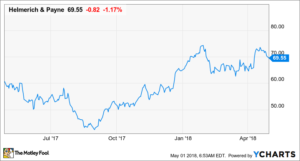
HP data by YCharts.

Market share now, payoff later

It’s a little curious to see Helmerich & Payne continue to upgrade its fleet at such a fast pace when the rate of rigs getting added to the field has slowed down considerably. One would think it would be an opportune time to slow the upgrade rate to lower costs and focus on improving margins and cash flow.

Instead, its high rate of upgrades and management’s comments about market share suggest that the company wants to ensure that any rig getting added to the field today will be a Helmerich & Payne rig. It doesn’t want to give any of its competitors any opportunity to add newbuild rigs to their fleets to meet incremental demand. After all, only 59% of Helmerich & Payne’s U.S. land fleet is utilized.

With oil prices rising steadily, it’s likely that we will see a few companies increase their capital budgets and put a few more rigs into the field relatively soon. If Helmerich & Payne can capture those additional rigs, then this high rate of spending will have been worth it.

As Good as Chevron’s Earnings Look, Something Feels Lacking

Chevron (NYSE: CVX) certainly deserves some credit for its most recent quarter. Higher production and higher prices led to a 39% increase in net income and gave management confidence to raise its dividend. But even though there was a lot of good news in this report, there is still something that doesn’t feel quite right when you compare Chevron’s future to its peers’.

Here’s a brief look at the company’s most recent earnings results and some of the milestones it hit this past quarter, as well as the oil giant’s plans for the future.

By the numbers

Metric                            Q1 2018                                 Q4 2017                                 Q1 2017
Revenue                     $37.8 billion                                    $37.6 billion                      $33.4 billion
Net income                $3.64 billion                               $3.12 billion                        $2.68 billion
EPS (diluted)                  $1.90                                         $1.64                                               $1.41
Operating cash flow       $5.04 billion                           $6.23 billion                            $3.78 billion
Data source: Chevron warnings release. EPS = earnings per share.

Chevron turned in one of the better quarters among the big oil companies thus far, in large part because its business is so much more tied to upstream production than the rest. Higher production rates from its core production assets and much higher realized prices — the average realized crude oil price was $61 per barrel — were the driving force behind this past quarter’s results.

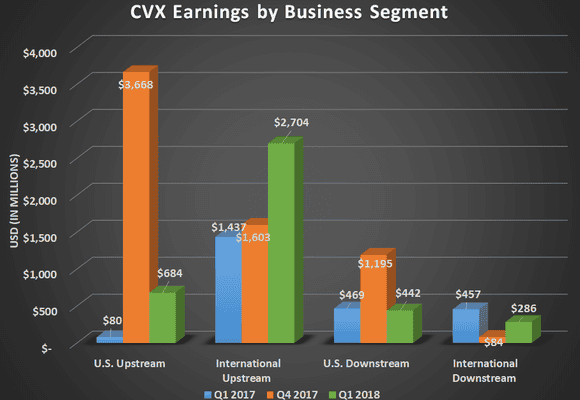
Breaking down these results into their respective business segments, you have to keep in mind that the company took a lot of one-time charges and benefits last quarter related to U.S. tax law, so take any U.S.-based business result with a grain of salt. The one that stands out here the most is the gain in international upstream, which was mostly attributed to its Gorgon and Wheatstone liquefied natural gas (LNG) facilities. Even though they export natural gas, the contracts in place are indexed to oil prices. That’s how its natural gas price realization — $5.85 per thousand cubic feet — was much higher than many of its peers’ in the quarter.

Chart showing Chevron earnings by business segment for Q1 2017, Q4 2017, and Q1 2018. Shows large gains for both U.S. and international upstream

Even though earnings were impressive for the quarter, cash flow was surprisingly light. That’s because Chevron had a large working capital build in the quarter. Adjusted for working capital movements, operating cash flow would have been a much more robust $7.1 billion. It ended the quarter with a net debt-to-capital ratio of 18.1%.

The highlights

  • First-quarter production came in at 2.85 million barrels of oil equivalent per day (BOE/D), an impressive 6% increase from this time last year. The two big drivers of this were Chevron’s shale operations in the Permian basin and the continued ramping up at its Gorgon and
  • Wheatstone LNG facilities in Australia. These two projects helped to offset natural field decline and about 60,000 barrels per day of asset sales.
  • Management was very adamant about noting that there was a large working capital build in the quarter that kept operating cash flow results down. Historically, the company has had large capital builds in the first quarter that draw down through the rest of the year.
  • Its results in the Permian Basin continue to be the crown jewel of Chevron’s portfolio. First-quarter production in the basin was 252,000 BOE/D. Even after management increased its forecast, production rates continue to wildly outpace guidance.
  • The board of directors approved a 4% increase to its dividend.
A floating production, storage, and offloading facility at dusk.

What management had to say

Here’s CEO Michael Wirth’s press release statement on the company’s most recent results:

Our cash flow continues to increase with the powerful combination of expanding upstream margins and volumes. Oil and gas production is increasing, most notably in our Gorgon and Wheatstone LNG Projects in Australia, and our shale developments in the Permian Basin where production grew 65 percent from a year ago. Upstream volumes are expected to continue to increase in future quarters.

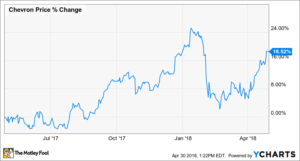
CVX data by YCharts.

The capital plan seems to be missing something

Over the past several months, most of Chevron’s peers have announced or started some form of capital return program involving buybacks and higher dividends. While management did just announce a dividend increase, it has been surprisingly quiet about any intention of share repurchases or something similar. The absence of a shareholder-friendly plan stands out even more when you look at its modest capital spending plans over the next few years. This capital plan is screaming for some form of capital return to shareholders, but management has said in analyst meetings and conference calls that it is pretty low on its lists of cash priorities right now.

According to CFO Pat Yarrington, it wants to get to a place where it has a more sustainable rate of excess cash flow such that it can make routine buybacks, and that the priority right now is paying its dividend with cash only and to grow that payout. The trouble is, Chevron has chosen to leverage itself to upstream production more than its peers, so sustainable rates of excess cash flow will be much harder to attain in the long run.

Something feels lacking in Chevron’s current capital plan, and its backlog of potential projects outside the Permian Basin is looking mighty small. I think management has something simmering on the back burner that will get announced soon because the current trajectory it has in place just doesn’t seem to add up to a value proposition as strong as its peers’.

Scientists create ultra-thin membrane that turns eyes into lasers

It will still be a while before scientists are able to harness Superman-like laser vision, but the technology is now closer than ever before thanks to a new development from the University of St Andrews. The team there have created an ultra-thin membrane laser using organic semiconductors, which is for the first time compatible with the requirements for safe operation in the human eye. Even though the membrane is super thin and flexible, it’s durable, and will retain its optical properties even after several months spent attached to another object, such as a bank note or, more excitingly, a contact lens.

The ocular laser, which has so far been tested on cow eyes, is able to identify sharp lines on a flat background — the ones and zeros of a digital barcode — and could be harnessed for new applications in security, biophotonics and photomedicine. Team member Professor Malte Gather said: “Our work represents a new milestone in laser development and, in particular, points the way to how lasers can be used in inherently soft and ductile environments, be it in wearable sensors or as an authentication feature on bank notes.”

This article originally appeared on Engadget.

Badoo adds Live Video chat to its dating apps

European dating giant Badoo has added a live video chat feature to its apps, giving users the chance to talk face-to-face with matches from the comfort of their own home — and even before agreeing to go out on a first date.

It’s claiming it’s the first dating app service to add a live video feature, though clearly major players in the space were not holding back because of the complexity of the technical challenge involved.

Rather live video in a dating app context raises some immediate risk flags, including around inappropriate behavior which could put off users.

And for examples on that front you only need recall the kind of content that veteran Internet service Chatroulette was famed for serving straight up — if you were brave enough to play.

(“I pressed ‘play’ last night at around 3:00 am PST and after about 45 clicks on ‘Next’ encountered 5 straight up penis shots,” began TechCrunch’s former co-editor Alexia Tsotsis’ 2010 account of testing the service — which deploys live video chat without any kind of contextual wrapper, dating or otherwise. Clearly Badoo will be hoping to achieve a much better ratio of quality conversation to animated phalli.)

But even beyond the risk of moving dick pics, video chatting with strangers can just be straight up awkward for people to jump into — perhaps especially in a dating context, where singles are trying to make a good impression and won’t want to risk coming across badly if it means they lose out on a potential date.

Sending an opening text to a dating match from a cold start can be tricky enough, without ramping up the pressure to impress by making ‘breaking the ice’ into a video call.

So while dating apps have been playing around with video for a while now it’s mostly been in the style of the Snapchat Stories format — letting users augment their profiles with a bit of richer media storytelling, without the content and confidence risks associated with unmoderated live video. And it’s a big step from curated and controlled video to the freeform risk and rush of live video.

Regardless, Badoo is diving in — so full marks for taking the plunge.

The feature has been introduced with some prudent limits too though. Badoo says video chat will only be switched on once both parties have matched and exchanged at least one message each.

And on the inappropriate content front, it has this guidance: “If a user is not what you expected, you can easily block or report that person so they will no longer be able to contact you again.” So basically if you get flashed, you can block and report the flasher.

To start a video chat with a match they’ve messaged with a user taps the icon in the top right corner of the chat screen — then they have to wait (and hope) for their call to be accepted.

While there are risks here, there is the potential for the feature to be really useful in an online dating context — if enough users can get over the confidence bump to use it.

Video chats could help to solve the core problem for online daters of how to know whether there’s any chemistry with a match before you actually meet them. Because while two people can aesthetically appreciate each other’s Instagram portraits from afar, and even like the cut of each other’s textual jib remotely, they still can’t know for sure ahead of time whether there’s any chemistry until they meet. And by then it’s too late — hence all those awkward first date stories.

Live video chatting isn’t as informative as meeting in person, of course, but it’s the next best thing technology can deliver for now — hence Badoo couching the feature as a way to “audition your date” before you meet. Though that phrasing does risk amping up the pressure.

The company also says live video can help enhance dating app safety — saying the feature can be a way for users to suss out a stranger to see whether seem trustworthy before risking meeting in person, and also help to weed out fake profiles and catfishing attempts — arguing: “It’s a safe way to have clarity on exactly who you’re talking to.”

So it may help to figure out if that stunner you matched with really is a Russian model wanting to date you or some Kremlin-backed scammer. (Though Badoo does already have some features aimed at thwarting catfishing, such as a request a selfie feature and a photo verification option; and, well, fake Russian models are unlikely to ever pick up your incoming call — unless it’s a very sophisticated scam indeed. Or, well, you’re actually talking to a professional dating service who your match has paid to carry out their dating ‘grunt work’ — in which case they’ll make you schedule in a live video hours or days in advance.)

On the flip side, live video chatting will inevitably be more daunting for less confident singles to use, so certain users may end up feeling disadvantaged and/or falling to the back of the dating queue vs more extroverted types who relish the opportunity to express themselves in the moment and in front of a lens.

Or it could just end up being a feature that attracts only a subset of likeminded users and the rest carry on as normal.

Now that Facebook has decided to take inspiration from Bang With Friends and directly cater to date-seekers inside its walled garden — announcing a forthcoming matchmaking service at its f8 conference yesterday — it’s clear that dedicated dating/matchmaking services like Badoo are going to have to up their game to stave off the competitive threat. So offering richer feature sets to further engage their communities of singles is going to be important.

Facebook’s dating foray has been given the unfortunate name of ‘FaceDate’ but will nonetheless benefit from the massive leg over of Facebook’s gigantic reach combined with the gravitational network pull of it owning and operating multiple popular social services.

The company also has oodles of data — thanks to its pervasive snooping on people’s online activities — so if you buy into the theory that love can be algorithmically reverse engineered then Facebook certainly has enough data-points to play at being Emma.

It does not yet have the direct community of daters though — so it’s coming from behind in that sense. And young users have been less engaged on Facebook itself for a while — preferring other social apps like Instagram, for example.

Even so, dating apps like Badoo can’t afford to get complacent and will need to work hard to keep their communities engaged — or risk Facebook spinning up another gravitational blackhole to suck out their USP. This is why investors punished Match’s stock yesterday.

Right now, Badoo has around 380M users, and names its best markets as Europe and South America. It also says it sees 300,000+ daily sign-ups, along with 60 million swipes and six million matches each day — running a live tracker of usage here. It’ll be hoping the new live video feature keeps those numbers tracking up.

This article originally appeared on TechCrunch.