
Archives for April 16, 2018

Ford’s self-driving car network will launch ‘at scale’ in 2021

Ford hasn’t been shy about its plans for a self-driving car network in 2021,

Ford hasn’t been shy about its plans for a self-driving car network in 2021, including its hopes of fielding a purpose-built vehicle that year. However, there have been questions about the size — will this be like the services we’ve seen so far, where one city gets a limited taste of the autonomous future? Thankfully, no. Ford’s Jim Farley told the Financial Times in an interview that the automaker’s self-driving car network will be running “at scale” in 2021. It launched its recent Miami pilot precisely so that it “can scale [by] then,” the executive said, not to merely get the ball rolling.

Farley also stressed that this would be a truly Ford-run service. While Ford does have self-driving car partnerships with companies like Lyft, it intends to “own the fleet” for its own services. That’s somewhat similar to Renault-Nissan, but a sharp contrast with Jaguar Land Rover, Volvo and others focused on selling vehicles to outside services.

The company’s own efforts are focused more on delivery than on passengers. However, it’s not entirely surprising that the company would push for a large, in-house driverless network. Its leadership has repeatedly talked about preparing for the decline of car ownership, and that means a shift toward services (such as its on-demand commuter vans) instead of pure car sales. If it runs its own fleet, it has a reliable business even if vehicle sales to other customers eventually dry up.

This article originally appeared on Engadget.

Tesla batteries will live longer than expected, survey finds

Tesla batteries retain over 90 percent of their charging power after 160,000 miles, according to data gathered by a Dutch-Belgium Tesla owners group. According to its survey of over 350 owners, the EVs dropped about 5 percent of their capacity after 50,000 miles, but lose it at a much slower rate after that. If the trend holds, most Tesla vehicles will still have 90 percent capacity after around 300,000 km (185,000 miles), and 80 percent capacity after a whopping 800,000 km (500,000 miles).

Tesla has no battery degradation warranty on its Model S and X luxury EVs, but guarantees that the Model 3 will retain 70 percent battery capacity after 120,000 miles (long-range battery) and 100,000 miles (shorter-range battery). That’s a bit more generous than the one Nissan offers on the Leaf (66 percent over 100,000 miles) for instance. According to the survey data, Tesla will easily be able to meet this mark.

Lost battery capacity over time is one of the biggest concerns for EV buyers, so this new data, based on real-world usage, should be reassuring. There are some outlier EVs that lost capacity more quickly than others, for reasons that aren’t clear, though. As such, while the data looks promising, it might be best to reserve judgement pending larger scale surveys with higher-mileage EVs.

This article originally appeared on Engadget.

Calgary doctor, entrepreneur scores finalist spot in international innovation competition

Dr. Breanne Everett makes smart shoes that can prevent injuries to diabetics’ feet

Dr. Breanne Everett shares her pitch for Orpyx at the Pitch@Palace boot camp at Facebook London on Friday. (Pitch@Palace/Facebook)

A Calgary doctor and entrepreneur is a finalist in a prestigious U.K. innovation forum, for her business idea that helps prevent damage to the feet of people with diabetes.

Dr. Breanne Everett is a top 12 finalist in the Pitch@Palace Commonwealth Competition, which means she’ll be able to pitch her innovative medical technology to an international audience of entrepreneurs, tech experts, media representatives and investors at St. James’ Palace in London.

Everett is the CEO and founder of Orpyx, a company that makes wearable tech that measures foot pressure and gait for diabetics, to prevent issues that can come with a lack of nerve sensitivity in their feet.

“I was so interested in the opportunity to fix this really big problem that there wasn’t an effective solution for,” she told Russell Bowers on Daybreak Alberta.

She was the only Canadian to qualify for the competition, which has the theme of “Human Tech — Benefits for Humanity.”

Everett said she has a clinical background, and in the course of her training she saw many patients that had contact wounds and ulcers on their feet.

“I just found myself frustrated by the fact that we never addressed the underlying problem with complex wounds, which is that most people with diabetes actually lose sensation in their feet,” she said.

“It’s a complication of the disease. And with that loss of sensation, they can’t perceive pain properly … they can wear holes in the bottom of their feet the way someone might wear a hole in a sock.”

One in five of those wounds lead to amputation, Everett said.

The idea behind the technology is that the shoe’s insole can sense what the patient themselves no longer can.

“You can get ahead of the problem and prevent these really dreadful complications before they happen,” she said.

Everett said the company completed a randomized controlled trial recently that found the product could reduce the formation of wounds by 71 per cent.

She said its felt incredible to see the impact the sensors have had on patients.

“That’s what makes it all worth it, is to see somebody at the end of the line actually benefiting from the technology and the difference it makes on their lives.”

Winners and runners-up of the competition will be selected by audience vote after they pitch their ideas on April 16.

Arena jam-packed for Osmond performance, skating coach’s surprise

Young skaters surprise Karen Jones as she caps 10 years of coaching

Kaetlyn Osmond performs in front of a packed house in her hometown of Marystown on Saturday. (Ariana Kelland/CBC)

As Kaetlyn Osmond stood centre ice at the arena bearing her name in Marystown on Saturday, a crowd of young skaters watched with aspirations of one day being in the same position.

More than 1,000 people — including the Osmond family — packed into the Kaetlyn Osmond Arena to watch the Ice Crystal figure skating club’s show, which featured two performances from the world champion.

Having lived in Alberta for 16 years herself, onlooker Denica Foote knows the feeling of returning home to Marystown after a long stretch on the west coast of the country.

To watch Osmond perform was a “dream come true,” Foote said.

“It was amazing. I got to see her practise sometimes at the West Edmonton Mall.”

A young girl waits to watch performances at the Kaetlyn Osmond Arena in Marystown. (Ariana Kelland/CBC)

While Osmond dazzled with her two flawless performances, the crowd seemed just as enthused to watch some up-and-coming skaters — some so young they were helped to the ice by older members of the club.

Coach given surprise performance

Karen Jones, who is celebrating 10 years coaching the Ice Crystal club, was surprised with a performance by her pupils.

The group brought a teary-eyed Jones to the centre of the rink and skated around to A Thousand Suns by Hey Rosetta!

“I had no clue they were doing this behind the scenes at all,” Jones said after the show, holding a bouquet of flowers in her arms.

“I’m so proud of these skaters from where they were to where they are right now. When I look back, [I] think, gosh, these kids are a reflection of me, my work and my dedication to these skaters.”

Jones said she has no doubt there are other budding Osmonds in the group.

Later in the evening, the Town of Marystown announced it will award a $1,000 scholarship annually to a member of the Ice Crystal club in Osmond’s name.

As for the world champion and Olympian, Osmond is heading to Conception Bay South on Sunday morning before jetting to Toronto.

She will return next weekend to perform in Corner Brook and Grand Falls-Windsor.

Founder of Ottawa’s 1st hospital takes step toward sainthood

Élisabeth Bruyère declared a ‘Venerable Servant of God’ by Pope Francis

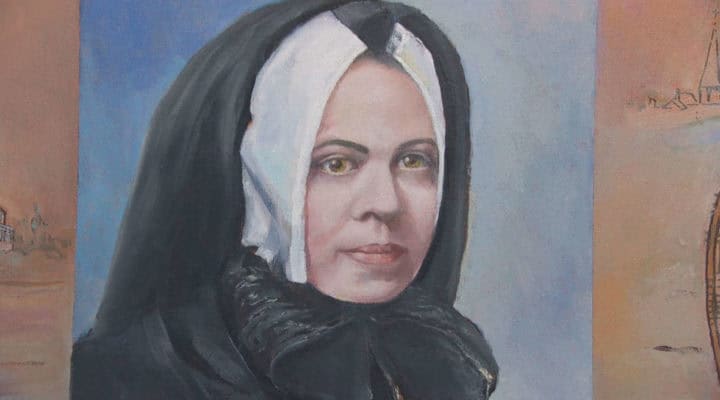
A portrait of Élisabeth Bruyère, founder of the Sisters of Charity of Ottawa and the city’s first general hospital. The Vatican has begun investigating whether Bruyère is worthy of sainthood. (Radio-Canada)

The nun who founded Ottawa’s first hospital is on the official track to sainthood after she was declared venerable by Pope Francis Saturday.

Élisabeth Bruyère was one of eight people — and the only Canadian — to be named a “Venerable Servant of God,” which means the Vatican has started investigating if she is worthy of sainthood.

Bruyère was a woman ahead of her time.
– Rachelle Watier, superior general of the Sisters of Charity of Ottawa

The church is now examining whether she and the seven others are each responsible for one or more miracle.

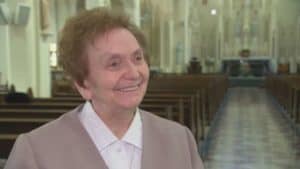
It was a long-awaited decision for the members of the Sisters of Charity of Ottawa, said Sister Rachelle Watier, who has waited 40 years for the announcement.

Sister Rachelle Watier said Bruyère was filled with the love of God and “a burning desire to do God’s work.” (Radio-Canada)

“Bruyère was a woman ahead of her time,” Watier said in a statement issued by the Archdiocese of Ottawa. “The sanctity of her virtues has been officially recognized.”

“This is also a great day for the city of Ottawa.”

A life for others

Born near Montreal in 1818, Bruyère arrived in Ottawa in 1845, back when the city was named Bytown.

Within months, she founded a school, a home for the elderly, an orphanage and the city’s first general hospital.

She died in 1879 at age 58.

“Mother Bruyère’s ministry, her life of prayer and heartfelt devotion toward helping the neediest, reflect God’s love for us all,” said Ottawa Archbishop Terrence Prendergast in a press release.

“May mother Bruyère continue to guide her fellow sisters and sustain them in their efforts as they continue to cater to the needs of the people of Ottawa.”

In addition to the hospital, Élisabeth Bruyère also has one street in Ottawa and two in Gatineau named after her.

The declaration is proof of the exceptional contributions Bruyère made throughout her life, said Michel Prévost, president of the Société d’histoire de l’Outaouais.

“We [live] in a world of men,” Prévost told Radio-Canada in French.

“When we study the capital region in the 19th century, they are just men [aside from] one notable exception — and that is Mother Élisabeth Bruyère.”

New housing planned for Indigenous women in Victoria at risk of homelessness

Temporary complex will provide 21 modular housing units with 24/7 support services on Hillside Ave.

The modular housing development planned for Hillside Avenue will be similar to the one on the corner of Main St. and Terminal Ave. in Vancouver, built to provide housing for low-income people. News files

A new partnership between the provincial government, the City of Victoria and local housing advocates will see new modular housing built for Indigenous women with round-the-clock support services.

Twenty-one homes, each with their own bathroom and kitchen, will be built in the 800-block of Hillside Avenue, as part of the Evergreen Terrace complex.

The housing will be temporary, operational for approximately five years, and will include mental health and addictions treatment and support as well as shared amenity space, access to laundry facilities and custodial and maintenance services.

The endeavour is a collaboration between the provincial government, the City, Atira Women’s Resource Society and the Aboriginal Coalition to End Homelessness.

Fran Hunt-Jinnouchi, executive director of the Aboriginal Coalition, said she was pleased to see the creation of a safe space for Indigenous women to call home.

“The women we support face multiple barriers, are often caught up in the chaos of domestic violence, and are at high risk, Hunt-Jinnouchi explained. “Culturally supportive housing has the potential to transform lives.”

The Aboriginal Coalition works in partnership with the Greater Victoria Coalition to End Homelessness, focusing on a culturally-specific approach to homelessness on the traditional Coast Salish, Nuu-chah-nulth and Kwakwaka’wakw territories.

They currently operate the Indigenous Women’s Circle, a program designed to strengthen Indigenous self-identity, provide life skills and knowledge around food security, while building a sense of family and community.

“Indigenous women are more likely than other women in Canada to experience both violence and homelessness,” said Mayor Lisa Helps, calling the housing at Evergreen Terrace an opportunity to interrupt those trends.

“[It will] bring culturally responsive, safe, and affordable stability to the lives of Indigenous women in Victoria, while building community,” she added.

The project is part of the province’s 30-point plan for housing, as the government invests $550 million over the next 10 years to help build 1,750 new homes for Indigenous people in B.C.

At Evergreen Terrace, the province will kick in $3 million to build housing and provide support services.

Minister of Indigenous Relations and Reconciliation, Scott Fraser called these new supportive homes “a signal that government and its Indigenous partners are here to help Indigenous women.”

“Indigenous women are the strength of their communities, families and culture, but for too long they have also been victims of violence, homelessness and poverty,” Fraser said.

Pending municipal approvals, construction will begin in fall 2018, and is expected to be complete by March 2019.