Archives for April 16, 2018

Smart Speakers Are No Longer Just a Novelty

With the release of the Echo smart speaker in late 2014, a new category of tech gadgets was born. Powered by Amazon’s (NASDAQ: AMZN) Alexa digital assistant, the device combined the artificial intelligence capabilities of voice recognition and language processing with a rudimentary speaker for home use. The voice-controlled Echo quickly became a hit with consumers, who used the smart speaker to stream music, set alarms, and order pizza.

The early success of the device quickly spawned competition, with Alphabet (NASDAQ: GOOGL) (NASDAQ: GOOG) releasing the Google Home in late 2016, and Apple (NASDAQ: AAPL) debuting its HomePod earlier this year.

Recent research suggests that the smart speaker, which was initially viewed as a novelty, is becoming much more mainstream.
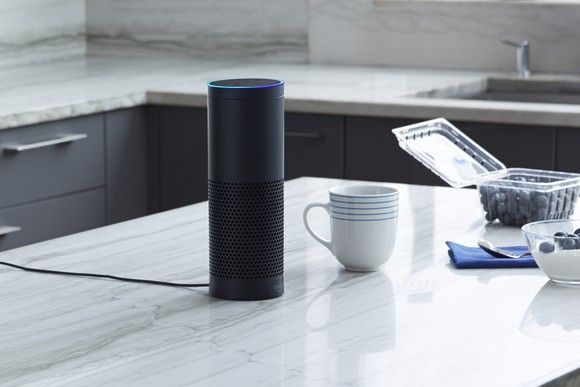
Amazon Echo on a kitchen counter near a coffee cup and blueberries.

The next must-have device?

Smart speakers can now be found in 20% of U.S. homes with Wi-Fi — which represents a 67% increase between November and February — according to data provided by comScore. That puts these devices in an estimated 18.7 million homes.
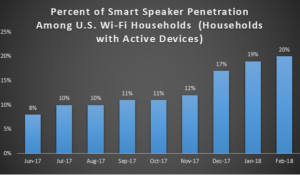
Bar chart showing smart speaker penetration, growing from 8% in Jun 2017 to 20% in February 2018.

There are a number of factors that contributed to the recent uptick in adoption, including new device offerings and lower price points.

The Google Home Max and Home Mini were both announced in October and were available during the important holiday shopping season, with the Mini priced at $29 to take advantage of the seasonal demand.

Amazon stole Google’s thunder by announcing a variety of new Echo devices and price points in September. The company added the Echo Spot, a smart alarm clock that can do many of the same things an Echo can do, but with a 2.5-inch touchscreen that can also make video calls, and the Echo Plus, which has a built-in hub for smart-home devices. Amazon also offered its most popular device, the Echo Dot for $29 for the holidays.

Will it move the needle?

One of the more intriguing questions regarding these smart speakers is how they will contribute to the bottom line of their respective companies. Unfortunately, it’s complicated.

Apple is hoping to appeal to audiophiles and those already locked into its ecosystem. At $349, the HomePod is among the higher priced smart speakers, ensuring that Apple collects its typically high margins.

The Google Home retails for $129. At this point, it’s unclear how Google plans to monetize its devices. Company executives were asked that very same question by an analyst during the fourth quarter conference call, and CEO Sundar Pichai said, “There are a lot of interesting ideas internally … We see a lot of potential, but the guidance I’ve given the teams is to be squarely focused on user experience. We are really getting started … So, you’ll see us focused on user experience there for a while to come.”

Google Home with numerous base colors in an array.

Show me the money

Of the three, Amazon has the clearest path to additional revenue. Some suggest the company is making little or no money on the devices themselves, which range in price from $49 to $229 each. However, Amazon is using them to increase customer engagement, which appears to be working.

The ability to use voice control to order or reorder products directly from Amazon’s e-commerce website was a stroke of genius and it appears to be paying off. Independent research shows that customers that use the Echo tend to spend $1,700 annually, on average, much more than the $1,000 spent by the average Amazon customer, according to Consumer Intelligence Research Partners.

Amazon Music vice president Steve Boom revealed another way the company benefits from Alexa and Echo. He pointed to the growing base of smart speakers as a catalyst for increasing adoption of its Music Unlimited streaming service. Boom said the company had “tens of millions” of paying customers, and that its subscriber roles have more than doubled in the past six months.

Early days

It’s important to remember that it is still early innings for these devices and the full extent of their reach has yet to be seen. Amazon is offering the Alexa Development Kit to companies that want to include Alexa’s voice control into their own products. There are currently 50 third-party Alexa devices, but that number could soon spike to the hundreds or thousands. And that’s how Amazon wants it.

Alexa, are you becoming ubiquitous?

What to Watch When Procter & Gamble Reports Earnings

Investors don’t buy stocks like Procter & Gamble (NYSE: PG) with the expectation that they’ll witness exciting sales growth or soaring profits. Instead, traits like a diversified product lineup, stability, predictability, and dividend income make the consumer products titan’s shares attractive as an investment.

But P&G can still surprise Wall Street every now and then. Its upcoming earnings report, for example, might have a bit more drama than shareholders are used to seeing. The announcement should clarify for investors whether the company will reach its fiscal-year growth targets, for one. It’s also the first earnings report following a controversial board shakeup, which means the company might articulate a fresh strategic approach to its turnaround targets.

With that in mind, let’s look at some of the key trends to watch for in this report, set for release before the market opens on Friday, April 20.

A woman shops for cleaning supplies.

Growth and market share

P&G is more than halfway through what might mark its third straight year of accelerating revenue growth. Organic sales rose by 1% in fiscal 2016 and then by 2% last year. The company’s latest forecast calls for that figure to come in between 2% and 3% in fiscal 2018, too. That would be enough to beat rival Kimberly Clark (NYSE: KMB), which is looking to expand at a 1% pace in 2018.

However, P&G hasn’t been growing quickly enough to boost overall market share. In fact, it lost ground across each of its main product categories last year, with its Gillette shaving franchise suffering particularly tough losses. That’s a problem since its business model relies on P&G achieving at least modestly market-beating sales growth.

Back in January, the company said it was encouraged to see a moderation in market-share losses. Yet management also noted increased competitive challenges, especially around pricing. Investors will find out on Friday which of those trends won out over the last few months, and whether the latest demand shifts threaten P&G’s multiyear growth rebound.

Profits and strategy shifts

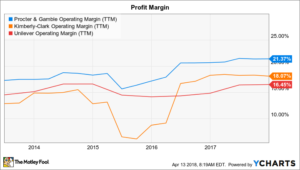
Investors should see more clear-cut wins this week on the financial side of the business. Even after slashing over $10 billion from the cost infrastructure, management is still finding plenty of room to cut expenses, and so profitability will likely rise.

PG Operating Margin (TTM) data by YCharts.

P&G is becoming more efficient in its use of capital, too, which is helping free up cash that executives can invest in the business or return directly to shareholders through dividends and stock buybacks. The company just announced its biggest dividend raise since 2013 and hiked its full-year earnings growth target last quarter to as much as 8%. CEO David Taylor and his team will probably stress these financial successes on Friday, especially if sales growth fails to impress.

Finally, it’s possible investors will hear a different tone out of management this week now that activist investor Nelson Peltz has joined the board of directors. After Peltz’s election, which P&G executives fought against, management admitted that they heard a clear message that investors were losing their patience. “There is broad shareholder support for P&G;’s strategies,” they explained in December, but “at the same time, shareholders indicated that P&G; needs to move faster to deliver improved results.”

If this week’s report doesn’t show signs of an accelerated expansion pace, then investors might hear about a new approach that management is working on, one that has a better shot at boosting overall returns for P&G shareholders.

Is bluebird bio, Inc. a Buy on the Dip?

Shares of bluebird bio Inc. (NASDAQ: BLUE) have tumbled from all-time highs reached just a few weeks ago. That’s a little surprising when you consider this pre-commercial biotech is heading into the home stretch with not one, but three experimental gene therapy treatments that could be worth billions.

Is the recent pullback an opportunity to pick up a top biotech stock at a fair price?

Person scratching their head while looking at a bunch of question marks on a chalkboard.

Reasons to be excited

Bluebird bio Inc. doesn’t have anything it can sell yet, but a bursting late-stage pipeline could make it one of the best gene therapy stocks to own over the next several years. By mid-2018 the company expects to release data from the pivotal Northstar-207 study intended to support a European marketing application the company thinks it can submit before the end of the year.

Northstar-207 is testing LentiGlobin’s ability to help patients with transfusion-dependent beta-thalassemia (TDT) reduce their dependence on frequent blood transfusions. By allowing patients to produce functional hemoglobin on their own, the drug has allowed a majority of patients enrolled in earlier studies to go over a year without a transfusion.

Early LentiGlobin studies include similar success stories from patients with another hemoglobin related disorder, sickle cell disease. Marketing applications that could eventually expand LentiGlobin’s addressable population from beta-thalassemia to the larger sickle-cell indication might not be that far behind. A successful launch for both indications could drive annual LentiGlobin sales past $3 billion at its peak.

Bluebird has a second gene therapy program nearing the finish line that uses the same delivery technique as LentiGlobin called Lenti-D. This candidate gets a lot less attention because it addresses an ultra-rare disease called cerebral adrenoleukodystrophy, but its ability to help children born with the debilitating disease lead more normal lives has been downright incredible. So far 15 of the first 17 patients treated reached the main goal in a study the company is expanding to include 30 patients total. Investors can expect regulatory filings in 2019.

Laboratory scientist looking close-up at a medicine capsule.

In addition to two proprietary programs nearing the finish line, bluebird also sports a blood cancer candidate that’s being developed in partnership with Celgene (NASDAQ: CELG). The big biotech recently agreed to share 50% of costs and profits associated with bb2121, an experimental chimeric antigen T-cell (CAR-T) therapy for the treatment of multiple myeloma. Celgene already records around $10 billion in annual sales from its existing multiple myeloma drugs, and there’s a good chance bb2121 can become a $1 billion-plus blockbuster as well.

Multiple myeloma patients that have relapsed after more than one line of therapy are notoriously difficult to treat, but 94% of patients in a group receiving bb2121 showed responses. Moreover, 9 of 10 evaluated for minimal residual disease showed no trace of the disease.

Reasons to be nervous

Given the amazing early results we’ve already seen, odds of approval for all three of the company’s late-stage candidates seem better than average, if early observations hold up. Perhaps the most troubling problem with bluebird is that its $8.9 billion market cap is supported by data from fewer people than you’ll probably find in a mid-western shopping mall on a Tuesday. At the very least, investors should remain braced for long delays if regulators send applications back with requests for further lengthy studies.

If bluebird’s lucky enough to earn on-schedule approvals for all three of its late-stage drugs, getting end payers to foot the bill for treatments likely to carry six-figure price tags for a single dose could be tougher than hoped. Treatment with bb2121 involves a lengthy and expensive process that trains a patient’s own T-cells to recognize a target often found on cancer cells. LentiGlobin also involves removal and reinfusion of blood cells after their individual off-site training sessions.

Bluebird’s Celgene partnership could also run headlong into competition from a similar CAR-T treatment directed against the same target. Chinese upstart, Legend Biotech popped up out of nowhere last winter with solid multiple myeloma results from an initial 35-patient trial with LCAR-B38M. After seeing 94% of these relapsed, drug-resistant patients enter complete remission following treatment with the therapy, Johnson & Johnson quickly offered the company $350 million upfront for co-development rights.

The treatment is already under review in China. J&J will probably need to run another trial to satisfy the FDA, but you can count on the world’s largest healthcare company to steer the program through America’s regulatory maze as quickly as possible.

Putting it together

If bb2121, Lenti-D, and LentiGlobin launch, but fizzle on the tarmac, there isn’t much for the company to fall back on. Bluebird’s pipeline beyond the trio is limited to another Celgene partnered multiple myeloma candidate in very early human testing, called bb21217, and a second sickle-cell candidate ready to begin clinical trials later this year.

A recent market cap of around $8.9 billion could rise in the long run, but LentiGlobin and bb2121 need to succeed in the commercial setting to make that happen. Until we see complex, cell-based therapies put up blockbuster sales, it would be irresponsible to assume any company will do so in its first few attempts. I’ll reconsider the stock if it dips further, but for now, bluebird bio stays on my watchlist.

3 Things to Watch in the Stock Market This Week

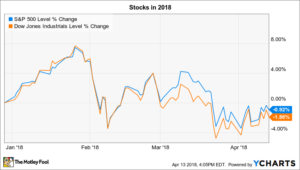
Stocks ticked higher last week as first-quarter earnings season began. Both the Dow Jones Industrial Average (DJINDICES: ^DJI) and the S&P 500 (SNPINDEX: ^GSPC) gained less than 2%, which put the indexes just slightly lower so far in 2018.

^SPX data by YCharts.

Earnings season kicks into high gear over the next few trading days, with highly anticipated reports on tap from Netflix (NASDAQ: NFLX), Johnson & Johnson (NYSE: JNJ), and Procter & Gamble (NYSE: PG). Here are a few trends for investors to watch in these announcements.

Netflix’s subscriber growth

It’s the market’s single biggest winner over the past decade, which means streaming video giant Netflix has a lot to prove when it posts earnings results on Monday. The last quarterly outing gave investors plenty to celebrate, as subscriber growth sped up to 24 million in fiscal 2017 from 19 million in the prior year. Netflix’s profit margin nearly doubled, just as management predicted, as an improving content slate allowed the company to raise prices without sacrificing user gains.

A Netflix streaming screen.

CEO Reed Hastings and his team have predicted that this positive momentum will continue into 2018, with subscriber growth forecast to accelerate to about 6.35 million this quarter from 4.95 million in the year-ago period. New content releases and growth in international markets will be the main drivers behind those gains. And if streamers continue to binge these original series, then investors can expect Netflix to keep spending heavily to keep that pipeline of new content as full as possible.

Johnson & Johnson’s drug pipeline

Healthcare titan Johnson & Johnson will announce its results before the market opens on Tuesday. Investors are optimistic that both sales and profits will increase at a robust pace this quarter. After all, the blue chip was able to overcome falling sales of its core Remicade drug last year to post a 6% increase in organic revenue. Each of its three massive business lines — consumer products, pharmaceuticals, and medical devices — expanded in 2017.

Johnson & Johnson has many more drugs in development that will help pick up the slack in its Remicade declines this year. Investors should look for CEO Alex Gorsky and his team to discuss that pipeline on Tuesday while also highlighting the company’s stellar cash flow.

As for its latest operating forecast, the outlook calls for a growth slowdown in 2018 to between 3.5% and 4.5%. But management might tweak that prediction on Tuesday. Earnings, on the other hand, are expected to rise by as much as 9.6% for the full year to $8.20 per share.

Procter & Gamble’s organic sales

Procter & Gamble’s stock has had an unusually weak run over the past five years, underperforming the market by nearly 50 percentage points. That’s because while sales growth has accelerated in each of the last two fiscal years and profitability is reaching new highs, the consumer products giant has lost market share across key franchises like Gillette.

A baby having his diaper changed.

Investors voiced their displeasure about these trends by voting to elect activist shareholder Nelson Peltz to the board of directors. This Friday’s earnings report will be the first one since the new board was seated, and so it might include the articulation of a strategic shift.

But the pressure to make aggressive changes will be greater if sales growth disappoints. Back in January, P&G said that organic gains would come in at the low end of their guidance of 2% to 3%, which would translate into essentially no improvement over the prior year’s disappointing pace.

Zillow will flip houses on its own internet marketplace

Zillow is no longer just a real estate marketplace that can help you find your

Zillow is no longer just a real estate marketplace that can help you find your next home — the company has decided to become an active participant in the field. In an announcement today, Zillow has revealed that it’ll flip houses in Phoenix and Las Vegas starting this spring. The company has teamed up with local brokerages in those areas to offer sellers money for their homes. If they accept, Zillow will make repairs and then list those houses on its own marketplace as quickly as possible.

By choosing to buy and sell houses, Zillow is now officially an OpenDoor competitor. “We are genuinely excited, having invented this new category in 2014,” OpenDoor chief Eric Wu told TechCrunch, “and it’s invigorating to see a host of others in the industry recognize the importance of removing hassle and time from the transaction.”

It doesn’t sound like everybody’s happy with Zillow’s new business model, though. As TechCrunch noted, its shares fell 7 percent after the revelation, probably because flipping houses has a whole other list of risks a simple real estate marketplace won’t have to face — Zillow chief Spencer Rascoff has even admitted that it’s taking on debt to fund its new venture.

This article originally appeared on Engadget.

SpaceX will try ‘giant party balloon’ to recover upper rocket stages

SpaceX ultimately wants to recover every stage of a rocket, not just the

SpaceX ultimately wants to recover every stage of a rocket, not just the first, and it may resort to some unusual tactics to make that happen. Elon Musk has claimed that his company will try to take rocket upper stages out of orbital velocity using a “giant party balloon” — yes, he knows it sounds “crazy.” He hasn’t shed more light on the subject as we write this, but we’ve reached out to SpaceX to see if it can elaborate.

If such a system works out, it could provide more than a few benefits to SpaceX. As of 2018, SpaceX estimates a cost of $62 million to launch a Falcon 9 rocket with a first stage landing factored in. If it can reliably recover the upper stage with a relatively low-cost method like a balloon, it can both reduce its own expenses and make launches more attractive to customers. Throw in the eco-friendliness (there’s no dead stage plummeting to Earth) and it could easily be worth attempting to use a balloon, however ludicrous the idea might sound at first blush.

This article originally appeared on Engadget.