Archives for March 14, 2018

Robson Square in downtown Vancouver to remain traffic free

NPA’s Melissa Degenova wanted to reopen the 800-block of Robson Street to buses and cyclists

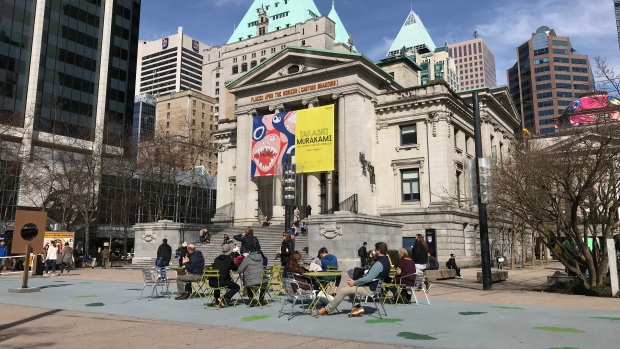
A lunchtime crowd gathers at Robson Square on a sunny weekday afternoon. (Jesse Johnston/CBC)

Robson Square will remain closed to traffic, despite a Vancouver city councillor’s push to reopen the area to buses and cyclists.

Melissa Degenova says the square has been a failure since traffic barriers were put up two years ago and it hasn’t lived up to the family-friendly, vibrant gathering place that it was originally billed as.

“That’s not what I’ve seen,” Degenova said.

“I’m very concerned that there are a few groups of people that come out time and time again, including cannabis vendors, and they create an atmosphere that is not family friendly.”

Degenova hoped to convince council to reopen the square to traffic at Tuesday’s meeting but her notice of motion was found to be out of order for procedural reasons.

She says she’s also heard many complaints about marijuana vendors and also from seniors who say they were inconvenienced when bus routes were moved off Robson Street.

Untapped potential

The square has its share of critics but it also has plenty of supporters who want to see it kept traffic free.

Local musician Sam Chimes says it’s one of his favourite places to places to play in the city.

On a sunny Monday afternoon, Chimes had a good-sized lunchtime crowd gathered around him on the plaza as he played the keyboard.

Musician Sam Chimes says Robson Square is one of his favourite places to play for a crowd. (Jesse Johnston/CBC)

“It’s picturesque and a lot of people go by here, especially around lunchtime and dinnertime,” said Chimes, who frequently performs at Robson Square.

“I really like the visuals of it. I actually want to shoot a video here at some point.”

Paola Qualizza with the Vancouver Public Square Network says the block is in the middle of a design process that should inject some life into the area in the near future.

Paola Qualizza with the Vancouver Public Square Network is opposed to reopening Robson Square to buses and cyclists. (Jesse Johnston/CBC)

“They’re going to define the ends of this block better to create more of a hangout space, add more seating and add more programming,” she said.

“The consequence of having buses move through here is that it’s no longer a plaza and it cannot functionally perform as a cohesive public space or as a plaza if there are motorized vehicles through it.”

Solar-powered car added to Saskatoon carshare program

Saskatoon’s 1st electric carshare vehicle will be parked in City Park

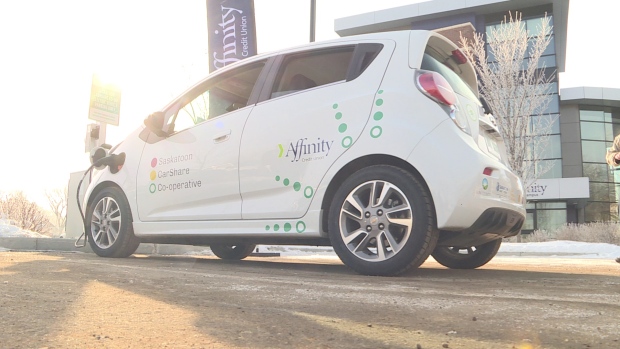
Saskatoon’s first solar-powered rideshare vehicle is parked at the Affinity Credit Union building on Seventh Avenue N. (Bridget Yard/CBC)

Saskatchewan’s first solar-powered vehicle to be part of a carshare program is ready to be booked.

It’s one of only 160 electric vehicles in the province, which does not offer incentives to purchase or use electric vehicles.

The Saskatchewan Environmental Society and the Saskatoon Carshare Co-operative have collaborated to bring the 2015 Chevrolet Spark to Saskatoon’s City Park neighbourhood.

The vehicle is parked in the Affinity Credit Union lot off Seventh Avenue N.

The charging station is currently using electricity generated by Saskatoon Light and Power, gathered as solar energy. The program has plans to install its own renewable energy installation.

There are other charging stations open to the public in Saskatoon, including stations at Peavey Mart, the Confederation Inn, and the Delta Bessborough.

The Spark can be driven for 140 kilometres before it needs a charge in warm weather, and about 90 kilometres during the winter.

City council, the Saskatchewan Research Council, and several organizations and businesses have supported the endeavour.

“It’s time; it needs to happen,” said Allyson Brady, Saskatchewan Environment Society’s executive director.

“There’s so much momentum around car sharing and electric vehicles.”

Carshare hoping to grow membership

The Carshare Co-operative’s other vehicles are parked at Eighth Street and Broadway, and behind Broadway Roastery in Nutana.

“People generally will use the vehicles for short trips for groceries or heading to a meeting on the other side of town,” said Megan Van Buskirk, Saskatoon Carshare’s co-ordinator.

“For the most part, it’s just people who live in the neighbourhoods close to where the vehicles are located, that don’t own a vehicle already, or have a vehicle and need a second for a growing family. We have young folks, older folks.”

The program has 70 members, but organizers expect that number to triple over the span of two years. More solar-powered vehicles will be added to the fleet.

Usage fees start at $10 every month, plus 25 cents per kilometre, and $6 an hour. Participants can book a vehicle online, any day of the week, depending on availability.

“The program will run about two years and our expectation is that after those two years, the vehicles and charging stations will continue to be around,” said Brady.

“In that short term we’ll be able to get lots of good, hard data.”

‘5 is a blessing’: P.E.I. seniors’ home celebrates its 100-year-old residents

‘I forget I’m that old, I just keep going along’

This group of centenarians is the largest the Garden Home has ever had.

The Garden Home in Charlottetown has a record number of centenarians this year — as of June the P.E.I. seniors home will have five residents who are one hundred years old or older, the most its ever had.

“Five is a blessing, I’ve never heard of it,” said Angela Boudreau, director of activities for the Garden Home.

“I think it’s amazing.”

Boudreau said when she realized they had so many centenarians she wanted to do something special.

She organized a gathering to get them all together and called the meetings “Words of Wisdom.”

The group chats during the session and shares memories from days gone by.

Angela Boudreau started the Words of Wisdom meetings to help the residents share their memories. (Laura Meader/CBC)

“They are full of history and they are the best history teachers that you could have,” Boudreau said.

“I personally enjoy sitting down and talking about how they grew up and what things were in their life, like what they did for excitement and their struggles and their heartaches and their happiness.”

“I mean they all come together and they enjoy talking about it and they light up on certain things that they speak of.”

Elinor Smith

Elinor Smith worked as a teacher and as a manager in a department store and raised five children in her 102 years.

“I forget I’m that old, I just keep going along,” she said.

“Well, you have to enjoy what you’re doing or you’re going to be cranky.”

Elinor Smith began teaching at the age of 15 and was involved in the founding of the St. Andrews United Church. (Laura Meader/CBC)

Smith shared a story of how she had to escort a thief out of the store down to the police station using a hand gun — as that was the policy at the time.

“They were stealing things from the fitting room,” she said.

“The gun was loaded, the gun was a little shivery, I wondered if I could do it without fainting.”

Smith said in life it’s important to think and learn as you go.

“We’re learning how to manage our lives, you have to think for yourself.”

Fred Hughes

Fred Hughes turned 100 years old last December. He shared stories of loving horses and growing up on a farm in Covehead, P.E.I.

He said living for a century is no big deal.

“Well I’ve been 99 for quite a little while, so I’m finally 100, it seems okay,” Hughes said.

Fred Hughes was a farmer before he retired and says he always loved horses. (Laura Meader/CBC)

“It’s a little bigger birthday, that’s about all.”

He said it’s important to keep up with the times and credits his old age to the good food he ate growing up.

“We always had good meals, home cooked meals,” he said.

Edna Ellsworth

Edna Ellsworth actually turns one hundred in June, but they let her in the club early. She worked on the farm and raised 14 children.

“My favourite thing from those times was looking after those children and bringing them up,” Ellsworth said.

Edna Ellsworth shared lots of memories with the group including a time when Stompin’ Tom visited her house as a child. (Laura Meader/CBC News)

And it’s important to have a sense of humour along the way.

“People should learn to be jolly and laugh,” Ellsworth said.

She remembers working at Pete Burke’s Hotel as a girl and also at a lobster factory.

Edith Mullen

Edith Mullen is over 102 years old and was raised in Portage, P.E.I.

She said living for more century is hard to believe and that time has passed quickly.

Gladys Blacquiere

Gladys Blacquiere turned a 100 in February but, she said with a laugh, that she keeps it a secret.

She grew up in England and was a seamstress during the Second World War.

She suggested people should travel and have adventures.

“Just get up and do what you want to do,” Blacquiere said.

Bank of Canada head underlines potential of Quebec child care for entire country

Canada has considerable untapped potential in its labour force, says Stephen Poloz

Bank of Canada Governor Stephen Poloz credited the Quebec’s child-care program for raising prime-age female workforce participation from 74 per cent 20 years ago to about 87 per cent today.

The head of the Bank of Canada is pointing to Quebec’s subsidized child-care program as a possible tool to boost the entire economy because it could significantly raise female workforce participation across the country.

In a speech Tuesday, bank governor Stephen Poloz used Quebec’s affordable child-care model as one way to show how Canada could unlock some of the considerable untapped potential in its labour force.

Helping more women, young people, Indigenous peoples, recent immigrants and Canadians living with disabilities enter the job market could help the labour force expand by half a million people, he said. By his estimate, that kind of workforce injection could raise the country’s output by $30 billion per year or 1.5 per cent.

“That’s equal to a permanent increase in output of almost $1,000 per Canadian every year, even before you factor in the possible investment and productivity gains that would come with such an increase in labour supply,” said prepared remarks of Poloz’s speech at Queen’s University in Kingston, Ont.

“Clearly, that is a prize worth pursuing.”

He added that encouraging more people into the workforce would also enable Canada to permanently raise its growth capacity without generating higher inflation.

Poloz highlighted Quebec’s child-care program as one model to help women, which he noted represent the largest source of economic potential, enter the workforce.

He credited the province’s child-care program for raising prime-age female workforce participation from 74 per cent 20 years ago to about 87 per cent today. In comparison, he said about 83 per cent of prime-age women participate in the national workforce.

The head of the Bank of Canada is pointing to Quebec’s subsidized child-care program as a possible tool to boost the entire economy because it could significantly raise female workforce participation across the country. Bank of Canada Governor Stephen Poloz listens to remarks after addressing the Canadian Club of Toronto on Thursday, December 14, 2017. THE CANADIAN PRESS/Chris Young (THE CANADIAN PRESS)

“If we could simply bring the participation rate of prime-age women in the rest of Canada up to the level in Quebec, we could add almost 300,000 people to our country’s workforce,” said Poloz, who noted the central bank has no role in implementing specific policies designed to break down labour-force barriers.

He noted that the federal government’s budget last month made commitments aimed at increasing the labour-force participation of women.

However, some economists and critics have said while the federal budget took steps in the right direction, they argued its failure to announce steps towards national affordable child care likely means a significant number of women will remain out of the workforce.

How to play retro video games

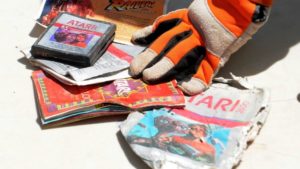
File photo: The first recovered Atari cartridge and packaging recovered from the old Alamogordo landfill are shown in Alamogordo, New Mexico, April 26, 2014. (REUTERS/Mark Wilson)

Some of the best video games ever were made ages ago. Super Metroid, Planescape: Torment, Deus Ex, and hundreds of other amazing games were produced for platforms that don’t really exist anymore. They were made for systems that used cartridges and PCs that ran Windows 95. Some have aged well and some haven’t, but they’ve all made their mark on video game history.

Unfortunately, you can’t easily play them in their original forms on current systems. Consoles stopped using cartridges many moons ago, and what worked on Pentium-era Windows 95 PCs baffle Core i7-era Windows 10 machines. Add an unsettling trend of dismissiveness in archiving classic games and you run into the very real risk that some of the best video games ever will some day be lost, or remain just out of reach.

Fortunately, you have options. Whether they’re old PC games or old console games, you can probably find at least some way to play them.

PCs have been PCs for decades, but changes in Windows versions and CPU architectures mean today’s PCs can’t easily run games made for 80s and 90s machines. It’s easy to install and run games now thanks to widespread and fairly universal graphics accelerators, extensive multimedia support, and automatic driver setup, but those benefits only apply to games that can take advantage of them. Back when mice and keyboards used PS2 and serial connectors, and sound cards and optical drives were considered high-end gaming hardware, you had to wrestle to get games running. Now, with hardware so advanced those games might as well be cavemen staring at UFOs, it’s even harder to get them running. Fortunately, you have some options.

Modern Remasters/Ports

Plenty of classic PC games have been remastered or otherwise ported to modern PCs, and are readily available on Steam and other digital distribution services. These games have been overhauled to run easily on your Windows 10 PC without any processing layer or emulation. Planescape: Torment Enhanced Edition, Baldur’s Gate: Enhanced Edition, Grim Fandango Remastered, and Resident Evil HD Remaster take 15-plus-year-old games and make them work on your modern computer, with modern monitor resolutions.

Some of these games are straight ports with higher resolution settings, but some overhaul graphics and interface elements to look and play better. Some even have iOS versions, so you can play your favorite classic RPG or adventure game on your iPad! Remastered games are usually very affordable, too, with prices typically between $10 and $20.

GOG.com

If the original publisher doesn’t feel like remaking or remastering a classic PC game, there’s a good chance GOG.com will be able to get the original to work. This digital distribution service takes DOS and early Windows games and performs all the front-end work necessary to make them work on a Windows 10 PC with DOSBOX, a DOS PC emulator. DOSBOX is incredibly powerful and flexible, but getting each game to run requires PC knowledge and a willingness to experiment with different settings and commands, often beating your head against runtime errors, audio glitches, and unresponsive controls until it works properly.

GOG.com does all that work for you. Every classic PC game that’s old enough to need DOSBOX is preconfigured with all of the commands and settings needed to run properly, so all you have to do is unzip the file and double-click on the game. GOG.com also often throws in lots of extras with each game, like digital versions of its print manual, wallpapers, and even soundtracks. Not bad for $6 to $10 for most classic games, including Fallout 2, Crusader: No Remorse, and SimCity 2000.

DOSBOX

If GOG.com doesn’t have the DOS game you want, you can still probably find a way to play it. You just need to find the game yourself and set up DOSBOX to run it. I wasn’t kidding when I said DOSBOX is a powerful emulator. GOG.com offers hundreds of titles that work through DOSBOX, but that’s just a fraction of the thousands of DOS games confirmed to be playable through the emulator.

You still need to have the original game, though (unless you can find a digital backup of it through legally dubious sources online like abandonware sites, which we can’t recommend). You also need to be able to work with command lines, because DOSBOX doesn’t have much of a graphical interface. A DOS emulator requires a DOS mentality, and that requires typing things like “MOUNT D D:\ -t cdrom.” The PC Gaming Wiki is a very useful resource for this, and it can let you know if the game you want to play is available on GOG or has any sort of patch that makes it easier to run.

Build/Refurbish an Old Computer

This one is a little extreme, and requires even more technical knowhow than DOSBOX. Just find an old computer, ideally Pentium or earlier. Pop Windows 95 or 98 on it. Wrestle with the driver conflicts, IRQ errors, serial connections, and all the little frustrations you completely forgot about in the last two decades. Wonder how you ever managed without USB peripherals. Spend hours getting everything to work, then game like it’s 1998. You can play anything this way, but compared with using modern PCs it’s a slog.

Console Games

You can pull any old PC game off of a CD-ROM or floppy disc, but console games aren’t so easy. Cartridges are their own unique media that you can’t read with a computer without some specialized hardware, that accounts for the majority of console video games made before 1996. Even for consoles that use optical discs, you can’t easily play them on modern systems; the Xbox One has a solid list of backward compatibility for Xbox and Xbox 360 games but it isn’t complete, and while the PlayStation 4 has some PlayStation 2 and PlayStation 3 classics available digitally, it can’t play PSX, PS2, or PS3 games on disc at all.

Depending on the game and system, you might have some pretty easy ways to play your favorite retro console games, though, whether your have the original carts or not.

Modern Remasters/Ports (Again)

Like lots of classic PC games have been rereleased and even overhauled for modern PCs, lots of classic console games have been released on modern systems. The vast majority of these games are ports, but you can find some downright breathtaking remasters that breathe new life into a game, like Shadow of the Colossus for the PlayStation 4.

Games released in the last 15 years or so might be available on modern consoles through digital distribution. The Xbox One and PS4 both have lots of games from their previous two generations ready for download, most of which render at 1080p or higher to offer sharper graphics, though user interface elements and textures generally remain untouched. If you have the original game disc and it’s on the supported list, the Xbox One can even play your physical Xbox and Xbox 360 games.

The Nintendo Switch is also swimming in classic ports for such a new system. Many excellent games for the Nintendo Wii U have been ported or will be ported for the Switch, including Bayonetta 2, Mario Kart 8 Deluxe, and The Legend of Zelda: Hyrule Warriors. They’re relatively recent last-gen games, but they’re still excellent. For older arcade classics, the Switch also has a remarkably large library of Neo Geo games, ported by Hamster.

If you want to play older, non-Neo Geo games, you might have some difficulty. The Nintendo Wii U and 3DS both had extensive Virtual Console libraries of NES, SNES, Game Boy, Sega Genesis, and Nintendo 64 games available to download, but so far the Switch only has a few scattered Arcade Archives games like Mario Bros. and Vs. Super Mario Bros. You’re covered for Neo Geo titles, but if you want to play classic Nintendo games, you need to reach back a generation. Fortunately, the 3DS is still readily available, and the Virtual Console on that system can still be accessed, letting you digitally buy classic console games for $6 to $10 each.

You can also find compilations of classic games, either as retail releases or digital downloads. The Mega Man Legacy Collection, Mega Man Legacy Collection 2, and The Disney Afternoon Collection highlight some of the best platforming games Capcom ever made, and all three are available on PS4, Xbox One, and PC. The Switch is also getting the Mega Man Legacy Collections, along with a compilation of Mega Man X games. For non-Capcom games, there are arcade collections like Namco Museum.

Compilation Consoles

You can’t play the best NES and SNES games on the Nintendo Switch yet, but you can play them on tiny versions of the original systems. The NES Classic and Super NES Classic are emulation-based game systems that hold dozens of NES and SNES games in a collector-friendly mini-retro-console package. Just plug them into your TV and the low resolution sprites are rendered in crisp HD, with useful features like the ability to save your progress any time you want. It helps that they have some of the best games ever made, like Super Mario Bros. 3, The Legend of Zelda: A Link to the Past, and Super Metroid. The NES Classic is still incredibly hard to find at retail price, but the SNES Classic is a little more readily available, and has a stronger selection of games.

There are also third-party compilation consoles like the Retro-Bit Super Retro-Cade. This system isn’t as striking as the NES or SNES Classic, and its upconversion isn’t as good, but for $60 it features 90 classic arcade and console games from Capcom, Data East, Irem, and Technos. There’s also the Sega Genesis Flashback HD, which we’ve not yet tested, if you are a fan of Sega’s 16-bit system.

You can also find non-HD compilation consoles like the various Atari Flashback systems, that let you play Atari 2600 games, and the Sega Genesis Flashback, which has Sega Genesis/Mega Drive games. They’re inexpensive and readily available, but they don’t output over HDMI at 720p or higher resolutions. Instead, they output over composite video, which means you need to rely on your TV’s composite input if it’s available, and deal with your TV’s own upscaling to render your games properly. This usually means very fuzzy sprites.

Retro Game Systems

There’s a whole field of new game systems designed to play older games. Since Nintendo doesn’t make any systems that use cartridges anymore, and Sega doesn’t make game systems at all, third-party companies like Innex, Hyperkin, Analogue, and Cybergadget have made their own cartridge-playing consoles. These are systems with slots for one or more classic game cartridges, that use either software emulation or hardware-based electronics to play them.

Innex’s Retro-Bit RES+ and Super Retro Trio+ are inexpensive game systems that use a system-on-a-chip to function like NES, SNES, and Sega Genesis hardware. They read game cartridges as if they were the original hardware, and output games at 720p using a separate analog-to-HDMI upconverter. The upconversion is sharp for NES games, but 16-bit games tend to look fuzzy. If you don’t mind spending significantly more to play SNES games that look good on your TV, the Analogue Super Nt uses a much superior upconverter and FPGA hardware to act like an original Super Nintendo.

The Hyperkin RetroN 5 and Cybergadget Retro Freak are emulation-based systems that can play games for the NES, SNES, Sega Genesis, Game Boy, and more. Emulation enables better upscaling and more graphical options, along with useful features like save states, patches, and cheats. However, it isn’t as reliable as hardware-based systems, and the code these emulators are based on is in an ethically dubious position, according to some complaints made by the original developers who released the code under the General Public License. The Libretro organization made similar complaints about Innex and the Retro-Bit Super Retro-Cade a few months ago, but since then the two groups have been working together to resolve the issue.

Original Consoles

If they still work, there’s no reason you can’t play your classic NES, SNES, Sega Genesis, or other retro games on your classic NES, SNES, Sega Genesis, or other retro systems. Cartridge-based hardware is hardy if you treat it with some care and know how to clean pin connectors, and barring power surges, water damage, or just getting smashed, your old consoles should work fine. If they do, you just have to hook them up to your TV, which will require a composite video connection. And it will probably look pretty fuzzy and blotchy through that connection.

You don’t need to settle for standard definition video on your old game consoles, though. An analog-to-HDMI upconverter can turn that composite video signal into HDMI at 720p or 1080p. Inexpensive upconverters can be found for $40 and up, but at that level you probably won’t get much better upconversion than if you just plugged the cable straight into your TV. If you want your games to look crisp, you’ll have to invest in a higher-end HDMI upscaler. The Framemeister line of upscalers isn’t formally sold in the United States and costs between $300 and $400 to import, but many retro gaming enthusiasts swear by it for playing their older games on modern TVs.

The Emulatephant in the Room

Let’s be honest here, there’s a very big part of retro gaming that we can’t directly address, because our legal department won’t let us. We touched on the existence of abandonware sites for PC games, and noted that some retro game consoles use emulation to play their cartridges, but those are just the tips of a gray market software iceberg.

Even if old games aren’t sold by their publishers anymore, that doesn’t mean those publishers don’t still legally own the rights to them. As such, downloading those games is software piracy. Even if the developer and original publisher doesn’t exist anymore, abandonware is extremely dubious and more often than not some company will own the rights to it, and they’ll be protective of it.

Of course, the means to play that software is much less illegal. There are open-source emulators for nearly any computer or game hardware made between 1970 and 2000. If you have a PC, it can act like a hundred other types of computers. Most of these emulators have portable versions for devices like the Raspberry Pi. In fact, you can make a Raspberry Pi into an all-in-one retro game system using the RetroPie software, which supports over 50 different consoles and handhelds. You can even 3D print your own SNES Classic-style case for it and make the ultimate classic gaming device, ready to put countless games on your TV at 1080p.

But we can’t recommend that, since there are no legal ways to load such a system with games (besides software you already own). And we won’t point you toward any sites or services on which pirated software can be found, obviously.

But if you wanted to build that kind of device, just to see if you can, even without any games to legitimately put on it, you could. It might even be a fun project. Might be.

This article originally appeared on PCMag.com.

SXSW: Scientists tout ‘pen’ technology that detects cancer in 20 seconds

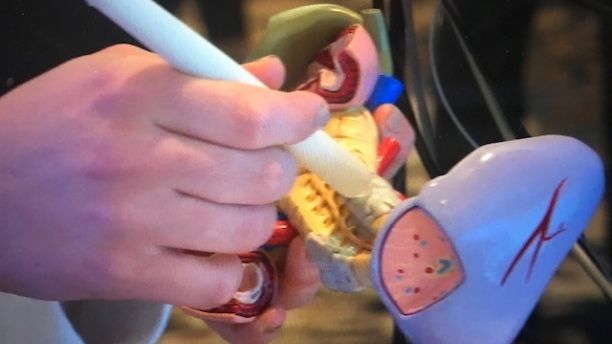
Researchers at the University of Texas at Austin say the MasSpec Pen uses touch to diagnose cancerous tissue during surgery. (Fox News)

Imagine if you could detect cancer within seconds. A group of researchers from the University of Texas at Austin say they’ve developed the technology to do just that. The MasSpec Pen, which is being showcased at SXSW this week, can identify cancerous tissue during surgery in real time.

“The MasSpec Pen is a handheld device coupled to a mass spectrometer that can diagnose cancer during surgery in 20 seconds,” said Marta Sans, graduate research assistant for the Livia Eberlin Research Group.

The pen uses touch to make a diagnosis. It’s placed over tissue. A foot pedal triggers the device, and the pen releases water droplets, which extract molecules from the tissue. The water is drawn into the mass spectrometer, which then analyzes the molecular composition.

“Then, we can create a molecular fingerprint that can say if this is cancer or if it’s not based on the molecules of the pen,” said Sans.

For doctors, the technology is groundbreaking. Determining cancerous tissue from normal tissue during surgery is sometimes difficult and waiting for results from pathologists is often time-consuming.

“The doctor may take it out, may have to send it to the pathologist for a frozen section. Meanwhile, everyone’s waiting for a report from the pathologist to see if the margin’s clear,” said Dr. Leonard Lichtenfeld, Deputy Chief Medical Officer for the American Cancer Society.

Researchers say the pen was 96 percent accurate in detecting four types of cancer: breast, ovarian, thyroid, and lung cancer. (Fox News)

Furthermore, Lichtenfeld says the failure to remove all cancerous tissue during surgery can create more complications down the road.

“The real question is, if you don’t get all the cancer out, does that leave a place? A sanctuary, if you would, where tumor cells can stay and come back or even migrate to other parts of the body at a later time?” said Lichtenfeld.

And just because the cancer pen is fast doesn’t mean it’s not accurate. Researchers say after analyzing 300 patient samples, they were able to diagnose four types of cancer ‒ breast, thyroid, ovarian and lung cancer ‒ with over 96 percent accuracy, eliminating the risks of unnecessarily removing healthy tissue.

“It’s going to provide great benefits to patients and also to the health care system,” said Sans.

Still, Lichtenfeld is cautiously optimistic.

“We have to remember that it’s a long way from concept, to proving it really works, to get it used by doctors in real life. We don’t know the answer to that yet and, clearly, the researchers understand that they have more work to do,” he said.

The MasSpec Pen hasn’t been tested on a human during surgery yet. Over the next several months, three of the devices will be installed in Texas hospitals: Dell Medical School, MD Anderson Cancer Center and Baylor College of Medicine.

The Food and Drug Administration has to approve the technology as well, and the regulatory process could take a few years.