Archives for February 8, 2018

First Nations gathering in Vancouver want better water legislation, safe drinking water

Water advocate Autumn Peltier among opening speakers at Assembly of First Nations conference in Vancouver

Perry Bellegarde, Autumn Peltier and Regional Manitoba Chief Kevin Hart at July 2017 Chief Assembly, Regina, Sask.

In a conference room at the Fairmont Hotel Vancouver, more than 200 people sat around tables with white linen napkins and jugs topped with ice water on Tuesday morning.

Speaking from the podium at the front of the room, Kevin Hart reminded everyone of another reality in his home province of Manitoba.

“Right now, we have elders going down to the lake, chopping holes in the ice to bring water to their households. Right now,” the Manitoba regional chief for the Assembly of First Nations said.

“So, as you can see, there’s a lot of work that we need to do, and my passion is to get results for our people.”

Right now we have elders going down to the lake, chopping holes in the ice to bring water to their households. Right now
– Manitoba Regional Chief Kevin Hart

Hart was among the first speakers on Tuesday morning at a three-day symposium hosted by the Assembly of First Nations titled, Reconciliation through Sustainable Water Management.

One of the main items on the agenda is reviewing current legislation around safe drinking water in First Nations communities, which the assembly wants to see repealed and discussing a way forward with the federal government.

Lawyer Allison Thornton was among the many speakers on Tuesday, which included remarks from water advocate Autumn Peltier and a keynote speech from David Suzuki. Thornton spoke at length about the issues she sees with the current legislation — the Safe Drinking Water for First Nations Act — which was passed by the Harper government in 2013.

“[My perspective here is] to encourage us to walk away and to adopt a different way forward than working within the framework of that deeply flawed legislation,” she said.

Among the shortcomings she pointed out were: a failure to address the resource gap, a failure to respect First Nations authority and concerns; and the law’s vulnerability to shifts in political commitments from Ottawa.

Looking to build on success

Speaking about commitments from Ottawa, many people highlighted the recent promise from Indigenous Services Minister Jane Philpott to eliminate all long-term boil water advisories in First Nations by March 2021.

“I want to reiterate … we have been very clear with the department, we must get this done. We are firm on the commitment that the prime minister has made and we will get the work done,” Philpott told reporters at a news conference last month.

Attached to that announcement was an acknowledgement of 91 long-term drinking water advisories in communities throughout Canada. Several people who spoke at the symposium pointed out that those numbers only reflect a fraction of the need for better infrastructure.

Terry Teegee, B.C. regional chief for the Assembly of First Nations, says the bigger context around safe drinking water is that water affects everything.

For Terry Teegee, the B.C. regional chief for the Assembly of First Nations, new legislation should help to address those infrastructure needs. He sees legislation as a way to force the federal government to provide long-term sustainable funding to meet community water needs, instead of short-term, unpredictable financial commitments.

“I think if you have something legislated in law, they’re obligated to put funding into that issue every year, right? They have to. And I think that’s an important part for legislation, for anything that concerns Indigenous people,” he said.

In order to come up with suggestions for the federal government, the symposium has brought together people from communities across Canada — elders, hereditary chiefs, academics, doctors, business owners.

Teegee says he’s looking forward to having people share their stories of success, like the work done by Nadleh Whut’en to codify their water laws.

“Those lessons learned need to be spread across the country,” he said.

‘We’ve got a lot of work ahead’
While legislation may be top of mind, so too is reconciliation.

For Teegee, access to safe drinking water is an important part of reconciliation and water, but it’s also about a lot more than that.

“If you look in a very holistic way, as many Indigenous people do… water affects everything right? It’s not only safe drinking water in the communities but it’s also water on the land so the fish can come back, enough water so you can have the vegetation in your area,” he said.

Thirteen-year-old Autumn Peltier, from Wikwemikong on Manitoulin Island in Ontario, also spoke to the bigger picture around water and reconciliation — beyond legislative changes. The young water advocate was invited to speak as part of the opening ceremonies at the symposium.

13-year-old Anishinaabe water advocate to speak at United Nations

At only 13 years of age, Autumn Peltier has gained national and international recognition for her advocacy for clean water for Indigenous communities in Canada. (Linda Roy/Irevaphotography)
“So Google says reconciliation means the restoration of friendly relations or the action of making one view or belief compatible with another,” she said.

Peltier said she hears adults talking a lot about this word, talking about the relationships between First Nations and Ottawa, about the church, about industry.

“[And] I thought to myself, I have never seen the federal government reconcile with Mother Earth. Not once in my research have I seen a form of government acknowledge Mother Earth and how she sustains all life. Not just human life but everything in existence…. Now there’s a relationship I would like to see happen.”

“The alliance we need is with the water,” she said, to a captive audience who gave her a standing ovation when she finished speaking.

With a packed agenda ahead, Chief Kevin Hart spoke optimistically about the task before them.

“We’ve got a lot of work ahead to do. We’re going to talk about an important issue this week, water. Sacred. One of our most sacred sources of life. Let’s all work together and work hard and find some results for our communities…hiy hiy,” he said.

The symposium and trade show will wrap Thursday afternoon.

3D-printed pet figurines let you ‘have your dog forever,’ says Calgary company

60-camera system used to create lifelike three-dimensional representations

A Calgary company that offers doggy daycare and pet photography has gone 3D.

“It gives you a three-dimensional figurine that you can hold in the palm of your hand that looks exactly like your dog,” managing director Brian Burke told CBC News on Monday.

“It’s not as crazy as an action figure, more like fine china, would be a good way to describe the quality of it.”

A golden retriever sniffs its replica, made by Calgary company GravityB 3D. (Monty Kruger/CBC)
Burke’s company GravityB 3D, in northwest Calgary, embarked on a project a couple of years ago.

“We’ve owned a dog daycare for 14 years. I have been doing pet photography for about 11 years. About two years ago, I came across the idea of doing 3D prints. I’ve spent the last two years to get to this point,” Burke explained.

And in those two years, the project has already grown.

The end product is a figurine, a few inches in height, that is a near perfect representation of a dog, person or both.

“I have changed from a 24-camera system, to a 36-camera. Now we are doing a 60-camera system. I needed to be able to record fast enough, so when the dog’s tail is wagging, I need to be able to capture that. If there is motion in a 3D scan, the scan won’t render properly. It actually lets your dog, be your dog. Whichever way your dog sits, the 3D capture, captures that.”

The end product is a figurine, a few inches in height, that is a near perfect representation of a dog, a person, or both — but getting the dog to “play ball” is sometimes the challenge.

“There are special sounds you can make. There are treats you can use. We have a squeaky toy. We have little KONGs [hollow rubber toys] filled with peanut butter,” Burke said.

After two years of work, Brian Burke can now create a realistic 3D-printed figurine of man’s best friend.

“It takes a little bit to get the dog comfortable in this environment, but it’s a fast process. If you know how to get the dog to pose and your timing is good, then I am pretty much guaranteed to get a really good pose.”

Prices start at $125 for people and $150 for dogs. It takes about four weeks after the photography is complete.

“You can have your dog forever. You have your dog with you when you’re not with your dog. You can bring your dog to work with you, you can bring your dog on a trip with you,” he said.

“When your dog passes away, it’s a three-dimensional representation of your dog.”

3 High-Yield Tech Stocks

Hand building successively taller stacks of coins, dividend concept

As many people search for the best high-yield dividend stocks, the fast-changing tech sector is often the last place they look. But make no mistake; some of the market’s most promising dividend stocks hail from the world of technology.

So we asked three top Motley Fool investors to each pick a high-yield tech stock that they believe investors would be wise to consider today. Read on to learn why they chose Verizon Communications (NYSE: VZ), Cisco Systems (NASDAQ: CSCO), and Seagate Technology (NASDAQ: STX).

A juicy yield from a telecom giant

Steve Symington (Verizon Communications): Things were looking up for Verizon shareholders after the company’s latest quarterly results exceeded expectations two weeks ago. But the telecommunications leader has all but given up those gains as the broader market pulled back hard over the past few days.

However — keeping in mind Verizon has increased its dividend for 11 straight years — patient investors can take solace knowing that its dividend yields around 4.72% annually as of this writing. And its underlying wireless business remains strong, with the company adding an impressive 1.2 million retail postpaid wireless subscribers last quarter. Verizon also achieved healthy postpaid phone churn of 0.77%, demonstrating exceptional customer loyalty and marking its 11th straight period of keeping the metric under 0.9%.

What’s more, that loyalty should be cemented with Verizon’s planned commercial launch of its next-generation 5G network in 2018. Though to be fair, investors should watch closely to ensure the Trump administration doesn’t follow through with potentially disastrous plans to nationalize the wireless industry.

Meanwhile, Verizon is expected to benefit greatly from recent U.S. tax reform initiatives, with management estimating the changes will result in a net increase to cash flow from operations in the range of $3.5 billion to $4.0 billion this year. Add to that the potential for incremental growth from Verizon’s Oath media subsidiary — which generated revenue of $2.2 billion last quarter from dozens of leading media brands including the likes of Yahoo, AOL, TechCrunch, HuffPost, and Engadget, to name only a few — and Verizon could be a fantastic bet for yield-hungry shareholders looking for a place to put their money to work.

A return to growth

Tim Green (Cisco Systems): Shares of enterprise networking hardware vendor Cisco Systems shot up nearly 27% last year, outpacing the broader market. After two years of slumping quarterly revenue, the company forecast a return to growth in its fiscal second quarter, results for which will be announced on Feb. 14. Cisco’s ongoing shift to subscriptions and recurring revenue, while painful in the short term as revenue is pushed out into the future, is finally starting to pay off.

This rise in the stock price has pushed down Cisco’s dividend yield, but the stock still offers a yield far higher than the S&P 500. Based on Cisco’s latest quarterly dividend payment, shares of the tech company sport a yield of about 2.8%. And Cisco will likely announce a dividend increase in the next month or so, if history is any indication.

Cisco’s dividend currently eats up a little less than $6 billion annually, less than half the company’s annual free cash flow. Cisco will likely provide an update when it reports its results in February about how the tax bill will affect the company’s results. A lower corporate tax rate coupled with the repatriation of foreign cash could lead Cisco to accelerate its dividend growth.

Cisco stock trades for less than 16 times its fiscal 2017 free cash flow. That ratio drops further if you back out the net cash on Cisco’s balance sheet. If you want a high-yield tech stock trading for a reasonable price, look no further than Cisco.

Imperfect, inexpensive, with incredible dividends

Anders Bylund (Seagate Technology): The hard-drive manufacturer certainly qualifies as a high-yielder, thanks to a beefy 4.9% dividend yield at current share prices. That torrential cash spigot becomes even more impressive when you consider that Seagate’s stock gained 40% in January and 54% over the last six months — if you bought shares in early August, you’d be looking at an effective yield of 7.5% right now.

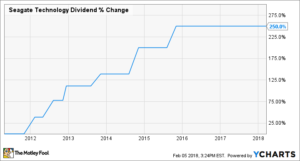
The company is not an out-and-out Dividend Aristocrat, but rather an opportunistic booster of dividend check amounts. The quarterly payout has been stuck at $0.63 per share since the fall of 2015, freezing Seagate’s dividend and freeing management to put its surplus cash to other use. That being said, the annual payout has increased by 250% over the last seven years.

STX Dividend data by YCharts

None of this matters if the company is going down the drain, of course. I have been a skeptic because Seagate is lagging behind nemesis Western Digital (NASDAQ: WDC) in terms of addressing the rise of solid-state storage devices — high-speed tools built around memory chips rather than spinning magnetic discs. The company is winning me over in two ways:

Traditional hard drives seem to have a long-term ticket to ride the enterprise sector. Seagate’s sales to large corporations with enormous data storage needs are booming, thanks to the lower cost of large disc-based drives. That trend might even have legs after all.
Seagate recently signed a long-term supply deal with memory chip maker Toshiba (NASDAQOTH: TOSBF), showing that management is considering new ideas.
So you’re taking on some risk with this investment, but Seagate’s generous dividends just might be worth it.

Warren Buffett’s Wells Fargo Problem

Warren Buffett at Berkshire’s annual meeting.

Warren Buffett’s Berkshire Hathaway (NYSE: BRK-A)(NYSE: BRK-B) owns a big slug of Wells Fargo & Company (NYSE: WFC), a company that is quickly becoming a big problem for the Omaha, Nebraska-based conglomerate.

A series of high-profile problems, including news that Wells Fargo opened 3.5 million fake accounts, and a recent discovery that the bank charged as many as 570,000 customers for car insurance they didn’t need, culminated in an unprecedented move by the banking industry’s chief regulator last Friday.

Fed limits Wells Fargo’s growth

The U.S. Federal Reserve ordered Wells Fargo to cease its growth until “it sufficiently improves its governance and controls.” The bank will have to cap its assets at roughly $2.0 trillion, which is where its balance sheet stood at the end of 2017, until it gets back on regulators’ good side.

Even though Wells Fargo may be lagging the banking industry in terms of recent stock performance, its valuation baked in healthy deposit and loan growth. Prior to the announcement, Wells Fargo shares traded for more than two times tangible book value, a price that reflected its ability to retain earnings to support growth in deposits, loans, and of course, earnings. Wells Fargo has grown quickly in recent years, as assets have grown at a compounded annual rate of roughly 6.3% since the end of 2013, impressive for a bank that ranks among the largest by assets.

Not surprisingly, the market wasn’t too pleased with news that Wells Fargo’s growth would be capped for an indefinite period of time. Shares shed nearly 10% of their value on Monday. Berkshire Hathaway was one of the biggest losers, as its stake in the bank declined by approximately $2.7 billion in a single trading day.

Stuck in a tough spot

While some investors find it easy to sell their stock and ask questions later, Buffett and Berkshire Hathaway don’t have the same luxury. Because Berkshire Hathaway is a C-corporation, it pays full corporate taxes on any gain. Uncle Sam’s share of Berkshire’s profits makes selling its winning stocks a tough pill to swallow even after the Tax Cut and Jobs Act reduced the corporate tax rate from 35% to 21%.

I estimate that Berkshire Hathaway’s stake in Wells Fargo was worth $27 billion at market close on Monday, but if Berkshire were to cash out, it would only receive about $23.8 billion in after-tax cash for its stake. The math behind my estimates is detailed in the table below.

These are, of course, estimates. In truth, my estimation of Berkshire’s tax liability likely errs to the low side. Last year, Berkshire reduced its stake in Wells Fargo by roughly 7% at the request of regulators, likely selling off its shares with the highest cost basis to minimize its tax bill.

I estimated Berkshire’s cost basis from Buffett’s 2016 letter to shareholders, which was the last time Berkshire disclosed its cost basis for tax purposes, assuming that the 464.2 million Wells Fargo shares Berkshire owns today had the same average cost basis as the 500 million shares it owned at the end of 2016. At any rate, the difference is likely trivial, but the tax consequences of selling its stake in the bank are not.

What should Buffett do?

Warren Buffett and Charlie Munger may have publicly derided Wells Fargo for its scandals, but they’ve stopped short of actually selling a meaningful quantity of the shares Berkshire holds. I suspect the matter largely comes down to taxes.

I estimate that for every $1 of Wells Fargo shares Berkshire owns, it would only receive about $0.88 in after-tax cash should it decide to sell its shares at Monday’s closing price. To justify selling Berkshire’s stake in the bank, Buffett would have to believe that $0.88 invested in another company can outperform $1 invested in Wells Fargo. This also assumes Buffett has a place to put $24 billion to work, which he doesn’t, given that Berkshire Hathaway already has too much cash ($109 billion at the end of the third quarter).

Buffett and Berkshire Hathaway are simply stuck with Wells Fargo, for better or worse.

How to Fix Your Credit After Identity Theft

The sooner you go on the defensive after identity theft, the quicker you can regain control of your credit. Here’s how.

Identity theft and credit card fraud are on the rise. Advisory firm Javelin Strategy & Research reported a 16 percent increase in the “identity fraud incidence rate” in 2016, the highest since the firm started tracking in 2003. The result? A massive $16 billion of losses during a single year.

Although the majority of these incidents involved credit card fraud, account takeovers (in which someone steals your information to access your financial accounts) increased by 31 percent, totaling a $2.3 billion loss in 2016. What’s more, this type of fraud is one of the toughest to combat.

Tough to combat doesn’t mean impossible, however. The sooner you go on the defensive after identity theft, the quicker you can regain control of your credit. Here’s how.

1. Contact all companies that have fraudulent charges or accounts in your name
If you’ve been contacted by debt collectors regarding accounts that weren’t opened by you, then you can go ahead and work with them to resolve the issue. But if you discovered fraudulent accounts by other means, contact the company the charge was made with.

Each company might have a different process for resolving such issues, so it’s best to communicate with them right away.

2. Close and reissue cards for any compromised credit and deposit accounts
For any fraudulent charges using your credit or debit card, call your issuer to report the charges and close your accounts. Your issuer should then take care of opening new accounts for you and issuing you new cards.

As soon as you do this, you can halt the thief’s spending spree with your money.

3. Put a fraud alert or a credit freeze on your credit reports
The next step is to put safeguards around your credit, which you can do with a fraud alert or credit freeze.

A fraud alert lasts for 90 days and can be renewed, or you can do an extended fraud alert that lasts for seven years. For this, reach out to each of the three credit-reporting agencies (Experian, Equifax, TransUnion) and either request this over the phone or follow the steps to do it online.

The fraud alert requires lenders to undergo additional steps to verify your identity before opening new accounts. But if you’ve experienced multiple instances of identity theft or want to take even more precautions, you can instead opt for a credit freeze.

A credit freeze is just what it sounds like — as long as the freeze is in place, no one can access your credit report. This is something to keep in mind if you’re in the market for a new loan, such as a mortgage, or even if you’re looking for a new apartment and know a credit check will be involved.

However, you can temporarily lift a credit freeze if you need to. Rod Griffin, director of public education at Experian, says all you have to do is contact the agencies before you need your credit to be available for an application and give them the PIN code you received during your freeze. Griffin also warns that, “a credit freeze will not prevent identity theft or use of a stolen identity to commit fraud that does not involve credit reports.”

Just like with a fraud alert, you can do the freeze online or contact the credit-reporting agencies to get their help with the process.

4. File a report with the Federal Trade Commission
The Federal Trade Commission (FTC) has created a website specifically to help with identity theft instances such as the one you might be going through: IdentityTheft.gov.

Not only does this site provide a great deal of information to help, it also enables you to report the fraud to the FTC directly. You can either report the issue here or call the commission at 1-877-438-4338. The FTC advises that you include as many details as you can in your report.

This report will serve as proof to the businesses you’re dealing with that you have in fact been victimized by identity theft.

5. Dispute fraudulent accounts on your credit report
Finally, make sure you let the credit-reporting agencies know if there are any accounts on your report that aren’t yours.

How can you tell if this has happened if you’re not sure already? Simply get your credit report — one from each of the three credit-reporting bureaus — at AnnualCreditReport.com. This service is available for free once per year, making it easy to review your accounts to ensure that they’re all yours.

And if any aren’t, immediately dispute the error with the credit-reporting agency (or agencies) that show it.
Maintaining good credit habits after identity theft
The average American’s household budget is already tight enough. Piling on fraudulent charges and accounts could nudge a tight financial situations to its breaking point.

You can protect yourself from this with a few small steps. For example:

  • Use long and complex passwords with numbers and special characters for all your logins — and have a different password for every online account you create.
  • Only shop on secure websites (look for the lock icon on the address bar) and sites you trust.
  • Never input your financial information or access financial accounts on public networks.
  • Review your bank and credit card statements each month to ensure all charges were in fact initiated by you.
  • Keep a close eye on your credit reports, and act immediately if there’s anything that you know isn’t yours.

When it comes to protecting your credit, a little diligence can go a long way.

New mortgage stress test rules have borrowers flocking to alternative lenders

New rules to stress test borrowers have many of them turning to alternative lenders who can operate outside those rules.

Mortgage brokers say the borrower rejection rate from large banks and traditional monoline mortgage lenders has gone up as much as 20 per cent after Canada’s banking regulator imposed a new stress test for home buyers who don’t need mortgage insurance.

As a result, alternative lenders are seeing an uptick in business as brokers increasingly direct home buyers toward borrowing options that are beyond the reach of the Office of the Superintendent of Financial Institutions’ newly enacted tighter lending requirements.

Clients who don’t meet the bar are turning to private lenders, mortgage investment corporations (MICs) and credit unions, which are provincially regulated and not required to implement the stress test, said Carmen Campagnaro, president of Pro Funds Mortgages in Burlington, Ont.

Campagnaro is one of the brokers who said rejected loan applications to traditional lenders have risen by 20 per cent since Jan.1, when OSFI mandated a new stress test for uninsured borrowers, or those who have more than a 20 per cent down payment.

Private lender Fisgard Asset Management Corporation in Victoria is seeing an influx of borrowers and “better quality business” said Hali Noble, its senior vice president of residential mortgage investments and broker relations.

“A lot of these people should be bankable,” said Noble. “But they’re not.”

The guidelines, known as B20, are aimed at curbing risky lending amid rising household indebtedness and high home prices in some markets.

In order to get a loan from a federally regulated lender, home buyers have to prove that they can service their uninsured mortgage at a qualifying rate of the greater of the contractual mortgage rate plus two percentage point or the five-year benchmark rate published by the Bank of Canada. An existing stress test already requires those with insured mortgages to qualify at the Bank of Canada benchmark five-year mortgage rule.

Superintendent Jeremy Rudin has said OSFI is aware the stricter rules could have unintended consequences, such as sending borrowers towards more risky lenders that are out of the regulator’s purview.

“We can’t control what we can’t control,” he said in October.

“Our mandate is focused on the safety and soundness of the federally regulated institutions… It isn’t something that we favour but it isn’t something that we have an authority to prevent.”

Since the revised mortgage guidelines came into force, both the Bank of Canada of rate and benchmark rate has risen, dealing a “double extra whammy” to borrowers, said Dave Teixeira, vice president of operations, public relations and communications for Dominion Lending Centres.

Dominion mortgage brokers are seeing a higher rate of rejection and clients have to submit multiple applications to various institutions before finding a lender that works, he added.

In turn, their brokers are submitting 80 per cent more applications than last year, Teixeira said.

“Normally, we would see our volume going to the big banks and monolines, and now we’re seeing a little bit more of that, roughly up to 20 per cent… moving over to credit unions.”

However, some credit unions have voluntarily implemented the new stress test or tightened their own requirements.

Quebec credit union Desjardins Group has been applying OSFI’s new mortgage rules in full since Jan. 1.

“We believe it represents an effective way to protect consumers against interest rates variations,” said Desjardins spokeswoman Valerie Lamarre.

Vancouver-based Vancity Credit Union has voluntarily increased the stress test its members must meet to qualify for a mortgage.

Rick Sielski, Vancity’s senior vice-president of risk, would not disclose the mechanics of the stress test and said it was too early to gauge the impact of the new guidelines.

“What we’re really trying to do is make sure we’re serving our market, serving our members in a responsible way,” he said.

The higher bar for borrowers is also shifting business to riskier lenders.

Harold Gerstel, better known as Harold the Mortgage Closer from his television ads, said his Toronto-based mortgage arm is seeing an influx as well.

“We’re definitely getting more business. Whether it’s a substantial change, it’s too early to tell,” he said.

The new rules are sending better quality demand down the credit line, said Robert McLister, a mortgage planner at IntelliMortgage and the founder of RateSpy.com.

“The demand is shifting down the ladder, so you have these less regulated lenders with higher risk tolerance now seeing materially more business. And they can charge more, and they can be pickier with the types of borrowers that they lend to.”