
Archives for February 4, 2018

2020 Ford Explorer ST: A Sporty Explorer, Likely with Rear-Wheel Drive

What It Is: The sportiest variant of the next-generation version of the Ford Explorer. Don’t be surprised if the Explorer’s engineers opt to return to model’s pre-2011 longitudinal layout, sending power to the rear axle in two-wheel-drive form, while all-wheel drive will remain available throughout the model line.

Regardless of the next-generation Explorer’s favored drive wheels, we’re all but certain the new crossover will make better use of its available interior space relative to the present model. Currently the Explorer suffers from thick sills that intrude into the cabin and push the crossover’s three rows of seats toward the center of the interior.
Why it Matters: As one of Ford’s top-selling models, the Explorer is key to keeping the lights on at the Dearborn, Michigan–based automaker. With the exception of the F-150 pickup truck and the Escape compact crossover, no other Ford model moved as much metal as did the Explorer in 2017. With such high financial stakes on the line, you can be sure Ford doesn’t want to mess up the good thing that is the Explorer.

Platform: The latest Explorer is rumored to rest on the brand’s new CD6 modular platform, which is said to accommodate front-, rear-, and all-wheel-drive powertrain setups. Expect the Explorer to rely on a heavier use of mixed materials to shed weight relative to the current model, with more aluminum used throughout the chassis. The body, however, likely will continue to be made largely of steel.

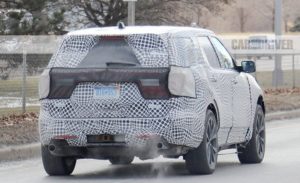
Despite using the body of current Explorer, this camouflaged mule appears to be wider and feature a noticeably longer hood and an increased dash-to-axle ratio—a tantalizing indication the new Explorer’s engine will be mounted longitudinally and come standard with rear-wheel drive.

Powertrain: While the basic Explorer is likely to use a version of the current crossover’s turbocharged 2.3-liter inline-four in lesser models, expect higher-end variants to feature the brand’s twin-turbocharged 2.7-liter V-6. This mule appears to be an even sportier model, as indicated by its chunky split-spoke wheels and dual-exhaust outlets, and we anticipate it will bear the ST name, which also is featured on sporty variants of the Fiesta, the Focus, and the updated 2019 Edge. Look for an Explorer ST to come equipped with the twin-turbocharged 3.5-liter V-6 that currently sits under the hood of the Explorer Sport, a trim we anticipate that the ST will replace. While the engine is rated at 365 horsepower in the Explorer Sport, we expect the bent-six to add a handful of additional ponies into its stable, bringing total horsepower closer to 400. All-wheel drive is all but guaranteed to come standard with the big engine, as is a 10-speed automatic transmission.

Competition: Dodge Durango SRT, Jeep Grand Cherokee SRT

Estimated Arrival and Price: Look for the new Explorer to show its face in early 2019, possibly at the Detroit auto show, with sales following shortly thereafter. Pricing should start in the low $30,000 range, with the sportier ST coming in closer to $50,000 before options.
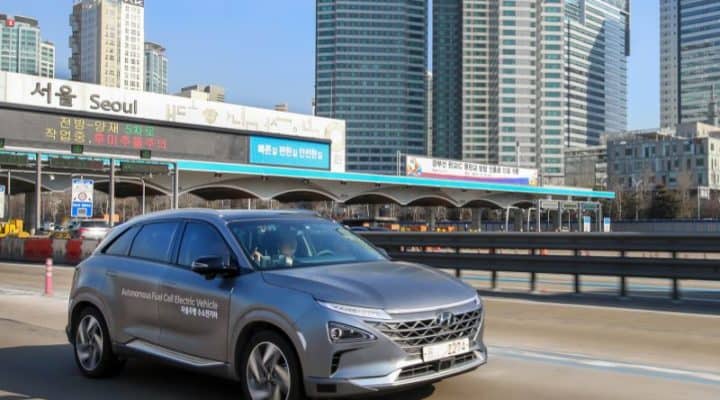

Hyundai’s self-driving fuel cell cars complete a record highway trip

Future self-driving cars don’t have to be pure electric vehicles, and Hyundai is determined to prove it.

Future self-driving cars don’t have to be pure electric vehicles, and Hyundai is determined to prove it. The automaker just had a five-strong fleet of Level 4 autonomous hydrogen fuel cars drive themselves 118 miles from Seoul to the Winter Olympics’ home venue of Pyeongchang. That’s the longest any self-driving vehicle has traveled at highway speeds (around 62-68MPH), the company claimed. Previously, they had to putt around at slower speeds, and frequently on limited road sections.

Three of the cars were shiny new Nexo SUVs (such as the one above), while the other two were more familiar Genesis G80 sedans. They were also showcases for cellular tech, with 5G inside for backseat smart home control, chat bots, streaming media and video calls with health consultants.

Is this a publicity stunt? You bet — Hyundai doesn’t expect to commercialize Level 4 cars until 2021, with fully autonomous models arriving by 2030. Most of those will likely be pure EVs, too. And when 5G networks are just getting started, we wouldn’t expect in-car gigabit data for a long while. Still, this helps demonstrate that driverless cars aren’t limited to short city jaunts.

What would a million cigarettes cost? Health Canada wants to know

The federal government might want to buy a million of the low-nicotine variety

The federal government wants to research the market for very low-nicotine cigarettes.

The federal government is doing a little window-shopping for cigarettes — a million of them.

Health Canada recently issued a tender notice asking suppliers what it would cost to purchase a million very low-nicotine cigarettes as part of its wider tobacco control strategy.

VLN cigarettes, which have less than 0.4 mg of nicotine each, aren’t available in Canada now. The tender notice is meant to find out which companies could make them and at what cost.

It also asks how a million cigarettes could be safely stored, and for how long, without a “deterioration in quality.”

Health Canada spokeswoman Rebecca Purdy said the government issued the tender notice merely to learn more about the availability of “Canadian-style” VLN cigarettes for possible research applications.

She stressed it’s a “preliminary inquiry and does not necessarily signal intent to carry out the research.”

Rob Cunningham, a senior policy analyst with the Canadian Cancer Society, said the idea of VLN cigarettes has been around for 25 years, but the product hasn’t succeeded commercially anywhere.

“Smokers will not smoke cigarettes without nicotine, and if that was the case, they’d be on the market today,” he said.

Cunningham points to herbal cigarettes that are available for sale now, but aren’t very popular.

‘Like marijuana without the THC’

“This idea is similar to allowing the legalization of marijuana but saying marijuana can’t contain THC. That wouldn’t work,” he said. THC is the chemical compound that gives marijuana its effect of making people “high.”

The federal government’s current Tobacco Control Strategy expires next month. That strategy included educating Canadians about the link between tobacco and health conditions such as heart disease and stroke as well as cancer. It also led to the pictorial health warnings on tobacco products.

To create a new one, it held a series of public consultations last year and released a summary document last December.

In that document, Health Canada says it is exploring options to reduce the addictive effect of tobacco products.

“The government indicated that it is examining a wide range of possible options to modernize the federal approach to tobacco control, including the development of regulatory approaches for reducing the addictiveness of tobacco products,” Purdy said.

The Canadian Cancer Society was among the groups that took part in those consultations.

Cunningham said he supports some of the federal government’s efforts, such as moving ahead with plain packaging and banning menthol cigarettes.

Invest the money in cessation programs: Cancer Society

But he said that if the federal government really wants to further reduce smoking rates in Canada, it must spend money on the right things — noting that Health Canada’s tobacco control budget is less than a third per capita of the budget in the United States.

“We want a comprehensive strategy that includes cessation programs, prevention programs, community programs, better research and surveillance and enforcement, and all of these things have been cut [by the previous government],” Cunningham said.

“If we’re going to have the impact that we want to, to reduce smoking in Canada, we should be looking for measures that are viable in Canada. And taking nicotine out of cigarettes in Canada is not a viable approach.”

Cord-Cutting: Why Virtual Reality’s Future Must Be Wireless

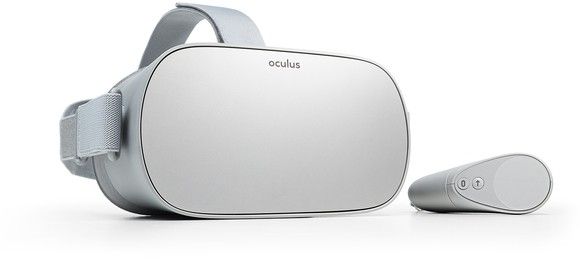
Oculus Go with a controller.

By almost any measure, virtual reality has been a disappointment on a consumer level so far. Between Facebook’s (NASDAQ: FB) Oculus, HTC’s (NASDAQOTH: HTCKF) Vive, and Sony’s (NYSE: SNE) Playstation VR, there are fewer than 5 million headsets in the market worldwide, and many consumers still don’t know what virtual reality is.

That could change in 2018 as virtual reality devices become cheaper and more accessible to the masses. Wireless technology, in particular, will be a big focus this year. Here’s are just a few of the key advancements in making VR wireless that we know are coming in 2018.

Wireless VR for the masses

High-end virtual reality headsets today require a powerful PC and a tethered headset. But that’s slowly beginning to change. HTC has led the stand-alone VR move with Vive Focus, a headset with its own processor, operating system, and even controller. It’s only available in China, for now, and comes with a still lofty price of $604.49, according to UploadVR.

We don’t know when the Vive Focus will make its way to the U.S., but we do know Facebook’s Oculus is planning to launch a headset called Go early in 2018. The headset will be a lot like a Samsung Gear experience, except instead of attaching your phone to a headset, the screen will be built-in. Like the Vive Focus, the Oculus Go will come with a small controller and a custom operating system that should make it very easy to use. And its $199 price will be very attractive to the consumer market.

High-end virtual reality without wires

Not only are the lower-end virtual reality headsets going wireless; so are the high-end devices.

HTC’s recently announced Vive Pro package will bring increased resolution and an upgraded sound system. But the bigger development could be a wireless adapter that will eliminate cords for the high-end VR experience. The adapter will be welcome news for those who own a Vive but expect wireless to be a built-in feature for Vive 2.0, whenever that’s released.

Oculus expects to take a big leap forward when its headset called Santa Cruz is released, reportedly sometime in 2018. The high-end headset will have advanced tracking like the Rift or Vive but will be completely wireless. Even controllers in a user’s hand will be tracked from within the headset rather than use outside sensors.

Going wireless in high-end virtual reality will be truly revolutionary and may ease the burden of cumbersome cords that weigh down VR today.

Can the leader keep up?

Notably absent from these VR announcements is Sony, whose Playstation VR actually has a bigger installed base than Oculus or HTC. The Playstation VR experience is almost easier to adopt than Oculus or HTC because there are tens of millions of Playstation 4s already in people’s homes. It doesn’t require a complex setup or a new PC, so it makes sense that barriers to adoption are lower.

But there’s not a lot of word from Sony about a next-generation device and, given the Playstation platform, it may be tough for the company to take its virtual reality plans completely wireless.

I think given the public announcements and new products coming in 2018, the future of virtual reality looks to be wireless — and it looks like Facebook’s Oculus and HTC are the two horses with a chance to win this tech race.

Amazon’s cloud is big enough to be the 5th-largest business software company in the world

Amazon’s cloud business has become a powerhouse in software and is poised to become an even bigger force over time.

Amazon’s cloud business has grown so quickly in the past decade that it’s now the fifth-largest business software provider in the world.

Revenue at Amazon Web Services jumped 43 percent in 2017 to $17.5 billion, representing about one-tenth of Amazon’s total revenue, the company said this week. The only publicly-traded business software companies ahead of AWS are Microsoft , IBM , Oracle and SAP, according to data from FactSet.

AWS is far and away the leading provider of cloud infrastructure technology, and it has proven that Amazon can diversify beyond e-commerce. Microsoft, Google, IBM and others are all chasing AWS in the cloud.

Assuming AWS continues to grow as much as it did last year, it could pass SAP in size before the end of 2019. SAP’s 2017 revenue of $26.5 billion was up 6 percent, and the company expects the same growth rate in 2018. Analysts are currently projecting 38 percent growth at AWS this year, according to FactSet.

With its lineup of cloud-based databases, data analytics tools, productivity apps and raw computing capacity, AWS is almost twice as big as Salesforce , which generated sales of $9.9 billion over the past four quarters, growing 25 percent.

Ottawa Hospital unveils plan for new Civic campus

Consultations raised questions about access, parking and greenspace

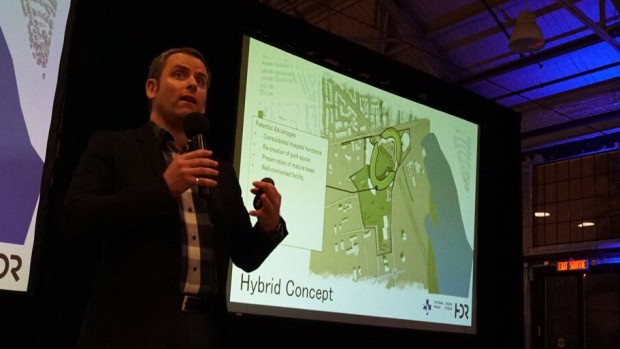
Jason-Emery Groen, a consultant with HDR, presenting the first conceptual design for the new Civic hospital campus.

The Ottawa Civic Hospital unveiled the architectural plans for its new campus on the northeast corner of the Central Experimental Farm on Wednesday night.

Jason-Emery Groen, from architecture firm HDR, ran through the proposal which includes three main buildings mostly oriented toward Carling Avenue.

The buildings with the highest turnover, teaching and outpatient clinics, are oriented towards the northeast corner of the land near the Carling Avenue and Preston Street intersection, as well as the O-Train’s Trillium Line.

The proposed architectural design for the new Ottawa Hospital campus along Carling Avenue, near Dow’s Lake. (The Ottawa Hospital)

The acute care facility would be built toward the southwest portion of the land and back onto an underground parkade that would have a green roof.

Groen said the proposal is meant to respect sightlines and the context of development in the surrounding community.

The plans follow a two-month community consultation that highlighted accessibility, parking and greenspace as major concerns in the development of the new hospital campus.

Access, parking concerns

Those concerns were echoed by some of the more than 200 people who came to the meeting at Lansdowne Park’s Horticultural Building.

Urusula Mount, who lives near the proposed campus, said she still prefers the original location proposed for the new Civic, but appreciated it appeared the hospital was listening to the community.

“I think they have incorporated the environment, the natural habitat because I know there are pathways through there. So from that point of view I think they have listened,” she said, though she still has some reservations.

“You wonder how the access is going to be possible with parking and everything.”

Michel Gauthier, executive director of the Canadian Tulip Festival, said he was excited by the proposal but worried about the elimination of a parking lot near Dow’s Lake, which could affect his festival and Winterlude.

“Now you’re removing the parking lots which are accessible and adjacent. Yes, you’re putting in spots but they’re at the other end of the world,” he said.

“We’re going to have to sit down and find a new way of doing this.”

River Coun. Riley Brockington said he liked what he saw in the plan and that the question of location isn’t going to be reopened.

He said he’s also watching access and parking issues.

“Parking absolutely has to be adequate. I do like the fact that it will be underground and buried,” Brockington said.

“We need to maximize the use of [public transit for] employees, visitors and patients who are maybe not urgent patients coming to the hospital.”

Make a new O-Train stop: Naqvi

Yasir Naqvi, Ontario Attorney General and Ottawa Centre MPP, said he has proposed a dedicated O-Train station for the new hospital on the Trillium line, just south of the existing Carling stop.

“I think in order to really encourage people, especially the staff who will work at this new site, to take public transit like the Trillium line, it probably would be better to have a station right inside the building,” he said.

Naqvi did not say whether the province would pay for the new stop, but added he didn’t think it would be too significant of a cost in the context of the multibillion-dollar hospital project.

Cameron Love, the hospital’s executive vice-president and chief operations officer, said they haven’t pinned down the number of parking stalls.

“We have to try and really create flexibility around it,” Love said.

“Fifty years from now: are there going to be as many cars? Are they self-driving cars?”

Some programs moving

The hospital also said it will be reorganizing some of its programs to take advantage of the new space and make it easier for patients to get their care in one place.

The acute mental health, nephrology and rehabilitation programs would move to the new Civic campus, according to Love.

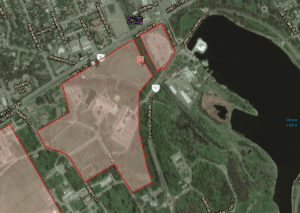
Aerial view of the proposed new location of the Ottawa Hospital’s Civic campus, the former site of the Sir John Carling Building. (National Capital Commission)

Love said the cost of the proposal, which has been estimated as $2 billion in the past, will be determined by what kind of facilities the Ministry of Health and Long-Term Care decides need to be built in the region.

The hospital said it is still accepting public feedback and is working to have a more complete proposal in three years.

The new hospital is slated to open in 2026.