
Archives for February 4, 2018

Braving the cold and hurrying hard: Outdoor bonspiel draws nearly 300 curlers in Winnipeg

72 teams participating in 17th Ironman Outdoor Curling Bonspiel at The Forks this weekend

The Ironman Outdoor Curling Bonspiel takes place on the Red River near The Forks in Winnipeg from Feb. 2 to Feb. 4.

Bundled up and sweeping with old household brooms and sponge mops to stay warm, curlers faced the extreme cold Saturday during the 17th annual Ironman Outdoor Curling Bonspiel.

Nearly 300 players on 72 teams are taking part in the weekend-long event, a fundraiser for the Heart and Stroke Foundation of Manitoba, which sees players hurl their granite rocks down heavy, frozen ice on the Red River at The Forks.

“It’s still two feet in a hack and throw your guts out,” said player Darren Brown about the ice conditions.

He is playing in his fourth outdoor bonspiel this year. The slow, cold river ice makes sliding virtually impossible.

“Don’t bring your curling stuff like your shoes and that. Forget it,” said Brown. “People are just pushing the rocks with a broom. It’s a lot easier.”

Darren Brown and others braved the cold during the Ironman Curling Outdoor Bonspiel in Winnipeg Saturday. (Justin Fraser/CBC)

Despite the slow ice, sheets this year are better than past years, when Brown said players had to navigate around gaping holes left by ice fishers.

Saturday’s extreme cold warning in Winnipeg, where the high was –19 C (and felt like –33 with wind chill), meant Brown’s team and others wrapped up six ends with expert efficiency.

Brown’s game lasted less than an hour.

“We did not win today but that’s strategy … we wanted to get off the ice as quick as we could,” he said with a smile just visible under a thick mass of frozen beard.

Ingrid Reid, a spokesperson for the Ironman Outdoor Curling Bonspiel, said restaurants at The Forks are open to players who just need a space to warm up and there’s hot chocolate available closer to the ice. The odd open bonfire helps keep the chilly edge off too.

“It is a unique experience, that is for sure,” she said.

For the first time, the local brewery Torque is supplying refreshments because, as Reid said, no curling event should be without a beer garden.

Winners of the Ironman Outdoor Curling Bonspiel receive new curling jackets.
Oil Stocks: What to Watch in 2018

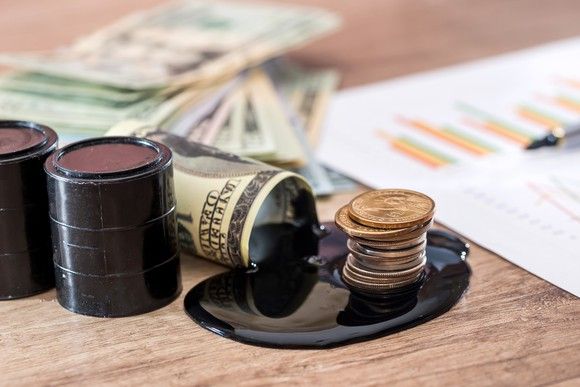
Various items including miniature oil barrels and a pile of money sit on a wood background

It seemed like every day in 2017 was full of despair for oil investors, as morning after morning went by with oil prices stubbornly stuck around $50/barrel. Then, toward the end of the year, prices began rising, and with it, hopes for — finally! — an industry turnaround.

Now, it looks like every day in 2018 is going to be a nail-biter for oil investors as they check to make sure the price of oil doesn’t start heading back down again. Here’s what savvy investors will want to keep an eye on in 2018 as they look into independent oil and gas drillers like ConocoPhillips (NYSE: COP), refiners like HollyFrontier (NYSE: HFC), and integrated majors like ExxonMobil (NYSE: XOM).

The stock market seems to finally be rewarding oil stocks as oil prices move higher. But investors should keep an eye on things as they buy. Image source: Getty Images.

Producers: watch the price

No sector of the oil industry is as dependent on oil prices as E&Ps, the insider name for independent oil and gas exploration and production companies. Because they directly sell the crude oil they produce, E&P stocks tend to be the first ones affected when the price of oil changes: They drop first (and often farthest) when oil prices go down, but they also tend to rise more quickly when oil prices go up.

Take ConocoPhillips, the largest U.S. E&P. Between June 2014, when the oil price dropped, and the end of the year, Conoco’s stock took a 17% hit, while ExxonMobil’s lost a more modest 10%. By the time oil stocks hit rock bottom in January of 2016, Conoco’s shares had lost 59% of their value, while Exxon’s were down less than half that, at 28%.

However, the opposite is also true. Since crude oil stocks began steadily rising in August 2017, Conoco’s stock has appreciated more than 30%, while Exxon’s has gone up less than 10%. So, the thing to watch when looking at E&Ps is where the price of oil seems to be headed. If it’s on the rise, or at least stabilized at current levels — both Brent Crude and WTI crude are comfortably above $60/barrel now — E&P stocks should do well. But if the price starts dropping, don’t be surprised to see some panic selling in the market, and be prepared to snap up shares while they’re cheap.

Refiners: watch the crack spread

No, the “crack spread” isn’t some weird new sandwich topping; it’s what the industry calls the difference between the purchase price of crude oil and the selling price of refined petroleum, and it’s how oil refiners make their money.

Low oil prices can actually be good for petroleum refiners, because if demand stays high for refined petroleum, the crack spread can get very wide indeed. In fact, that’s just what happened to HollyFrontier in 2017, as a busy summer driving season followed by Hurricane Harvey-related supply disruptions pushed the crack spread for WTI Crude to above $30/barrel, up from a range of $6 to $17 in 2016. Holly took advantage by running its refineries at 102% of capacity, and its stock reaped the benefit, rising more than 50% for the year.

However, the rising price of oil is putting pressure on the crack spread, which is unlikely to match its 2017 levels in 2018. Not to mention, there’s a limit to how much capacity a refiner can squeeze out of its facilities, and many refiners were operating at peak capacity in 2017. Those refiners will now be facing tough comparable year-ago quarters in 2018, so it’s unlikely they’ll have the banner year they had in 2017.

Integrated majors: watch everything

The integrated majors — the largest of the oil companies — combine exploration and production activities with refining and also selling of refined products. During the oil price downturn, those profitable refining and selling operations were subsidizing the oil majors’ underperforming exploration and production activities. Some oil majors even had to resort to offering scrip dividends — paying dividends in shares instead of in cash — to fund their payouts.

Cost-cutting measures also helped, as most oil majors were able to push their breakeven points — the per-barrel oil price at which they would turn a profit — below $40/barrel. With costs still low and the price of oil now edging higher, some companies are ending their scrip dividend programs and even eyeing costlier and riskier deepwater investments.

ExxonMobil is one such oil major. With a low breakeven point and a healthy balance sheet, the company has made extensive offshore investments in Guyana that seem to be paying off. But it isn’t ignoring onshore opportunities, either. In fact, Exxon recently announced it expected to triple its Permian Basin production by 2025.

The combination of higher margins thanks to rising oil prices and cost-cutting should allow many oil majors to expand their operations, pay down debt, make acquisitions, raise dividends, and generally benefit shareholders. Each individual company, though, is likely to prioritize something different. For oil majors, investors will have to keep an eye on the whole package rather than just one or two elements in isolation.

A sector to watch

Analysts are expecting good things from the oil sector in 2018 as higher oil prices combine with successful cost-cutting measures to give a boost to companies across the industry. However, there’s some concerns that the stock market in general looks expensive right now, which may lead to a broader market pullback. If that happens, oil stocks could get caught up in an overall downtrend.

The best thing to do, though, is to invest in quality companies with good prospects. And keeping an eye on oil prices, crack spreads, and the overall performance of the integrated majors is a great way to figure out which parts of the oil sector will give you the best bang for your buck.

Credit-card companies to add to bitcoin investors’ misery

More credit-card issuers are ditching bitcoin.

Three of the largest banks in the U.S. said Friday that they would no longer permit credit-card customers to buy bitcoin with their credit cards. The decisions were announced after a brutal week for bitcoin prices, which have plummeted more than 50% from their peak in December.

Citigroup Inc. said late Friday that it has decided to no longer permit its credit card customers to buy bitcoin with their Citi credit cards. The bank is in the process of implementing the block, which will apply to Citi credit-card holders globally. “We will continue to review our policy as this market evolves,” said a bank spokeswoman.

The bank joins JPMorgan Chase & Co. and Bank of America Corp., which earlier Friday also said they won’t allow credit-card customers to use credit cards to buy bitcoin.

The Wall Street Journal reported on Jan. 25 that banks were becoming concerned about the risks associated with credit cards being used to purchase bitcoin. Capital One Financial Corp. prohibited credit-card purchases of bitcoin in January and Discover Financial Services banned them in 2015.

With the latest announcements, most top credit-card issuers by volume won’t allow bitcoin purchases. One of the biggest concerns for banks is that bitcoin purchases will push up their card losses. That includes cardholders who don’t pay their bills when the price of bitcoin falls below what they paid to buy it with the card.

Mercedes and Bosch will test self-driving taxis in a few months

Mercedes (or rather, its parent Daimler) and Bosch aren’t far off from making their self-driving taxis a practical reality… in a manner of speaking. Bosch chief Volkmar Denner has informedAutomobilwoche that the two companies will put test vehicles on the road within a few months. He didn’t supply other details, but the mention provided a more definitive timetable for their ambitions. Until now, the two had only promised to have fully autonomous vehicles ready by the start of the next decade.

The news suggests the two are acting on their promises to make up for lost time. In a sense, they don’t have much choice. When BMW plans to sell self-driving cars in 2021 and Waymo is already ordering thousands of Chrysler vans, Daimler doesn’t have the luxury of taking things slowly — it either steps up its game or risks missing out.

Daimler is mainly betting on the purpose-built nature of its taxis as an advantage. The taxis won’t just amount to a “technology-kit mounted on a serial vehicle,” according to Daimler VP Wilko Stark — they’ve been design as autonomous rides “from the beginning.” That could give them an edge if their ergonomics and performance are better than retrofitted conventional cars. The question is whether or not it’ll matter. If other companies establish enough of a footprint for self-driving taxis before the Mercedes offerings are ready, superior tech might not be enough.

Mysterious ‘pants’ arch baffles internet, geologists and Nunavut tourism office

‘My first reaction when I saw the photo was, ‘No way, this is definitely Photoshopped,’ says tourism worker

The photo that started it all. Max Kalluk sent CBC North this photo back in August. It prompted widespread disbelief — and an investigation to determine if the formation actually exists.

Behold.

A massive, pants-like rock formation, standing tall and glorious in a pool of salt water in Canada’s Arctic.

The Nunavut community of Arctic Bay calls it “Qarlinngua” — pronounced “kar-ling-wah,” which means “like pants” in Inuktitut.

You probably can’t find much about it on Google, beyond photos posted to CBC North’s Facebook pages.

And not many people have seen it in person, according to our investigation.

CBC North received this photo from a local hunter from Arctic Bay back in August, and shared it with the world.

But the internet thought it was fake; CBC even got a typo report on it.

“Any provenance for that? Anything that big and spectacular should be a Natural Wonder of the World, but Googling reveals only THAT picture of it,” a reader wrote back in December.

“It looks like a fake photo to me.”

CBC reached out to the tourism office in Iqaluit to verify the photo, and got a similar response.

“My first reaction when I saw the photo was, ‘No way, this is definitely Photoshopped.’ I definitely thought it was fake,” said Sarah Demeester, an information counsellor with the Unikkaarvik Visitor Centre.

“And also, I just wondered why I had never heard of such an amazing formation before.”

She said there was a buzz around the office as colleagues discussed the validity of the photo. Demeester said after reaching out to her local sources, she was able to confirm the arch exists.

‘I haven’t seen anything like this in the Arctic, despite my widespread fieldwork.’
– John England, professor at University of Alberta

“[It’s] really just amazing. It kind of emphasized to me how remote we are in this part of the world up in Nunavut — the fact that something so amazing can exist … and hardly any people have laid their eyes on it in person.”

Where is it?

The Qarlinngua is located in an uninhabited area of the Brodeur Peninsula on the north end of Baffin Island, about 80 to 90 kilometres southwest of the community of Arctic Bay, according to Max Kalluk, the hunter who submitted the photo to CBC North.

The arch is only reachable by boat. It’s a four- to five-hour ride from Arctic Bay.

And there’s only a small window during the year when the summer sea ice is broken up enough to get there, Kalluk said.

“I can see why it’s considered fake because it’s very phenomenal.”

Kalluk said he was around 12 years old when he first saw the formation, passing by with his family while they were out hunting for seals.

“We get to see it every year, going to our destination where we narwhal hunt,” he said.

He estimates it stands more than 50 metres tall.

“Kind of makes you feel like small or humble, seeing something like that,” he said. “And makes you appreciate and feel privileged that you get to see this.”

A rocky cliff with similar layering serves as the Qarlinngua’s backdrop. Kalluk said there are more unique formations in the area, including one that looks like an elephant, just five minutes away by boat.

How was it formed?

Four geologists from across Canada examined the Qarlinngua photos.

“I haven’t seen anything like this in the Arctic, despite my widespread fieldwork,” said John England, a professor emeritus at the University of Alberta’s earth sciences department, who’s done research throughout Canada’s Arctic for 50 years.

He said the scientific name for it is a sea arch, or a natural arch.

The scientific name for this formation is a sea arch, or a natural arch. It’s created through erosion over time. (Max Kalluk)
England explained that most coastlines in the Arctic are still rising from the sea due to “the unloading of the crust” by the ice sheets that melted away about 10,000 years ago, gradually moving the coastline away from the cliff. But there are also areas where the land is sinking relative to the sea.

“So, in these areas,” he said, “likely like where your photo was taken, the sea is now rising faster than the land, and if there’s a lot of open water in the summer, the sea is eroding into a nearby cliff, whose coastline is slowly sinking.”

A combination of wind and water would erode cliff rocks over many years, forming isolated sea arches. The horizontal layers in the Qarlinngua indicate it is sedimentary rock, or sandstone, which is good erodible material.

The portion that’s still standing likely contains a large volume of quartz, which is resistant to erosion, said Linda Ham, chief geologist with the Canada-Nunavut Geoscience Office.

Ham also confirmed she and her fellow geologists in the office in Iqaluit have never seen anything like the formation anywhere in the Arctic.

“Because up here, [we have a] very, very hostile environment,” said Ham, who explained it’s more common to see natural formations like these farther south in places like Alberta, Utah or the Oregon coast.

Ham said the rocks in the Brodeur Peninsula area are Paleozoic rocks, meaning they’re around 250 to 600 million years old.

England said until recently, most of the coastlines in the Arctic had been dominated by summer sea ice, which would allow for a slower erosion of formations such as the Qarlinngua.

More open water could speed up the process.

England estimated the Qarlinngua could collapse and disappear in a matter of decades, while other geologists who spoke with CBC News said it could take thousands of years.

But they said the cliff behind the Qarlinngua will also erode, so it’s possible several new arches will form.

‘A land of opportunities’

Arctic Bay Adventures confirmed it’s the only tour company that takes people to the Qarlinngua.

Manager Gene O’Donnell said he’s taken several groups of tourists to the formation in the past three years. He said the company plans to advertise the tour on its website soon.

“It’s like a monument to something. I’m not sure what it is,” O’Donnell said. “I think it’s something sacred.”

Nunavut’s tourism director says she was unaware of the Qarlinngua and is excited to start promoting it. (Submitted by Max Kalluk)
The challenge, O’Donnell said, is the very limited window when the formation is accessible — last year it was just a week; the two years prior it was 13 days.

“It’s fantastic. It’s phenomenal,” said Nancy Guyon, Nunavut’s director of tourism and cultural industries.

She, too, was unaware of the formation until CBC asked for comment.

She said the government’s tourism department will soon hold meetings on the Qarlinngua and hopes to promote it to its target tourism clients: high-income travellers aged 45 and up. It can cost around $2,000 for a one-way flight from Iqaluit to Arctic Bay.

“Nunavut has so many gems like this,” Guyon said.

“I’m always calling it a land of opportunities.”

3 SRI Stocks to Consider Buying Now

Socially responsible investing (SRI) is based on the idea that investors can earn an attractive return while investing in companies that are doing good for the world. The strategy has taken off in recent years, as many SRI funds have enjoyed market-beating returns from hefty stakes in high-flying tech stocks and comparatively small stakes in major oil producers, which have lagged the market.

Those who want to take control of their own portfolio by purchasing SRI stocks on an individual basis might want to look at Alphabet (NASDAQ: GOOG)(NASDAQ: GOOGL), JPMorgan Chase (NYSE: JPM), and Costco Wholesale (NASDAQ: COST). Here’s why.

1. Searching for social responsibility

Alphabet, parent company of Google, is often heralded as one of the most socially responsible technology companies. It launched with the idea that lives could be improved if people had better access to information, and today almost every internet user uses one of its products to complete an internet search (Google), watch videos (YouTube), or communicate with friends or family (Gmail and Android).

When it went public as Google, the company set aside 1% of its stock for the Google Foundation, to which it also pledged to contribute 1% of its profits each year — no small sum, given that Alphabet earned more than $25 billion in 2017, excluding one-time items from a corporate tax cut, primarily from Google’s search and display advertising business.

Google also leads on efforts including renewable-energy development. It recently announced that it purchased enough renewable-energy capacity to cover all of its energy needs for an entire year, hitting its target of matching 100% of its energy use with investments in renewable energy. Alphabet has also made financial bets on green energy and other initiatives that are good for the planet. Nest Labs, best known for its smart thermostats that help homeowners use less electricity, is one of its largest “other bets,” a company it acquired for $3.2 billion in 2014.

Alphabet can afford these investments because it sits atop a business that throws off an incredible amount of cash, generating more than $24 billion of free cash flow in 2017, largely from its own internet properties (search and YouTube), and from display advertising products (AdWords and AdSense) that place ads across the internet.

Alphabet isn’t just a good SRI company; it’s also a good stock to own for the long haul. Even if its moonshot bets don’t pan out, the search business alone offers an opportunity to profit from growing wealth all around the world, as Google is, in many ways, the toll road to the internet that users pay for with the occasional click of an ad.

I believe the company has a long runway of double-digit growth ahead of it, driven by increased internet use, improved monetization on a per-user basis, and rising advertising prices over time. Priced at about 30 times free cash flow, it’s no clear bargain, but rapid growth in advertising profits justify a higher-than-average multiple for the business.

2. Banking on social responsibility

Though banks aren’t often what people first think of when it comes to SRI stocks, JPMorgan Chase has won many awards for social responsibility. The bank received accolades for large community investments, particularly in economically challenged areas like Detroit, where it made a $100 million philanthropic investment, in addition to investments in its own business.

JPMorgan sees Detroit as a model for how cities can work with large corporate entities to create the base for economic growth. The bank invested in business incubators such as TechTown and Eastern Market, to spur new business development in the city. It also invested in an Entrepreneurs of Color program, which makes loans to minority-owned businesses.

Though internet retailers are taking up a greater share of every dollar spent in the United States, the reality is that small businesses are still very important on a local level. JPMorgan found that, in Detroit, roughly “43% of consumer purchases came from residents shopping in the same neighborhood where they live.”

Taking care of communities isn’t just good for the community; it’s good for the banking system, too. It leads to stabilized real estate values, against which banks can lend. Rising real estate values also encourage people to buy homes to become a permanent part of the community, leading to neighborhoods filled with people who are personally invested in the success of those in close proximity.

JPMorgan is a well-run institution, the largest bank in the United States by assets, and often one of the most profitable. Despite being large, it’s growing quickly, as average deposits in its consumer and community banking segment grew 7% year over year in the fourth quarter. Its CEO, Jamie Dimon, often refers to the bank’s “fortress balance sheet,” which describes its well-capitalized portfolio of loans and leases, and its attractive funding sources, including community and business banking deposits.

At about 2.2 times tangible book value, JPMorgan is an attractive bank stock, given that rising interest rates could reasonably drive its returns on tangible common equity (ROTCE) above 15% in 2018, higher than the 13% ROTCE it earned in the fourth quarter of 2017 after adjustments for one-time tax items.

3. An SRI stock in a desert of social responsibility

Though large retailers including Walmart and Target may be raising employee pay to combat turnover in a tight labor market, Costco has long been a leader in paying its retail employees high wages.

Costco sees highly compensated employees as central to its strategy, writing in its reports to shareholders that paying higher wages results in employees who are more experienced, helping it sell more per store and per square foot than the vast majority of its peers. It reported that its employee turnover is as low as 6% per year among employees who have been with the company for more than one year, an impressive feat in an industry known for high turnover among the lowest-ranking employees.

Costco warns its shareholders in its annual reports that it doesn’t view cutting employee pay or benefits as a way to drive profits, evidence of its commitment to socially responsible values:

With respect to expenses relating to the compensation of our employees, our philosophy is not to seek to minimize their wages and benefits. Rather, we believe that achieving our longer-term objectives of reducing employee turnover and enhancing employee satisfaction requires maintaining compensation levels that are better than the industry average for much of our workforce. This may cause us, for example, to absorb costs that other employers might seek to pass through to their workforces.

Ruthless efficiency is the name of the game in retail, particularly in warehouse clubs like Costco, where the most important driver of success is being able to turn inventory quickly. The average product sits on Costco shelves for just over 30 days, which passes off most of the burden of financing inventory to suppliers.

Of course, Costco’s success is almost universally recognized, and shares are rarely offered at a cheap price, as it often trades near 30 times earnings, a high multiple for any retailer. But when shares become available at the average multiple on the S&P 500 Index (recently, 26 times earnings), they’re an attractive buy, given that, in my view, Costco’s business prospects are far better than average.