
Archives for February 4, 2018

Canadian Regulators Approve Country’s First Blockchain ETF

The Ontario Securities Commission has approved Canada’s first blockchain exchange-traded fund (ETF), which is set to launch on the Toronto Stock Exchange next week.

Harvest Portfolios, an independent Canadian investment management company, filed the preliminary paperwork for its Blockchain Technologies ETF (ticker: HBLK) in January, seeking to provide Canadian investors with the opportunity to buy into the blockchain technology sector, according to the Globe and Mail.

The fund will invest “in equity securities of issuers exposed, directly or indirectly to the development and implementation of blockchain and distributed ledger technologies,” a Harvest Portfolios statement said. The company intends for the ETF to track blockchain technology projects, mirroring its Harvest Blockchain Technologies Index.

According to the Globe and Mail, two other Canadian companies, First Trust Portfolios Canada and Evolve Funds Group Inc., are also seeking to launch blockchain funds, and filed their first prospectuses with regulators this week.

First Trust is already a presence in the U.S. market, offering its blockchain ETF under the ticker LEGR. The introduction in Canada of its First Trust Indxx Innovative Transaction & Process ETF (ticker: BLCK), modeled after the Indxx Blockchain Index, is the product of client demand, the company said.

“Every conversation we are having with clients – regardless if we are talking about a Canadian equities product or a U.S. equity product – inevitably leads to [a discussion about] blockchain or bitcoin,” Karl Cheong, head of ETFs for First Trust Portfolios Canada, told the Globe and Mail.

Evolve Funds Inc. claims that its proposed blockchain ETF, known as LINK, would be the first “actively managed” available to Canadian investors. The product will position the company to “capitalize on emerging opportunities in the industry.”

Its fund will invest in “equity securities of issuers that are involved in the research, development, or utilization of blockchain technologies, or involved in the supply chain for blockchain applications including technology hardware,” the company said in a statement.

As previously reported by CoinDesk, the first blockchain ETFs to trade in the U.S. launched on Nasdaq and NYSE Arca last month.

Microsoft is secretly building Polaris, a slimmer, more modern version of Windows

Microsoft’s latest internal project is reportedly a new pared-down version of Windows codenamed Polaris. This new version of Windows isn’t a successor to Windows 10, not in the traditional sense.

Microsoft’s latest internal project is reportedly a new pared-down version of Windows code-named Polaris. This new iteration isn’t a successor to Windows 10, not in the traditional sense. Instead, it’s an alternative operating system more like iOS or Chrome OS — a lightweight OS designed for devices like ultra-mobile laptops, 2-in-1s, and tablets. And according to Windows Central, it could be the future of Windows.

So what is it, exactly? Good question. Last January, we reported on efforts to develop an “adaptive shell” called C-Shell for Windows 10 so that the platform can properly scale out across PC, mobile, console, HoloLens, and embedded devices. Different products running Windows would use different iterations of that shell. And according to noted Microsoft-watcher Mary Jo Foley, Polaris is Microsoft’s effort to build a desktop Shell using C-Shell to run on top of the Windows Core OS.

Maybe, maybe not. Here’s another theory: Polaris could take over for Windows 10 S, the pared-down student version of Windows 10 that Microsoft is using to test the lightweight OS waters.

Windows 10 S could be seen as something of a trial balloon here, with Microsoft angling toward the education market to see how a pared-down Windows experience would go over with the average user.

Polaris reportedly aims to strip out all the legacy components that make Windows 10 a full-featured operating system in favor of a system designed around the basics — like Chrome OS. An operating system designed for people who typically work out of a web browser. The new Windows Polaris would be quicker, more nimble, and carry a lot less baggage.

Polaris would, according to Window Central, be built entirely on Microsoft’s Universal Windows Platform, or UWP, making it a much more hospitable environment to existing UWP apps and potentially offer battery life and performance gains. (The world’s reaction to UWP has been … somewhat mixed.)

“The current Windows Shell is one of the major legacy components that Microsoft is replacing in Polaris; it is also stripping out legacy, unneeded Win32 components and apps like Notepad or Paint in favor of a UWP experience, just like Windows 10 Mobile,” Windows Central reports.

It’s an interesting move and it certainly makes sense with Microsoft’s recent shift toward unifying its Windows experience across all of its platforms, but it’s unclear whether or not Polaris would end up seeing widespread adoption. Currently, Chromebooks offer a unique niche for lightweight on-the-go computing, and Windows 10 exists in its full version on laptops and mobile devices up and down the price spectrum without any issues. Pulling out functionality in favor of marginal gains in performance and battery life might not appeal to the average laptop, tablet, or 2-in-1 user.

Montreal wants your ideas for 3 new Griffintown park projects

The City of Montreal wants to hear what residents in Griffintown want three new parks in their neighbourhood to look like.

The parks, which have yet to be named, are situated at the following intersections:

– Corner of Saint-Thomas and Ottawa streets (Park A)

– Corner of Peel and Ottawa streets (Park B)

– Corner of Ann and Ottawa streets (Park C)

His idea for the new park space is an open area to “sit down with my dog and enjoy the sun during the summer.”

“I think there should be more ice skating rinks around for youngsters, and adults to probably practise and learn,” he said.

“For the kids and for adults, I think there should be more parks around.”

Maria Arias, who has lived in the area for more than four years, said it’s a problem.

“Right now I’m pregnant, so of course, this is something that I’m starting to think about. Eventually, where are the kids going to play?” said Arias.

The borough’s mayor, Benoit Dorais, said that hundreds of people attended the first consultation and offered a variety of ideas.

“They want parks for sport. They asked for tennis, we heard also about a soccer field,” said Dorais.

Another two meetings will take place in the coming weeks: a co-design workshop on March 21 followed by another meeting later in the spring where the park sketches will be unveiled.

“The participatory approach we have decided to undertake is the ideal opportunity to achieve a green project that clearly meets the aspirations of citizens, while taking into account their needs,” Montreal Mayor Valérie Plante said in a statement.

In 2016, under former mayor Denis Coderre’s administration, Montreal opened its first park entirely devoted to families in the Southwest neighbourhood.

Raytheon Profits from PATRIOT-ism

Ever since Hawaii’s false alarm about a non-existent North Korean nuclear missile attack last month, missile defense has been at the top of defense investors’ minds. Turns out it’s on the Pentagon’s mind as well.

Over just the past two weeks, the U.S. Department of Defense has announced two multi-billion-dollar awards to defense contractors tied to the business of missile defense. Let’s take them in turn:

Raytheon is a PATRIOT — and that’s good news for investors

On January 30, the DoD awarded missile-maker Raytheon (NYSE: RTN) a $2.3 billion, five-year long contract “for engineering services to support Phased Array Tracking Radar Intercept on Target (PATRIOT) system of systems.”

Commonly known simply as “PATRIOT,” this missile defense system consists of three main parts: A radar system to detect, track, and target hostile missiles, a missile launcher (both built by Raytheon), and a magazine full of interceptor missiles (built by both Raytheon and Lockheed Martin (NYSE: LMT)) to take down the offending objects.

The PATRIOT is arguably Raytheon’s most recognized product, and indeed a popular product all around the globe. Since achieving initial operating capability in 1984, Raytheon has produced more than 220 Patriot “fire units” and sold them to the 14 nations that use the PATRIOT for short- and medium-range missile defense — which have in turn used PATRIOT in combat more than 200 times.

Fortunately for investors, PATRIOT is also inarguably one of Raytheon’s most profitable products. Housed within Raytheon’s second-to-smallest business division, Integrated Defense Systems, PATRIOT contributes to that business’s whopping 16.1% operating profit margin, the strongest of any Raytheon division according to data from S&P Global Market Intelligence.

At that margin, Tuesday’s PATRIOT contract award can be expected to generate in excess of $370 million in pre-tax operating profit for Raytheon.

Boeing’s pretty “patriotic,” too

Believe it or not, though, Raytheon’s profits from PATRIOT aren’t even close to the profits that Boeing (NYSE: BA) is likely to earn from its latest missile defense contract. One day after the PATRIOT contract was announced, the DoD awarded Boeing $6.56 billion to extend the company’s prime contractor role developing and maintaining the Ground-based Midcourse Defense (GMD) missile defense system. In order to enhance missile defense, the Pentagon is hiring Boeing to build two new missile silos for its GMD base in Alaska and create an entirely new missile field “with 20 additional silos” at a location yet to be revealed.

In contrast to the PATRIOT, which was initially designed to function primarily as an anti-aircraft system and only later pressed into service to shoot down short-range Iraqi Scud ballistic missiles, GMD was built from the “ground” up to serve as a missile shield against long-range intercontinental ballistic missiles (ICBMs). Also in contrast to the PATRIOT, which generally targets missiles as they are descending toward their target, GMD aims to destroy them in space, at the “midcourse” point in their ballistic arcs, by striking them with an “exoatmospheric kill vehicle.”

At least four separate companies play key roles in GMD, including Northrop Grumman (NYSE: NOC), Orbital ATK (NYSE: OA), and Raytheon itself, which makes the GMD interceptor missile. (The DoD will be buying 20 more GMD interceptors as part of this contract, by the way.) That’s good news for Raytheon’s biggest business unit, Missile Systems, which at a 13% operating profit margin is none too shabby in the profits-making business. Still, as the prime contractor on GMD, Boeing can be expected to reap the lion’s share of the profits from Wednesday’s mammoth contract award.

How much might Boeing earn? Boeing hosts GMD within its smallest major business segment, Network & Space Systems. But as is the case with Raytheon, this also happens to be Boeing’s most profitable business unit. Earning 12.9% pre-tax operating profit margins, Boeing NS&S can be expected to earn nearly $850 million from Wednesday’s GMD contract over the course of the six years this contract will run.

Bad news for North Korea’s nuclear ambitions, perhaps, but good news for shareholders of Raytheon, Northrop Grumman, Orbital ATK — and Boeing most of all.

Restaurants ‘taking from Peter to pay Paul’ amid minimum wage hike

Higher percentage of servers’ tips being shared amongst other staff

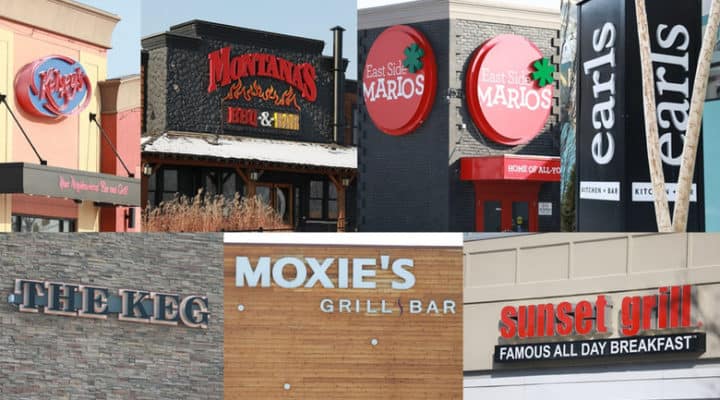
Marketplace visited random locations of seven popular Canadian restaurant chains and found they have increased the amount of tips servers must share with their colleagues since Ontario’s minimum wage went up to $14 on Jan. 1.

A number of popular Canadian restaurants have increased the amount of tips servers must share with their colleagues, CBC’s Marketplace has learned. And many servers say that money is being doled out to higher-paid staff in lieu of a raise.

“Tipping out” is a common practice in which servers pay into a pool that managers then distribute to non-tip-receiving staff such as hostesses, bussers and kitchen workers.

As businesses grapple with increases to minimum wage, some have cut employee hours, reduced benefits or found other ways to offset increased costs.

In a hidden microphone investigation, Marketplace visited seven randomly selected restaurant chains that had raised servers’ tip out percentages since Ontario’s minimum wage went from $11.60 to $14 on January 1.

Many large family dining chains calculate tip out as a percentage — typically between two and five per cent — of each server’s total food and beverage sales each shift. If 10 tables each spend $100, the server’s tip out could be between $20 and $50.

Apart from Quebec, which does not allow restaurant owners to enforce tip sharing, there are no federal or provincial regulations governing tip out amounts.

Most of the restaurant locations Marketplace visited had bumped the tip out by one percentage point.

For instance, The Keg went from four to five per cent. East Side Mario’s from 2.5 to 3.5 per cent.

Earls, a chain with 56 locations across Canada, increased its tip out by .5 per cent, but it had the highest total tip out, CBC discovered, at 5.5 per cent.

An employee at Moxie’s, which has 66 locations, told Marketplace their tip out was expected to increase to 5.75 per cent, from 4.75.

Servers ‘aren’t happy’

Ontario and Alberta will both have a $15 minimum wage by this time next year, and in several other provinces the minimum wage increases each year on a certain date. With those increases, there is pressure on some restaurateurs to also give a salary hike to higher-paid workers, often as an incentive to keep reliable and valuable staff.

“We, the servers, have to pick up the slack,” said one employee at a Keg location. “The servers aren’t happy about it but there’s nothing we can do.”

A server at a popular family dining chain in Alberta says it isn’t fair to supplement the higher-paid workers’ wages with the lower-paid ones.

Grace Ford says raising the tip out isn’t fair because it’s taking more of her earnings and redistributing it to employees who already make more than she does. (Trevor Wilson/CBC News)
“I am a little frustrated,” said Grace Ford. “There’s days where I worked 12 hours, and I still give out $80 of my tips that I’ve worked all day for to people who sometimes mess up [customers’] food … a customer gets mad, it’s me who in the long run suffers from it.

“There’s money taken out of my pocket that I worked so hard for, and it just disappears and goes to other people who already make more money than I do.”

Out of pocket

In statements to Marketplace, the Ontario Ministry of Labour said, “Tip pool money (including tip outs) can only come from an employee’s tips or other gratuities, not from any other source.”

The issue arises when servers don’t get tipped, or earn less in tips than what they would have to contribute to the tip out. In a restaurant with a 5 per cent tip out policy, a server still has to tip out $5 on every $100 tab.

Some employees Marketplace spoke to said they’ve sometimes had to pay out of their own pockets to make their tip out contribution.

At one Moxie’s location a server told CBC, “The amount of times I’ve… pretty much had to give the restaurant money out of my pocket, it’s a lot.”

A server at a Montana’s said, “There [were] times that I had a party of 12 … they didn’t tip me because they were upset with the food that they got, nothing to do with my service. And I actually paid to come to work.”

Restaurants respond

“Employers are feeling very confident to be able to start changing the tip pool and how it’s distributed amongst the staff,” says Deena Ladd, a workers’ rights advocate.

“And I would say to employers that, you know, part of you running your restaurant is based on customer satisfaction. Do you really want your customers knowing how you’re treating your workers?”

She says restaurant owners should be creating a tip pool that is not “taking it out on servers” and that all the employees feel is fair.

In a statement, Earls told Marketplace, “Our people are our greatest asset, and our priority has always been to make sure all roles contributing to the service experience are fairly compensated.”

Moxie’s said it is confident that all of its policies are lawful and fair.

Sunset Grill referred Marketplace to a CBC story last month that reported the increase in tip outs was made to “bridge the unfair pay equity gap for all non-serving staff.”

The Keg, East Side Mario’s, Kelsey’s and Montana’s did not respond to requests for comment.

Restaurants Canada, the group representing the industry, said in a statement, “Tip-pools and tip outs are a way to recognize the efforts of the entire team — from the server to the kitchen staff to the hosts and the bussers.”

The group would not publicly disclose its member restaurants. Earls told CBC the organization’s statement accurately reflects its point of view.

‘Find other ways’

Ford says it’s wrong to take more from servers.

“They should stop raising the money that’s coming out of my pocket and find other ways to give them higher wages — or increase food prices even,” she said.

An Ottawa restaurateur also disagrees with hiking tip outs for servers.

“We felt that some of the models that we’re seeing elsewhere is a bit of robbing Peter to pay Paul,” said Ivan Getz, owner and manager of Union Local 613. “When we make decisions here, my staff know exactly how much money I make. When we make strategic decisions, they’re involved in that process.”

His solution? Shaving dollars off his profits and slight increases to menu prices.

“The customer wouldn’t even notice it.”

Sprint announces it will commit to 5G coverage by 2019

Sprint

On Friday, Sprint announced that it planned to roll out a mobile 5G network in the first half of 2019. This would mean that Sprint would lag behind its rivals AT&T and Verizon, as mobile carriers have said they have plans to roll out 5G coverage later this year. This target date would be Sprint ahead of T-Mobile, however, which has set 2020 as its roll-out date for 5G networks.

That being said, Sprint does have one advantage over Verizon when it comes to its potential 5G networks. As of right now, Verizon is only working on fixed networks, meaning that it will only use 5G as a way to improve its wireless broadband coverage. Sprint is working on creating a mobile 5G network that would work on smartphones.

Sprint has said that it is working with Qualcomm on 5G technology and one South Korean company says that it already has a 5G device in the works for Sprint’s network.

In terms of pricing, Sprint CEO Marcelo Claure also provided some details on the prices for its 5G networks and some customers may not be happy. Sprint is planning on raising its rates for unlimited service from $50 and $60 to about $70 and $80. This would bring it in line with the prices of its competitors.

“It’s going to be very difficult for our competitors to increase the price of unlimited,” Claure said. “But we’re going to have a lot of room to increase our price of unlimited to get to similar prices as Verizon and AT&T in the future.”

Sprint is using different technology from Verizon or AT&T when it comes to building its 5G network. Both of those companies are relying on millimeter spectrum, which provides fast speed within a limited service area. Claure says that such a service isn’t practical for building a nationwide coverage network.

Sprint’s 5G plans are certainly ambitious, but it should be noted that Claure has made similar announcements in the past. In 2015, he said that within two years’ time, Sprint would have the best network in the country. Sprint’s coverage has improved over the past three years, but it still lags behind its rivals though Claure says that is due to the company underestimating how long its infrastructure improvements would take.