
Archives for January 23, 2018

How to Plan an Off-the-Grid Trip to Japan

Don’t be intimidated—it’s easier to see this country’s hidden corners than ever before.

Japan is in the middle of a travel boom. Political instability across much of the world has given it the appeal of a safe haven, and before the 2020 Olympics, the country has been rolling out the red carpet for visitors.

Among the new perks are two luxury sleeper trains: the Twilight Express Mizukaze, which offers a circular tour around the Sanyo and Sanin areas of western Japan, and the Train Suite Shiki-shima, connecting formerly extreme corners of the countryside. There’s also the just-formed Ryokan Collection, a consortium of high-end inns that aims to improve access for non-Japanese-speaking travelers outside of the major cities.

Travel to Japan showed double-digit growth in 2017 from the previous year, so you’ll want to take advantage of this development and escape the crowds by hitting the stunning countryside. Here, four towns to discover—before everyone else does.

For Sake and Shopping: Kurashiki

The Nakahashi Bridge at dusk in Kurashiki.

It’s only 45 minutes from Osaka on the bullet train, but Kurashiki feels worlds away. The historic city center of Bikan, a 10-minute walk from the station, is a time warp to the Edo era, when its namesake river formed an important cornerstone of Japanese mercantile trails; the area is still car-free. Along the riverbanks, willow-flanked white-and-gray houses are just as they were in the 1600s—but instead of acting as rice stores and granaries, they’ve been reborn as cafes, pottery workshops, and Japanese denim boutiques. (Make a beeline to the Betty Smith Jeans Museum, where you can pick up $900, custom-made selvedge jeans.)

Kurashiki is also the town credited with birthing sake. Base yourself at the newly expanded Ryokan Kurashiki, with seven tatami-style rooms in a former sugar warehouse. Then explore sake shops for a day before a trip to the contemporary art paradise of Naoshima Island and the Isamu Noguchi Garden Museum in Takamatsu, where more than 150 of the famous sculptor’s stone works are still preserved. Both are roughly an hour’s drive away.

For a Culinary Pilgrimage: Ise Shima

Machiyo Yamashita, a female sea diver known as an ama, gathers wakame seaweed at the shore in Shima.

If your favorite word at sushi restaurants is uni, try Ise Shima. It’s set at the tip of Mie prefecture—four hours southeast of Kyoto by shinkansen—and is known for its amas, or fisherwomen, who free-dive for sea urchin, abalone, and oysters. Sample their daily catch at any of the oyster stands along Ago Bay (it’s best to go with a guide, who will negotiate $25 all-you-can-eat deals) or at Kagetsu, a more formal spot that makes tasting meals out of lobster-infused miso soup and abalone sautéed in a foie gras-like abalone liver sauce.

An alternate plan is a noontime visit to go pearl shopping at Mikimoto, which maintains its headquarters and a small museum in Ise Shima. Stay at the waterfront Hiramatsu Hotel & Resorts Kashikojima, one of four new hotels run by Japanese star chef Hiroyuki Hiramatsu. And don’t miss a visit to the Ise Grand Shrine, one of the country’s biggest and most important monuments, which gets completely rebuilt every 20 years.

For Enchanted Landscapes: Yakushima

A forest in Yakushima.

Cherry blossoms get all the attention, but Japan is full of natural wonder—much of it little known. Take Yakushima. This tiny island in Japan’s far south has UNESCO protection for its towering cedar forests, all draped in thick carpets of brilliant green moss. Dreamlike hiking trails are dotted with suspension bridges, river views, and ancient trees—including one sacred cedar that’s considered to be 7,200 years old. On the coast, you’ll find mangrove-dense beaches that are havens for loggerhead turtles; inland, you might spot unique local breeds of deer and monkeys. And in between are shops of woodworkers who give new life to fallen trees.

Stay at the sustainably minded Sankara Hotel & Spa, with 12 luxury cottages scattered throughout the forest; the innkeepers can point you toward rhododendron-heavy gardens, the island’s best natural hot springs, or firefly-filled clearings with views of the Milky Way.

For Architectural Wonders: Shikoku

Awa Kokubunji is one of the most dynamic examples of a landscape style known as karesansui, the Japanese rock garden.

The smallest of Japan’s four major islands, Shikoku is best known for its 88-temple pilgrimage route. It’s a place to take in Japan’s remarkable architectural heritage, from the Iya-no-Kazurabashi Bridge, which was built entirely out of thick vines by samurai 800 years ago, to the remote village houses in Iya Valley, which are now being restored by Japanophile author Alex Kerr as part of the Chiiori Trust initiative. You can even rent them out as vacation homes.

Focus on the most beautiful sections of the temple trail—like the five-storied pagoda at temple 31—and save time to visit the country’s oldest Kabuki theater, Old Konpira. The Edo-era homes in the town of Mima are also worth a visit: Many are now shops, selling traditionally made kimonos and wooden sandals. Then get the ultimate contrast by visiting one of the most modern monuments in the country: the minimalist Komyo-ji Buddhist temple, where the walls of latticed joinery are the work of Pritzker Prize winner Tadao Ando. The architect has also designed a seven-room hotel in the area called Setouchi Aonagi; its concrete-framed lap pool juts out over the countryside for dramatic sunset views.

Whom to Call

Booking an off-the-grid trip to Japan isn’t especially do-it-yourself-friendly—you’re better off working with local experts who can secure insider access at famously closed-off artisan studios or exploring temples with guides who can explain their full significance. If you’re looking for a deep dive on culture, turn to Catherine Heald of Remote Lands, who has an unrivaled proficiency in Japan’s most hidden corners. Each of her trips is bespoke, and all feature top-notch guides. For more of an active vacation—whether you want a sense of adventure or more hands-on experiences—try Black Tomato, whose co-founder Tom Marchant has a personal passion for Japan. And for true insider access, Japan Curator has an impressive Rolodex with the country’s elite, facilitating everything from brown bear safaris in Hokkaido to private dinners with the cast of a live-action manga movie.

E-Commerce Stocks Crushed It in 2017. Will 2018 Be a Repeat?

2017 was a banner year for the U.S. stock market as all three major indexes gained at least 19%, but e-commerce stocks may have been the biggest winners of them all.

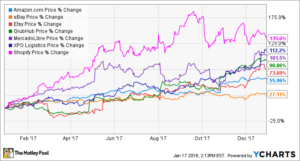
Among stocks in the sector that soared were major online retailers like Amazon.com (NASDAQ: AMZN), smaller ones like Etsy (NASDAQ: ETSY), and key suppliers like XPO Logistics (NYSE: XPO), and Shopify (NYSE: SHOP). The chart below shows last year’s performance of some popular e-commerce plays.

AMZN Chart

The stocks above gained in part due to individual circumstances. Etsy, for example, got a new CEO as activist investors pounced on the stock, and XPO Logistics shares spiked after Home Depot considered acquiring the company. But more broadly, investors’ optimism about the possibilities for the industry grew, driving the whole sector higher.

Some of these companies are enjoying incredible revenue growth, such as Shopify, which saw a 72% top-line increase in its most recent quarter, and MercadoLibre (NASDAQ: MELI), where revenue jumped 60%.

However, with valuations already stretched, can investors expect another year of outperformance from e-commerce stocks?

A delivery man holding several boxes while another man signs for them.

The big picture

The share of retail sales that go to e-commerce has been steadily growing for years, and total U.S. online sales have increased about 15% annually since the financial crisis. As of the third quarter of 2017, e-commerce accounted for 9.1% of total retail sales, according to the Census Bureau. Based on that figure, it’s easy to see why e-commerce is viewed as having such a long growth path ahead of it. Even if online sales doubled, they would still amount to less than 20% of the total. And U.S. retail sales hit $5 trillion last year, or $5.7 trillion when restaurants and bars are included. In other words, there may be no greater business opportunity in the world. It’s no wonder Amazon, the industry leader, is one of the most valuable companies in the world and still growing fast.

However, nobody should expect that all store-based sales will eventually shift to online channels. Sectors like supermarkets, home improvement, and restaurants have proven difficult to disrupt, although major players in those sectors like Walmart, Home Depot, and Starbucks are rapidly embracing e-commerce. And of course, there are categories like gasoline, which accounted for $455 billion in sales last year, where e-commerce’s delivery model is just not practical.

Still, the opportunity to convert traditional retail sales to the online channel is broad, and it’s reasonable to expect that to continue driving e-commerce sales up by 15% or so every year for the foreseeable future.

The Amazon effect

One other key factor that investors should consider is Amazon. Just as the e-commerce giant has leveled traditional retailers, it’s also threatened its e-commerce peers. For instance, it’s introduced Amazon Handmade, its competitor to Etsy, and has entered restaurant delivery, potentially peeling away customers from GrubHub (NYSE: GRUB), the leader in online restaurant ordering. At one point, Amazon had its own Shopify competitor, Amazon Webstore, but eventually shut it down, saying it would partner with Shopify instead, and its move into the Brazilian market shook MercadoLibre. With its plans to build its own shipping fleet, Amazon could even one day challenge XPO Logistics, the leader in last-mile delivery.

What investors therefore need to keep in mind is that while the industry as a whole will see significant growth, the segments within it may be zero-sum as pure-play companies like GrubHub and Etsy battle it out with Amazon. That means that investing in a pool of e-commerce stocks may be a better way to play the sector than just buying one or two.

The valuation question

As the chart below shows, P/E ratios climbed for most of these stocks last year, as their stock price gains were based more on growing revenues and market enthusiasm than in jumps in profits.

However, when it comes to companies like Amazon, investors have shown that if a business’s competitive advantages are strong enough, they’re willing to accepts such ambitious valuations. I also tend to agree with my colleague Brian Stoffel, who argues that optionality and moats are more important considerations than valuations, especially in a bull markets when growth stocks tend to outperform more defensive plays as investors don’t want to miss out on big gains.

Given that the global and U.S. economies are finally operating at full capacity and stocks are already off to a strong start, 2018 is shaping to be another good year for e-commerce stocks.

Thinking outside the bucket: Fried chicken styles from around the world on display in new festival

A finger-licking good festival in Winnipeg this week might make it hard for some people to keep their healthy New Year’s resolutions.

Fried Chicken Fest brings together chefs from 15 local restaurants to compete for the best fried chicken in the city. The festival will feature a wide variety of styles of fried chicken influenced by cuisines from around the world.

Co-organizer Allan Pineda, founder of local pop-up dinner series “Manila Nights,” was approached with the idea of doing the festival a few months ago. At the time, a new book of Filipino recipes was about to be published, and it contained Pineda’s own fried chicken recipe.

“My recipe is from my mom. It was made with rice and no utensils,” he said in an interview on CBC’s Weekend Morning. “Our fried chicken, we don’t bread it that much, for Filipinos.”

Pineda says he tried some of the best fried chicken he’s ever had on a trip to Korea.

“It was super simple, but it was so good. It was different from here… Maybe it was the beer, I don’t know, it was just really good,” he said.

The festival runs from Jan. 21 to 28. Participating restaurants include Underdogs, Tallest Poppy, Kyu Grill, Inferno’s on Academy, Pine Ridge Hollow, and La Carnita.

People can vote for their favourite dish online.

Pineda has his own preferences when it comes to fried chicken.

“It can’t be too greasy, that’s one. Nobody wants to eat a mouthful of grease. It can’t have too much breading, I think. I don’t want to be eating a whole bunch of just bread and no chicken, which everybody’s had once or twice.”

As for anybody concerned about breaking their healthy diet Pineda has advice for those people too: “There’s always a cheat day somewhere.”

The First Phone With an In-Display Fingerprint Sensor Will Launch January 24

The first smartphone with a very desirable in-display fingerprint sensor will launch at the end of January. It won’t come from Apple, Samsung, LG, or another familiar brand; but Vivo, a Chinese manufacturer that has been working hard to perfect the technology where others have failed. We know it has done a great job, because we went hands-on with a working prototype of the phone at CES 2018, and ended up giving it a coveted award.

Vivo couldn’t confirm the launch date outside of early 2018 or the final name of the device at the time, but has now announced an event on January 24 in Beijing, where the Vivo X20 Plus will be revealed, complete with the in-display fingerprint sensor. Rumors have previously suggested the phone will be named the X20 Plus UD (presumably for Under Display), but this isn’t certain. The associated teaser image shows a swirling pattern that looks a little like a fingerprint, complete with the strap line, “Unlock the future.”

The Vivo X20 Plus already exists and was announced in October last year. The specifications of this modified version are likely to be very similar, and are in-line with the device we saw at CES 2018. These include a 6.4-inch screen, a Qualcomm Snapdragon 660 processor, 4GB of RAM, and a dual-lens 12-megapixel camera on the back. We liked the stylish phone demoed in Las Vegas, especially the almost bezel-less screen.

However, it’s the fingerprint sensor that will attract all the attention. Vivo worked with sensor company Synaptics to integrate the Clear ID in-display fingerprint sensor, and it performed very well in our tests. We spent some time with the phone, and found the sensor to be accurate, fast, and simple to setup and use. While Vivo will be first out with such technology, expect others to follow in 2018. Apple and Samsung were both rumored to be working on a similar fingerprint sensor for release in a phone during 2017, but were unable to produce a model suitable for release at the time.

We don’t know how much the Vivo X20 Plus with an in-display fingerprint sensor will cost yet, and we doubt it will be sold outside China, at least for a start. Vivo has recently release the V7 Plus internationally, and a desirable model like the X20 Plus would be a great follow up release. We’ll keep you updated.