
Archives for January 23, 2018

United Airlines saves 170,000 gallons of fuel by printing inflight magazine on lighter paper

United Airlines has switched its inflight magazine and seatback service guide to lighter paper, reducing the weight by one ounce on each magazine.

United Airlines has lightened the load on its flights – and wallets – by using lighter paper to produce its inflight magazine.

The carrier said it has started printing the magazine, Hemisphere, on light paper, cutting one ounce from each magazine and bringing it down to 6.85 ounces, the LA Times reports.

The major U.S. airline has more than 4,500 flights a day across 744 mainline planes. On average, the new magazine will shave about 11 pounds of paper weight off each flight.

The airliner said the small move saved each flight 11 pounds on average, equaling 170,000 gallons of fuel, or $290,000 in fuel costs a year.

The minimal reduction will amount to huge savings in cost, however. United said the weight decrease will save 170,000 gallons of fuel, or $290,000 in fuel costs, a year.

The airliner said it switched its seatback service guide to lighter paper as well for additional weight and money savings.

Last March, United saved money when it stopped selling duty-free items on board, citing dwindling sales. According to the LA Times, the move saved the airline $2.3 million by cutting 1.4 million gallons of fuel a year.


Wal-Mart Shops Brazil Unit Stake to Advent, Other Funds: Sources

FILE PHOTO – A man talks on his mobile phone in front of a Wal-Mart store in Sao Paulo, Brazil, February 16, 2016.

SAO PAULO (Reuters) – Wal-Mart Stores Inc (WMT.N) is in talks with buyout firm Advent International Corp and other funds to sell a major stake in its Brazilian operations, two people with direct knowledge of the matter said on Sunday.

Wal-Mart is being advised by Goldman Sachs & Co, according to one of the sources who spoke on condition of anonymity. Other private equity firms that are looking into the investment in the Brazilian unit are GP Investments Ltd (GPIV11.LU) and Acon Investments LLC, the source added.

Wal-Mart officials in Brazil declined to comment. Advent and GP declined to comment. Goldman and Acon did not immediately reply to requests for comment.

A partial exit by Wal-Mart from Brazil, as Chief Operating Officer Judith McKenna takes over the international unit of the world’s biggest retailer, would give a new partner the chance to turn around a sprawling operation that has struggled to turn a profit.

Wal-Mart operates 471 stores in Brazil, according to the company’s local website. The retailer’s Brazilian unit reported revenues of almost 30 billion reais ($9.4 billion) in 2016.

Wal-Mart, however, has posted operating losses in Brazil for seven years in a row after an aggressive, decade-long expansion left it with poor locations, inefficient operations, labor troubles and uncompetitive prices, Reuters reported early in 2016.

One of the people with knowledge of the deal said Wal-Mart’s operations in Brazil had not improved over the last two years, which coincided with the country’s harshest recession in decades.

Wal-Mart began sounding out possible investors in the unit several months ago but got no interest from rival retailers, which led the company to seek out buyout firms, the source said.

The retailer intends to keep a stake in the Brazilian unit to be able to recoup part of its losses in the country later if an economic recovery and restructured operations boost results, according to the source.

Retail sales in Brazil are starting to recover from the recession. Christmas sales were 5.6 percent higher than a year ago, according to credit data supplier Serasa Experian.

Earlier on Sunday, newspaper O Globo said private equity Advent was in talks to acquire 50 percent of the Wal-Mart unit. The paper did not say how it got the information or any details on the state of the talks.

Liberals Quietly Tap Experts to Craft New Paternity Leave Policy in Coming Year

Liberals quietly tap experts to craft new paternity leave policy in coming year


OTTAWA — Shortly before the 2015 election, a group of Liberal policy advisers took a long look at how to create dedicated leave for new fathers — but once in office, opted instead for allowing all new parents extra time off without an increase in benefits.

Now, after that plan received a cool reception, the governing Liberals appear to be going back to their original idea.

For weeks, federal officials have been furiously consulting with experts on how to create dedicated leave for new dads, probing their various options, the potential costs and the timelines for implementation.

Multiple sources with knowledge of the discussions, speaking on condition of anonymity about matters not yet public, say ideas under consideration include creating an entirely new leave benefit similar to one that exists in Quebec, and setting aside a portion of the recently expanded parental leave for new fathers or non-birthing parents.

A spokesman for Social Development Minister Jean-Yves Duclos would only say that officials are looking at different options and will provide more details later this year.

The Liberals first floated the idea of dedicated paternity leave two years ago. Prime Minister Justin Trudeau brought it up anew during a recent town hall meeting when he said his government was exploring the possibility of mandatory paternity leave.

Trudeau wasn’t entirely sure how the policy would work without having negative effects on single mothers and LGBT families, nor did he elaborate on the options under consideration.

Quebec is the only province that has dedicated leave for fathers.

Elsewhere in Canada, fathers or non-birthing parents are able to split parental leave with a new mother. Under changes that took effect in early December, parents can split 35 or 61 weeks of employment insurance leave.

Put another way, new parents can use up to 18 months of leave, but only get 12 months of employment insurance benefits under the new policy.

During the government’s consultations, experts, labour and business groups warned the Liberal plan for more time off without a corresponding increase in benefits would have negative effects on Canadian families, particularly women who take the extended time away from the labour market.

One specific recommendation that came up during the meetings was a use-it-or-lose-it paternity leave option in any parental leave changes, as well as expanding eligibility to anyone who wasn’t considered a primary caregiver, such as a grandparent.

Kate Bezanson, an expert on parental leave policies, said opting for extra leave without additional benefits was a “huge missed opportunity” to at least target a portion of the extra leave to another caregiver.

“The government is quite receptive to doing some revision to that,” said Bezanson, chair of the department of sociology at Brock University in St. Catharines, Ont.

“There is a good model in Quebec … that we can emulate quite easily in terms of eligibility criteria, in terms of a targeted use-it-or-lose-it leave, and it has really significant uptake.”

Quebec’s parental leave system provides up to five weeks of paid leave to new fathers that covers up to 70 per cent of their income.

Research into the Quebec benefit has shown take-up has steadily increased since 2006, when paternity benefits became part of the provincial leave plan. There is one caveat: Quebec was already tops in the country when it came to new fathers taking time.

Sophie Mathieu, who researches the Quebec parental leave system, said it’s not entirely clear what fathers do with their time off.

Those who are more involved in caring for a newborn are more likely to help new mothers mentally post-partum, and close a gender gap that still sees mothers as primary caregivers, said Mathieu, a lecturer at the University of Montreal.

A joint Canada-U.S. business council formed by Trudeau and U.S. President Donald Trump this week highlighted the need to boost men’s involvement in caring for children. The council’s report called on both governments to review maternity leave policies and tax incentives among other measures “to level the playing field between caregivers — for example, paternity leave policies.”

Audi Smart Home Battery Grid Creates a ‘Virtual Power Plant’

Audi isn’t going to let rival automakers like BMW and Tesla corner the market on home batteries.

Audi isn’t going to let rival automakers like BMW and Tesla corner the market on home batteries. The German badge is testing a Smart Energy Network where solar-powered batteries not only help your home minimize use of the electrical grid, but talk to each other. The result is, as Audi put it, a “virtual power plant” — households collectively feed power into the grid and help balance overall consumption.

The trial is limited to both Audi’s home of Ingolstadt as well as the Zurich area. There’s no mention of how long it will run or how likely it is the pilot will expand.

The strategy is a logical one for companies making deeper commitments to electric vehicles. It’s easier for Audi to sell you on the concept of an EV if it can promise to lower your power bill in the long run. Also, this makes the most of the VW brand’s work on batteries — it can venture beyond selling cars and make sure the batteries it makes find customers. It just so happens that this can both save you some money and, potentially, help the environment in the process.

‘Forest Skating’ is the Coolest New Winter Workout

There’s no reason for your workouts to wane as temperatures drop.

As temperatures drop, fitness junkies know that there’s only so many gym workouts one can squeeze in before cabin fever hits, and dreams of spring begin. Fortunately, a hip new cold-weather workout has arrived just in time to beat the winter blues: forest skating. Better yet, it doesn’t cost a dime more than a pair of skates, and sense of adventure.

Akin to hiking or walking trails, Country Living defines the wintertime activity as ice skating frozen paths that wind through snowy forests and woods. The sport is growing in popularity in Canada, while there are still only a few large-scale trails in the U.S. Forest skating is not only putting traditional rinks to shame, but also a great way to get active in winter weather.

From Fairlee, Vt.’s Lake Morey Resort to Minocqua, Wis.’s Tomahawk Lake to gliding the frozen trails at Chicago’s Skating Ribbon and Maple Grove in Minnesota, aspiring forest skaters need not book a ticket north to join in the winter fun. If you are craving a proper getaway, however, Country Living notes that the trails at Quebec’s “Domaine De La Forêt Perdue,” and Ontario’s Arrowhead Provincial Park are two of the best.

Skeptics need not worry that ice skating won’t jump-start a toned warm-weather body – Peter Zapalo, director of sports science and medicine for U.S. Figure Skating told Vogue that skating boasts more body-sculpting and strengthening potential than it’s given credit for.

“It has cardiovascular benefits as it trains both your aerobic and anaerobic systems, and it’s a fantastic overall body challenge to your core, your balance, your coordination, and your posterior chain,” Zapalo said. “Also: Skaters have great butts.”

Walking in a winter wonderland has never looked so cool, after all.

Why Retailers Don’t Mind Bigger Wage Bills

When a labor-intensive business like retail becomes more generous, do investors have cause for alarm?

Workers at a newly built Walmart Super Center in Compton, Calif., prepared for customers before the store opened on Jan. 10, 2017.

Last week, Walmart , WMT 0.28% America’s largest employer, announced plans to increase its minimum wage to $11 and provide a one-time cash bonus of $1,000 to eligible employees. It is one of nearly 200 companies, including major employers like American Airlines, AT&T , and Bank of America , to have given such bonuses, citing the lift from tax cuts.

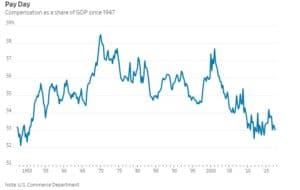
One reason stocks have done so well during a fairly ho-hum economic expansion is that wages have risen only modestly relative to profits. When a business as labor-intensive as retail becomes more generous, investors might have cause for alarm.

But they can rest easy. Retailers, and certain ones in particular, are positioned to benefit from middle-class consumers with thicker wallets. On Thursday, Goldman Sachs upgraded its rating on Walmart to buy from neutral and added the company to its list of favorite stocks.

Although the White House has praised the retailer’s generosity, the value of the tax cut to Walmart will be passed overwhelmingly to shareholders. According to Walmart, the total value of the bonuses will be $400 million. The company had pre-tax profits of $20.5 billion in fiscal 2017, with a tax rate of 30%. The new corporate tax rate of 21% means the bonuses amount to around 2% of the total value of the tax cut to Walmart over the next decade.

In terms of costs, though, wage pressures may be more substantial than bonuses in the long run. They aren’t so much a product of tax reform as a necessity of an increasingly tight market for unskilled labor. Despite a supposed retail apocalypse, demand for retail workers is high. As of November 2017, there were 711,000 such job openings—the highest number since the data was first collected in 2000, according to the National Retail Federation.

“We’ve been waiting for a wage increase as the unemployment rate has come down,” says Jack Kleinhenz, chief economist of the National Retail Federation. “It’s probably just starting to percolate up.”

Target last fall announced it was raising its minimum wage to $11, with plans to establish a $15 minimum by 2020. Some cities and states have raised their minimum wages by law, taking the decision out of companies’ hands.

The net benefit of bigger paychecks and higher costs may be greatest for retailers like Walmart and Target and less so for, say, dollar stores or high-end shops. Companies may paint the bonuses and wage hikes as a boon for U.S. workers, but the real beneficiaries will be their shareholders.