Uncategorized

Weekly Market Review – June 22, 2019

Stock Markets

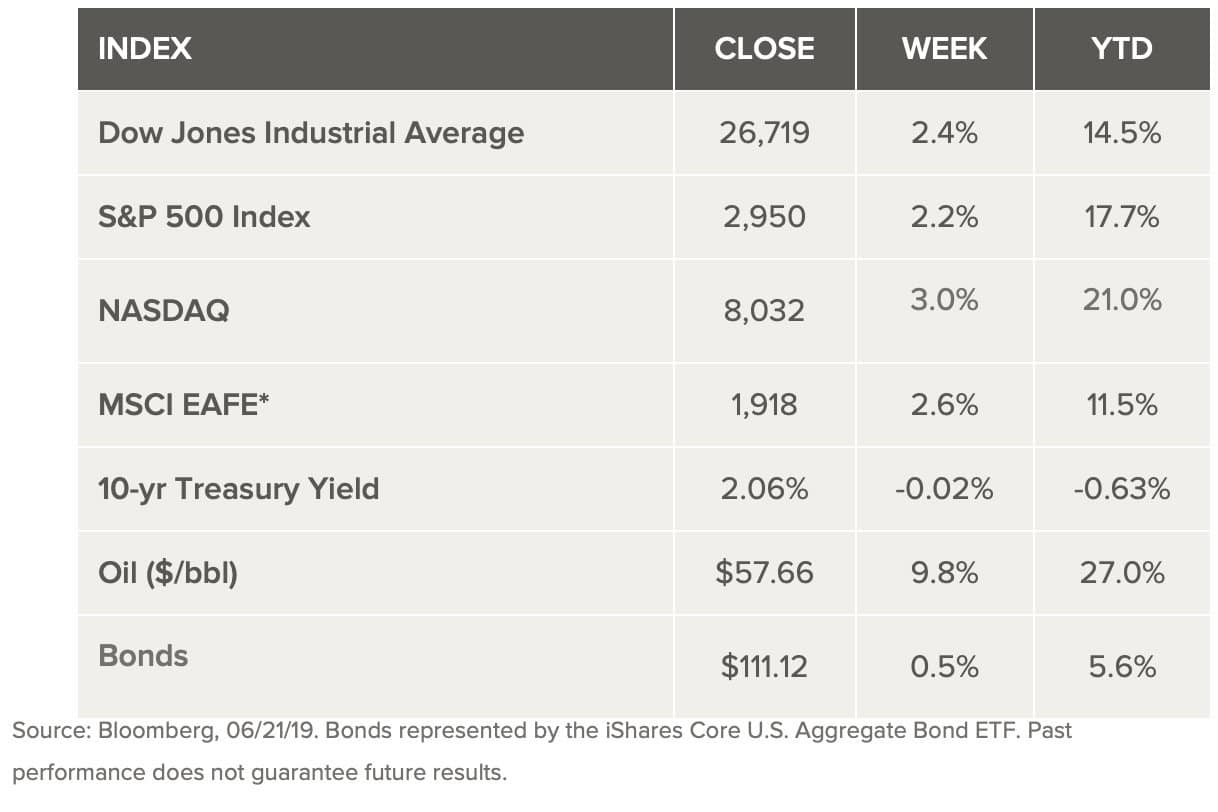
This is the third straight week that U.S. stocks finished higher. Both the S&P 500 and the Dow closed at new record highs. The clear driver for the for the rally in both bonds and stocks was the Federal Reserve releasing news that it is open to rate cuts this year – possibly as early as next month. The committee dropped its statement about being patient in setting rates, which had signaled it would hold rates steady for some time. Instead, it now states it will act as appropriate to sustain the economic expansion. Following the financial crisis of 2008, the U.S. stock market first achieved a new record high in 2013. It has now set 225 all-time highs, validating the fact that new highs can’t be viewed as a single indicator of exhaustion. It’s important to note that periodic dips in the market provide a good opportunity for long-term investors to expand diversity in their portfolios by adding high-quality assets at lower prices.

U.S. Economy

In the first quarter, the U.S. economy grew at a solid 3.1%, but showed some signs of weakness. Consumer spending dropped to half its average rate and when combined with a lackluster jobs report and slowing wage gains set the stage for potential slowdown. This week though, the Fed demonstrated to the markets its willingness to cut rates in order to head off rising risks from deflation, trade threats and a slowing global economy.  Markets reacted swiftly as the U.S. 10-year Treasury yields dropped to 2.0%, but rebounded to 2.06%. U.S. rates are low but still higher than most developed countries. So, it is likely that foreign demand for U.S. Treasuries will help keep long-term rates low and analysts expect it to prolong the bull market by providing inexpensive credit to businesses and consumers.

Metals and Mining

It looks like the patience of gold bulls has finally paid off. This week, demand for the precious metal managed to drive prices to levels we have not touched on in nearly six years. Gold climbed 2 percent on Friday morning (June 21), rising above US$1,400 per ounce to reach as high as US$1,410.78 at one point. The driver for the surge is obviously the Fed delivering its dovish opinion that the market was seeking. Essentially this has removed the ‘patience’ approach to cutting rates,” that the Fed has echoed all year. Some analysts feel gold’s major breakout could be just the start of a long-awaited rally as investors strongly expect a shifting interest rate based on a cut that could come as early as next month. Gold saw most of its gains this week following the Federal Reserve’s monetary policy meeting.

Silver followed gold’s lead once again proceeding the Fed announcement, but in the end gave up 1.2 percent of its gains. In the other precious metals group, platinum was down nearly 2 percent for the week. On Friday morning, the metal was trading at US$799 per ounce. Like the others, palladium rallied up 1.43 percent for the week, but edged down just over 1 percent on Friday. As of 9:43 a.m. EDT, palladium was trading at US$1,487 per ounce, still higher than gold.

Energy and Oil

Oil prices spiked up about 5 percent on Thursday as the U.S. announced out was considering a military strike against Iran. The U.S. military seemed poised to carry out a strike late Thursday, but the operation was called off by President Trump at the last minute. Reuters reported that Trump may have relayed a message to Iran that he was seeking to open negotiations. Friday morning Trump tweeted that he called off the strike because it would not be proportional to the shooting down of an unmanned drone. His tweet reads “I am in no hurry, our Military is rebuilt, new, and ready to go, by far the best in the world. Sanctions are biting & more added last night. Iran can NEVER have Nuclear Weapons, not against the USA, and not against the WORLD!,”.

Still, this had the whole region on alert. Iranian sources told media that the Supreme Leader was opposed to negotiations. They also said that any attack would have regional and international consequences. As the week closed oil prices were set for their largest weekly gain since February. Natural gas spot price movements were mixed this report week. Henry Hub spot prices remained flat at $2.36 per million British thermal units. At the New York Mercantile Exchange, the price of the July 2019 contract decreased 11¢, from $2.386/MMBtu last Wednesday to $2.276/MMBtu Friday. The price of the 12-month strip averaging July 2019 through June 2020 futures contracts declined 9¢/MMBtu to $2.442/MMBtu.

World Markets

Equity markets rose this week on expectations of added stimulus. European stocks rose, mostly fueled by anticipation of more central bank stimulus measures. The pan-European STOXX Europe 600 Index, UK’s FTSE 100 Index, the exporter-heavy German DAX index, and Italy’s FTSE MIB Index all gained. This followed an announcement by ECB President Mario Draghi that the bank could offer more stimulus measures as early as July. Draghi’s comments came prior the Federal Reserve’s commitment that it is ready to cut rates if the U.S. economic outlook does not improve.

The euro fell about 1% against the U.S. dollar on the week while the yield on 10-year German government bonds fell to a new all-time low of -0.315%, and the yield on the French 10-year bond hit 0%, its lowest level ever. The British pound rose almost 1% against the U.S. dollar, in part led by the Bank of England’s (BoE) decision to hold short-term rates steady at 0.75%.

With positive momentum across all markets, the Chinese stocks advanced for the week. Traders are betting that a meeting between U.S. President Trump and his Chinese counterpart Xi Jinping at this week’s G20 meeting in Japan would put the two countries back at the trade table, which halted last month. The benchmark Shanghai Composite Index gained 4.2% and the large-cap CSI 300 Index, added 4.9%. Both indexes recorded their largest weekly gains since the week ended April 5, according to Reuters.

Sentiment toward Chinese stocks also picked up after the Fed left its key rate unchanged and signaled that it was ready to lower short-term interest rates for the first time since 2008.

The Week Ahead

Important economic news to come out this week ranges from consumer confidence to global influence. The Conference Board’s consumer confidence report comes out on Tuesday followed by the important durable goods orders numbers on Wednesday. To cap off the week, the University of Michigan issues its sentiment report on Friday. The very important G20 Leader’s Summit kicks off in Japan beginning Friday. President Trump and Chinese leader Xi have said they will to meet separately in a session aimed at resolving important issues hanging up trade negotiations between the two global powers. The outcome will certainly send messages to global markets.

Key Topics to Watch

–           US – Iran military tensions

–           G20 Leader’s Summit

–           Conference Board Consumer Confidence Report

–           U of M sentiment report

–           Durable goods orders report

–           Gold entering new territory

Markets Index Wrap Up
Weekly Market Review: June 15, 2019

Stock Markets

The week was pretty quiet with stocks edging higher and in a bright spot, small-cap companies outperforming. There were a number of high-profile mergers that lifted investors’ confidence this week, but indexes gave back some gains on Friday, likely due to chipmaker Broadcom’s announcement that the U.S./China trade tensions are suppressing demand. On Thursday, following attacks on two tankers near the Persian Gulf, oil attempted a brief rally, but finished out lower pressured by worries about sinking global demand for oil. Retail sales reports showed a rebound in U.S. consumer spending in May that followed a relatively slow first quarter. This is solid evidence that consumers are still well-positioned. In a snapshot, all major indexes have rebounded to near all-time highs – a very positive outlook with some expectations of higher volatility by analysts.

U.S. Economy

The real driver in the 10-year U.S. economic expansion is consumer spending. In fact, it accounts for a full two-thirds of overall GDP. Consumption spending averaged 2.6% growth in 2018 and then fell to half that rate for the first three months of 2019. That’s because seemingly strong GDP was propped up by temporary factors like inventories and imports. The release of the lackluster May jobs report and slowing wage gains last week compounded concern that consumer spending might be weaker than analysts thought.

That is why this week’s retail sales numbers are being closely monitored as an indicator of consumer health and market strength. In the end, it was very good news, with May retail sales stronger than expected. That was followed by news that the previous months’ retail figures were revised higher. So, all told, retail sales suggest that consumer spending rebounded in the second quarter to a healthy 3.5%. That’s even higher than in 2018.

Tariff Concerns Linger

The ongoing elevated trade tensions between the U.S. and China have added to market concerns that economic growth could be slowed due to increasing tariffs. A clear indication of the sentiment followed news of progress towards a trade deal earlier this year, which triggered a rally in share prices. With negotiations between the U.S. and China at a kind of impasse, it seems that trade tensions are taking a toll on both countries. China’s industrial production sank to 17-year lows in May, and U.S. industrial production has also suffered in recent months, while it did manage to rebound marginally in May. 

Metals and Mining

Precious metals were fueled by ongoing trade war concerns this week between the US and China, alongside some wavering global equities.

Gold was flat on Friday after making gains in the previous session. That was pushed by the US dollar dropping from the two-year peak it hit on Wednesday and global equities declining due to increased China-US trade tensions.

Sentiment is turning bullish for gold as prices broke through critical resistance, pushing to their highest level since early-April 2018. Analysts are warning that gold could face a short-term setback this week after the Federal Reserve’s monetary policy meeting.

Gold’s continued four-week rally is seen as a result of aggressive market signals that the Federal Reserve will loosen monetary policy with a first cut coming in July. According to the contrarians, the market’s fortunes could shift if the Fed doesn’t meet the market’s expectations.

Silver followed gold’s lead on Friday and dipped slightly after climbing over 1 percent in the previous session. Industry experts still believe in the silver’s potential, however. Firms polled in a key report from FocusEconomics echoed that silver could reach as high as US$17.80 per ounce by end of year. Platinum made small gains on Friday after reaching its lowest level since February and stayed on track for its fifth straight weekly loss. Palladium made the most gains on Friday, ticking up over 1 percent and once again entering into US$1,300 per ounce territory.

Energy and Oil

The big energy news was oil prices surging early Thursday after two oil tankers were reported to have been hit by explosions in the Gulf of Oman between Iran and the United Arab Emirates (UAE). That’s just one month after a previous incident in Middle Eastern waters. The U.S. has video proof, CENTCOM says, that Iran was behind the explosions that rocked the two tankers in the Gulf of Oman.

Immediately following the event, WTI Crude was surging 3.17% at $52.76, while Brent Crude was soaring 3.42% at $62.02. However, at week’s end, oil finished its stand lower forced back down by worries of lower global demand for oil.

On the natural gas front, mild weather and record U.S. natural gas production kept prices low despite low storage levels and high exports. On June 6, the price of the Henry Hub natural gas near-month futures contract at the New York Mercantile Exchange (NYMEX) closed at a three-year low of $2.324 per million MMBtu. That is its lowest price since May 31, 2016. Following on June 11, the spot price of natural gas at the Henry Hub closed at $2.34/MMBtu, the lowest price since November 17 according to Natural Gas Intelligence.

World Markets

As was widely expected, Mexican assets rallied early in the week in response to Mexico’s immigration-related agreement with the U.S., reached late last week in order to avoid new tariffs.

European stock markets ended the week slightly higher, pushed by the rise in oil prices that stemmed from the tanker incident in the Gulf of Oman. They are under pressure from U.S.-China trade tensions and weak industrial data coming out of China. The pan-European STOXX Europe 600, the UK’s FTSE 100 Index, the exporter-heavy German DAX index, and Italy’s FTSE MIB Index were all gainers.

Japan’s GDP figures were revised upward: for the quarter ended in March, Japan’s gross domestic product annualized growth rate was increased to 2.2%. That’s up from the 2.1% estimate a month ago. Sources in the Cabinet Office say this was due to upwardly revised capital spending data.

Chinese stocks rebounded as traders’ confidence increased that Beijing will make efforts to step up stimulus measures that could help cushion the economy from any impact from U.S. tariffs. The benchmark Shanghai Composite Index ended up 1.9%, an eight-week high. The large-cap CSI 300 Index, which tracks blue chips listed on the Shanghai and Shenzhen exchanges, added 2.5%. These gains come just one week after both indexes closed at their lowest levels in nearly four months.

The Week Ahead

There are a couple of key drivers that will light up the headlines this week in the markets: first and foremost is a rate decision from the Federal Reserve that comes out on Wednesday. Another important focus will be the U.S. housing data, which details housing starts and building permits in a report issued on Tuesday, with existing home sales released this coming Friday. Tensions are increasing in China and could see more unrest in Hong Kong, where protesters are planning more demonstrations.

Key Topics to Watch

–           Fed Rate released Friday

–           Gold moves based on fed rate indicators

–           Increased tension in China’s internal policies

–           U.S. housing starts report

–           U.S. home sales numbers issued Friday

Markets Index Wrap Up

Weekly Market Review: June 9, 2019

Stock Markets

The S&P 500 rallied 4.4% as stocks finished higher for the best weekly gain in the last six months. However, bond yields declined to the lowest levels in nearly two years. Increased expectations of a Fed rate cut, positive response to the U.S. and Mexico reaching a resolution to avoid tariffs, and improved valuations, all helped stocks move higher.

In terms of economic data, signals were mixed with strength from the services sector mostly offset by weakness in the manufacturing sector. While job gains for the month of May came in below expectations, the unemployment rate is still very healthy at a 50-year low. Analysts expect a more balanced mix of positive and negative moves this season and feel confident about rising corporate profits, strong economic growth, combined with low interest rates creating a positive fundamental base that outweighs risks.

This also offers an opportunity to enhance diversification. Reviewers call for appropriate global stock-market allocations, with diversification across asset classes, including small- and mid-cap stocks, that will likely benefit from increased trade fears or renewed economic signals.

U.S Economy

There remains continued evidence of a slowdown in the U.S. economy, which in turn boosted hopes for a turn in Fed’s policy. Numbers from ADP showed that private sector payrolls had grown by the smallest monthly amount in over nine years for the month of May. Alongside that news, the Labor Department reported overall, payrolls had expanded by only 75,000 in May. The saving grace: May’s unemployment rate held steady at of 3.6%, its lowest in five decades. Almost immediately after the figures were issued, futures markets began pricing in over a 98% probability of a rate cut in 2019, which they say has a 90% chance taking place by July (source: CME Group data).

Economist suggest that ultimately, the determination of whether the economy continues to grow or falls into recession will be determined by the labor market and household spending. By most estimates, these are expected to remain healthy enough to support moderate GDP growth this year. This is heavily weighted in favor of the still-healthy labor market that is driving several key metrics.

Mexico On Hold

Expected tariffs planned to come into effect on June 10th were averted in a last-minute deal reached between the U.S. and Mexico. In a joint declaration released by the U.S. state department, the two countries said Mexico would take “unprecedented steps” to curb irregular migration and human trafficking.

The U.S. did not however, get one of its key demands that would have required Mexico to take in asylum seekers heading for the U.S. and process their claims on its own soil.

Mexico agreed to:

  • Deploy up to 6,000 additional troops along Mexico’s southern border with Guatemala using its National Guard beginning Monday
  • Take “decisive action” to tackle human smuggling networks

The US agreed to:

  • Expand its program of sending asylum seekers back to Mexico while they await reviews of their claims.
  • “work to accelerate” the adjudication process

Both countries have offered pledges to “strengthen bilateral co-operation” over border security, including what they have called “coordinated actions” and information sharing.

These actions, while not inferring a long-term solution, have arrested the immediate actions of the intended tariff going into place and offered some signs of confidence that the two parties can work out terms that will give the markets breathing room.

Metals and Mining

The precious metals markets were given a lift this week by geopolitical issues that continue to plague investors who then seek out the metals as safe havens. At the forefront was the gold market, which saw its best weekly performance in more than a year. Some leading analysts have predicted that the precious metal has enough momentum now to snap the critical long-term resistance barrier in the near-term. Lower U.S. employment growth helped push gold prices back to within close breaking distance of the all critical $1,350 level. During the week, August gold futures traded at $1,347.10 an ounce, up 2.7% compared to the previous Friday.

Gold faces some strong technical headwinds. Since hitting its 2015 low, it has tested resistance at or near $1,350 a total of eight times. Silver is taking some signals here, following gold’s lead on Friday. It added gains on the back of ongoing geopolitical concerns too, trading just under the US$15 per ounce level on track for its best week since late January. The others in the precious group were also up: platinum was up close to 1 percent for the week and on track for its first weekly gain in the last seven weeks. Palladium also climbed, edging up 1.05 percent for the week. As of 10:05 a.m. EDT Friday, palladium was trading at US$1,346 — a gain of close to US$20 from the previous week.

Energy and Oil

Once again, energy shares lagged, weighed down by continued weakness in oil prices, and the typically defensive utilities and real estate sectors also underperformed. Oil futures climbed for a second straight session Friday, with U.S. prices erasing their loss for the week just two days after dipping into a bear market. Natural gas spot prices fell at most locations this week. Henry Hub spot prices fell from $2.63 per million British thermal units (MMBtu) last Wednesday to $2.39/MMBtu. Temperatures were close to normal across much of the Lower 48 states, with warmer-than-normal temperatures in the Pacific Northwest and cooler-than-normal temperatures in the Southwest and Northeast. At the Chicago Citygate, prices decreased 22¢ from a high of $2.43/MMBtu last Wednesday to $2.21/MMBtu yesterday. Traders will be watching updates on a production-cut agreement between the Organization of the Petroleum Exporting Countries (OPEC) and other major oil producers ahead of the deal’s expiration at the end of this month.

World Markets

European stocks rose as investors began pricing in expectations for rate cuts as both the U.S. Federal Reserve and the European Central Bank (ECB) indicated that they could possibly intervene if trade tensions hit the global economy. The pan-European STOXX Europe 600 Index and the UK’s FTSE 100 Index gained more than 2%. The exporter-heavy German DAX Index and Italy’s FTSE MIB Index both gained almost 3%. Germany, which leads European economies, reported that its Bundesbank data showed weak exports are taking a toll on the German economy and cut its economic output forecast to 0.6%, down from 1.6% in December. The central bank also slightly lowered forecasts for 2020 and 2021. Meanwhile, signs of China’s slowing economic growth continued to accumulate. Clearly this is raising hopes for stimulus from Beijing. The International Monetary Fund trimmed its 2019 growth forecast for China to 6.2% from a prior 6.3% estimate and projected 6.0% growth next year.

The Week Ahead

This coming week is a relatively light week for reporting, but some areas to focus on include inflation numbers to be released on Wednesday, along with May retail sales and consumer sentiment reported this coming Friday.

Key Topics to Watch

–           Mexican Tariffs relaxation

–           China Trade War changes based on Mexico

–           U.S. Retail Sales Report for May

–           U.S. inflation figures reported by the Fed

–           Gold to test the $1350 per ounce mark

Markets Index Wrap Up

Weekly Market Review: June 2, 2019

Stock Markets

Stocks declined for the 4th straight week impacted by rising trade tensions and continued geopolitical uncertainty. With the White House announcing that the U.S. will impose tariffs on Mexico in order to quell illegal entry, concerns increased on unresolved U.S.-China trade issues. These have a serious impact on global growth. May showed the largest stock market pullback this year, but in counterpoint, bonds rallied significantly.  Overall, both the U.S. and global yields showed declines; the 10-year Treasury ended at its lowest point in 21 months at just 2.13%. German yields followed suit moving into negative territory.

U.S Economy

The leading US economic news surrounded the proposed tariffs on all imports from Mexico in a bid to force Mexico to deal with its illegal immigration problem. It’s hard to tell if higher tariffs on China and Mexico are short-term tactics aiming to spur on specific actions, or they are more long-term strategies that could stay in place after any goal is achieved. Both of those things have occurred in past tariff bouts. Higher tariffs on U.S. imports generally lead to higher prices in the U.S. and slower economic growth for the countries involved. But the impacts are also typically small when compared to the overall U.S. economy. Most analyst are still looking at economic growth to continue at 2% to 2.5% in 2019. That’s thanks to strong job numbers, slowly rising wages, low inflation, low interest rates and aggressive fiscal policy.

Tariffs on Mexican Imports

The surprise tariff increase on Mexican imports is a 5% tariff slated to begin June 10 and to increase monthly to cap at 25%. The plan is to pressure Mexico over its inaction in dealing with stopping illegal immigration flows to the U.S. Leading imports from Mexico include autos and electronics, with the overall import figure at about $350 billion. Stocks in the leading sectors declined in response. It’s hard to tell if these tariffs will prompt a response from Mexico, but most analysts don’t expect tariffs to rise to 25% on imports from Mexico. However, ongoing threats of higher tariffs and trade disruptions are expected to add to stock market volatility.

Metals and Mining

The gold market is living up to its potential as a safe-haven asset this week with prices pushing back above $1,300 an ounce. Gold is seen as attractive because it is considered one of the cheapest safe-haven assets out of all the financial markets. The U.S. dollar index has struggled to hold gains above 98 points, but it continues to trade near a two-year high. Meanwhile, the U.S. 10-year bond yields are trading at around 2.16%. The inverse is true for gold, which is trading at a two-week high. The August gold futures last traded at $1,309.20 an ounce. That is up over 1% from last week. Geopolitical tensions always come to bear on the metals markets, and especially gold. Some analysts think they have reached a tipping point with President Donald Trump adding a 5% tariff on Mexico in his efforts to halt illegal immigration into the U.S.

Energy and Oil

U.S. oil futures dropped by more than 5% on Friday to settle at their lowest since February as another market saw affects of the Trump administration’s plans for tariffs on Mexican goods. The concern is that the tariffs may affect economic growth and therefore, energy demand. Overall, energy shares performed worst for the second consecutive week as domestic oil prices tumbled to their lowest level since February. The prices were dragged lower by a smaller-than-expected decline in U.S. crude inventories. In a move not widely reported, the Trump administration has decided to approve expanded use of ethanol fuel. That is expected to help corn farmers hurt by the trade conflict with China. According to data from PointLogic Energy, the average total supply of natural gas rose by 1% compared with the previous week. Dry natural gas production grew by 1% compared with the previous report. Average net imports from Canada were down 2% from last week.

World Markets

This week, both the U.S.-China trade tensions and President Trump’s new plan to impose tariffs on Mexico pushed equity markets in Europe down as investors moved to lessen risk. The pan-European STOXX Europe 600 fell about 2%, the UK’s FTSE 100 lost about 1.6%, and the export-heavy German DAX index dropped 2.4%. Tensions are increasing in Italy between the euroskeptic government and the European Union (EU). As a sign, the FTSE MIB Index lost almost 3%. Investors sold Italian government debt likely due to growing fears of a showdown between Rome and Brussels over Italy’s high debt levels. Over the week, the benchmark Shanghai Composite Index added 1.6%, and the large-cap CSI 300 Index added just under 1%. The CSI 300 is notable as it tracks all bluechip stocks listed on the Shanghai and Shenzhen exchanges.

The Week Ahead

There’s plenty of economic data to watch this week: the Manufacturing Purchasing Managers’ Index comes out, along with auto sales and construction spending from the month of May. A bigger factor will be May’s jobs report, which will be released this week, with most market watchers and economist expecting the unemployment rate to stay right in line with the cyclical lows.

Key Topics to Watch

• Mexican Tariffs by the US
• China Trade War with the US
• ADP National Employment Report
• U.S. International Trade in Goods & Services Report
• ISM Manufacturing Report on Business
• Revised Productivity & Costs

Markets Index Wrap Up

Weekly Market Review: May 26, 2019

Stock Markets

The fact that US stocks finished the week lower seems to weigh on concerns that U.S. trade tensions with China are expected to be prolonged. The broad sentiment across economic reports suggest that global growth is showing signs of slowing. Lower oil prices pushed energy stocks down, but utilities came back to lead advancing sectors. This is a “normal” seasonal shift since it’s common for sector leadership to alternate from over time. For investors, this reinforces why it’s important to ensuring your portfolio is diversified across different sectors with variations in risk.

U.S Economy

The US economic figures are continuing strong; perhaps the strongest we have seen to date. A snapshot of the key figures tells the story pretty well. The US is about to tally the longest economic expansion yet. Based on current figures, the streak of positive U.S. GDP growth will pass the 1990s expansion to become the longest on record in June. As for unemployment, the country is at a 50-year low. At 3.6%, the unemployment rate has fallen from 10% a decade ago to its lowest level since the late 1960s. The US markets are on their second-best all-time bull market. In the current run, the market has gained more than 400% from its lows in 2009. The only previous bull market to overtake this stretch was the 1987-2000 run that was both the longest and strongest.

Actions by The Fed

The US Fed continues to help moderate the markets as it has for nearly a decade. Despite tariff war worries, geopolitical issues and global uncertainties, the Fed has stayed steady. What was a late-2018 sell-off then became a strong 2019 rally thanks mostly to the Fed’s pivot to a more friendly position on interest rates. The release of the Fed’s recent meeting minutes last week proved that the U.S. central bank is holding off on additional rate hikes for the immediate future. Since the economy is growing modestly with low inflation, the Fed’s policy makes sense. But because the market that has gotten used to the Fed’s defensive position, any policy shift viewed as a negative could be a potential market risk. Investors then are eyeing allocation to some bonds as a good defense. 

Metals and Mining

It wasn’t a great week for gold bugs, as the gold market has essentially given up all its earlier gains and is preparing to end the session at a near a two-week low. The week started out positive week for gold as investors moved into safe-haven assets likely due to the across-the-board 2% drop in equities. But that was short lived with gold prices looking to end the week down nearly 1% since last Friday. June gold futures last traded at 1275.90 an ounce. Certainly, some bears are pushing the renewed bearish sentiment for the precious metal expecting that the momentum of strong equities could push prices to a new low for the year in the near-term. Platinum made small gains on Friday after reaching its lowest level since February 15 and palladium made the most gains on Friday, ticking up over 1 percent and once again entering into US$1,300 per ounce territory.

Energy and Oil

Natural gas has been inching higher as above normal temperatures are coming into view. Ending the week, crude oil settled 11 cents lower at $62.76 as OPEC considered easing production cuts amid escalating Middle East tensions. Equity markets finished the session on a down note as investors were reluctant to push stocks higher with uncertainty surrounding trade negotiations. Analysts believe natural gas will likely remain locked in a narrow trading pattern as strong production and mild temperatures chip away at the global storage deficit.

World Markets

Trade worries are certainly front and center for global markets. Negotiations have stalled and the threats of additional retaliatory tariffs between the US and China are in play again. Last week’s U.S. manufacturing and durable goods orders indicate that activity slowed recently. This has again increased fears that trade turmoil is beginning to show up in the entire economy. When U.S.-China trade tensions escalated in 2018, markets absorbed sharp sell-offs and enjoyed serious rallies. The same has occurred as of late, possibly linked to some positive signs on broader trade with the U.S. dropping retaliatory tariffs with Canada and delaying auto tariffs with the EU. Manufacturing and trade are important, but they are not the central driver of U. GDP. That number is driven by consumer spending. As an important side note, the British pound fell against the U.S. dollar but rebounded slightly after embattled UK Prime Minister Theresa May announced that she would resign on June 7 given her inability to get her Brexit deal approved by the British Parliament.

The Week Ahead

The coming week will be shortened by the Memorial Day holiday in the US. Look for second-quarter gross domestic product (GDP) which is slated for Thursday, and both consumer spending data and the University of Michigan Consumer Sentiment Index will be released on Friday.

Key Topics to Watch

  • US – China Trade
  • 2nd Quarter GDP
  • Consumer Spending Data
  • Consumer Sentiment Index

Markets Index Wrap Up

Places to Find Inexpensive Workout Equipment

THE BENEFITS OF exercise are numerous: It improves your physical condition, boosts your self-confidence, reduces your long-term health care costs and improves your thinking.

For many, however, the routine of going to the gym for exercise is an expensive one. The cost of gym membership at even the most inexpensive gyms adds up to hundreds of dollars per year and can quickly jump into the thousands at a top-flight gym.

One of the best ways to kill that ongoing expense is to bring the exercise equipment you use most into your home. Are you an avid user of the rowing machine? Put one in your apartment. Do you mostly use the elliptical machine at the gym? Install one in your basement. With such equipment, a workout fiend can exercise at home and easily cancel the gym membership.

Of course, this introduces another problem: Exercise equipment can be costly. Here are eight ways to find good exercise equipment that will meet your needs at a reasonable cost.

Freecycle. On this website, people give away items that they don’t want to deal with any more. Often, these are low-cost items without resale value or bulky items that are difficult to transport, and gym equipment often falls into the latter category. If you’re looking for workout equipment, it’s worth glancing at Freecycle to see whether someone is giving away something that will work for you.

Craigslist. This website is a great place to look for low-cost secondhand workout equipment. People will often list weights and exercise machines on the site at a low cost, provided you’re willing to come and take it away. Often, such equipment has barely been used, as it was bought by those with good intentions who never incorporated using the equipment into their daily routines.

Facebook Marketplace. This consumer site is similar to Craigslist in that it provides local listings for used items, which often includes exercise equipment. Facebook Marketplace listings often include images of the equipment, but it’s also heavily trafficked and tends to include people listing items with high prices.

Play It Again Sports (or other secondhand sports equipment stores). These retailers are great places to look for whatever specific kind of equipment you’re hoping to buy. As opposed to most of the other options on this list, you’ll probably find the exact equipment you’re looking for if you check out a few used exercise equipment stores, but the price will be somewhat higher.

Garage sales and yard sales. Neighborhood yard sales are frequently places where you’ll find used exercise equipment, often in good shape. The best strategy here is to pay attention to yard sale listings to identify which ones might have workout equipment and visit the sales early before they get picked over.

Going-out-of-business sales or equipment-upgrade sales. These events are held by gyms and fitness centers when they’re making changes to their business, and you can often profit from this. Such places will typically hold auctions where they will sell off unwanted equipment to the highest bidder. If you’re looking for gym-quality equipment, this is a great way to get it at a discount.

Bulletin boards in public places. Your local listings will often include postings about used exercise equipment for sale. Check the bulletin board at your local gym, library, post office or city hall to see what used exercise equipment listings you might find there. Also, if you’re the member of any community groups or churches, their bulletin boards will sometimes have postings for people selling used items.

UsedGymEquipment.com. This is a site where gym owners will buy and sell equipment, providing them with another option besides auctioning off the equipment when a gym goes out of business or needs to move out older gear. This is another great outlet if you’re seeking used equipment straight from a gym. It’s worth noting that this site is aimed at gym-to-gym sales because the equipment it sells is designed more for gym use, but it does sell to interested individuals, too.

Between all of these options, you can definitely find workout equipment that meets your exercise needs and your budget.