Uncategorized

Cannabis Sector Recovery: Why Smart Money is Positioning for the Next Bull Run

After enduring a brutal three-year bear market that wiped out over 80% of sector value, the cannabis industry is showing unmistakable signs of life. The cannabis sector recovery is no longer a distant hope but an emerging reality, driven by regulatory momentum, operational maturity, and compelling valuations that haven’t been seen since legalization began. For investors who missed the initial cannabis boom or watched their positions evaporate, 2024 presents a unique opportunity to enter at ground-floor prices with significantly reduced risk profiles.

The numbers tell a compelling story: leading cannabis companies are trading at fractions of their revenue, many operators have achieved profitability, and regulatory catalysts are building across multiple jurisdictions. This convergence of factors suggests we may be witnessing the early stages of a sustained cannabis sector recovery.

Regulatory Momentum Fuels Cannabis Market Resurgence

The regulatory landscape that once served as cannabis investing’s biggest headwind is rapidly transforming into its strongest tailwind. The U.S. Drug Enforcement Administration’s ongoing review of cannabis scheduling represents the most significant federal policy shift since prohibition began. A rescheduling from Schedule I to Schedule III would eliminate the punitive 280E tax provision that has strangled cannabis company margins for years.

Beyond federal action, state-level expansion continues accelerating. Ohio’s recent adult-use legalization added another 11.8 million potential consumers to the addressable market, while states like Florida, Pennsylvania, and New York are rapidly expanding their programs. This regulatory momentum creates a multiplier effect: each new market not only adds revenue opportunities but validates the sector’s long-term viability.

Germany’s adult-use legalization and the UK’s growing medical cannabis program signal that the cannabis sector recovery extends beyond North American borders. International expansion opportunities that seemed speculative just two years ago are now materializing into concrete revenue streams for positioned operators.

Cannabis Stocks Show Operational Excellence After Market Reset

The brutal market correction that decimated cannabis valuations also forced necessary operational discipline across the sector. Companies that survived the downturn emerged leaner, more focused, and genuinely profitable. Leading multi-state operators like Trulieve, Curaleaf, and Green Thumb Industries have demonstrated consistent EBITDA generation while maintaining market share.

This operational maturation represents a fundamental shift from the growth-at-any-cost mentality that characterized early cannabis investing. Today’s cannabis leaders focus on sustainable margins, efficient capital allocation, and strategic market positioning. The result is a sector populated by legitimate businesses rather than speculative ventures.

Cash generation has improved dramatically across the sector. Many leading operators are generating substantial free cash flow, enabling organic growth investment and debt reduction without dilutive equity raises. This financial stability provides the foundation for sustained cannabis sector recovery rather than another boom-bust cycle.

Valuation Opportunities in Marijuana Industry Turnaround

Current cannabis valuations present extraordinary opportunities for patient investors. Many profitable operators trade at enterprise value-to-sales ratios below 2x, compared to 15x+ at sector peaks. These valuations reflect maximum pessimism rather than fundamental business realities.

Consider that leading cannabis companies generate higher margins than many consumer staples while serving markets with significant barriers to entry. Yet they trade at fractions of comparable companies in adjacent industries. This valuation disconnect creates asymmetric risk-reward profiles favoring upside participation.

The sector’s correlation with broader markets has decreased significantly, suggesting cannabis stocks are finally trading on fundamentals rather than risk sentiment alone. This normalization process typically precedes sustained sector outperformance as institutional investors recognize value opportunities.

Strategic Cannabis Investment Themes for 2024

Several investment themes are emerging as the cannabis sector recovery gains momentum. Multi-state operators with strong balance sheets and established market positions represent the safest way to gain sector exposure. These companies benefit from regulatory changes while maintaining competitive moats through scale and brand recognition.

Canadian licensed producers focused on international expansion offer compelling growth optionality as global legalization accelerates. Companies with established European operations or strategic partnerships are positioned to capitalize on the expanding international opportunity.

Cannabis technology and ancillary service providers present lower-risk exposure to sector growth without direct regulatory risk. These businesses often enjoy higher multiples and clearer paths to profitability while benefiting from overall industry expansion.

Risk Management in Cannabis Sector Recovery

While the cannabis sector recovery appears sustainable, investors must acknowledge remaining risks. Regulatory setbacks, though unlikely, could temporarily derail momentum. Federal banking restrictions continue limiting institutional participation, creating liquidity constraints for some operators.

Successful cannabis investing requires diversification across multiple operators and geographies. Single-company concentration remains dangerous given the sector’s regulatory sensitivity. Focus on companies with strong balance sheets, diverse revenue streams, and experienced management teams with proven track records.

Position sizing should reflect cannabis’s higher volatility profile while capitalizing on the significant upside potential. Consider building positions gradually rather than making large initial investments, allowing for tactical additions during market weakness.

Key Takeaways:

  • Regulatory momentum across multiple jurisdictions is accelerating, with U.S. rescheduling potentially eliminating major tax burdens
  • Leading cannabis operators have achieved operational maturity and consistent profitability after surviving the sector downturn
  • Current valuations reflect maximum pessimism, creating asymmetric risk-reward opportunities for patient investors
  • Strategic focus on multi-state operators, international expansion plays, and ancillary service providers offers diversified sector exposure

The cannabis sector recovery represents one of the most compelling contrarian investment opportunities in today’s market. After years of disappointment, the sector is demonstrating the operational discipline and regulatory progress necessary for sustained outperformance. Investors who position themselves carefully during this early recovery phase may be rewarded with significant returns as the cannabis industry matures into a mainstream investment sector. The question isn’t whether cannabis will recover, but whether investors have the patience and discipline to capitalize on this generational opportunity.


Weekly Market Review – January 16, 2021

Stock Markets

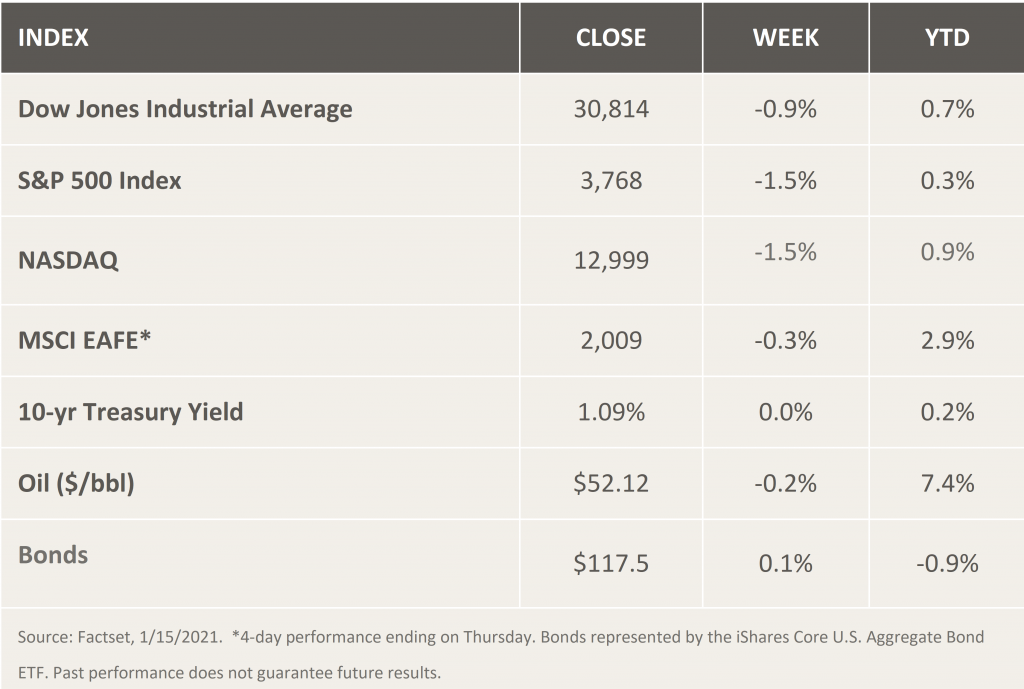
After hitting record highs in the first trading month of the year, stocks corrected by more than one percent at the close. Earnings reports were released by JP Morgan and Wells Fargo at the start of what analysts anticipate will be a robust earnings season. The much-awaited fiscal-stimulus package was indeed announced by President-elect Joe Biden to the tune of $1.9 trillion, intended to mitigate the COVID-19 impact. Fears of an extended economic lockdown spread among the investing community as the new highly-contagious coronavirus strain appeared over several states and the vaccine roll-out failing to meet expectations. Further need for economic stimulus is signaled by a slowing job market as initial claims spiked during the two weeks ending January 9. The current short-term outlook looks volatile, however, the classic response of the stock market to the coming fiscal and monetary stimulus is expected to be optimistic and would only be further bolstered by resolution of the current delays in vaccine distribution. 

U.S. Economy

As the stock market appeared to lose its steam after testing historic highs, fixed income and Treasury yields drew the attention of investors during the first two trading weeks of 2021. Although the benchmark 10-year Treasury yields started the new year at what turned out to be the lowest level to start a new year in history, it has steadily climbed to test the highest level it has been since March before ending Friday on a slight correction. Future potential higher yields for investors poses some interesting prospects:

  • Inflation for December increased only slightly, registering a comparatively modest price index gain of 1.6% compared to 2.2% the year before, with the exclusion of energy and food. Expectations for future inflation, though, appears to be trending up for the first time in years, as indicated by the 10-year breakeven rate reaching levels unseen since 2018.
  • The announced fiscal stimulus plan amounting to $1.9 trillion represents approximately 9% of GDP. The economic plan covers added relief checks to households, increased unemployment benefits, an expansion of minimum wages, funding for the COVID-19 vaccine, and expanded aid to states and local governments. The increased spending is expected to strengthen recovery efforts while adding to the already growing bond supply and moving yields higher.
  • Under a scenario marked by a possible sudden increase in long-term yields, growing inflation, and a resulting tightening of monetary policy by the Fed, valuations may come under pressure resulting in greater market volatility.

In a strong interest rate regime, it is appropriate for investors to allocate a major proportion of their portfolio to bonds and other fixed-income investments. Certain sectors in the equities market will continue to remain viable and attractive such as the technology sector which generally outperforms the market due to strong earnings. Investments that are economically sensitive and that have recently lagged, such as small-cap stocks, can also provide buying incentives.

Metals and Mining

After dropping from a year-to-year high during the week, gold prices recovered to show modest gains on January 15th. It was priced at a 60-day high of $1,942 per ounce on January 4th but gave up its gains on January 11th when it slid 5% to $1,834.70. Nevertheless, analysts expect a further move upward due to the anticipated $1.9 billion stimulus package. Gold is also expected to gain from a possible stock market pullback and inflationary pressures as a result of investors’ flight to safety. By 10:02 am EST on Friday, gold was trading at $1,840.10 per ounce.

Silver continued on a slow uptrend during its second straight week in an attempt to test its five-month-high of $30 per ounce set in early January. Continued volatility has kept the metal below the $26 level for the week, trading at $25.01 at 10:10 a.m. on January 15th. In the meantime, platinum moved closer to its three-year peak of $1,114 per ounce on Thursday, while palladium ticked up slightly. Supply challenges out of South Africa during the year are bound to benefit the prices of both metals, according to analysts. Palladium traded at $2,284 while platinum was priced at $1,075 as of 10:45 p.m. on Friday.

Base metals are mixed for the week, responding to both corrective pressure and buying interest due to concerns that coronavirus lockdowns may disrupt supply chains and cause shortages. Copper prices traded at $7,951 per tonne which represents a 2.3% slide from its January value of $8,146, an eight-year high. It recovered slightly on Friday morning to trade at $8,002The week’s trades saw zinc at $2.716 and lead at $2,040, while nickel rose 4.5% due to supply disruptions from the Philippines, the world’s second-largest nickel exporter. 

Energy and Oil

Market sentiments weighed heavily on oil prices as China reported its highest COVID-19 case count in months. OPEC upgraded its forecast for U.S. oil production to increase by 370,000 bpd from a previous expected 71,000 bpd. Total decides to withdraw from the American Petroleum Institute, the most powerful lobby in the industry due to API’s opposition to methane regulations, EV subsidies, and carbon pricing. Total likewise took issue with API’s political contributions to U.S, politicians who oppose the Paris Climate Agreement. In related developments, Saudi Arabia has announced a reduction in its sales of oil to 11 or more Asian refineries, in compliance with its commitment to reduce oil production by 1 mb/d.

Regarding renewables, companies in the solar and wind power industries rose in value, prompting the likelihood of a growing bubble in clean tech stocks. Major investments in clean energy are also foreseen in a possible sequel package to Biden’s stimulus plan, which ay likely to take place in the spring. It bears watching whether the rally in clean energy will remain sustainable in the long term.

Natural Gas

Skyrocketing LNG prices due to seasonally cold weather have expanded beyond Asia to other regions of the world. Consumers are being forced to cut back  Global markets are experiencing consumer cutbacks due to supply shortages, further undermining the spot market and possibly driving players to seek greater stability through oil-linked contracts. In Mozambique, a chronic insurgency poses risks to Total’s $23 billion gas production and LNG export project, which halted work due to nearby attacks. The same situation poses risks to ExxonMobil’s planned $33 billion facility. Finally, the Port of Cork in Ireland allowed its agreement with NextDecade Corporation for an LNG import terminal to expire due to concerns surrounding methane emissions. While NextDecade has been experiencing setbacks for similar projects in Europe it still is currently in plans for an LNG export terminal in Texas.

World Markets

A resurgence in coronavirus outbreaks in Europe tempered optimism in a prospective Biden stimulus package. The pan-European STOXX Europe 600 Index slid 0.81% lower; the German Xetra DAX Index declined by 1.86%, Italy’s FTSE MIB by 1.81%, and the French CAC 40 by 1.67%. The UK’s FTSE 100 Index lost 2.00% in response to economic data indicating that its economy contracted in November as a result of a more stringent coronavirus lockdown.  Political uncertainty in Italy prompted cored eurozone government bond yields to fall and peripheral eurozone bond yields to climb. UK gilt yields rose for the first half of the week but gave back their gains in the second half to end down overall due to coronavirus concerns, mirroring trading patterns in core markets.

Shifting focus to the Asian markets, Japan’s Nikkei 225 Stock Average surged 380 points (1.4%) to end at 28,519.18, a new decades-long record weekly closing high, The large-cap TOPIX Index moved sideways while the TOPIX Small Index descended. The resiliency of Japan’s markets can be attributed to loosened government lending policies and financial support during the pandemic. Chinese stocks gave up their gains as nine other Chinese companies were added to the U.S. investment blacklist on Thursday, bringing the total of blacklisted companies to 44. These companies were cited for their ties to the Chinese military. The large-cap CSI 300 Index slid by 1.4% while the Shanghai Stock Exchange Composite Index fell by 0.6%, on jitters that Alibaba and Tencent might likewise be blacklisted. Further disappointing news surrounded Sinovac’s coronavirus vaccine CoronaVac, which was found by Brazilian scientists to barely exceed 50% efficacy, far below initially reported levels.

Brazil’s Bovespa Index descended 3.7% on news that the country’s 2020 inflation was 4.5%, a four-year high, with core inflation likely to extend to 5% by midyear due to price shocks in the food and electricity sectors. Turkey’s BIST-100 Index also declined, by about 1% due to a reported current account deficit of $35 billion from January to November 2020.   

The Week Ahead

Monday is Martin Luther King Day in recognition of which markets will remain closed. For the rest of the week, economic data to be released will include building permits, housing starts, existing home sales, and PMI breakdowns.

Key Topics to Watch

  • National Association of Home Builders
  • Inauguration of Joe Biden as president
  • Initial jobless claims (state program, SA)
  • Continuing jobless claims (state program, SA)
  • Housing starts
  • Building permits
  • Philadelphia Fed Index
  • Markit manufacturing PMI
  • Markit services PMI
  • Existing home sales

Markets Index Wrap Up

This image has an empty alt attribute; its file name is Market-Jan.-19-2021-1-1024x689.png

Weekly Market Review – August 8, 2020

Stock Markets

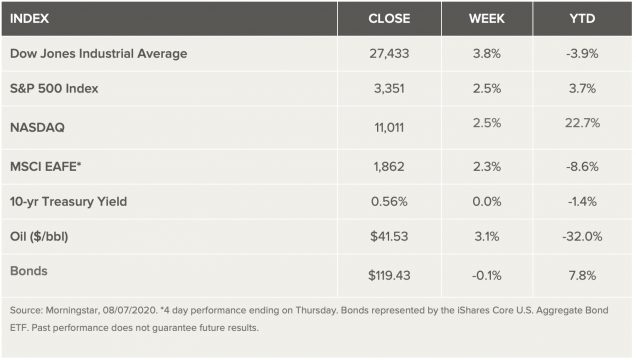
Stocks extended the previous week’s gains, while the Nasdaq set another record on better-than-expected economic data and improved trends in U.S. coronavirus cases. Business activity for the services sectors expanded, and the U.S. economy added 1.76 million jobs in July, beating estimates. The continuing, yet moderating, gains in employment show that the recovery in the labor market and the economy is on track, but there is still a long road ahead.

US Economy

As seen in restaurants and retail stores across the country, change is hard to come by. In fact, the U.S. is experiencing a coin shortage — just another effect of the coronavirus pandemic that has reduced the number of coins in circulation due to dampened consumer spending and limited supply. Coins are not the only form of U.S. currency currently under pressure. Though the U.S. dollar rallied a bit last week from the two-year low reached in late-July, the economic downturn, higher levels of government spending, and near-zero interest rates are likely to continue to push the dollar lower relative to a basket of global currencies.

A path of the U.S. dollar has a mixed effect on the economy. A weak dollar makes imported goods from other countries more expensive for U.S. consumers, but it also makes domestic exports more competitive abroad, which boosts profits for multinational U.S. firms.  With the U.S. dollar being the world’s primary reserve currency, investors pay close attention to it because its path is a key driver of returns across financial markets, from stocks and bonds to commodities and precious metals. Trends in the U.S. dollar also impact interest rates and inflation, shaping what investors can expect from asset returns in the future.

Metals and Mining

Gold’s historic rally continued this week, taking the metal into new record-setting territory. It topped US$2,070 per ounce on Thursday, pulling back overnight as the US dollar gained. The greenback strengthened from a two-year low due to heightened purchases amid growing animosity between Washington and Beijing. Despite the renewed momentum, investors continue to choose safe haven gold as COVID-19 cases increase globally. The yellow metal’s run past US$2,000 marks its ninth straight week of gains. Since March, the price of gold has climbed 36 percent. Silver was also on track for its sixth consecutive week of gains, adding as much as 27 percent to its value. It edged close to US$30 an ounce on Thursday, a seven year high for the white metal. After ending July under price pressure, platinum saw a week of steady gains. Starting the session at US$902 per ounce, the metal moved as high as US$995 before pulling back to US$965. Platinum’s recent price growth is likely linked to tight supply stemming from mine shutdowns and curtailments in H1. An ounce of platinum was valued at US$952.50 as of 11:45 a.m. EDT on Friday. Palladium prices also trended higher this week, fortifying above US$2,000 per ounce. Current supply and demand fundamentals have contributed to palladium’s positive performance, but the metal was already experiencing a prolonged run prior to the pandemic. 2020 mine supply challenges have been less impactful on palladium compared to platinum’s woes. On Friday, palladium was moving for US$1,993.

The base metals also gained broadly, edging higher throughout the week. On Monday, copper was priced at US$6,441 per tonne, a range unseen since April 2019. After slipping to a year-to-date low in March, the red metal has clawed back 39.7 percent. Copper was trading for US$6,453.50 on Friday. Zinc also made gains this period, braking past US$2,300 per tonne for the first time since January. Some of zinc’s growth may be associated to a decrease in Shanghai stocks of the metal, which recorded a 4.4 percent decrease this week amid growing demand. On Friday morning, zinc was priced at US$2,377.50. Nickel has spent the first part of August rocketing higher after a slight slip at the start of the month. On Monday, nickel was sitting at US$13,683 per tonne, but it had climbed 5 percent by Thursday. This week’s gains could be the result of Tesla’s Elon Musk making public calls for more nickel production. The metal is a key component in electric vehicles, a sector where Tesla is a dominant player. To end the week, nickel was selling for US$14,381. Lead also squeezed out a gain this for the first full week of August. Prices faced pressure mid-week, slipping below US$1,860 per tonne. The metal quickly recovered and climbed back above US$1,880; by week’s end, lead was valued at US$1,913.

Energy and Oil

Oil prices rallied to multi-month highs mid-week on stronger EIA data. But the market narrative remains the same – tightening fundamentals set against a weak macro backdrop has kept oil prices stuck in a narrow trading range. On Friday, prices fell back, erasing some gains. Giant BP announced more details earlier this week on how it plans on transitioning into a low carbon energy company, which notably included an expected 40 percent decline in production by 2030, or 1 mb/d. However, the plan apparently relies heavily on selling assets. “It is a simple calculation of natural production decline and planned divestment,” a BP source told media sources. In a securities filing, ExxonMobil said that 20 percent of its oil and gas reserves are at risk of getting wiped off the books because of low oil prices, although the company won’t offer an update until the end of the year. Exxon singled out its Kearl oil sands project in Canada. At least three major Asian refiners are planning to buy less oil from Saudi Aramco in September, potentially a sign of softer demand. In the U.S., shale drillers are not prepared to add rigs back into the field for the remainder of the year and will likely use any increase in cash flow to repair balance sheets rather than return to growth. As a side note, prices of cobalt, a key element in EV batteries, have lately been surging as Covid-19 lockdowns in southern Africa have created severe supply chain bottlenecks. Natural gas spot prices were mixed at most locations this week. The Henry Hub spot price rose from $1.75 per million British thermal units (MMBtu) last week to $2.18/MMBtu this week. At the New York Mercantile Exchange (Nymex), the August 2020 contract expired last week at $1.854/MMBtu. The September 2020 contract price increased to $2.191/MMBtu, up 26¢/MMBtu from last week to this week. The price of the 12-month strip averaging September 2020 through August 2021 futures contracts climbed 9¢/MMBtu to $2.714/MMBtu.

World Markets

European shares rose on signs that an economic recovery may be gaining traction and hopes for more U.S. stimulus. However, escalating tensions between the U.S. and China and fears that Europe could suffer a resurgence of coronavirus cases curbed equity markets’ gains. In local currency terms, the pan-European STOXX Europe 600 Index ended the week 2.03% higher, Germany’s Xetra DAX Index rose 2.94%, France’s CAC 40 gained 2.21%, and Italy’s FTSE MIB climbed 2.22%. The UK’s FTSE 100 Index advanced 2.28%.

Eurozone business activity strengthened in July, signaling the fastest growth rate in two years, according to final data based on surveys. The composite index, which combines manufacturing and services output, rose six points to 54.9. However, firms operated with considerable spare capacity and continued to shrink their headcounts. German industrial production continued to recover in June, rising 8.9% on the month, compared with 7.4% in May. On a year-over-year basis, the country’s industrial output declined 11.5%.

Mainland Chinese markets rallied after data lifted confidence in the economic recovery. The large-cap CSI 300 Index and benchmark Shanghai Composite Index each posted solid gains, even after declining on Friday on news that the Trump administration tightened restrictions on Chinese social media networks TikTok and WeChat in the U.S. In another sign of the growing tech rift between the U.S. and China, San Jose-based video conferencing company Zoom, which gained popularity during the pandemic, said that it would halt direct sales to China and only provide video conferencing services through third-party partners.

The Week Ahead

The second-quarter earnings season will start to wind down with less than 3% of companies in the S&P 500 reporting results. Economic data being released in the U.S. include inflation on Wednesday and retail sales along with consumer sentiment on Friday.

Key Topics to Watch

  • Job openings
  • NFIB small-business index
  • Producer price index             
  • Consumer price index
  • Core CPI
  • Federal budget                                              
  • Initial jobless claims (regular state program, SA)
  • Continuing jobless claims (regular state program, SA)
  • Continuing jobless claims (federal & state, NSA)
  • Import price index                                         
  • Retail sales
  • Retail sales ex-autos
  • Productivity Q2
  • Unit labor costs
  • Industrial production
  • Capacity utilization
  • Consumer sentiment index
  • Business inventories              

Markets Index Wrap Up