Uncategorized

Weekly Market Review – September 14, 2019

Stock Markets

Stocks advanced to near record highs this week thanks to improving economic data, supportive global central-bank policies, and new optimism around the trade issue that has been plaguing the markets. In a positive move, China announced that it would exclude certain U.S. products from tariffs. The U.S. immediately provided a “good dog” response by delaying the increase for some of its tariffs that are scheduled to take effect in October. These small mercies by both sides appeared to lift optimism that it is possible to reach an interim trade agreement. Market moves last week included a major rise in Treasury yields along with the outperformance of typical cyclical sectors such as industrials, financials, and energy versus defensives stocks such as health care, staples and utilities. There was also a shift in the preference for stocks with depressed valuations over stocks that traditionally trade at higher price-to-earnings ratios.

U.S. Economy

The stock market’s rebound from the August pullback is no surprise. It remains consistent with analysts’ view that equities will likely see more volatility at this stage in the cycle, set against a fundamental backdrop that still supports the extension of this bull market. Things cooled slightly on the geopolitical front in September so far, but the core contributors fueling the bouts of volatility have not been eradicated. It’s likely that the Fed will cut rates this week, but viewers expect markets will respond to any signals that additional policy moves aren’t in sync with current expectations for more rate cuts. Also, despite signs of progress, most don’t expect the trade situation with China to reach an end soon, keeping markets volatile. The important Brexit issue is likely to get a lot of attention on the horizon.

Metals and Mining

Gold regained further momentum Friday as the US dollar slumped, based on concerns surrounding a global growth slowdown. Although it was up, gold was capped by equity markets that were gaining thanks to a potential respite in the US-China trade tensions. Analysts feel that that continued fears surrounding a global economic downturn and negative-yielding government debt, married to a dovish monetary policy outlook by global central banks will support gold long-term. Experts in the gold market continue to predict increasingly high levels for the metal’s price. Silver was also up slightly on the back of a lower dollar and ongoing global economic tensions. Since it tends to follow the path of gold, many investors believe that it too is still in a great position to continue strong gains as it has been since early August. In other other precious metals, platinum was up on Friday, continuing to trade above the US$900 per ounce level. Platinum prices have surged over the last month thanks to greater safe haven demand paired with supply concerns.

Analysts see the price of the metal rising slightly, but they feel it will trail behind its sister metal palladium. On that side, palladium lost on Friday after experiencing an all-time high during the previous session that peaked at US$1,621.55. Analysts feel palladium prices may dip, but it will continue to be supported throughout the year. Next week, market participants will be keeping a close eye on $1,500 gold pricing as the first line of defense gold prices have to hold in the near term, according to analysts.

Energy and Oil

The series of back-and-forth gestures between Washington and Beijing has boosted market sentiment. Chinese firms bought 10 shipments of U.S. soybeans on Thursday in another effort to build confidence inspiring the October trade talks. Politico reports that the Trump team is trying to find an ease the trade war that the President started. There is a growing effort to head off trade escalation. However, a breakthrough in negotiations is a serious challenge. Oil remains tight now with a surplus in 2020. The IEA said this week that the market will see inventory drawdowns of 0.8 mb/d in the second half of 2019, but that a surplus would return in 2020. The request to OPEC is set to decline by 1.4 mb/d next year. This will present a serious situation for the cartel to resolve. Natural gas spot prices rose at most locations this week. Henry Hub spot prices rose from $2.42 per million British thermal units (MMBtu) last week to $2.59/MMBtu this week.  At the New York Mercantile Exchange (Nymex), the price of the October 2019 contract increased 11¢, from $2.445/MMBtu last week to $2.552/MMBtu this week. The price of the 12-month strip averaging October 2019 through September 2020 futures contracts climbed 9¢/MMBtu to end at $2.561/MMBtu.

World Markets

European stock markets were up this week as the European Central Bank announced new monetary stimulus aimed at supporting the eurozone economy. At the same time, fears of a no-deal Brexit were waning. The pan-European STOXX Europe 600 Index rose about 1.3%, the German DAX gained 2.4%, and the UK’s FTSE 100 Index rose 1.2%. The British pound rose to its highest level against the U.S. dollar since July. That’s due to Parliament passing a law that forces the UK government to seek a Brexit extension from the European Union as well as avoids a no-deal Brexit on October 31. The German Ifo Institute cut its forecast for German growth this year to 0.5% from 0.6% and lowered its estimate for next year to 1.2% from 1.7%.

Chinese stocks advanced in what was a holiday-shortened week. Both China and the U.S. took important steps toward reducing their trade war. Expectations also increased that Beijing would be putting more stimulus measures in place to boost the economy. For the week ended Thursday, the benchmark Shanghai Composite Index rose 1.1%, its highest level in 10 weeks. The large-cap CSI 300 Index added 0.6%. Stock markets on the mainland were closed Friday for the Mid-Autumn Festival.

The Week Ahead

This week’s focus will be primarily on the Federal Reserve as it issues its latest rate decision this Wednesday. There are other important economic figures emerging during the week as well including housing starts, industrial production numbers, existing home sales, along with Friday’s figures on the leading economic index.

Key Topics to Watch

  • Empire state index
  • Industrial production
  • Capacity utilization
  • Home builders’ index 
  • Housing starts
  • Fed announcement
  • Jerome Powell press conference                                            
  • Weekly jobless claims
  • Philly Fed survey
  • Current account deficit Q2
  • Existing home sales
  • Leading economic indicators

Markets Index Wrap Up

Weekly Market Review -September 7, 2019

Stock Markets

Despite the turmoil and a shortened week, U.S. stocks finished higher for a second week in row. To follow suit the S&P 500 entered a range that appears to be about to reach a record high. The rally was driven again by positive news around the U.S. and China trade talk advancement which is being tabled for a meeting in Washington in October. The reading on economic data was a two-pronged sword where manufacturing activity contracted and fell to a three-year low, but on the other side, non-manufacturing activity that carries most economic activity, expanded and accelerated compared to July’s numbers. The August jobs report indicated hiring slowed partially but held to a level strong enough to keep unemployment at its near 50-year low. Stocks continue to enjoy healthy consumer action, positive economic growth, and low interest rates, although analysts expect to see volatility based on trade issues.

U.S. Economy

Labor Day is over and signals the unofficial end of summer to most. That did not hold true for the bull market which was sound last week. The ongoing volatility felt all summer and especially in August reflected the ever-present risks of the U.S.-China trade battles and were compounded by the growing fears of an impending recession. Neither of these situations were resolved over the summer, however September kicked off with positive economic data and stock-market performance that leave analysts with the conclusion that the recent pullback is most definitely not the beginning of the end.

Metals and Mining

Gold is getting all the attention in the metal markets. After a very volatile session, gold closed a second straight week of losses. Analysts remain bullish but slightly more cautious for the coming week. Seeing gold hit new fresh six-year highs, then drop more than $50 on a weekly basis has been a little unsettling for traders. The US Federal Reserve and the European Central bank are expected to cut rates this month in order to stimulate the economy. If another cut takes place in September, it is likely that interest rates will be decreased by as much as 25 basis points, or 0.25 percent playing into gold’s favor. Silver was also affected by the rising dollar and investors moving away slightly from the safety it offered them over the past month. Silver slumped almost 5 percent in Thursday’s session. Despite the recent downturn for silver, market watchers still believe that it will continue to grow in price because of how closely it follows gold which is expected to gain momentum. As for the other precious metals, platinum rebounded slightly. Analysts at FocusEconomics see the price of the metal rising slightly from its current level. They believe it will continue to be downplayed and follow behind its sister metal palladium. It seems the market is currently regarding platinum as the cheaper precious metal when compared to gold. If predictions that gold will continue its price increase are realized, platinum is more than likely continue to be supported as investors look for a cheaper alternative to gold. Palladium was also subject to declines the other precious metals made on Thursday. However, palladium has claimed another week as the highest trading precious metal.

Energy and Oil

Oil has shown more life this week after the U.S. and China agreed to hold trade talks in October. Jobs data from the U.S. Labor Department was slightly worrying, particularly employment gains showing signs of slowing. However, markets appear increasingly confident that the Federal Reserve will cut interest rates again this month as indicated. Another bullish report from the EIA also served to ease fears of an imminent recession. The agency reported strong drawdowns in crude oil, gasoline inventories, and a dip in production. Oil prices were up on the positive news. Natural gas spot prices rose at most locations this week. Henry Hub spot prices rose by 8% from $2.24 per million British thermal units (MMBtu) last week to $2.42/MMBtu this week. At the New York Mercantile Exchange, the September 2019 Henry Hub natural gas contract expired last week at $2.251/MMBtu. The October 2019 contract increased to $2.445/MMBtu, up 22¢/MMBtu from last week to this. The price of the 12-month strip averaging October 2019 through September 2020 futures settlement prices climbed 10¢/MMBtu to $2.474/MMBtu.

World Markets

On a positive note prior to the ECB meeting, European markets experienced one of the best weeks since June, likely due to the easing U.S.-China trade tension along with increased hopes for an end to unrest in Hong Kong. All that while the possibility of the disorderly Brexit fell off. The pan-European STOXX Europe 600 Index rose almost 2%. Traders noted that moves out of defensive stocks and into cyclicals helped propel the market higher. The British pound gained more than 1% against the U.S. dollar while the FTSE 100 rose 1.25% as the prospect of a disorderly exit from the European Union (EU) on October 31 decreased. In a separate move, Italian government bonds rallied, pushing yields to record lows after Italy’s president approved the new coalition government. The new combination is expected to be more EU friendly. The German manufacturing orders numbers fell more than expected in July as new orders from foreign buyers dropped 6.7%, more than was expected. Industrial production fell a disappointing 4.2% on a year-over-year basis. All of the German data offered more evidence that trade disputes and geopolitical factors are pushing the German economy toward recession.

China’s benchmark stock index posted its best weekly performance since June. That came after China’s cabinet signaled it would enact fresh stimulus measures to bolster an economy increasingly battered by tariffs battles. For the week, the benchmark Shanghai Composite Index and the large-cap CSI 300 Index, each surged 3.9%. China’s central bank last cut the required reserve ratio in January after statements from the State Council in December.

The Week Ahead

Most people are back to a regular schedule and so is the economic data reporting to be released this week. On Tuesday look for the important retail sales along with the very telling consumer sentiment which is out on Friday. Also, on the global front, the European Central Bank (ECB) has set expectation that it will cut rates on Thursday. That’s when the ECB meets with a policy decision announcement to follow.

Key Topics to Watch

  • Consumer credit
  • NFIB small business index
  • Job openings
  • Real median household income
  • Producer price index
  • Wholesale inventories
  • Weekly jobless claims                         
  • Consumer price index
  • Core CPI
  • Federal budget
  • Retail sales
  • Consumer sentiment index
  • Business inventories

Markets Index Wrap Up

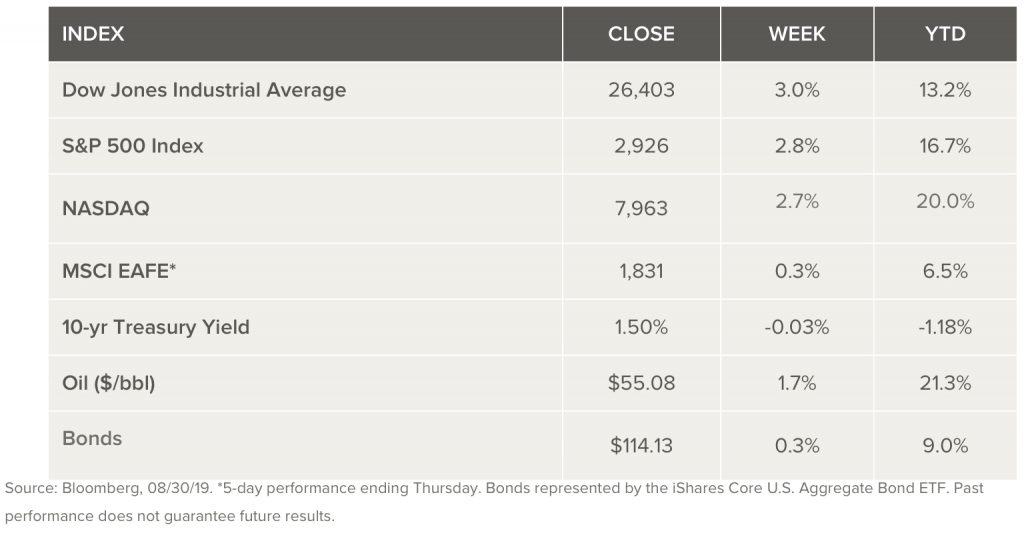
Weekly Market Review – August 31, 2019

Stock Markets

U.S. stocks managed to eek out another gain, ending the week in and the month of August on positive note. The rally was fueled by optimism about the possible reduction of trade clashes between the U.S. and China based on conciliatory talk emerging from both countries. The economic data that showed consumer spending rose by 4.7% over the second quarter also helped. Remember that consumer spending accounts for for 70% of all economic growth. A change in Britain’s Brexit situation reared its head once again as the odds of the U.K. leaving the European Union without an agreement were bolstered by the new prime minister announcing he would be suspending Parliament before October 31 – the Brexit deadline. So even with the spate of geopolitical uncertainties, the solid consumer fundamentals, rise in corporate profits continuing, and generous monetary policies are likely to extend the current economic expansion – one of the longest in recent history.

U.S. Economy

The end of August was the period on a volatile month during where stocks swung on frequent changing trade news between China and the U.S. Sometimes they rebounded off progress on negotiations and then escalated based on news of tariffs. Overall, the S&P 500 is up a strong 17% in 2019. It is down 3.5% from the recent high and at about the same level as it was this time last year. The sell-off last December was followed by a strong rally to new highs through much of 2019. It lost some traction over the past month. But as impressive as this bull market has been over the last 10 years, it is certainly not smooth, with several significant periods of market volatility. And while stocks finished August on a high note, recession fears are still hanging on. So there are several cautionary signals that give pause to the bull market’s longevity.

Metals and Mining

Gold was softer on Friday as both the US dollar and equities moved up. Despite the slight slide in the market, concerns about the economy trade war battles kept the gold on track for its fourth consecutive monthly rise. Gold surged through a more than six year peak earlier in the week, climbing over US$1,550 per ounce as investors sought safe haven refuge. The situation between the US and China has been grabbing the attention of market participants for over a year now, and fueling concerns around a global slowdown. Silver managed to continue its rally on Friday, holding strong. Like gold, it is being supported by interest from investors thanks to concerns surrounding the state of the economy and geopolitical issues. In terms of where the silver price may go from here, markets watchers say that investors won’t have to wait long for it to hit US$20. As for the other precious metals, platinum made gains, finally breaking through the US$900 per ounce level. That’s over a more than one-year high and heading for its best month since January of last year. Palladium made huge gains this week, ticking up over 5 percent as it went head-to-head with gold on Friday for the highest trading precious metal title.
After a relatively lackluster August, it got momentum at the end of the trading week as it hit a one month high. Palladium was trading at US$1,526 per ounce as of 11:00 a.m. EDT, Friday.

Energy and Oil

It looked like oil prices were set for their biggest weekly increase since July until demand fears caused by Hurricane Dorian hitting Florida sent prices crashing on Friday morning. Oil prices were initially pushed up by cautious language from the U.S. and China, falling oil inventories, and also by the major Hurricane heading for the southeastern U.S. Despite the apparent easing in the trade war, tariffs are set to jump on Sunday. Analysts state that upside momentum should not be taken for granted and that recession fears are casting a shadow on sentiment and oil prices should keep dancing to the tune of the U.S.-China trade saga.

Natural gas spot prices fell at most locations this week. Henry Hub spot prices dropped slightly from $2.25 per million British thermal units (MMBtu) last Wednesday to $2.24/MMBtu this week. At the New York Mercantile Exchange, the September 2019 contract expired yesterday at $2.251/MMBtu, up 8¢/MMBtu from last week. The October 2019 contract increased to $2.222/MMBtu, up 4¢/MMBtu from last week. The price of the 12-month strip averaging October 2019 through September 2020 futures contracts climbed 3¢/MMBtu to $2.373/MMBtu.

World Markets

European markets rose this week lifted slightly by improvements in U.S.-China trade talks and a new agreement forwarded by Italian political parties to join together for a new government. The pan-European STOXX Europe 600 Index rose over 2%, while the German DAX advanced 2.5%, and Italy’s FTSE MIB Index made serious headway and gained almost 4%.The FTSE 100 Index rose after Prime Minister Boris Johnson suspended Parliament from mid-September until October 14 in an attempt to push through Brexit. The idea behind the move shortens the time period when opponents of Brexit will have to prevent a disorderly Brexit. It was endorsed by by Queen Elizabeth II. Unfortunately it could end up triggering a possible election based on non-confidence.

Chinese investors were not as pleased by the latest trade developments and seemed to be preparing for a new wave of U.S. tariffs. The benchmark Shanghai Composite Index declined 0.4% and the large-cap CSI 300 Index dropped 0.6%. Both indices fell in August, with the Shanghai composite falling 1.6% and the CSI 300 giving up 0.9%.

The Week Ahead

The coming week is shortened by the Labor Day holiday, and holds light reporting including the Manufacturing Purchasing Managers’ Index on, auto sales, foreign trade deficit numbers, non-farm payrolls and August’s jobs report on Friday.

Key Topics to Watch

  • Markit manufacturing PMI
  • ISM manufacturing index
  • Foreign trade deficit
  • Motor vehicle sales
  • Weekly jobless claims
  • Markit services PMI
  • Non-farm payrolls
  • Unemployment rate
  • Average hourly earnings

Markets Index Wrap Up

Weekly Market Review – August 24, 2019

Stock Markets

It appeared that stocks would finish the week higher Friday until China unveiled a new round of retaliatory tariffs. That was met with a swift reply by President Trump vowing to respond, which sent things reeling. As trade tensions escalated, China announced that it will impose tariffs ranging from 5% to 10% on $75 billion U.S. goods in two batches on Sept. 1 and Dec. 15. That was punctuated with a 25% tariff on U.S. automobiles. Fed Chair Powell meeting at the annual central bank summit in Jackson Hole, Wyoming, left the option for another rate cut on the table, likely when the committee meets next month. That’s in answer to the risks to global and U.S. growth created by ongoing trade uncertainty. The Fed and trade lead the media buzz, however the economic and corporate data continue to be positive. Earnings reports from several high-profile retailers last week were solid, demonstrating that consumer strength, which is the main driver of the U.S. economy, remains intact.

U.S. Economy

The U.S. economic numbers seem to outweigh current concerns. The weekly jobless claims fell to their second-lowest level in the past four months last week. Alongside that news, wages have now grown above 3% for 12 consecutive months which is the longest such continuous streak since 2007. The unemployment rate is also down to 3.7% from 4% at the beginning of the year and nearing the 50-year low. It seems that the recession signal from the inverted yield curve is getting a lot of traction, but in reality, it’s household spending that will rule the future outlook. Over the past four U.S. recessions, unemployment rose by a minimum of 0.5% before each recession began, which indicated deteriorating consumer conditions. That is not on the U.S. economic radar at present. 

Analysts believe that the Fed will lower rates, even if not as aggressively as the market seems to be anticipating. Economic data suggests moderate cuts may be appropriate to support a softening in growth. But as the Fed incorporates trade risks in its response, it could get more aggressive in rate cuts. Policy easing from the Fed is a supportive factor for the stock market and could be an additional catalyst for near-term swings in both interest rates and stock prices. 

Metals and Mining

Gold prices were making gains of over $24 an ounce in late-morning trading Friday after the U.S.-China trade war kicked into a higher gear based on China’s newly announced trade tariffs on U.S. goods followed by Trump’ s retaliation in a series of threatening tweets – even going so far as to demand that U.S. businesses find ways to stop doing business with China. Trump also tweeted about who remains the bigger enemy: China’s President Xi or the Federal Reserve? That certainly helped to unnerve the marketplace heading into the weekend, all of which is bullish for the safe-haven gold mentality. As of the week’s end, December gold was last up $23.60 at $1,532.10. Silver was up slightly on Friday, still holding strong above the US$17 per ounce level. Silver continues to be supported by interest from investors thanks to the same concerns about the state of the US economy and ongoing geopolitical issues. Analysts suggest that Silver’s recent rally could lend credence to the theory that it will outperform gold in the not so distant future. Platinum was relatively flat on the week and is still unable to break through the important US$900 per ounce level. For its part, palladium was down close to 2 percent on Friday, and continues to trade below the gold. That’s not to say there are still many market participants in palladium’s corner. Metals Focus for instance, has stated that it believes the metal will continue to rise, forecasting that autocatalyst demand will more than likely go up by 3.6 percent in 2019, setting records at 8.59 million ounces due to tighter emission standards. As of 10:18 a.m. EDT Friday, palladium was trading at US$1,444 per ounce.

Energy and Oil

Oil plunged on Friday after the China announcement on new tariffs on U.S. goods, which included crude oil. The move reignited fears of economic recession. That focused all eyes on the Jackson Hole symposium, an elite financial summit that could give some insight into the U.S. Federal Reserve thinking. U.S. State Department special representative for Iran, Brian Hook, said that Iran’s oil exports have plunged below 100,000 bpd, although independent assessments from S&P Global Platts puts the figure closer to 450,000 bpd.

Natural gas spot prices rose at most locations this week with Henry Hub spot prices rising from $2.15 per million British thermal units (MMBtu) last Wednesday to $2.25/MMBtu this week. The Nymex price of the September 2019 contract increased 3¢, from $2.143/MMBtu last Wednesday to $2.170/MMBtu this week. The price of the 12-month strip averaging September 2019 through August 2020 futures contracts climbed 1¢/MMBtu to $2.329/MMBtu.  Net injections to working gas totaled 59 billion cubic feet (Bcf) for the week ending August 16.  As a side note, natural gas prices in Europe fell to a 10-year low as cheap LNG washes over the continent. Gas storage in many European countries is significantly higher than the five-year average.

World Markets

Most major European markets rose throughout the week but continued under pressure after the new spurt of U.S. and China tariffs threats. The pan-European STOXX Europe 600 Index, the German DAX, and Italy’s FTSE MIB Index all rose, while the UK’s FTSE 100 Index dropped. The European Central Bank signaled Thursday that a stimulus package to address the region’s slowdown may be about to land. Signs that Germany may be entering a recession seemed to stack up during the week. The IHS Purchasing Managers’ Index showed orders at German factories and services companies dropped at the fastest pace in six years, and companies expect output to fall in the next 12 months. The German economy contracted 0.1% for the three months ended June 30.

As might be expected, Chinese stocks advanced as positive corporate earnings reports and monetary policy changes buoyed investor sentiment and helped to offset U.S. trade-related concerns. For the week, the benchmark Shanghai Composite Index added 2.6%, and the large-cap CSI 300 Index, which tracks blue chips listed on the Shanghai and Shenzhen exchanges, rose 3.0%. The news issued on Friday helped push the markets over the edge as they ended the biggest weekly gain for both indices since June.

The Week Ahead

Outside of trade battle news, this will be a relatively light week for reporting as the summer holiday season winds to a close. Key economic data due for release in the U.S. include durable goods orders, core capex orders, consumer spending, core inflation, a revised second-quarter GDP report on Thursday, and the important consumer confidence index on Friday.

  • Key Topics to Watch
  • Durable goods orders
  • Core capex orders
  • Consumer confidence index
  • GDP revision
  • Personal income
  • Consumer spending
  • Core inflation
  • Consumer sentiment index

Markets Index Wrap Up

Weekly Market Review – August 17, 2019

Stock Markets

This is the third straight week that stocks declined, pressured by ongoing signs of a global economic slowdown and concerns about the yield-curve. The White House helped trigger a short-term rally when it announced that some tariffs scheduled to take place in September would be delayed possibly until December instead. The rally was, however, short lived. For the first time since 2007, 10-year rates dipped below two-year rates and 30-year yields fell to a new low around 2%. The news was not all bad though. Figures showed that U.S. productivity grew at a healthy pace, while retail sales for the month of July were positive; up the most they have been in the past four months. Most economist feel that recession fears are being overhyped, but they acknowledge the fact that global uncertainties may extend the current volatility.

U.S. Economy

The U.S. economy saw some good data this week. Retail sales signaled that consumers continue to spend at a solid pace. July retail sales were up 0.7% from the June and increased for the fifth straight month in a row. Data out last week also showed that consumer prices have risen. The Federal Reserve sees this as a positive economic signal. Without a doubt, consumer spending has been fueling growth for the current expansion, making up 70% of the economy and helping to create a positive environment for stocks to make gains. Although consumer sentiment edged down last week, analysts contend that a strong labor market, steady wage growth, and growing household net worth are helping consumer spending avert sentiments from any trade uncertainties.

Metals and Mining

Gold pricing consolidated this week as traders took gold to its highest daily closing price this year. Gold futures basis – the most active December contract – is currently trading down $6.30 and fixed at $1524.50. The result of this week’s trading, even with Friday’s moderate selloff is that gold has now closed at a new record high for the week. Gold opened on Monday at $1509 per ounce and effectively closed at $1524.50 for a net weekly gain of $15.50. Although gold is still making weekly gains and staying above the US$1,500 per ounce level, the metal is weighed down by a stronger US dollar that has strength on data that showed US retail sales surged last month, helping curb some recession fears. Silver is continuing its recent rally and maintaining levels around the US$17 per ounce range. Like gold, silver has been gaining more interest from investors thanks to concerns surrounding the state of the US economy and ongoing geopolitical issues. In other precious metals, platinum remained pretty flat, unable to break through the US$900 per ounce level. Analysts believe the price of silver rising slightly from its current level thanks to strong investment demand. Palladium, which has been strong this period, was up slightly on the week, but remains out of the US$1,500 per ounce range. There are still many market participants in palladium’s corner, with Metals Focus stating that it believes the metal will continue to rise.

Energy and Oil

Oil prices rebounded Friday on the back of some positive U.S. crude data, but the rebound isn’t likely to last as the world economies continue to struggle. Data showed that retail sales in the U.S. remain strong, but fears of a global slowdown have not retreated. The inverted yield curve also served to create concerns about a potential economic recession. Crude oil was not removed from the global selloff this week, as the data from China and Germany this week raised more red flags. The WTO is quoted as saying that that trade volumes could contract in the third quarter. The Trump administration is working to end regulation on methane emissions. The energy industry has said that it could prevent the federal government from regulating methane from oil wells and infrastructure, so they are against the action. Natural gas spot price movements were mixed this week with Henry Hub spot prices rising from $2.12 per million British thermal units last Wednesday to $2.15/MMBtu this week. At the New York Mercantile Exchange, the price of the September 2019 contract increased 6¢, from $2.083/MMBtu last Wednesday to $2.143/MMBtu a week later. The price of the 12-month strip averaging September 2019 through August 2020 futures contracts rose 2¢/MMBtu to $2.323/MMBtu.

World Markets

European stock markets came under pressure throughout the week from the fresh round of U.S.-China trade tensions coupled with growing signs of recession. The pan-European STOXX Europe 600 Index lost about 0.5%, the UK’s FTSE 100 Index dropped 1.8%, and the German DAX index dropped about 1.3%. Eurostat reported that the eurozone economy barely grew in the second quarter of 2019, expanding just 0.2%, as economies across the bloc lost steam. Germany, which the region’s largest economy, shrank by 0.1% in the second quarter, according to stats just out. The gross domestic product flash estimates numbers, including year-on-year growth of 1.1% from the second quarter of 2019, were in line with economists’ forecasts. The report showed that Spain’s economy grew 0.5%, France’s expanded 0.2%, and Italy’s economic growth was flat for the same period. Other signs of slowing were seen in the 1.6% June downturn in eurozone industrial production.

Chinese stocks ended up on the week after Beijing pledged to roll out measures that will boost disposable incomes for the next two years. The idea is to offset the slowing economy. The statement from the National Development and Reform Commission, China’s state planning agency, included few details, but raised hopes that China’s government would step up efforts to stimulate domestic demand. For the week, the benchmark Shanghai Composite Index added 1.77%, and the large-cap CSI 300 Index, rose 2.11%. A number of solid earnings reports from some of China’s biggest companies also help to lift investor mood.

The Week Ahead

This will be a light week for economic data and reporting following the heavy S&P reporting that just ended. Key economic data being issued this week include existing home sales and the Federal Reserve’s July meeting minutes, flash PMIs on Thursday, the leading economic indicators for July and on Friday, new home sales figures.

Key Topics to Watch

–           Existing home sales

–           Weekly jobless claims

–           Markit manufacturing PMI (flash)

–           Leading economic indicators (July)

–           New home sales

Markets Index Wrap Up

Weekly Market Review – August 10, 2019

Stock Markets

Escalating trade tensions between the U.S. and China helped stocks to finish the week modestly lower. Bond yields fell to their lowest point in three years on volatility. An unexpected drop in China’s currency had global markets reacting widely. The drop in value was seen as a response to the recently announced tariffs on Chinese goods scheduled for September. Chinese investors were reassured as officials sought to explain that they don’t plan to embark on a currency devaluation campaign. Analysts believe that a form of an agreement or some compromise can be reached, but with no immediate time horizon. They say the head-to-head trade antics will likely continue to fuel volatility and pullbacks as things go forward. Overall, they say that the outlook is still positive based on economic expansion, modest rises in corporate profits, and low interest rates.

U.S. Economy

Familiar themes entered the picture again last week, with the current dust up in the U.S.-China trade battle and a significant drop in interest rates both working to move stocks lower. However, there’s no denying that both stocks and bonds have done well this year. As witness, just two weeks ago, the S&P 500 was at an all-time high, and bonds are on pace for their best year over all since 2002. That’s not to downplay the fact that the stock market just endured its worst day of the year on Monday. The Dow averaged intraday swings of 460 points during the week – a sign that anxiety is rising that things may be trending to a drop. There are three items to focus on as market volatility enters the scene:

  1. It’s unlikely that the current trade war will end anytime soon, but it’s also unlikely that the economy will tip as a result.
  • Falling rates are a sign of the prevailing headwinds, but the yield curve isn’t a definitive sign of any expected trouble.
  • Sizable swings and significant daily market drops are not indicative of the wider market action.

Trade fears have surfaced frequently along with worries over the yield curve/falling rates. But so far, the markets reacted similarly each time, pulling back before reconnecting to the greater fundamentals that set the course. The past instances may have caused the market to take periodic jogs off the main path, but not halt or reverse their momentum. 

Metals and Mining

In bull-market runs, any price pullbacks are viewed as bargain-buying opportunities. That’s how gold ended on Friday. Early gains were lost, but buyers stepped in on the dip.  Gold held steady just above the US$1,500 per ounce level. The metal saw its biggest weekly gain in more than three years, in a week when it broke through US$1,500 for the first time in six years. Gold is also seeing support from a down US dollar and the tepid stance on policy from the world’s central banks. The central banks of New Zealand, Thailand and India surprised markets as they all cut interest rates. In all, gold has risen 4.3 percent on the week and about 17 percent for the year. Geopolitical issues are also helping silver, which broke US$17 per ounce midweek. Silver’s rally positioned it to deliver a weekly gain of almost 5 percent. Palladium was up just under 1 percent on Friday, managing to stay within the US$1,400 per ounce range. It appears to be falling behind gold’s luster for the first time since late last year. Platinum remained relatively flat on the week after experiencing dips in the previous two sessions.

Energy and Oil

In its news this week, Saudi Arabia buoyed hopes with a promise to keep oil exports below 7 million bpd. But as markets go, the overall sentiment for oil appears to be very bearish. News from the IEA late in the week referred to global oil demand as “fragile” and characterized the global economy of showing signs of slowing. The agency said in its monthly report that, “The situation is becoming even more uncertain: the U.S.-China trade dispute remains unresolved and in September new tariffs are due to be imposed,”. Oil consumption declined in May by 160,000 bpd year-on-year. Between January and May, demand was up by a marginal 520,000 bpd. That’s the weakest increase since 2008. Overall, the agency cut global demand growth for 2019 to 1.1 mb/d. Natural gas spot prices fell at most locations this week. Henry Hub spot prices fell from $2.23 per million British thermal units (MMBtu) to $2.12/MMBtu. The New York Mercantile Exchange priced the September 2019 contract down 15¢, from $2.233/MMBtu last week to $2.083/MMBtu this week. The price of the 12-month strip averaging September 2019 through August 2020 futures contracts declined 12¢/MMBtu to $2.304/MMBtu.

World Markets

Like the U.S. market, European stock markets ended the week lower thanks to elevated volatility. In general, stocks followed the trading patterns of global markets, with a steep drop on Monday based on news that China allowed the yuan to fall sharply against the U.S. dollar before recovering some losses within the week. The pan-European STOXX Europe 600 Index, the UK’s FTSE 100 Index, and the German DAX all posted significant losses. Wednesday’s data showed that German industrial output decreased 1.5% in June, a decline that was much larger than estimates. The disappointing industrial production number added to fears that trade conflicts could help drive Germany’s economy into recession. UK gross domestic product (GDP) shrank 0.2% in the second quarter. This surprised most analysts who had expected growth to go nearly unchanged. The quarterly drop was the first such contraction in seven years.

As would be expected, China stocks posted their largest weekly drop in three months, with traders preparing for a potentially long U.S.-China economic battle. For the week, the benchmark Shanghai Composite Index shed 3.2% and the large-cap CSI 300 Index fell 3.0%. Chinese technology shares were among the week’s biggest losers after Bloomberg reported late Thursday that the White House was delaying a decision about granting licenses to U.S. companies that applied to resume sales to Huawei Technologies. That Chinese telecom company is blacklisted in the U.S. based on espionage risk.

The Week Ahead

Second-quarter earnings season will slow down next week with less than 3% of companies in the S&P 500 reporting results. Important economic data to eye include the U.S. inflation numbers released Tuesday, retail sales coming out on Thursday, and the all-important consumer sentiment figures released Friday.

Key Topics to Watch

  • Federal Budget on Monday
  • NFIB Small Business Index report
  • Q2 Household debt
  • Import price index numbers
  • Retail sales figures
  • Philly Fed index
  • Housing starts
  • Consumer sentiment index

Markets Index Wrap Up