
Editor

3 Reasons It Pays to Buy a Home in 2018

House with for-sale sign in front

In the age-old debate of renting a home versus owning one, there are plenty of arguments to be made for each side. When you rent your home, you only have to worry about a single monthly payment; maintenance and repairs are somebody else’s logistical and financial problem. On the other hand, many will argue that renting essentially means throwing your money away, whereas when you own a home, you get a chance to build equity, sell that property at a profit, and reap certain tax benefits.

If you’re thinking of becoming a homeowner at some point, you should know that there’s no time like the present to make that leap. Here are a few reasons it pays to consider buying this year in particular.

1. Mortgage rates aren’t too high — at least not yet

In December 2017, the Federal Reserve once again raised interest rates. This represented not only the third rate hike in 2017, but the fifth since the 2008 financial crisis. But while higher interest rates can be a positive thing — think getting more money out of your savings account — they can also spell trouble for homeowners looking to sign mortgages. That’s why it pays to lock in a home loan this year — because mortgages rates are still at a relative low.

For example, if you have excellent credit (meaning a score of 780 to 850), you might qualify for a 3.613% APR on a 30-year, $300,000 fixed mortgage. If your credit is good but not outstanding, you can snag a 3.835% APR on that same sort of loan. These are still extremely favorable rates compared to what we’ve seen historically, but we don’t know how long they’ll hold steady. Therefore, if you’re thinking of becoming a homeowner at some point, 2018 is a good year to pull the trigger.

2. You can still write off your mortgage interest

You may have heard that the mortgage interest deduction was going away under the new tax rules, but that simply isn’t true. Quite the contrary — you can deduct your mortgage interest in full this year provided your loan value doesn’t exceed $750,000.

Now if you’re looking at a particularly costly property, you won’t get to claim the deduction in full. But since, as of late 2017, the average new mortgage balance in the country was $244,000, it’s fair to say that the majority of soon-to-be homeowners won’t have a problem getting the maximum benefit from this deduction.

Of course, this all assumes one thing: that you itemize on your tax return, which the majority of Americans don’t. If you claim the standard deduction, you won’t get to write off your mortgage interest. And since the standard deduction has nearly doubled under the new laws, you’ll need to crunch some numbers to see whether itemizing actually makes sense going forward.

3. You’ll have more properties to choose from

For the past number of years, there’s been a limited number of moderately priced homes available on the market, which caused younger buyers to stay away and keep renting. But according to realtor.com, mid-level inventory should begin to pick up in 2018, making homeownership more attainable for those with limited budgets.

Furthermore, now that the SALT (state and local tax) deduction has gone from limitless to capped at $10,000, homeowners in expensive parts of the country will no longer get to deduct their property taxes in full. This, in turn, could easily drive home prices down, which will help if you’re looking to buy.

The sooner you go from renter to owner, the sooner you’ll get the opportunity to turn your housing expenses into an investment. If you’ve saved enough for a down payment and have a steady job, it pays to think about taking the plunge in the not-so-distant future.

Why Twitter, Inc. Stock Jumped 47% Last Year

Shares of the social network surged on strong engagement and the company’s move toward profitability.

What happened

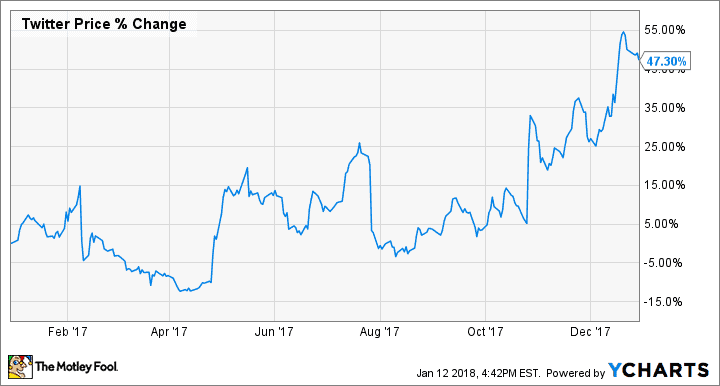
Shares of Twitter, Inc. (NYSE:TWTR) bounced back in 2017 as the company’s turnaround seemed to come into focus and yield results, especially toward the end of the year. According to data from S&P Global Market Intelligence, the stock finished 2017 up 47%.

As the chart below shows, the stock moved up and down several times, but surged toward the end of the year on hopes for its first GAAP profit.

So what

Twitter limped into 2017, trading near all-time lows, as the stock has been a huge disappointment since its 2013 IPO. However, the company got a gift toward the end of 2016 — the election of Donald Trump. As president, Trump has relied on Twitter as a direct line of communication to Americans, exemplifying the utility of the platform and drawing an audience and added engagement to the medium.

A young woman lying in bed holding her smartphone

Despite that assist, Twitter stock still drooped during the first months of the year. Shares plunged in February as the company posted disappointing fourth-quarter results, with revenue growing just 1%, to $717 million, significantly missing estimates at $740 million. Ad spending continued to lag audience growth.

However, its encore performance was stronger, as shares jumped more than 25% over a weeklong span after it turned in its first-quarter results in late April. Twitter reported strong daily average user growth (DAU), saying that DAUs were up 14% year over year, and that they had accelerated in every quarter for the last year.

The stock then gave back much of those gains in its second quarter, as shares fell 14%, when the company said monthly average user growth was flat from the previous quarter. However, the stock surged after an impressive third-quarter report in October, when management predicted it would generate its first GAAP profit ever in the upcoming fourth quarter. User engagement growth was also strong as it has been throughout the year. A pair of upgrades sent the stock higher in December.

Now what

Twitter is clearly getting better, as the company has jettisoned unnecessary products and worked to improve engagement. It’s also benefited from increased interest in the news cycle, as have newspapers, which saw a spike in subscriptions following the election.

Going into 2018, the company looks set to reach GAAP profitability for the first time, but there are still issues to fix — like falling cost per engagement and declining revenue. While Twitter is far from a sure thing at this point, the stock certainly earned its gains last year.

New water treatment plant ‘definitely coming’ for Potlotek First Nation after years of brown water

‘We’ve been waiting 40 years for this,’ says Chief Wilbert Marshall

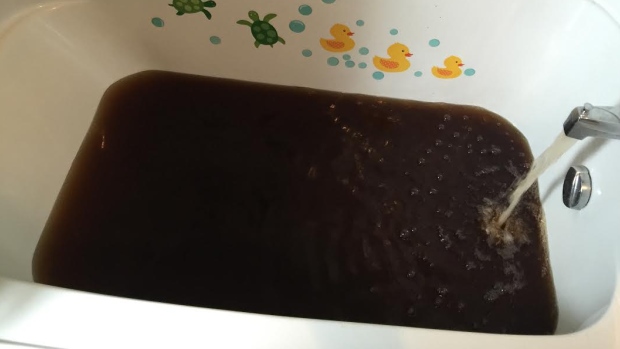
Tub water in Patricia Paul’s house in Potlotek First Nation, N.S.

The Mi’kmaq community of Potlotek in Nova Scotia has signed documents to begin construction on a new water treatment facility after decades of dealing with brown, smelly water, unfit for drinking.

Since December 2013, Health Canada issued boil water advisories for Potlotek for a total of 539 days, and do-not-consume orders for 79 days, a spokesperson for Indigenous and Northern Affairs Canada told CBC News.

INAC added that the boil water notices were “precautionary and not as a result of unsafe drinking water.”

But most in the community rarely use the water anyway, says Potlotek member Bernadette Marshall, and it’s been like that for a long time.

Potlotek resident Bernadette Marshall said her family never drinks the tap water. (Bernadette Marshall)

“We’re so used to it now,” she said.

“When they say ‘boil order,’ we stop using it, but my family never drinks it anyway. We purchase our own water. The hardest thing is washing the clothes, bathing in it. It’s very frustrating for us.”

Water discoloration and staining has been such a common issue that some community members say they only buy dark-coloured clothing — light items tend to stain brown in the washing machine.

Like so many other First Nation communities in Canada, some Mi’kmaq in Potlotek see their lack of access to fresh water as normal.

“It’s something that we hate to live with, but we live with it,” said Marshall.

New plant being designed

The new water treatment plant, which is slated to be built next to the current one, is based around technology and a filtering method that is new to the community.

Potlotek’s director of public works, Quentin Doucette, says it’s now in the design stage and after consultation meetings with the community and its Elders, it’s basically a done deal.

“It means we’re going to have a nice source of water,” said Doucette.

“It’s taken us a long time to get to a point where everyone will be happy.”

Figures from INAC put the facility’s estimated cost at $6 million.

Patricia Paul shows the effects of Potlotek water on laundry.

Doucette said he and engineers plan to find a contractor to build the new plant by June or July of this year. If all goes according to plan, he said it will be finished in the summer of 2019.

For at least the first year of operation of the new system, Doucette said the band’s engineering firm, CBCL Ltd., will be training Potlotek staff and working with them to ensure the system lasts.

Doucette said measures are being put in place to ensure limited disruption of water services throughout the construction process.

As the community will use the existing facilities during that time, he said the band will continue to provide enough bottled water for every individual in the community if more boil water orders should come about.

A fix coming

The announcement is not the first time there’s been hopeful developments on the water system.

Since the community rallied to protest the conditions in 2016, Potlotek council sought consultation from a European water filtration company, and INAC has poured more than $840,000 into the existing facilities for repair — ultimately promising a new system.

Some community members say they’ve been left in the dark, and are frustrated with the lack of progress.

Wilbert Marshall, Chief of Potlotek First Nation, says a new water treatment plant is ‘definitely coming.’

“The paperwork has been signed,” said Potlotek Chief Wilbert Marshall, adding that his community members can be assured the work is finally going ahead.

“We’ve been waiting for this for 40 years. The new plant is definitely coming.”

Marshall said he had “lost all faith” that the federal government was going to help them decades ago. Environmental factors have caused elevated levels of iron and manganese for “as long as he can remember.”

He said a new water system was installed when he was a councillor in 1999, but it wasn’t long before band management realized it was faulty. He said his community was given only “band-aid fixes” from politicians when they asked for assistance.

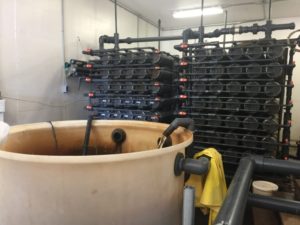
The current Potlotek water treatment plant.

That is, until he had a colourful phone conversation with Minister of Indigenous Services and Prime Minister Justin Trudeau last year.

“I told them we were f–king tired of this shit,” Marshall said with a laugh.

He said he explained the lengthy history of the community’s water woes and that they were “respectful” of his frustration.

“A few weeks later, the money came in to fix it,” he said.

“And now, we’ve got a whole new system coming. It’s exciting.”

Facebook Says Its Putting Friends, Family First

FILE – Balloons are seen in front of a logo at Facebook’s headquarters in London, Dec. 4, 2017.

LAS VEGAS — Facebook on Thursday announced a major update that will put friends and family above pages or celebrities in a user’s news feed — and likely result in people spending less time on the leading social network.

The change to the way Facebook ranks posts will put more weight on social interactions and relationships, according to News Feed product manager John Hegeman.

“This is a big change,” Hegeman said.

People more important

“People will actually spend less time on Facebook, but we feel good about that because it will make the time they do spend more valuable, and be good for our business in the end.”

For example, a family video clip posted by a spouse will be deemed more worthy of attention than a snippet from a star or favorite restaurant.

“We think people interaction is more important than passively consuming content,” Hegeman said. “This will be one of the more important updates that we have made.”

Facebook co-founder and chief Mark Zuckerberg has said that bringing people together and strengthening communities in the real world are priorities.

Update coming soon

The news feed ranking update, which is set to roll out globally in the coming weeks, is expected to support that goal.

“As we roll this out, you’ll see less public content like posts from businesses, brands, and media,” Zuckerberg said in a post at his Facebook page.

“And the public content you see more will be held to the same standard — it should encourage meaningful interactions between people.”

Battling fake news

Google, Twitter and Facebook have come under fire for allowing the spread of bogus news — some of which was directed by Russia — ahead of the 2016 US election and in other countries.

Facebook has introduced a series of changes intended to address the problem.

“We are doing a ton of work to reduce the frequency of bad content on Facebook,” Hegeman said.

“This update is more about amplifying the things people value.”

He cited academic research indicating that interacting with loved ones is crucial to a person’s wellbeing, while reading news articles or watching shared videos may not be.

“There is really no silver bullet here to determine what is most meaningful, but we are trying to mine the signals to get the best representation that we can,” Hegeman said.

Fix Facebook

Known for setting annual personal goals ranging from killing his own food to learning Mandarin, Zuckerberg’s stated mission for this year is to “fix” the social network, including by targeting abuse and hate, and making sure visiting Facebook is time well spent.

“I’m changing the goal I give our product teams from focusing on helping you find relevant content to helping you have more meaningful social interactions,” Zuckerberg said Thursday.

Jeff Bezos Contributes $33M to ‘Dreamers’ Scholarship Program

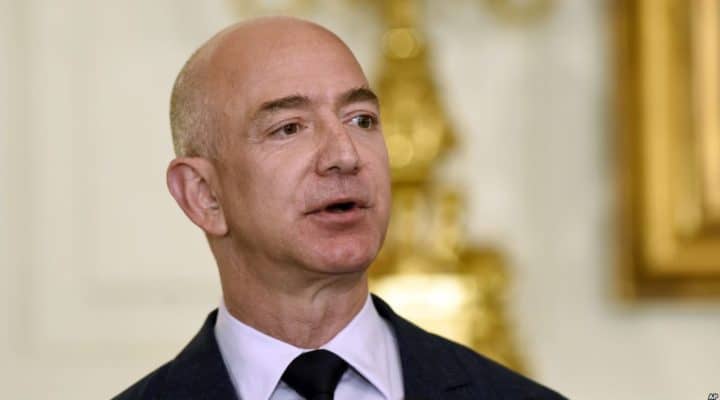
Jeff Bezos, the founder and CEO of Amazon.com, speaks in the State Dining Room of the White House in Washington, May 5, 2016.

Scholarship program TheDream.US said on Friday it had received a $33 million donation from Amazon.com Inc Chief Executive Jeff Bezos and his wife MacKenzie Bezos to fund 1,000 college scholarships.

The scholarship program will fund U.S. high school graduates with a Deferred Action for Childhood Arrivals (DACA) status, an Obama-era program protecting young immigrants brought to the United States illegally by their parents — commonly known as Dreamers.

U.S. President Donald Trump on Wednesday blasted the federal court system as “broken and unfair” after a judge blocked his administration’s move to end the DACA program.

2,850 students are currently enrolled in different colleges as part of TheDream.US scholarship, which covers the cost of tuition, fees and books.

Bezos’ parents, Mike and Jackie Bezos, were among the early donors to TheDream.US. The Bill and Melinda Gates Foundation, Pershing Square Foundation and Chan Zuckerberg Initiative are also among the other major contributers to the program.

No steering wheel? No problem. GM seeks approval for latest self-driving car

Would you get in a self-driving car that has no steering wheel and no pedals? General Motors thinks so.

Would you get in a self-driving car that has no steering wheel and no pedals? General Motors thinks so, and wants to test its newest autonomous-driving vehicle on public roads and highways starting in 2019.

“When you see this image for the first time it’s quite striking,” said Dan Ammann, president of GM.

“That’s why we believe this is a notable moment on the journey to full AV (autonomous vehicle) deployment.”

The automaker has petitioned the federal government for approval to adjust 16 motor vehicle standards so it can test cars that have no steering wheel, pedals and other driver controls.

If regulators in Washington approve, GM plans to test up to 2,500 of these modified Chevy Bolts on public roads in at least seven states.

The move comes as Waymo, formerly known as the Google Self-Driving Car Project, prepares to launch a ride-hailing program outside of Phoenix using driverless Chrysler Pacifica Minivans.

Those vehicles have been modified with sensors, cameras and radar equipment so the minivans can operate without a driver.

Unlike, General Motors, Waymo has not petitioned the federal government to allow it to test vehicles without steering wheels and pedals.

Last year, Ford said it plans to develop self-driving vehicles without steering wheels, though those vehicles are not expected to be ready until 2021.

Freeing up another seat

So why would GM want self-driving cars without a steering wheel and pedals? Mainly because the equipment frees up space and weight in vehicles that will be the heart of an autonomous vehicle ride-hailing program. Since there will not be a driver in the cars, GM is taking the next logical step of removing the steering wheel and pedals, freeing up another seat for a passenger.

What happens if there is an emergency or the car is not moving to the side of the road when it should? Each of the new steering-wheel free Chevy Bolts feature an emergency stop button passengers can press if they need to stop the car.

Ammann understands some riders will be curious the first time they see these cars, but he’s confident they will ultimately be embraced.

“We think people will look at that (car) and think it’s a pretty important development,” said Ammann.