Archives for December 8, 2019

Weekly Market Review – December 7, 2019

Stock Markets

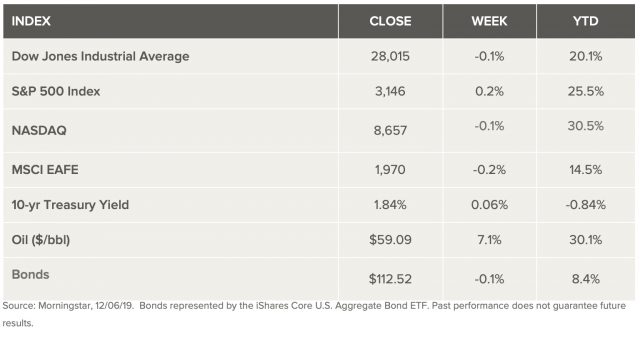
While it was trade-deals that were expected to drive the markets last week, the limelight moved quickly to economic fundamentals, which drove global stocks higher. It appears that international stocks outperformed domestic ones based on the fourth straight month of improvement in global manufacturing PMI, which is seen as a reflection of global growth. Data seems consistent with an improving demand climate. This seems to indicate that the manufacturing downcycle may over, for now. The U.S. jobs report was astounding and set off U.S. stocks best daily gain in over a month. The report showed strong job gains, rising wages, and a return to a 50-year-low unemployment rate. The attention of Trump’s economy has created a seven-month high in consumer sentiment, solidifying the fact that the U.S. economy is on course to finish 2019 on a high note.

U.S. Economy

For the first week of December, the U.S. economic news set an optimistic case for December and a bull market that will continue to year end and beyond. Stocks rose 0.9% on Friday on the solid news. Compared with the first week of December 2018, things were a real step up. Last year stocks slumped based on a yield curve inversion that worried investors with talk of recession. Last year too, the November jobs market missed expectations, and trade negotiations, were bogged down. This week has ended up being completely different from that period. With recession fears in the far distance and trade battles making headway, there is reason for real optimism ahead, albeit a cautious outlook.

Metals and Mining

Gold prices softened on Friday as increased hopes of reaching a phase one and broader US-China deal increased investors’ appetite for riskier assets. A very strong US jobs data report also took its toll on gold.  President Donald Trump said in the week that talks with China were making progress, indicating they may be nearing a deal and that there may be a potential end to the trade war. During 2019, gold has been supported largely by the trade war, helping the safe haven metal gain over 14 percent in that period. Gold was also hurt this week by the robust US jobs data report released earlier Friday. The report revealed that US job growth increased the most in the last 10 months in November. That put to rest investor fears that the economy may be headed for a major downturn. The better-than-expected jobs report took the favor out of demand for safe haven products such as gold, analysts said. Silver was also held back, dropping over 1 percent during Friday morning. Silver slid as its safe haven appeal declined too, but those were losses were capped by investors waiting to hear the upcoming Fed meeting. Overall, silver is up 9.7 percent on a year-to-date basis. In other precious metals, platinum was flat at the end of the trading week. Once again analysts at FocusEconomics believe that platinum prices are likely to pick up based on a fall in global supply. Palladium on the other hand was the leading precious metal with a large enough increase to hit US$1,880.37 per ounce for the first time. Palladium has gained over 40 percent since the beginning of 2019. Its large gains can be traced to stricter environmental regulations around car emissions. Air quality rules in line with cutting pollution have prompted automakers to increase the amount of palladium used in catalytic converters. As demand increases from the automotive sector, supply shortfalls are beginning to appear. That creates a spot price a boost on the market for palladium.

Energy and Oil

Oil jumped this week thanks to news from Vienna. It appears OPEC+ has agreed to cut 500,000 bpd more than the current arrangement, which raised some questions. However, Saudi officials are reported as saying they would maintain their unilateral cuts beyond what is required in order to defend oil prices. Global markets responded immediately with a bounce. OPEC+ agrees to keep the cuts until March. At the same time Saudi Arabia promises to maintain unilateral cuts that they say voluntarily take out 400,000 barrels a day. The news from Saudi Energy Minister Prince Abdulaziz bin Salman sent oil prices much higher. On the domestic front, the U.S. has become a net petroleum exporter. In September, the U.S. exported 89,000 barrels of crude and petroleum products, the first month since 1973 that its overall petroleum balance was net positive. In comparison, the U.S. was importing 10 million barrels per day on a net basis just a decade ago.  Natural gas spot prices fell at most locations this week. The Henry Hub spot price rose from $2.33 per million British thermal units (MMBtu) last week to $2.37/MMBtu this week. At the New York Mercantile Exchange (Nymex), the December 2019 contract expired November 26 at $2.470/MMBtu. The price of the January 2020 contract decreased 10¢, from $2.501/MMBtu last week to $2.399/MMBtu this week. The price of the 12-month strip averaging January 2020 through December 2020 futures contracts declined 7¢/MMBtu to $2.333/MMBtu.

World Markets

In Europe, stocks basically ended the week flat. This after retracing earlier losses set off by fears that a U.S.-China trade deal might be delayed even further – possibly until after the U.S. 2020 election. Stocks increased Friday after President Trump added reassurance that trade talks were “moving right along.” The stronger-than-expected U.S. jobs report really eased market fears of a global economic slowdown. The pan-European STOXX Europe 600 Index ended the week flat, Germany’s DAX index fell 0.5%, and the UK’s FTSE 100 Index dropped 1.6%. UK stocks tend to decline when the pound rises because many index companies are multinationals with overseas revenues. In Britain, the pound headed to a seven-month peak against the U.S. dollar and the euro. That marks its highest level yet under Prime Minister Boris Johnson. That speaks directly to Johnson’s popularity, especially in polls for the UK election. Analysts caution that even a 10% poll lead may not extrapolate as expected. Tactical voting—where voters support a candidate other than their first choice in order avert an undesirable outcome—as well as a surge in new voter registrations are making the election more difficult to predict.

China saw its stocks advance, snapping the last three straight weeks of losses. Apparently, investors felt that an interim U.S.-China trade deal is getting close. For the week, the benchmark Shanghai Composite Index rose 1.4%, and the large-cap CSI 300 Index added 1.9%. Friday added the largest weekly gains for both indexes since the week of October 11. China said it has started to waive retaliatory tariffs on U.S. pork and soy imports by domestic companies on Friday. The Chinese Finance Ministry is reported to be working to waive the tariffs resulting from the trade war after domestic companies bought a certain amount of U.S. farm products. That statement led traders to further support the notion that the U.S. and China were drawing closer to a phase one trade deal that is expected to create the groundwork for a broad, full scope agreement.

The Week Ahead

There are several Important economic data points emerging in the week including the NFIB small business optimism index, consumer inflation, unit labor costs and November retail sales. In what is expected to be an uneventful announcement, the Federal Reserve will release its policy rate on Wednesday. The rate is widely predicted to remain unchanged.

Key Topics to Watch

  • NFIB small-business index
  • Productivity revision
  • Unit labor costs revision
  • Consumer price index
  • Core CPI
  • Federal budget
  • FOMC announcement
  • Weekly jobless claims
  • Producer price index
  • Retail sales
  • Retail sales ex-autos
  • Import prices ex-fuels
  • Business inventories

Markets Index Wrap Up
Readers weigh in on what makes the OnePlus 7 Pro a worthy contender

User reviewers tell us how OnePlus’ latest flagship fares against more expensive phones.

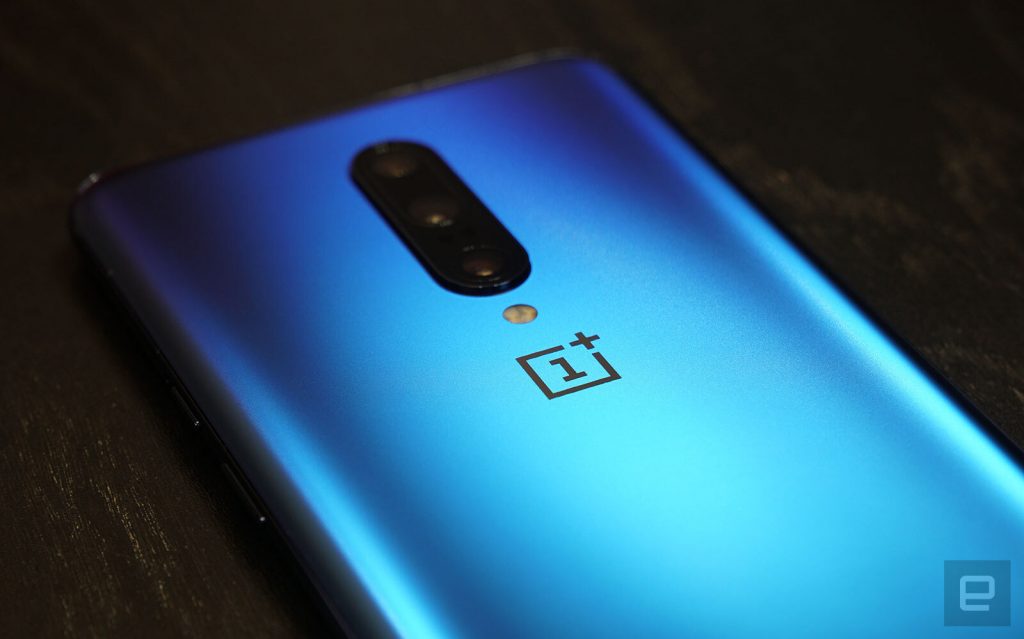
With the release of the 7 Pro, OnePlus showed it learned from the mistakes on the 6T: The company kept everything that users loved about the previous model while addressing its most glaring issues. Senior Editor Richard Lai was pleased to see that the dewdrop notch of the 6T had been replaced by a pop-up front camera; that the fussy fingerprint reader had become faster and more responsive; and that the 7 Pro maintained a sleek design with ambitious features. But was it enough to satisfy those who actually bought it? Here’s what our user reviewers had to say about their experiences with the $549 device.

Specs

Richard was pleasantly surprised that the 7 Pro was one of the first non-Samsung smartphones to feature a Snapdragon 855 chip. Alain was also happy about the phone’s performance. “It’s FAST,” he wrote (emphasis his). “I’ve thrown all the apps I can think of at it, and it just doesn’t skip a beat.” Ben found the 12GB of RAM and 256GB of storage much more noteworthy, declaring the specs here “unbelievable for the price (in the US unlocked version).”

OnePlus 7 Pro

Build

The phone’s design also appealed to Richard, who said the 7 Pro featured the same excellent build quality as its predecessors. He was particularly enamored with the frosted glass back and weightier feel. Alain mostly agreed with him but added that it “is heavy and a very big phone.” And while Alain was glad to see the dual SIM slot, he was let down by the lack of an SD card reader and headphone jack, but allowed that “you can’t get everything, I guess.”

The screen — a 6.67-inch curved fluid AMOLED panel that Richard called a “selling point” — also won praise from two of our user reviewers, Rad and Alain. Rad said they loved the notcheless screen and amazing display, while Alain called the screen “high, vibrant, smooth, bright … the best screen on any phone, period.” However, Ben said that when he compared it to his friend’s Samsung Note 10+ “it feels pretty much the same” and that “all the 90Hz really does is drain battery life.”

OnePlus 7 Pro

Fingerprint reader

OnePlus claims to have improved on the fingerprint reader used in the 6T. Indeed, Richard noted the sensor on the 7 Pro was much faster than before, and speedy enough to beat out the one used in the Huawei P30 Pro. Here two users weighed in: Alain who said the upgraded reader was “blazing fast and very VERY accurate,” and Twidget1995 who said the sensor is “the biggest issue I have with this phone. If your fingers are cold, wet or sweaty it won’t read the print.”

Battery life

Richard managed over 12 hours of battery life off the 7 Pro’s 4,000mAh battery, and was particularly satisfied by the 30W Warp Charge adapter, which took only an hour to fully rejuice the phone. Alain had a similar experience, saying it “easily lasts me 1.5 to two days of regular to heavy use.” Conversely, Ben felt the battery life “straight up just isn’t as long-lasting as my previous OnePlus phones.” He added: “The screen drains pretty quickly. I’m at about 20 percent after work, even when I feel like I haven’t used it much.” But he allowed that “Warp Charge is fast, which might make up for it. And the battery saver mode really, really extends time. I can hit 15 percent and last another eight hours through the night.”

OnePlus 7 Pro

Camera

Richard found that the 7 Pro “handles HDR shots much better than the 6T” and “produced a more accurate white balance while tightening highlights and shadows.” Across the board, our user reviewers were excited about shots they took with the 7 Pro. Alain, a self-described professional photographer, said all the photos he’s taken look amazing and “on occasion, look better than those of the P30.” Ben, meanwhile, often has his iPhone-toting friends asking him to use his 7 Pro camera “because it’s so clear.” The only drawback for Ben was the pop-up camera feature, which he admitted can be “kind of annoying sometimes. You open Snapchat and it pops up, even if you aren’t in camera mode.”

Software

The 7 Pro runs on Oxygen OS, which is based off of Android 9 Pie. According to Richard, navigation was smooth and speedy. Ben said he liked it as well “because it is basically stock Android plus a few needed features (things I used to get from ROMs back in the day, but now I don’t feel the need to do anything custom when it comes to the OS).” But Ben also admitted that there are “a fair amount of lags and frozen points that disappoint me. I’m looking forward to when the stable fix is sent OTA to me, so it will be updated an extra fast.” And although Alain was happy with the software, calling it a “clean and useful software with NO bloatware and a few genuinely useful add-ons”, Geo241 said they had experienced constant — and frustrating — issues connecting to their car, a Tesla Model 3, over Bluetooth.

OnePlus 7 Pro

Overall

In the end, Richard said it was “hard to find major faults” with the 7 Pro and that the company had “packed in advanced components to help it stand among, if not stand out against, all the other flagship smartphones.” He awarded the handset an impressive score of 91.

User reviewers sounded likewise contented with the smartphone: Ben said he would “recommend it to friends if they like stock Android, if they like big phones and if they want to spend less than a Samsung flagship costs. It’s still a killer deal.” Alain said he was “really satisfied with this phone” and that for him, “this is THE PHONE of 2019, especially because it’s cheaper than all the other flagships.” Nathan exclaimed: “I love my Oneplus 7 Pro! My OnePlus 6T is a good phone but the 7 Pro is great.” And Rad said “thus far, this is my favorite phone I have ever owned.” Despite the praise, the average score awarded to the 7 Pro by user reviewers was six points lower than ours: 85 out of 100.

OnePlus may return to low-cost phones with the 8 Lite

You may have to settle, if just a little bit.

OnePlus might be returning to truly low-cost phones years after the OnePlus X faded away. OnLeaks and 91Mobiles have posted renders and early tidbits of what they say is the OnePlus 8 Lite, a budget model that would sit below the rumored OnePlus 8 and OnePlus 8 Pro. Not surprisingly, this phone would scale back to ‘just’ two cameras on the back versus three on other variants (though there appears to be a depth sensor), and it wouldn’t have flashy features like a curved display. Given the name, we’d also expect a lower-cost processor and other sacrifices.

However, there are signs that you might not have to compromise too much. It would have a hole-punch front camera as expected with other OnePlus 8 models, and the lack of an obvious fingerprint reader suggests the Lite would use under-screen tech like existing models. This more affordable model might still have a 6.4- or 6.5-inch screen, too, although we wouldn’t count on a silky-smooth 90Hz OLED panel.

It’s not certain whether this would launch alongside the rest of the 8 series, assuming the rumor is accurate in the first place. With that said, we wouldn’t be shocked if there was an 8 Lite. It’s no secret that OnePlus’ pricing has creeped upward over the years, to the point where you’re paying nearly $700 for a flagship like the 7 Pro. The 8 Lite could fill the gap for those customers who miss OnePlus’ early days of bargain-basement prices, or just those who like OnePlus’ software but can’t justify the outlay for its higher-end hardware.

Porsche tests a four-motor powertrain for electric SUVs

Just which SUV gets it first is another story.

Porsche’s follow-ups to the Taycan may make its powerplants seem conservative by comparison. The Stuttgart crew has revealed that it’s working on a four-motor powertrain for electric SUVs, twice as many as what you’ll find in the Taycan. This isn’t about improving quarter mile times, though. Instead, the design is focused on control — one motor for each wheel lets Porsche rapidly shift the power distribution based on where it’s needed, whether it’s to counteract slippery roads or take corners at high speed. You could have the “agility of a sports car” in a large people carrier, the company claimed.

The technology doesn’t need additional sensors, and the software control can redistribute power “within milliseconds” instead of the relatively pokey limited-slip differential found in gas cars. Porsche said it has been testing the system over the course of two winters.

There’s one, overriding question: which model gets a four-motor system first? Porsche has already confirmed that a Macan EV is in the works, but it’s also a crossover aimed at the (relatively) entry level crowd. It wouldn’t be surprising if the company instead focused on larger SUVs, whether it’s an EV variant of the Cayenne or a completely new design. Whichever model gets first dibs, it might make a convincing case for electric SUVs by providing all-weather abilities that just aren’t available for combustion-powered vehicles.

Apple’s redesigned Mac Pro will be available to order December 10th

There are still plenty of unknowns about configurations, however.

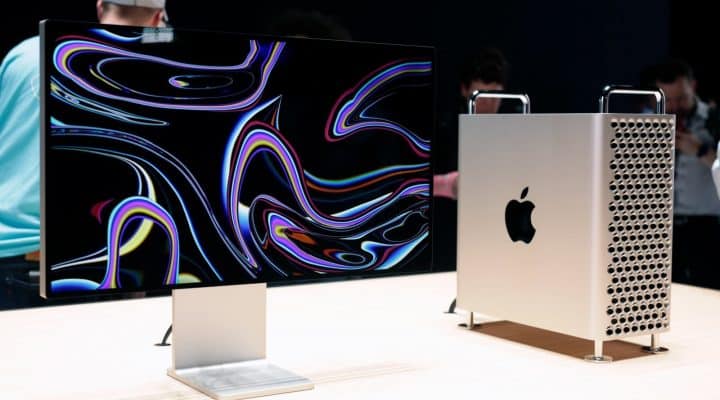
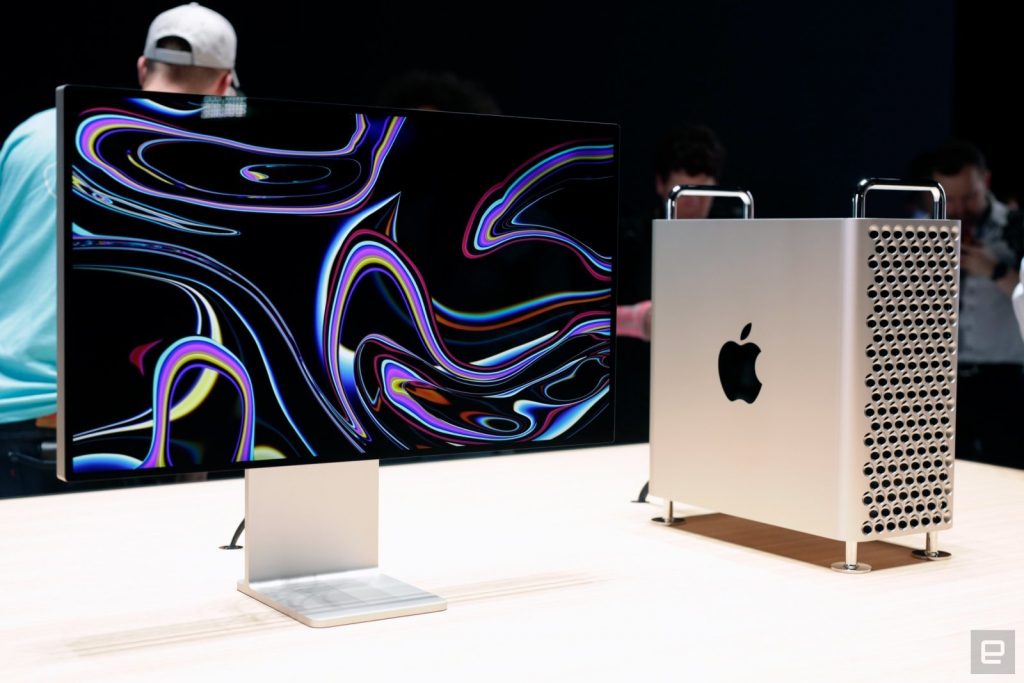
After half a year — or two years, if you really think about it — Apple’s reworked Mac Pro is close at hand. The company has notified interested customers that both the workstation and the Pro Display XDR will be available to order on December 10th. There’s still a lot Apple hasn’t said about the possible configurations and their respective pricing, but you can still expect the base system to sell for $5,999 with an eight-core Xeon, 32GB of RAM, a 256GB SSD and Radeon Pro 580X graphics. Expect those costs to spiral upward if you need a heavy-duty machine, especially if you intend to make the most of that 1.5TB RAM ceiling. At least you can add memory and storage yourself.

The Pro Display XDR is easier to figure out. It’ll start at $4,999 for a standard model, and $5,999 with nano-texture glass that reduces glare without resorting to a coating. And yes, that infamous stand will set you back $999 if the $199 VESA mount doesn’t do the trick. This is a professional display meant for people who would otherwise spring for a reference monitor in the five-digit range, and they’re likely the sort of person whose computer budget makes a pricey stand seem trivial. Like, say, a superstar DJ.

The IRS has a new tax form out and wants to know about your cryptocurrency

Tax season is still months away, but the IRS will want to know about your cryptocurrency holdings.

The IRS just released a new Schedule 1 for the 2019 tax season, spelling out the details on above-the-line deductions, including the tax break for student loan interest and health savings account contributions.

Eagle-eyed taxpayers will notice that the IRS threw in an extra question on the form: “At any time during 2019, did you receive, sell, send, exchange or otherwise acquire any financial interest in any virtual currency?”

This is the agency’s latest effort to gather additional information on taxpayers’ virtual currency holdings.

“The biggest thing is that the IRS is asking this for a reason, and my question is how much have you increased your audit risk by checking ‘Yes’ in response?” asked Jeffrey Levine, CPA and director of financial planning at BluePrint Wealth Alliance in Garden City, New York.

The inquiry itself is a vague one, experts said.

“As a taxpayer myself, I find this question very frustrating because it isn’t clear,” said Sarah-Jane Morin, partner at Morgan Lewis in San Francisco.

Moving your own virtual currency from one crypto wallet to another, for instance, could be considered “sending,” she said

“The most conservative approach that a taxpayer can take is to consider any interaction you’ve had with virtual currency and whether there’s any way this can fall under this very broad list of what you could’ve engaged in during 2019,” said Morin.

Indeed, the IRS has signaled that it would be taking a closer look at cryptocurrency.

Back in July, the agency announced it was sending letters to more than 10,000 taxpayers with virtual currency transactions who may have failed to report income and pay taxes owed.

Here are the tax basics on cryptocurrency.

Varying tax treatments

If you sold your cryptocurrency, you need to report the transaction. If you wound up with a capital gain, you must pay the appropriate tax.

Cryptocurrency you receive from an employer is subject to federal income tax withholding, FICA tax and federal unemployment taxes, just like wages. These should be reported on your Form W-2, the IRS said.

Meanwhile, independent contractors who are paid in virtual currency must pay self-employment taxes.

For those who mine cryptocurrency, the fair market value of it as of the day of receipt is included in your gross income, according to IRS guidance.

Failure to properly report these transactions can be costly: You may be audited and held liable for penalties and interest.

In the most extreme cases, you could face prison time and a fine of up to $250,000.

“A taxpayer who is investing in virtual currency should have a system for tracking the purchase and selling price of the assets,” said April Walker, lead manager for tax practice and ethics at the American Institute of CPAs.

“For tax purposes, the virtual currency is treated as property, similar to a security,” she said. “Therefore, taxpayers should maintain cost records similar to the way records are kept for stocks and securities, although there will be no monthly statements.”

Following basis

Gathering the data for computing these taxes is easier said than done.

That’s because to calculate what you owe, you’ll need your cost basis — that is, the original value of the asset for tax purposes.

“Back in 2018, the reporting requirements were still catching up to the times,” said Dan Herron, CPA at Elemental Wealth Advisors in San Luis Obispo, California.

“We’d have to go through 50 pages of transactions, throw it into a spreadsheet and figure out what did you buy this for, what did you sell it for,” he said.

If you need to hunt down the cost basis of some long-held stocks and your brokerage firm doesn’t have that information, you could dig up historical prices and dividend payments to figure it out.

The process is less straightforward with cryptocurrency, which any investor can trade on multiple platforms — and the exchange price can differ across platforms. The onus is on the taxpayer to keep track of the cost basis.

Indeed, some providers, such as Lumina and Bitcoin.Tax, have stepped up to aggregate crypto transactions and help calculate cost basis.

“If you’re a trader of bitcoin or other cryptocurrency, you’ll want to invest in some accounting software specific to crypto that will allow you to track transactions,” Levine said.

“Otherwise finding out your basis is going to be a disaster,” he said.