Archives for November 3, 2019

Weekly Market Review – November 2, 2019

Stock Markets

U.S. stocks reached new record highs following the October jobs report which indicated that the economy added more jobs than expected. That is positive despite potential impact from significant events such as the GM worker strike and the loss of temporary U.S. Census jobs. In an expected move, the U.S. Federal Reserve cut interest rates for the third time this year. They followed the announcement which indicated a pause in the lowering of rates in order to react more closely to changing economic tides. The third-quarter GDP estimate slowed last week from 2.0% to 1.9%, but possibly showed that several risks have lessened. Those include the lowering of U.S./China trade tensions, the ongoing uncertainty of the Brexit situation, and manufacturing weakness, which seems to have leveled. Analysts agree that the U.S. economy is pretty solid, supported by the three legs that have been driving growth: a strong labor market, rising corporate earnings, and interest rates that remain in check.

U.S. Economy

The data seems to support that there is still good support fueling the stock market. Most evident is the fact that stock prices rose 1.5% last week and hit a new record high. The rise was supported by what is seen as slowing economic and corporate data that remains positive and still surpassed market expectations. There are four growth trends that appeared in the recent data that should help offset risks from slowing domestic and global growth, as well as trade uncertainty. They will likely keep the bull market in full swing, but also slower than in the previous term.

The trends to watch are:

A healthy labor market supports consumer spending – The economy added 128,000 jobs in October, well above the consensus estimate and stronger than the 100,000 jobs needed to support new entrants into the workforce each month. Average hourly earnings grew by 3% from a year ago, besting consumer-price inflation over the same time period.

GDP growth is slowing but still positive driven by consumers – GDP data released last week showed that the economy grew by an estimated 1.9% in the period from July through September, slightly lower than the 2% pace posted in the previous three months. Consumers continue to show resilience in the face of these concerns.

The Fed monetary policy is well positioned for the bull market – The Federal Reserve delivered on a third straight reduction in benchmark interest rates, reducing the federal funds target to 1.5%-1.75% from 1.75% -2.0%. By stating that monetary policy was “in a good place,” the Federal Reserve chair signaled a pause in future rate cuts to assess the state of the economy.

Positive corporate earnings are supporting growth in share process with added volatility – The corporate sector is also showing earnings growth. Approximately 80% of firms that have reported third-quarter earnings so far have beat analysts’ estimates. Corporate results thus far have also reinforced our view that earnings will continue to grow at a measured pace.

Metals and Mining

Gold prices fell slightly on Friday based on stronger data from China, which pushed investors’ risk tolerance. Market watchers are also awaiting employment data from the US, which should give some perspective on its trade dispute with China and its impact on the US economy. Despite the downtrend, gold has support from trade uncertainties and the recent interest rate cut by the US Fed. Analysts say that shrinking interest rates and ongoing trade war concerns will help prop up gold in the medium to long term. Despite being down at the end of the week, gold was set for a weekly gain. Silver once again followed gold’s direction and dipped slightly. It continues to trade over the US$18 per ounce level. There is strong industry support for silver set against the current political and economic climate. With other precious metals, platinum was relatively flat on Friday, and hung around the US$900 per ounce level. It is trending upward for the most part based on gold’s momentum. Palladium was again the precious metal leader, hitting an all-time high of US$1,824.50 per ounce during Wednesday’s session. Its gains have been largely attributed to stricter environmental regulations surrounding car emissions and the demand that flows from them.

Energy and Oil

On Friday morning oil received a jolt on unexpectedly positive manufacturing data from China and a continued rig count collapse. Neither of these put to rest concerns about an economic slowdown. It appears that economic uncertainty will dominate the oil market narrative, and markets will hinge on the next movements in the ongoing trade war between the U.S. and China.  Brent crude climbed back above $62/barrel in intraday trade toward the end of October, before heading back down again. That was based mostly on growing concerns about weak Chinese industrial growth, following data showing Chinese industrial company profits had fallen for the second month in a row. Earlier data put India’s oil imports in September at three-year lows. India and China have accounted for more than 50% of global oil demand growth over the past decade. Earlier optimism suggests that given the right conditions, oil prices could shrug off the current weakness of a slowing global economy, but it will be an uncertain struggle with some serious bumps along the way. Natural gas spot prices rose at most locations this week. Henry Hub spot prices rose from $2.28 per million British thermal units (MMBtu) last week to $2.67/MMBtu this week. At the New York Mercantile Exchange (Nymex), the November 2019 contract expired at $2.597/MMBtu, up 32¢/MMBtu from last week. The December 2019 contract increased to $2.691/MMBtu, up 26¢/MMBtu from last week to this week. The price of the 12-month strip averaging December 2019 through November 2020 futures contracts climbed 14¢/MMBtu to $2.498/MMBtu.

World Markets

European stocks hit a 22-month high after the EU granted a Brexit extension. Highs were also supported by encouraging Chinese manufacturing data, and strong asset inflows into the region. The pan-European STOXX Europe 600 Index hit a 22-month high Monday and rose for the week. The German DAX and Italy’s FTSE MIB Index also gained, while the UK’s FTSE 100 Index dropped. Following UK Prime Minister Boris Johnson winning backing for a December 12 general election, the country headed immediately into election campaigning. Thanks to the plan, the UK will now have the ability to leave the bloc if the UK and the EU ratify the withdrawal deal that Johnson agreed to in October.

In China, stocks showed a strong weekly gain as positive earnings from mainland companies and data showing an upswing in private manufacturing activity helped dispel concerns about U.S.-China trade battles. The benchmark Shanghai Composite Index edged up 0.1%, and the large-cap CSI 300 Index rose 1.4% on the week. The Caixin/Markit manufacturing purchasing managers’ index (PMI) unexpectedly rose to 51.7 in October – its best reading since February 2017. The strong showing for the influential Caixin PMI survey, which tracks roughly 500 private factories, helped to support the positive condition of China’s economy despite the impact of U.S. tariffs. However, other data on the week made it clear that U.S. tariffs have had a toll the country’s manufacturing sector. China’s official factory activity gauge, the manufacturing PMI, fell to an eight-month low of 49.3 in October—the sixth straight month the index has stayed below 50. China’s economy grew below its forecast 6.0% in the third quarter. That is China’s slowest growth pace since 1992.

The Week Ahead

A number of important economic data points will be released this week including durable goods, the services Purchasing Manager’s Index, ISM manufacturing, weekly jobless claim, consumer sentiment index and the University of Michigan’s consumer sentiment this Friday.

Key Topics to Watch

  • Factory orders
  • Trade deficit
  • Markit services PMI
  • ISM non-manufacturing index
  • Job openings
  • Productivity
  • Unit labor costs
  • Weekly jobless claims
  • Consumer credit
  • Consumer sentiment index
  • Wholesale inventories

Markets Index Wrap Up

The 1 Reason to Claim Social Security at 62 That No One Ever Talks About

For many Americans, taking Social Security benefits at 62 is less of a choice and more of a necessity. A huge fraction of Social Security participants rely on the program for the majority of their income, and for some, their Social Security check is just about the only income they can count on month in and month out.

However, those who’ve managed to save up a healthy nest egg for retirement have more options. For them, delaying Social Security can be attractive, as it allows them to get larger monthly benefits later on, and in some cases pass those higher checks on to their loved ones in the form of survivor benefits. Yet there’s a choice that very few Social Security experts talk about — taking Social Security at 62 even if you don’t really need it, and investing your monthly benefits to generate additional returns.

The flaw in most Social Security analysis

Traditionally, most people looking at Social Security concentrate on the total amount of money they’re likely to get over the course of their lifetime. That’s in part because Social Security itself has argued that its benefit formula is designed to pay out roughly the same regardless of when you claim benefits — assuming that you live to roughly your actuarial life expectancy.

This approach has spawned breakeven analysis, which looks more closely at the impact of when you claim benefits. In general, if you just look at total dollars paid after adjusting for inflation, traditional breakeven analysis concludes that living through your late 70s or early 80s is the typical time at which delaying benefits starts to pay off. Here’s an example, based on someone who had earned a typical benefit of $1,400 per month at full retirement age of 66 1/2:

Graph with three lines reflecting lifetime Social Security payouts

You can see that the lines start to cross each other somewhere between 79 and 82.

But the problem with traditional breakeven analysis is that it doesn’t reflect the time value of money. That might not matter so much for the many retirees who need to spend their Social Security as soon as they get it. For those who can invest their benefit checks, however, the time value of money makes a huge difference, because investing early benefit checks provides a longer time horizon for investment growth.

What a difference a positive return makes

Even modest return assumptions can make a marked difference in your analysis of when to claim Social Security. Say, for instance, that you were ultraconservative and wanted to put your money in bank CDs. Right now, you could get long-term CDs paying around 2% in annual interest. If you do that, here’s what happens to the graph above:

Graph with three lines reflecting lifetime Social Security payouts assuming 2% return

As you can see, the breakeven dates move out a little bit, with the earliest coming at around age 81 and the latest coming around 84.

Put in more ambitious return goals, and things get even more exciting. Here’s the graph for a 7% annual return:

Graph of lifetime Social Security payouts assuming 7% return

The lines start to converge, but even at age 100, they haven’t yet touched. Claiming early gives you a sustained lead, and claiming later never catches up.

Some caveats to consider

The graphs above might convince you that claiming early is always the way to go. But there are many more factors to take into account, including these:

  • The graphs above make the unrealistic assumption that returns will be smooth and consistent. In the real world, markets are often volatile, and an ill-timed bear market can make this analysis look a lot different.
  • Taxation of Social Security benefits and forfeiture due to working before reaching full retirement age can reduce what you actually receive if you claim early, bringing that line in the graph down.
  • If a spouse or children will collect survivor benefits on your work record after your death, then the overall impact can be different.

Yet for those who do have the financial resources to invest their Social Security, considering the time value of money is a worthwhile exercise. You might not end up changing your claiming decision because of it. But in some cases, it can make a big different in your overall financial well-being in retirement.

Don’t miss the tax advantages of this savings account

As you choose your benefits for 2020, don’t overlook a key saving account that could beat your 401(k) plan — at least in terms of taxes.

This year, nearly 3 in 10 employers that offer workplace benefits provided a high-deductible health insurance plan along with a tax-advantaged savings account, according to data from the Kaiser Family Foundation.

These health savings accounts come with three main tax benefits: You can contribute to them on a pretax or tax-deductible basis, and your savings grow free of taxes over time. You can also make tax-free withdrawals to cover qualified medical expenses.

There’s a fourth less well-known tax advantage: Contributions you make to your HSA on a pretax basis avoid Social Security and Medicare taxes, often known as FICA (Federal Insurance Contributions Act) taxes.

The same applies to contributions your employer makes to your HSA.

This FICA tax is 15.3% that you share with your employer.

The point is so compelling, it can spur companies to make even larger employer contributions to workers’ HSA accounts, said Aaron Pottichen, senior vice president of Alliant Retirement Consulting in Austin, Texas.

Indeed, in 2018, workers in high-deductible plans with HSAs received an average annual employer contribution of $603 for single coverage and $1,073 for family coverage, according to the Kaiser foundation.

In 2020, you’ll be able to contribute up to $3,550 to your HSA if you have self-only insurance coverage. This amount goes up to $7,100 for family plans

“The communication that we have is that every dollar you spend on your employees goes further because Uncle Sam isn’t digging his hand into it,” Pottichen said.

Know your savings

Consider a married employee who is in the 24% federal income tax bracket and is setting aside $7,000 annually on a pretax basis into his HSA.

This person would save more than $535 annually in Social Security and Medicare taxes alone each year, according to Pete Isberg, vice president of government relations at ADP, a payroll company.

Further, those contributions aren’t subject to federal income taxes, resulting in another $1,680 in annual savings, according to Isberg’s calculations.

This participant would save even more if he or she resides in a state that doesn’t subject HSA contributions to income tax.

See below for Isberg’s example.

Tax savings of an HSA under a ‘cafeteria plan’

• Contribution: $7,000
• Federal Income tax (24% bracket): $1,680
• Social Security (6.2%): $434
• Medicare (1.45%) $101.50
• State Income tax (assume 6%) $420
• Total savings: $2,635.50

If that same participant invested the money that would have otherwise gone to taxes, and it grew at a 3% interest rate, his family would save $30,200 over 10 years, Isberg said.

Remember, companies split the cost of the FICA tax with their workers, so employers’ contributions to HSAs also avoid this levy.

“Employers like health savings accounts because they also save on Social Security and Medicare taxes,” Isberg said.

“In this example, an employer with 100 employees all taking advantage of an HSA under a cafeteria plan may save over $53,500 annually, that would otherwise simply be a tax expense,” he said.

Understand the advantages

The contributions you make to a traditional 401(k) plan aren’t subject to the same tax treatment as your HSA savings.

While 401(k) plan contributions avoid federal income taxes, they still face the FICA tax. When you withdraw money from this retirement account, the distribution is subject to income taxes, plus a 10% penalty if you’re under 59½.

Meanwhile, distributions from an HSA are tax-free if they’re for qualified medical expenses. But if you pull the money out for other reasons, you’ll pay income taxes and a 20% penalty that’s in effect until you’re 65.

“If you know you’re using the money for those medical expenses, the HSA is much more attractive than putting the money in the 401(k),” said Eric Bronnenkant, a CPA and head of tax at Betterment.

You don’t have to choose one account over the other.

Here’s how you can fund both your 401(k) and HSA, according to Debbie Freeman, a CPA and director of financial planning at Peak Financial Advisors in Denver.

  • Save enough to get the 401(k) employer match: This is free money. The most common match formula employers use is 50 cents on each dollar on the first 6% of pay, according to Vanguard.
  • Put away sufficient money in your HSA to hit your deductible: Cash left unused in your HSA rolls over into the future. “In the years you have excess funds or you didn’t have to touch the account, start investing the money,” Freeman said.
  • Optimize extra dollars: Max out your HSA and invest it for the long term. Stash any remaining dollars into your retirement plan.

“You know your contributions are going in and being immediately invested,” Freeman said.

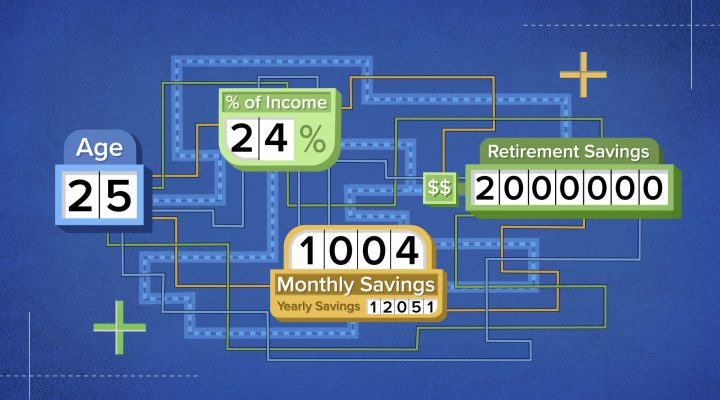
How to save $2 million for retirement if you make $50,000 a year, broken down by age

If you are making $50,000 a year, planning to save $2 million for retirement can seem like an impossible goal. Yet, with some hard work, dedication and a lot of time, you can get there, regardless of your age.

As a rule of thumb, most financial advisors suggest you save 10% to 15% of your salary. But if your goal is to get to $2 million, the percentage you need to invest will vary widely based on how old you are when you start.

NerdWallet crunched the numbers, and we can tell you exactly how much of your $50,000 you’ll need to tuck away to get there.

Just a few things to remember: These numbers assume you have no money in your retirement plan, that you will get a 6% return on your investments and that you will retire at age 65.

The math also does not account for potential pay increases, employer matches, inflation or any curveballs that life may throw at you. So plan accordingly.

Now let’s dive into the figures.

5 Quotes That Will Make You Rethink Your Personal Finances

There’s plenty of financial advice available on the Internet and in books, so it can sometimes be hard to decide which tips to follow.

But sometimes, you’ll read a quote or stumble upon some wisdom that can make you change the way you think about how you handle your financial life. These quotes could be profound or funny, but they stand apart because they lead to a change in perspective.

While these types of quotes may be few and far between, here are five of them that might just change the way you think about money.

Don’t tell me where your priorities are. Show me where you spend your money and I’ll tell you what they are — James W. Frick

Far too many people make budgets they don’t stick to, or claim they want to save for important goals such as retirement but end up spending their entire paychecks without putting a dollar in the bank.

This quote shows the importance of aligning your behavior to what you truly value. If you really care about retiring early or being debt-free, you’ll make the sacrifices necessary to do so. If you instead spend on frivolous things, you’re just showing that your pleasures today are more important than your security tomorrow. 

Wealth consists not in having great possessions, but in having few wants — Epictetus

If you’re constantly trying to keep up with the Joneses, you’re never going to feel you have enough. That’s why you’ll often hear stories of families with incomes in the mid-six-figures who claim to be barely getting by. 

This quote shows the importance of finding joy in the simple things. If you can be happy without the fancy car or the big house, you’ll feel a lot wealthier than someone with a higher income but with greater demands. 

Opportunity is missed by most people because it is dressed in overalls and looks like work — Thomas Edison

Managing money successfully is hard work — it involves sacrifice, saving when you want to spend, and sometimes working more than you’d like to have the money to accomplish all your goals. 

This quote underscores the importance of taking the hard road to financial success, rather than looking for get-rich-quick opportunities or lamenting the fact you’ll never be wealthy because you didn’t make that investment that would have made you rich overnight.

If you work hard and make the right financial decisions throughout your life, you will have the opportunity to build that big nest egg — but you need to seize the chances you have rather than waiting for an easy solution to financial woes. 

A bank is a place that will lend you money if you can prove that you don’t need it — Bob Hope

While this quote is humorous, there’s an important underlying truth to it. It demonstrates how opportunities to build wealth tend to collect around those who already have achieved some measure of financial success.

If you are a responsible borrower and work to build credit, for example, you can qualify for a mortgage or a student loan so you can build your net worth by acquiring an asset or increasing your income. Likewise, if you work hard to invest, you can grow your net worth by buying assets that increase in value. 

If all the economists were laid end to end, they’d never reach a conclusion — George Bernard Shaw

The key lesson within this clever quote: You can’t predict the future, and you shouldn’t try. Economists know this, which is why their advice is often equivocal — and it’s a truism you’re going to have to accept when managing your own money.

Instead of waiting for perfect investments or surefire wins, devise a strategy for investing that you can stick to over time even through unpredictable economic booms and busts. 

Do these quotes change your thinking?

Hopefully some of these quotes have changed your perspective on how you think about your finances. If not, there’s lots of other wisdom out there that might inspire you to look at money in a smarter way so you can use it responsibly to grow your wealth and establish a secure financial future. 

Motorola’s foldable RAZR may have been spotted in the wild

A real-life picture of the ‘flip phone’ with a flexible screen popped up on Weibo.

Yesterday a flurry of leaked photos showed Motorola’s upcoming RAZR posed for press pics, but now a picture has surfaced on China’s Weibo network claiming to show one in the wild. Sunniton posted this picture saying it was the real thing, showing the device fully unfolded, in someone’s hands. The chunky bottom chin is on full display, and what appears to be a notch at the top.

At this point we’ve heard all about its purported $1,500 price, midrange-ish specs and of course, the flexible screen inside that might bring back the classic feeling of snapping a phone closed to end a call. Yesterday’s pictures also showed that the device could be used by touch with it folded closed thanks to controls and a small screen on the outside that’s also useful for taking selfies. With less than two weeks to go before Motorola’s planned press event on November 13th, we can only wait and see what else leaks out before the device is officially revealed.

Motorola RAZR