
Archives for November 3, 2019

Total Energy Services Inc. (TOT:CA) Rises 9.43%

November 01 was a positive day for Total Energy Services Inc. (TOT:CA) as its stock finished the day having gained 9.43% to hit a price of $6.15 a share. The company reached a market cap of 279.43 million and has 45.49 million shares outstanding. Total Energy Services Inc. is a component of the the S&P/TSX SmallCap Index.

22,826 shares changed hands over the course of the day as compared to an average volume of n/a over the last 30 days for Total Energy Services Inc..

Total Energy Services Inc is an Alberta based energy services company. Through its subsidiaries, the operating segments of the company are Contract Drilling Services, Rentals and Transportation Services, Compression and Process Service, Well servicing and Corporate. The company’s operations are conducted within Canada, the U.S. and Australia. It derives a majority of the revenue from the Compression and Process Services segment in which the company fabricates a full range of natural gas compression equipment as well as select oil and natural gas process equipment.. The company makes its home in Calgary, AB, and is currently under the leadership of CEO Daniel Halyk.

Total Energy Services Inc. has hit a high of $11.00 and reached a low of $5.57 over its last year of trading. The stock’s 50-day SMA is now $n/a and 200-day SMA is $n/a. As for its price valuations, the P/E ratio is at n/a and P/B is now 0.51.

The S&P/TSX SmallCap Index tracks over 200 Canadian small-cap stocks for cumulative performance. Relying on market cap weighting to calculate returns, it’s an index similar in composition to the Russell 2000, only focused on Canadian companies and much smaller in terms of its total membership. Widely recognized as the benchmark for small-cap Canadian stocks, the member companies must have a market cap between C$100 million and C$1.5 billion and an average share price of at least C$1.
Power restored in Quebec

Crews restore power for millions in Quebec

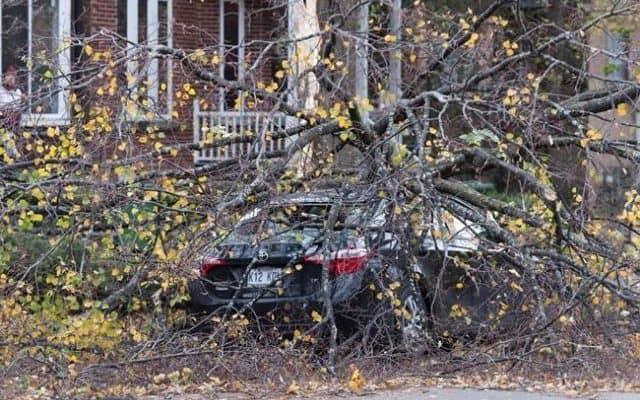
The number of Quebecers without power following Friday’s intense storm dropped steadily throughout the day Saturday, as hundreds of hydro employees worked to repair broken electrical poles and downed power lines across the province.

As of Saturday afternoon, about 340,000 customers were without power, down from a high of almost 1 million the night before, when an autumn storm unleashed heavy rain and punishing winds of up to 100 kilometres an hour across much of southern Quebec.

Quebec Premier Francois Legault said most of the homes and businesses that lost power would likely be reconnected to the grid by Sunday night, but warned that large swaths of the province would continue to be in the dark into next week.

“There are still three regions that are problematic and where we think it could take longer than Sunday,” Legault told reporters, pointing to the Monteregie area around the city of Sherbrooke, the Laurentians and Lanaudiere sectors north of Montreal, and the Beauce region south of Quebec City.

Legault said one person has died as a result of the storm — a 63-year-old man who was struck by a falling tree on Friday morning in Bromont, about 85 kilometres east of Montreal.

“I want to offer all my condolences to the family and friends of the man from Bromont,” Legault said.

Eric Martel, president of Hydro-Quebec, said about 1,000 hydro employees were working to repair 250 hydro poles knocked out during the storm. He said about 300 power lines were downed across the province, and 2,500 loads of branches, trees and other vegetation affecting the distribution system needed to be cleared away.

Hydro-Quebec often sends workers to other provinces and U.S. states to help restore power, Martel noted, saying that now it’s the province’s turn to request assistance. But few workers from outside the province were available, because areas around Quebec were also hit hard by the strong winds and rain.

Still, Martel said, contractors from New Brunswick had arrived to help, and 40 teams from Detroit were expected to arrive on Saturday afternoon and be ready to work by Sunday.

“We are putting in all the effort to bring the situation back to normal as quickly as possible,” Martel said. “The good news is that by (Sunday night) we should have covered the majority of the blackouts.”

Heavy rain also brought flooding to southern parts of the province, but Public Security Minister Genevieve Guilbault said earlier Saturday she didn’t know exactly how many people were forced from their homes because local authorities hadn’t updated their figures.

Around 250 homes and businesses were evacuated on Friday in Sherbrooke, and about 30 roads were flooded in the region. The city said Saturday afternoon that the water levels of the St-Francois River had receded and people had begun returning home.

About one million people were without power at the height of the blackouts, the highest number since the 1998 ice storm left 1.4 million homes and business in the dark. But unlike in 1998, when transmission lines collapsed, the hydro utility said the main network was not affected this time.

Meanwhile, in New Brunswick, about 6,000 customers were still without power on Saturday afternoon after the same storm system that hit Quebec made its was east. About 52,000 customers were affected at the peak of the outage during Friday’s storm.

According to estimates on the utility’s website, electricity was expected to be restored in most areas by late Saturday evening.

Power had also been largely restored across Nova Scotia and Prince Edward Island Saturday, where outage numbers were much lower than in New Brunswick.

Insurance broker suspended over ICBC bridge toll debt avoidance scheme

Insurance council was ordered to issue suspensions to reflect severity of conduct by licensees

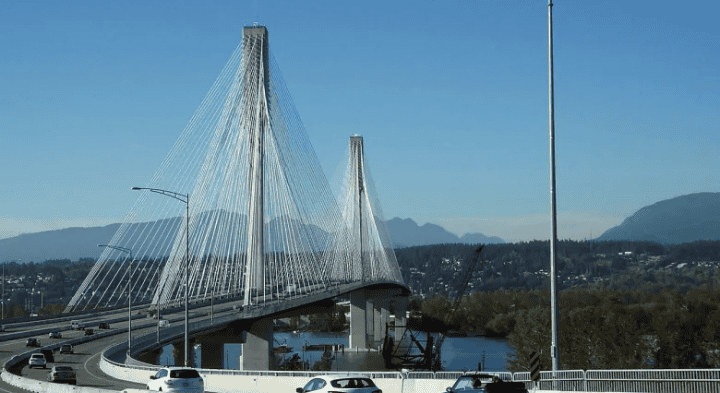
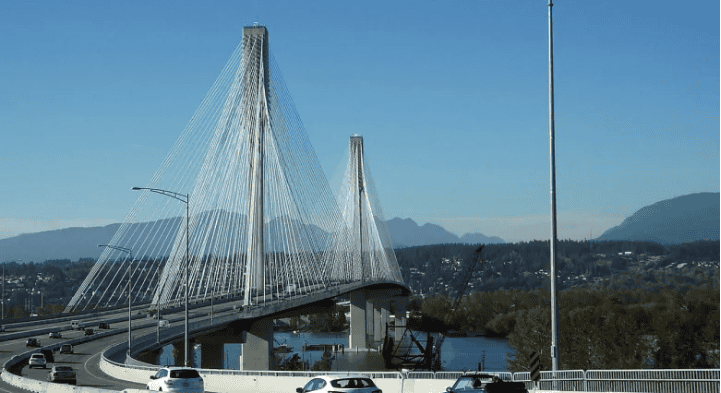
A Lower Mainland insurance broker has been handed an eight-month licence suspension for entering fake information in order to bypass outstanding debts for the tolls drivers once had to pay to cross the Golden Ears and Port Mann bridges.

Although the province stopped collecting tolls for the bridges in September 2017, the ramifications of an ICBC investigation into widespread dishonesty by more than 100 insurance brokers are still being felt within the industry.

The Insurance Council of B.C. suspended Jugjit Singh Sumra last month until mid-June 2020 after a hearing which included evidence from an officer with the special investigations unit that uncovered the scheme in 2015.

Sumra was accused of entering false receipts needed to override outstanding toll debts between 20 and 30 times. The officer also claimed that the licensee admitted to overriding his own toll debt on one occasion.

Failure to protect public interest

Sumra is one of eight brokers suspended in recent months after B.C.’s Financial Services Tribunal ordered the Insurance Council — which regulates the industry — to suspend licensees instead of fining them.

The other seven brokers were all initially given $5,000 penalties.

The province stopped collecting money for crossing the Golden Ears Bridge in 2017. But unpaid tolls could cause a massive headache for insurance renewal. 

But the Financial Services Tribunal said that wasn’t tough enough to reflect activity that involved lying and spoke directly to the trustworthiness of brokers — finding the regulator “failed to reasonably protect the public interest.”

The scheme came to light in 2015 after ICBC became aware that some licensees had been entering false information relating to the bridge toll debts in order to help customers renew their insurance.

Prior to the elimination of the tolls, customers were billed for crossing the bridges by administrators charged with collecting the tolls.

Customers who owed more than $25 after missing set deadlines had a note placed on their file that made it impossible to pay for their insurance without settling.

Insurance brokers couldn’t help customers pay the tolls when they wanted to renew their insurance, but they could override the system by entering receipt numbers customers were given when they called the administrators to pay.

Those receipt numbers contained two letters and a series of numbers.

But ICBC investigators found that by entering any two letters followed by any five numbers, the brokers could override the system.

‘Inappropriate and unreasonable sanction’

The Insurance Council of B.C. went public with the story in July 2017, saying several brokers had been fined and as many as 100 could be affected by the end of the investigation.

But those fines were challenged by B.C.’s Financial Institutions Commission (FICOM), which took the case to the Financial Services Tribunal, a kind of appeal body for the regulation of B.C.’s financial industries.

A number of insurance brokers have been suspended for overriding outstanding bridge toll debts so their customers could renew their ICBC auto insurance. 

“If a licensee is prepared to commit a dishonest act for 30 or 50 or 100 clients in the processing of insurance applications, that conduct deserves serious denunciation,” FICOM  claimed.

“A fine is an inappropriate and unreasonable sanction for dishonest conduct, especially when the conduct is repeated and deliberate.”

The brokers themselves largely claimed they had been trying to help customers.

One said she had a brain injury and couldn’t defend herself. Another lashed out at ICBC for tying the bridge toll debts to insurance in the first place, saying not a single customer “had positive things to say about ICBC.”

“It is truly disappointing that a Crown Corporation cannot devise a foolproof, properly tested computer system for the efficient handling of bridge toll debts,” the broker wrote.

‘Ethics for Insurance Brokers’

Yet another broker said that she had not intentionally given ICBC any false information, relying instead on the code numbers that her clients had given her.

She said she may have been guilty of “wilful blindness and not intentional fraud.”

In the end, the Insurance Council issued the other seven brokers suspensions of between five and nine months.

Sumra’s case went to a hearing, which he failed to attend, notifying the Insurance Council by email three hours before it was set to begin.

He claimed he was trying to find evidence that he did not — in fact — bypass toll debt on his own insurance.

At the end of the day, though, Sumra said he would “take all the blame.”

The council agreed to suspend him for eight months and order him to take an “Ethics for Insurance Brokers” course before returning to work.

He won’t be the only one in the course.

Cut emissions faster

Government urged to cut emissions twice as fast

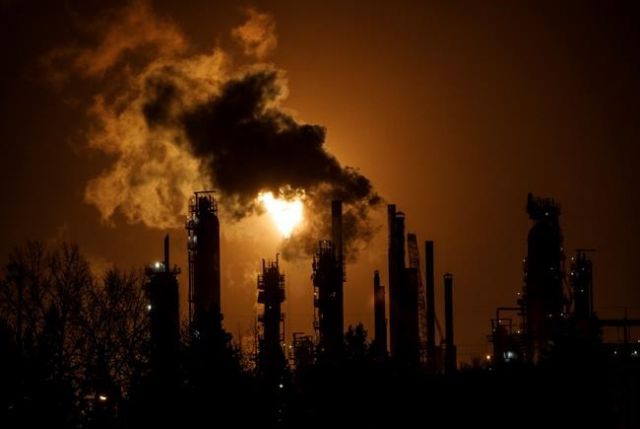
A coalition of climate-change advocates is urging Canada’s new minority Parliament to promptly develop a clear, effective and coherent strategy for reducing greenhouse-gas emissions in order to prevent escalating anxiety in the oilpatch from impeding urgently needed progress.

Climate Action Network Canada, along with representatives from Unifor, Leadnow, Greenpeace and 350.org, say climate was the biggest factor in the recent federal election, and those parties that ran on climate platforms owe it to voters to organize a co-ordinated response.

“This was truly Canada’s first climate election and it demands a significant shift in the politics surrounding climate action in Canada,” said Catherine Abreu, executive director of Climate Action Network Canada.

For too long, climate action has been a political football in a partisan game, and voters sent the message last month they expect that to change, Abreu told a news conference Friday in Ottawa. The Liberals, NDP, Green and Bloc Quebecois parties all had overlapping promises on climate change, which ought to make co-operating on the file easier, she added.

Logan McIntosh, executive director of Leadnow, said there was some disappointment earlier this week when NDP Leader Jagmeet Singh declared pharmacare, not climate change, as his top priority for lobbying the Liberals when Parliament resumes.

“We are facing a climate emergency and we want to see all the political parties put climate change at the top of their agenda,” McIntosh said.

The fallout from the Oct. 21 vote saw Justin Trudeau’s Liberals reduced to a minority government, with no MPs at all from Alberta and Saskatchewan — provinces where anxiety about the economic impact of combating climate change is highest and where voters overwhelmingly backed the Conservatives, a party with no plans to reduce domestic oil and gas production.

Abreu said politicians have been using those anxieties as “a political weapon” and interpreting the fears as a rejection of climate action.

“Instead of using the anxiety that workers are expressing as they face a series of challenges as a reason to stall climate action, we need to use climate action as an opportunity to build those new jobs and those new economic sectors that will ensure workers and communities are safe into the future.”

Ken Bondy, national representative for Unifor, which represents more than 11,000 oil and gas workers in almost every province, said the union has heard clearly from its membership that climate change is an issue for them but they are also concerned about their jobs.

“We need a balanced approach to taking climate action and just transition for workers that may be affected,” said Bondy. “Quite frankly I don’t believe anybody has nailed down a specific explanation for just transition, or what it looks like.”

Freeland calls for unity

Chrystia Freeland says Ukrainian community a Canadian unifier

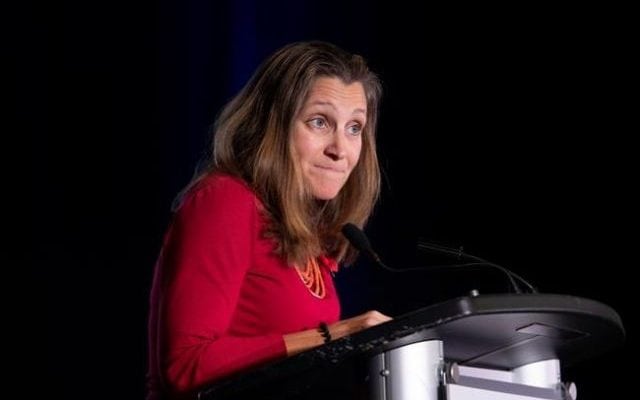
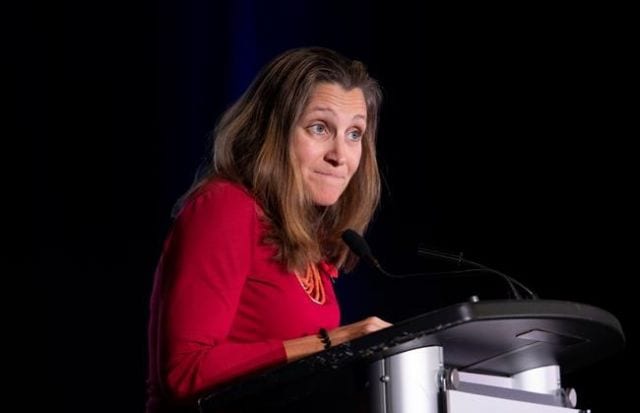
Foreign Affairs Minister Chrystia Freeland is touting the country’s Ukrainian community that spans provinces such as Alberta and Saskatchewan, as well as the rest of Canada, as a great unifier in post-election Canada.

She also pointed out Friday that she is Alberta-born, even though she now represents a downtown Toronto riding.

Freeland was addressing the opening of a three-day policy convention hosted by the Ukrainian Canadian Congress. Freeland is one of the 1.3 million Canadians of Ukrainian descent, which represents one of the country’s most influential diaspora communities.

Coming out of a federal election that has divided the country, Freeland suggested that Ukrainian-Canadians not bound by political affiliation can serve as a unifying example for a country that might feel divided.

The Liberals won a minority government, but were shut out by the Conservatives in Alberta and Saskatchewan, which is forcing Prime Minister Justin Trudeau to somehow ensure regional representation when he unveils his cabinet on Nov. 20.

“I represent University-Rosedale, but I am originally a proud Albertan,” Freeland said off the top of her breakfast speech. “We’ve just been through an election campaign. And elections campaigns inevitably and quite rightly are about drawing contrasts,” she added.

“But after elections, it is also important for the people who have the privilege of being chosen by Canadians to represent them in Parliament, it is then important for us to come together, and to recognize that collectively we have a responsibility to represent all Canadians, and to govern for the whole country.”

Freeland said she was inspired to see a roomful of Ukrainian Canadians representing all regions of the country.

She said the community “brings together Ukrainians from Ontario, from Quebec, from Alberta, from Saskatchewan and from Manitoba.

“I don’t want to forget anybody else, of course from Atlantic Canada, from B.C. We’re a community that really spans that regional divide in a way that is very powerful.”