Archives for September 29, 2019

Weekly Market Review – September 28, 2019

Stock Markets

U.S. stocks were in decline last week as U.S. politics dominated the news cycle around the globe. In a preemptive move, the House Democrats announced they would initiate inquiry in their attempt to launch impeachment efforts against President Trump. An impeachment requires a supermajority vote by the Republican controlled Senate and the findings of a major crime, which makes the chances of an actual conviction in this case almost non-existent. So, while this development in the Democrats’ ongoing battle adds to the political risks affecting the markets, it appears that stocks are more likely to reflect what is actually taking place in the economy and not the woes of the Washington swamp.

U.S. Economy

The inquiry into impeachment of President Trump was front and center all week long. But despite the bluster the inquiry seemed to cause on the political front, markets pretty well held their ground. Stock prices declined only 1% on the week. What this says is that markets responded more directly to policy developments than the news cycle this week. The actual developments included news that the U.S. and China plan to resume trade talks in mid-October. But there are real concerns that the White House is considering limiting investment in China even with negotiations. The two countries have had measured progress towards a trade deal over the last 2 years and that has been ratcheting up the impact on tariffs and trade restrictions. While progress may be slow, analyst think a trade deal will be reached (eventually) between these two world-leading economies. That would be a significant catalyst for global growth.

Metals and Mining

Gold declined this week as a result of pressure from the stronger US dollar. The metal was tracking its worst week in nearly 6 months as investors moved to the greenback over gold’s luster. The dollar reached a three-week peak Friday, but political tensions within the US have investors keeping close watch on gold. After US Democratic House Speaker Nancy Pelosi announced the launch of an official impeachment investigation on Tuesday, gold rose to US$1,534.10 per ounce. Speaking at the Denver Gold Forum, Frank Holmes, CEO and chief investment officer at US Global Investors told the media that gold has the potential to go much higher even without what he termed a major calamity. Holmes pointed out that gold would not reach US$10,000 per ounce without something catastrophic happening, but he believes a gradual rise to a significantly higher price is possible. Silver fell on the week but remains within reach of the important US$18 per ounce level. As if to parity gold, investors moved from silver in favor of the US dollar. In all, it dropped 2 percent for the week. In other precious metals, platinum steadied, continuing to trade above the US$900 per ounce level. Platinum has surged over the last month based on increased safe haven demand and some long-range concerns about supply. For its part, palladium lost slightly, but headed towards its eighth consecutive weekly gain. Panelists polled by FocusEconomics believe that, while prices are likely to dip slightly, palladium will continue to see strong support through 2019.

Energy and Oil

It appears that oil prices are responding to the rhetoric over Iran, as WTI and Brent have begun inching higher. The first salvo came Thursday following the Pentagon’s vow to deploy equipment and personnel to Saudi Arabia in an effort to boost its defenses. WTI pared losses from the day before on news of a US crude buildup, and Brent then finished higher Thursday. Ultimately, the Pentagon’s announcement doesn’t really have any effect on market moves in the long term. Oil headed lower Friday for a weekly loss. These moves can be attributed to real market contributors including fast paced recovery of Saudi production and slowing Chinese economic growth that is dampening the demand forecasts. Natural gas spot prices fell at most locations this week. Henry Hub spot prices fell from $2.68/MMBtu last week to $2.51/MMBtu this week. At the New York Mercantile Exchange (Nymex), the price of the October 2019 contract decreased 14¢ from $2.637/MMBtu last week to $2.502/MMBtu this week. The price of the 12-month strip averaging October 2019 through September 2020 futures contracts declined 8¢/MMBtu to $2.505/MMBtu.

World Markets

Stock markets in Europe moved lower on the week, while weak economic data and U.S.-China trade tensions helped to curtail sentiment for growth in the region. The pan-European STOXX Europe 600 Index dropped 0.48%, the German DAX was down 0.85%, and the euro lost 1.2% against the U.S. dollar. The UK’s FTSE 100 Index rose 0.6%, mostly on hopes for lower UK interest rates. Even though UK stocks rose, the pound came under some pressure, falling 1.4% against the U.S. dollar. That followed Bank of England (BOE) policymaker Michael Saunders’ announcement that the BOE might consider lowering rates even if a Brexit deal is reached. The flash eurozone manufacturing purchasing managers index (PMI) fell to its worst level in nearly seven years, at 45.6 in September, down from 47 in August. Readings below 50 indicate worsening conditions. German manufacturing PMI fell to 41.4 in September from 43.5. That’s the worst reading in over a decade.

Ahead of a weeklong holiday, Chinese stocks lowered as a lack of positive signs gave investors very little incentive. The benchmark Shanghai Composite Index sank 2.5%, and the large-cap CSI 300 Index gave up 2.1%. In economic news, China reported that profits at industrial companies fell in August, reversing the previous month’s gain. That is set against slowing industrial production and sales and dropping producer prices. The fall in producer prices is troubling for Beijing, which has been stepping up easing measures in efforts to boost the slowing economy.

The Week Ahead

Several important economic indicators coming out this week include the Manufacturing Purchasing Manager’s Index, construction spending, durable orders, factory orders and on Friday, the telltale September jobs report.

Key Topics to Watch

  • Chicago PMI   
  • Markit manufacturing PMI
  • ISM manufacturing index
  • Construction spending
  • Motor vehicle sales
  • ADP employment
  • Weekly jobless claims
  • Markit services PMI
  • ISM nonmanufacturing index
  • Factory orders
  • Nonfarm payrolls
  • Unemployment rate
  • Average hourly earnings
  • Foreign trade deficit

Markets Index Wrap Up

Algorithms help robot dogs trot more like real animals

They mimic the natural balance of vertebrates.

Robot dogs can move efficiently, but not all that naturally — and no, twerking doesn’t count. Virginia Tech researchers think they can do better. They’re developing a combination of algorithms and sensors that help robots move with gaits more like those of real animals. The system mimics the behavior of vertebrates, whose balance control comes largely from oscillating neurons in the spinal cord, using a combination of encoder sensors (to read relative positions for joints) and inertial measurement units (to measure the body’s orientation relative to the ground). The result is a mechanical canine that can walk, run and trot with more grace and speed than usual.

Cameras and LiDAR are also present to help robots avoid collisions. This doesn’t require dramatic changes to the bots themselves, at least. The test units are Ghost Robotics designs augmented with sensors to test the new algorithms.

The initial work has proven fruitful, but there’s a lot of work left before you could see this in robots beyond the lab. Assistant professor and key researcher Kavel Hamed also stressed that it wasn’t just about making the algorithms more effective — they also have to be genuinely “bio-inspired.” As such, it could be a while before there’s a pet robot that moves just as smoothly as the real thing.

Second SIM card attack can send texts and phone location data

The number of potential victims may not be as bad as claimed, though.

Simjacker isn’t the only SIM-based attack that could put phones at risk. Ginno Security Lab has detailed another exploit, WIBattack, that compromises the WIB (Wireless Internet Browser) app on some SIM cards to take control of key phone functions. Like its counterpart, WIBattack infects a phone through a carefully formatted SMS text that runs instructions on cards that don’t have key security features enabled. If successful, the intruders can send texts, start calls, point your web browser to specific sties, display text and send location info.

The vulnerability could be used to track a device’s location, point users to phishing websites and rack up fees on calls to toll numbers, among other tricks. Ginno has briefed the GSM Association on WIBattack, although it’s not clear what if anything the industry body is doing to address the issue.

It’s not certain just how many people are truly vulnerable. While Ginno warns that “hundreds of millions” of phones with WIB-capable SIM cards might be at risk, ZDNet obtained an SRLabs report suggesting the real number of potential victims might be considerably lower. Out of 800 tested cards, only 10.7 percent had WIB installed, and 3.5 percent of them were vulnerable to a Simjacker-like attack.

There’s also the question of whether or not this would be the most effective method for would-be attackers. It may be easier to try SIM hijacking (which can simply involve less-than-scrupulous carrier staff) or an SS7 exploit. Still, this is another significant flaw that may be difficult to completely eliminate until networks and users upgrade to more secure SIMs.

Apple’s 7th-gen iPad gets bigger but keeps the same size battery

The most popular iPad has grown to 10.2-inches.

In case you forgot, the iPhone 11 and Apple Watch weren’t the only new hardware Apple showed off at its big event a couple of weeks ago, it also upgraded the base iPad line. Now in its seventh generation, the “most popular” iPad that Apple sells has grown from 9.7- to 10.2-inches, ships with iPadOS and added a connector to support the company’s still-pricey keyboard add-on.

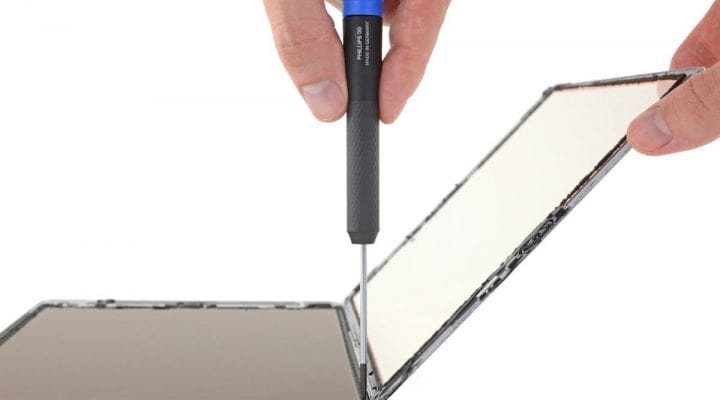
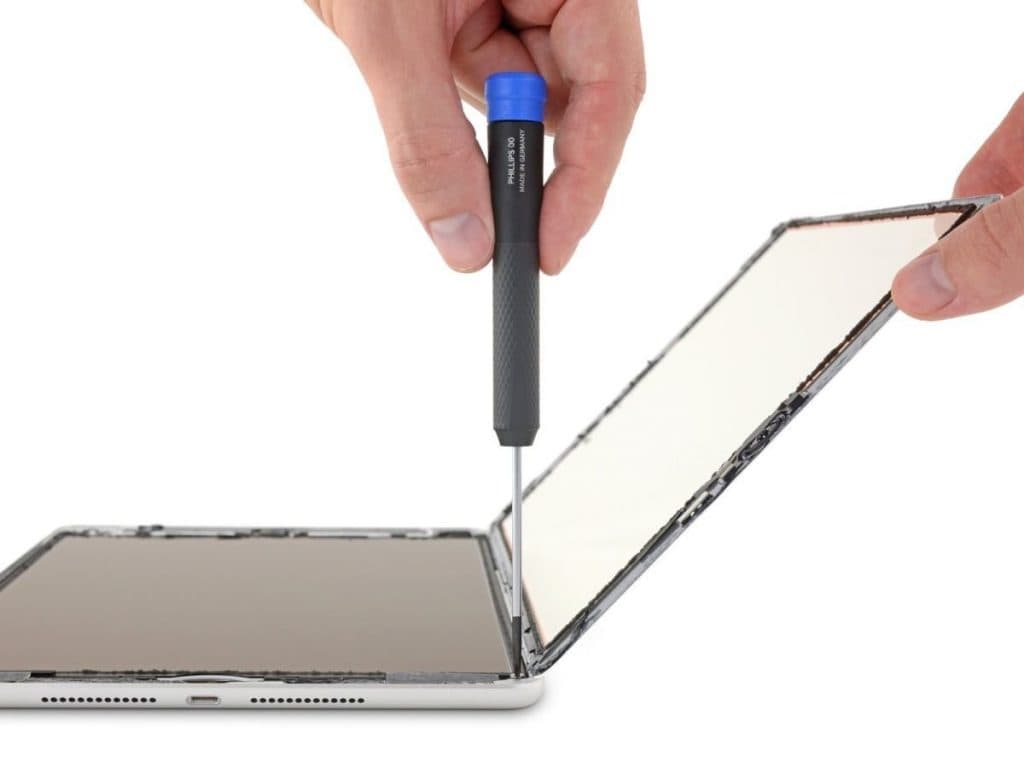
The folks at iFixit attacked the new model with their assortment of tools, and found that despite the new size, inside it’s still very similar to the previous model. Unlike the iPhone 11 Pro Max, for example, which made room for a larger battery than ever before, this new iPad has a unit that’s the same size as its predecessor at 8,827mAh or 32.9 watt hours, and presumably relies on other tweaks to the hardware and software to achieve its extra hour of estimated battery life.

The new iPad does include 3GB of RAM, an extra gig compared to the sixth gen models, and nice to have at its $329 starting price. The display is obviously larger, and iFixit notes that it’s still set up for easier replacements than the unit used on Apple’s Pro tablets, if you’re into DIY repairs. The iPad doesn’t make for as exciting of a teardown as smaller units, but it’s still new for 2019, so take a peek at the inside below.

SpaceX’s plan for in-orbit Starship refueling: a second Starship

It seems simple.

During an update on the SpaceX Starship program, Elon Musk just showed off a brief clip that explained part of the plan for using these vehicles to reach Mars. It involved a Starship in orbit around Earth, meeting a similarly-sized vehicle to refuel before it goes on the long trip to another planet. Musk has long touted his desire to make human life “multiplanetary” and expressed this as the way to achieve his goal.

He explained the Starship only requires its “Super Heavy” booster for launches from Earth, so it seems possible that the second vehicle could launch from the Moon powered only by its own Raptor engines.

SpaceX

In a graphic, the process is explained as “Propellant settled by milli-g acceleration using control thrusters.” The way Musk described it, having the ability to refuel a Starship means it can carry a full 1200 ton propellant load when leaving Earth’s orbit. He also showed off an updated version of the Starship’s design, with its 50m-long body covered in 301 stainless steel, with ceramic tiles in certain high heat areas.

Stocks to Watch: Northrim BanCorp, Inc. (NRIM)

Following recent share price movement on shares of Northrim BanCorp, Inc. (NRIM), we have seen that shares are now trading under the Chikou line. Traders might be tracking future price action to determine possible downward momentum if the price remains below the signal.

Stock market investors often rely on fundamental analysis for stock research. The EPS or earnings per share ratio shows the amount of company earnings that can be attributed to every share that is held. EPS lets investors directly compare one company to another when examining potential investments. Investors are typically searching for stocks that have a growing EPS. The EPS measure tends to be more telling when viewed over a longer period of time. When companies report quarterly earnings, the EPS measure is highly scrutinized by investors and analysts alike.

Currently, the 14-day ADX for Northrim BanCorp, Inc. (NRIM) is sitting at 13.16. Generally speaking, an ADX value from 0-25 would indicate an absent or weak trend. A value of 25-50 would support a strong trend. A value of 50-75 would identify a very strong trend, and a value of 75-100 would lead to an extremely strong trend. ADX is used to gauge trend strength but not trend direction. Traders often add the Plus Directional Indicator (+DI) and Minus Directional Indicator (-DI) to identify the direction of a trend.

Investors may be looking to compare the current stock price of Northrim BanCorp, Inc. (NRIM) to some of its moving averages. After a recent check, the 200-day MA is resting at 35.36, and the 50-day is 36.28. Moving averages are considered to be lagging indicators that simply take the average price of a stock over a specific period of time. Moving averages can be very useful for identifying peaks and troughs. They may also be used to help the trader figure out proper support and resistance levels for the stock.

Technical analysts have been monitoring shares of Northrim BanCorp, Inc. (NRIM) as of late. The Relative Strength Index (RSI) is one of multiple popular technical indicators created by J. Welles Wilder. Wilder introduced RSI in his book “New Concepts in Technical Trading Systems” which was published in 1978. RSI measures the magnitude and velocity of directional price movements. The data is represented graphically by fluctuating between a value of 0 and 100. The indicator is computed by using the average losses and gains of a stock over a certain time period. RSI can be used to help spot overbought or oversold conditions. An RSI reading over 70 would be considered overbought, and a reading under 30 would indicate oversold conditions. A level of 50 would indicate neutral market momentum. Presently, the 14-day RSI is standing at 63, the 7-day is 73.7, and the 3-day is resting at 92.21.

Taking a look at the numbers, Northrim BanCorp, Inc. (NRIM) has a 14-day Commodity Channel Index (CCI) of 186.59. The CCI technical indicator can be used to help determine if a stock is overbought or oversold. CCI may also be used to help discover divergences that could possibly signal reversal moves. A CCI closer to +100 may provide an overbought signal, and a CCI near -100 may offer an oversold signal.

For technical traders, support and resistance lines play an important role. The support line generally displays the lowest price that investors will let a stock trade. This means that the stock price is unlikely to drop under this level. When support lines are breached, chartists may be watching for shares to move lower until they reach the next support level. The resistance line is the exact opposite of the support line. The resistance level is typically the highest price that investors will allow the stock to trade at. Traders will carefully watch the stock price when a resistance level is broken. The thought is that the price will continue to move towards the next level of resistance. Traders and investors may use support and resistance lines for various purposes. One popular use of these lines is to identify possible entry and exit points for trades.