
Archives for May 6, 2019

Stocks to Watch: Eyes on Duluth Holdings Inc. (DLTH), Workday, Inc. (WDAY)

The price of Duluth Holdings Inc. (NASDAQ:DLTH) went up by $0.49 now trading at $16.31. Their shares witnessed a 3.75% increase from the 52-week low price of $15.72 they recorded on 2019-05-02. Even though it is still -118.7% behind the $35.67 high touched on 2018-09-06. The last few days have been rough for the stock, as its price has decreased by -1.03% during the week. It has also performed poorly over the past three months, as it lost around -30.54% while it has so far retreated around -5.83% during the course of a year. The stock of DLTH recorded -35.35% downtrend from the beginning of this year till date. The 12-month potential price target for Duluth Holdings Inc. is set at $20.67. This target means that the stock has an upside potential to increase by 26.73% from the current trading price.

21 institutions entered new Duluth Holdings Inc. (NASDAQ:DLTH) positions, 50 added to their existing positions in these shares, 56 lowered their positions, and 19 exited their positions entirely.

Duluth Holdings Inc. (DLTH) trade volume has increased by 24.84% as around 538,327 shares were sold when compared with its 50-day average volume of traded shares which is 431,202. At the moment, DLTH is witnessing a downtrend, as it is trading -3.85% below its 20-day SMA, -22.27% below its 50-day SMA, and -36.51% below its 200-day SMA. The company runs an ROE of roughly 16.1%, with financial analysts predicting that their earnings per share growth will be around 25% per annum for the next five year. This will be compared to the 1.8% increase witnessed over the past five years.

The first technical resistance point for Duluth Holdings Inc. (NASDAQ:DLTH) will likely come at $16.52, marking a 1.27% premium to the current level. The second resistance point is at $16.72, about 2.45% premium to its current market price. On the other hand, inability to breach the immediate hurdles can drag it down to $15.57, the lower end of the range. DLTH’s 14-day MACD is -0.31 and this negative figure indicates a downward trading trend. The company’s 14-day RSI (relative strength index) score is 33.4, which shows that its stock has been neutral. The 20-day historical volatility for the stock stands at 101.84 percent, which is high when compared to that of the 50-day’s 73.93 percent.

The shares of Workday, Inc. (NASDAQ:WDAY) has increased by 2.25%, and now trading at $203.12 on the Wall Street in the intra-day deal, with their shares traded now around 788,216. This is a decline of -954,788 shares over the average 1,743,004 shares that were traded daily over the last three months. The stock that is trading at $203.12 went higher by 73.25% from its 52-week low of $117.24 that it attained back on 2018-06-28. The stock recorded a 52-week high of $208.33 nearly 6 days ago on 2019-04-30.

WDAY stock has performed well over the past 30 days, as it added 4.97% while its price climbed by 27.2% year-to-date (YTD). Looking at the last few days, it has been tough for the stock, as it tumbled -0.63% over the last week. The stock’s 12-month potential target price is now at $199.91. This means that the stock price might likely increase by -1.58% from its current trading price. 20 out of 37 Wall Street analysts which represents 54.05% rated the stock as a buy while the remaining 37.84% rated it as a hold, with 8.11% of analysts rating it as a sell.

Workday, Inc. (NASDAQ:WDAY) has been utilizing an ROE that is roughly -23.2%, with stock analysts predicting that the company’s EPS for the next five years will go up by 31.48% per year, following the -13.9% drop that was witnessed during the past five years. The stock at the moment is on a uptrend, trading 4.24% above its 20-day SMA, 5.87% above its 50-day SMA, and 27.14% above its 200-day SMA. In percentage terms, the aggregate Workday, Inc. shares held by institutional investors is 99.4%. 112 institutions jumped in to acquire Workday, Inc. (WDAY) fresh stake, 318 added to their current holdings in these shares, 195 lowered their positions, and 48 left no stake in the company.

The stock’s 9-day MACD is 0.22 and this positive figure indicates an upward trading trend. The company’s 9-day RSI score is 61.45, which shows that its stock has been neutral. The 20-day historical volatility for the shares stand at 28.26 percent, which is less when compared to that of the 50-day’s 29.11 percent. On the daily chart, we see that the stock could reach the first level of resistance at $205.26, sporting a 1.04% premium to the current level. The next resistance point is at $207.39, representing nearly 2.06% premium to the current market price of Workday, Inc. (WDAY). On the other hand, failure to breach the immediate hurdles can drag it down to $195.91, the lower end of the range.


Stocks to Watch: Wake-up Call for Intel Corporation (INTC), DIGITAL TURBINE, INC. (APPS)

The price of Intel Corporation (NASDAQ:INTC) went up by $1.2 now trading at $51.75. Their shares witnessed a 22.17% increase from the 52-week low price of $42.36 they recorded on 2018-10-24. Even though it is still -15.15% behind the $59.59 high touched on 2019-04-17. The last few days have been rough for the stock, as its price has decreased by -1.3% during the week. It has also performed better over the past three months, as it added around 6.2% while it has so far retreated around -1.07% during the course of a year. The stock of INTC recorded 10.27% uptrend from the beginning of this year till date. The 12-month potential price target for Intel Corporation is set at $55.45. This target means that the stock has an upside potential to increase by 7.15% from the current trading price.

201 institutions entered new Intel Corporation (NASDAQ:INTC) positions, 1126 added to their existing positions in these shares, 1109 lowered their positions, and 83 exited their positions entirely.

Intel Corporation (INTC) trade volume has increased by 18.26% as around 25,565,115 shares were sold when compared with its 50-day average volume of traded shares which is 21,618,119. At the moment, INTC is witnessing a downtrend, as it is trading -6.79% below its 20-day SMA, -4.71% below its 50-day SMA, and 4.86% below its 200-day SMA. The company runs an ROE of roughly 28.4%, with financial analysts predicting that their earnings per share growth will be around 7.85% per annum for the next five year. This will be compared to the 18.5% increase witnessed over the past five years.

The first technical resistance point for Intel Corporation (NASDAQ:INTC) will likely come at $52.14, marking a 0.75% premium to the current level. The second resistance point is at $52.52, about 1.47% premium to its current market price. On the other hand, inability to breach the immediate hurdles can drag it down to $50.34, the lower end of the range. INTC’s 14-day MACD is -4.1 and this negative figure indicates a downward trading trend. The company’s 14-day RSI (relative strength index) score is 37.1, which shows that its stock has been neutral. The 20-day historical volatility for the stock stands at 38.14 percent, which is high when compared to that of the 50-day’s 28.43 percent.

The shares of Digital Turbine, Inc. (NASDAQ:APPS) has increased by 4.63%, and now trading at $4.07 on the Wall Street in the intra-day deal, with their shares traded now around 1,242,887. This is a decline of -20,929 shares over the average 1,263,816 shares that were traded daily over the last three months. The stock that is trading at $4.07 went higher by 263.39% from its 52-week low of $1.12 that it attained back on 2018-09-17. The stock recorded a 52-week high of $4.18 nearly 3 days ago on 2019-05-03.

APPS stock has performed well over the past 30 days, as it added 11.51% while its price climbed by 122.4% year-to-date (YTD). Looking at the last few days, it has been good for the stock, as it rose 13.06% over the last week. The stock’s 12-month potential target price is now at $4.13. This means that the stock price might likely increase by 1.47% from its current trading price. 5 out of 5 Wall Street analysts which represents 100% rated the stock as a buy while the remaining 0% rated it as a hold, with 0% of analysts rating it as a sell.

Digital Turbine, Inc. (NASDAQ:APPS) has been utilizing an ROE that is roughly 0%, with stock analysts predicting that the company’s EPS for the next five years will go up by 25% per year, following the 7.3% raise that was witnessed during the past five years. The stock at the moment is on a uptrend, trading 12% above its 20-day SMA, 18.55% above its 50-day SMA, and 92.33% above its 200-day SMA. In percentage terms, the aggregate Digital Turbine, Inc. shares held by institutional investors is 36.4%. 18 institutions jumped in to acquire Digital Turbine, Inc. (APPS) fresh stake, 27 added to their current holdings in these shares, 26 lowered their positions, and 10 left no stake in the company.

The stock’s 9-day MACD is 0.23 and this positive figure indicates an upward trading trend. The company’s 9-day RSI score is 73.87, which shows that its stock has been overbought. The 20-day historical volatility for the shares stand at 36.26 percent, which is less when compared to that of the 50-day’s 60.9 percent. On the daily chart, we see that the stock could reach the first level of resistance at $4.2, sporting a 3.1% premium to the current level. The next resistance point is at $4.33, representing nearly 6% premium to the current market price of Digital Turbine, Inc. (APPS). On the other hand, failure to breach the immediate hurdles can drag it down to $3.77, the lower end of the range.
Fed-up Canada leans on United States to help with China crisis

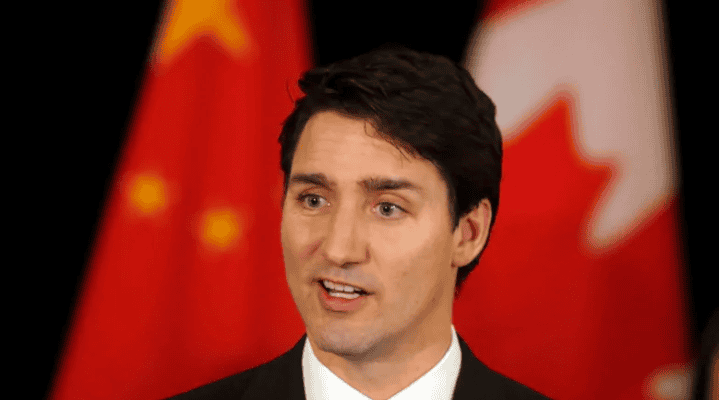
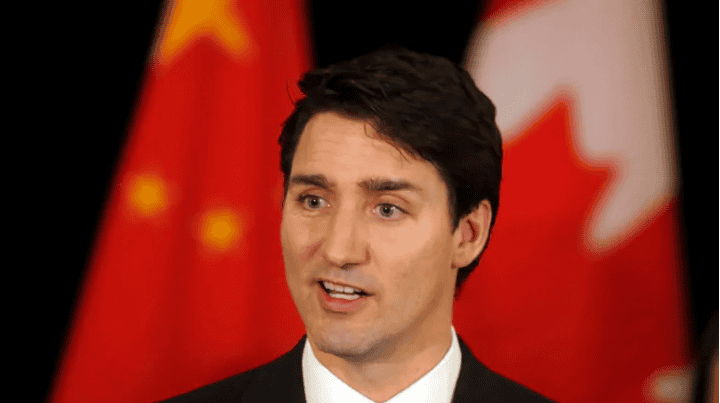
Canadian Prime Minister Justin Trudeau, shown here speaking in Beijing in 2017, has a formal relationship with U.S. President Donald Trump. The president blew up last year’s Group of Seven summit in Canada by describing Trudeau as very dishonest and weak.

Canada’s agriculture sector struggling during trade disputes with China

Canada is leaning on the United States to help settle a dispute with China, which has started to block imports of vital Canadian commodities amid a dispute over a detained Huawei executive.

In a sign of increasing frustration at what it sees as a lacklustre U.S. response, Prime Minister Justin Trudeau’s government is signaling it could withhold co-operation on major issues.

China has upped the pressure on Canada in recent weeks over the arrest of Huawei Technologies Co. Ltd Chief Financial Officer Meng Wanzhou, arrested last December on a U.S. warrant.

It halted Canadian canola imports and last week suspended the permits of two major pork producers.

After Meng’s Vancouver arrest, Chinese police also detained two Canadian citizens.

Beijing is refusing to allow a Canadian trade delegation to visit, forcing officials to use video conference calls as they try to negate a major threat to commodity exports.

With no cards to play against China without risking significant economic damage, Canada has launched a full-court press in Washington, which is negotiating its own trade deal with Beijing.

U.S. administration confusion

The results have been meagre.

“It’s a very challenging situation. When we raise it with the Americans they just say, ‘Dealing with the Chinese is tough,'” said a Canadian government source.

“It’s also not clear who we should be targeting since you never know who is up and who is down in the administration at any given point,” said the source, who requested anonymity given the sensitivity of the matter.

Among those the Canadians approached are Secretary of State Mike Pompeo, Agriculture Secretary Sonny Perdue, U.S. Trade Representative Robert Lighthizer and Republican Sen.Jim Risch, chairman of the Foreign Relations Committee.

The State Department said it was “concerned” by the canola ban. In March, the Foreign Relations Committee responded to Canada’s concerns by passing a bipartisan resolution supporting the country.

Canada says the United States is obliged to help, given that the U.S. arrest warrant triggered the crisis with Beijing.

U.S. negotiators have rejected Chinese proposals to include the Huawei issue in their current trade deal discussions, according to a source familiar with the negotiations.

Canada’s U.S. ambassador David MacNaughton, who noted Canada has assisted the current U.S. administration on diplomatic efforts with Venezuela, Latvia and NATO, strongly suggested future requests for aid would not be met so positively unless Washington cooperated more.

“How do you go to canola farmers and relatives of the two [Canadian detainees] and say, ‘Well, actually, notwithstanding all of this, we’re going to try and do whatever we can to help?'” he said.

“It makes it much more difficult in public opinion terms for the prime minister to have permission to do some of the things that would be in both countries’ interests.”

‘This administration doesn’t like us very much’

MacNaughton, who has cabinet-level status in Trudeau’s government, played a key role in negotiating a new North American trade deal last year.

Relations between Trump and Trudeau are formal at best. Officials in Ottawa have not forgotten that the president blew up last year’s Group of Seven summit in Canada by describing Trudeau as very dishonest and weak.

“At the political level, this administration doesn’t like us very much,” said a second well-placed source.

Intertwined with the China crisis is a second problem: the tariffs on Canadian steel and aluminum that Trump imposed last year on national security grounds.

Meng, who is under house arrest at her Vancouver mansion, next appears in court on May 8 ahead of an extradition hearing, in a process that could take years.

MacNaughton said part of Canada’s frustration also stems from a lack of information on U.S. intentions toward Meng. Trump has previously suggested the charges against her could be dropped if that would help the trade talks.

“What we’ve said is, ‘We’d like to have a little better sense of what your plans are in terms of dealing with her. Are you engaged in negotiations over a plea deal?,'” he said. “We’re completely in the dark.”

Major housing development planned on Indigenous land in heart of Vancouver

If all goes as planned, the Squamish Nation will build about 3,000 housing units next to the Burrard Street Bridge.

Squamish Nation will build about 3,000 housing units if plan goes ahead

Walking along the base of the Burrard Street Bridge that crosses Vancouver’s False Creek toward the downtown core, Khelsilem gestures across a gravel lot poised to become one of the largest Indigenous urban developments in Canada.

The Squamish Nation councillor, who also goes by the name Dustin Rivers, is standing on a pinched triangle of reserve land near the city’s centre that the First Nation won back in 2002 after decades of legal battles.

The project is in its very early stages but if all goes as planned, the Squamish Nation will build about 3,000 housing units in a project that promises to answer some of the region’s urgent housing needs at the same time that it presents a test of reconciliation.

“For a lot of other First Nations across the country, natural resources is the one option they have for growing their economies. Whereas for us, the land has been completely impacted [by the city’s growth] and so real estate is really the one thing we can get involved in that will make sense to generate revenue,” he said.

The same site was home to members of the Squamish Nation for thousands of years before villagers were illegally forced to accept a settlement and shipped on barges to less desirable land along Howe Sound in 1913. It had been declared a reserve in the late-1800s but was gradually fragmented by leases and dissected by railway lines.

By 1965, the entire 32-odd hectares of reserve had been sold off.

But in 2002, the Squamish regained a small section of the earlier reserve: today’s Kitsilano Indian Reserve No. 6.

‘We should be getting involved’

The idea to build two towers on the site gained some steam in 2009 and 2010 but was abandoned in the economic downturn.

Now, Khelsilem said, members are keen to see the First Nation use the land for economic development.

“They’re seeing the significant profits that everyone else is making. We’re right in the middle and we’re not doing anything, so I think there’s reasonable impatience that we should be getting involved,” he said.

The First Nation is in negotiations with one developer after gathering pitches through a request for proposals. At this stage, it’s looking at primarily rental housing with potential for some affordable units for Squamish members. Of the nation’s approximately 4,000 members, about 1,100 are on a waiting list for housing, he said.

The Squamish Nation is proposing to build 3,000 units of housing on land it controls at the south end of the Burrard Street Bridge.

For Vancouver Mayor Kennedy Stewart, the development offers an answer to one of the city’s biggest problems.

“The city is in the middle of a housing crisis, especially when it comes to rentals,” Stewart said, calling the preliminary figure of 3,000 housing units “fantastic.”

That’s not an insignificant number for a city that has approved 8,680 purpose-built market rental units over the past 10 years.

Expression of reconciliation

Stewart also sees it as an expression of reconciliation, acknowledging that if residents oppose the project there are few ways to fight it because the development is on Squamish land and outside the city’s jurisdiction.

“The shoe’s on the other foot and there’s really not a lot of need for Squamish to consult with the local community,” he said.

Despite that, Stewart said the First Nation has kept him in the loop on its plans since early this year. The relationship Stewart and the First Nation built as allies against the Trans Mountain pipeline expansion has helped.

“The thing about reconciliation is you don’t really know what it looks like until you’re in the middle of it. So I think this will set some parameters as to what us, Vancouver, being a city of reconciliation, looks like. I’m very keen to make sure this has the best chance of success.”

The Kitsilano neighbourhood is facing forces that could change its character on several fronts. The beach-side community of largely single-family residences has historically opposed development on a much smaller scale, including two recent five- and six-storey buildings planned further west.

But densification appears inevitable, especially along a SkyTrain line planned several blocks south.

This map illustrates land controlled by the Squamish Nation around the south end of the Burrard Street Bridge.

“There have been some developments on a smaller scale that have been getting some opposition, there’s no question about that,” said Larry Benge, co-chair of the Coalition of Vancouver Neighbourhoods.

For his part, Benge said he recognizes the neighbourhood has no legal say in the matter but wants to let the Squamish Nation know that neighbouring associations are available and interested in participating in engagement.

Until more details are released, he said he’s taking an optimistic view of the project.

“I don’t want to build into this development a whole slew of, ‘Oh my gosh, what if this happens, isn’t this going to be awful.’ We should instead be looking at, ‘This is a wonderful opportunity for something that could be very positive for everyone involved,’ ” Benge said.

Consultations planned

Khelsilem said the First Nation plans to communicate with residents, adding it could make the project stronger by raising questions that the designer or developer hadn’t considered.

It’s not the first Squamish development, nor the first urban Indigenous development.

The MST Development Corp. is a partnership between the Musqueam Indian Band, Squamish and Tsleil-Waututh First Nations. The three bands are full or co-owners of six prime properties throughout Metro Vancouver, covering more than 65 hectares of land available for development valued at over $1 billion.

Among its largest developments, the corporation is beginning consultations on the 36-hectare Jericho lands in West Point Grey.

The Musqueam are also planning a 1,250-unit, mixed-use development near the University of British Columbia and the Squamish act as landlords to the Park Royal shopping centre on its reserve land in West Vancouver.

Khelsilem said the Park Royal project has provided income that the First Nation can use toward other things, like housing, and the Burrard project is expected to be a similar “money tree” on a much larger scale.

The next step will be putting things like the land designation amendment and business terms before Squamish members in a referendum.

“This project we’re looking at is much more substantial and significant,” he said.

“We want to bring our people home, we want to build more housing for them, we need to create some economic development to pay for it and this is the first step in that.”

The growing problem of oil and gas companies not paying local taxes or landowners

Energy companies in Alberta failed to pay more than $81 million in property taxes last year, according to a survey by the Rural Municipalities Association.

Local governments raise tax rates to make up for millions of dollars in unpaid bills by energy sector

Months before its demise, Trident Exploration made a plea to landowners to accept half of the payment it had promised to have the company’s natural gas wells on rural properties throughout Alberta.

The Calgary-based firm explained it was in dire financial straights and needed help to stay afloat.

Many of the landowners (mostly farmers) rejected the idea and still wanted full compensation.

In March, the natural gas company cut the payments anyway and said in a letter “we had a disappointing response to that request.”

The letter by Trident’s chairman and interim CEO Darren O’Brien painted a picture of the company’s problems:

Trident is under severe financial strains resulting from several factors beyond its direct control. A few of these factors include (1) the ongoing and unprecedented low price of natural gas, (2) extremely high rural municipality taxes, (3) the high cost of operations, and (4) costs of surface lease rentals. As a result, every possible effort is being made to keep the company financially viable through these difficult times.

Less than two months later, the company ceased operations.

Trident blamed low commodity prices and a lack of export pipeline capacity, among other reasons, for shutting down last week.

When a company is forced to shut its doors, there are unique circumstances related to its assets and operations, among other factors. However, broadly speaking, it’s been a common occurrence for oil and gas companies in Western Canada to fail since the oil price crash in 2014.

Since then, dozens — if not hundreds — of companies have gone bust. And many rural Alberta residents say problems associated with the industry are getting worse as municipalities struggle to collect taxes and landowners often go unpaid for allowing companies to operate on their property. The situation underscores how many people are affected by the struggles of the oilpatch, even if they aren’t employed in the sector.

While the majority of energy companies fulfil their financial obligations, those that don’t are having a significant impact.

The Rural Municipalities Association (RMA) asked all of the 69 counties in Alberta how much money they failed to collect from the energy sector last year. Fifty-four responded with a collective total of more than $81 million.

Foothills County around Okotoks in Southern Alberta said it’s still owed $698,800, while Wood Buffalo around Fort McMurray has $14.5 million outstanding, according to the RMA.

Woodlands County, northwest of Edmonton, is short $4.3 million and the amount of unpaid taxes is about 22 per cent of the municipalities’ total tax levy and budgeted revenue for 2018.

The local government said the oil and gas sector’s failure to pay taxes could potentially have an impact on the “county’s viability and sustainability,” according to a news release in February.

The problem is also affecting municipalities in Saskatchewan.

“It’s an issue that is not going away,” said Al Kemmere, president of the RMA and elected councillor of Mountain View County, just north of Calgary.

‘It’s just a headache’

Bankrupt companies aren’t the only problem for local governments.

“Now, companies that are operating and continue to operate — are not paying their taxes, which makes it much more difficult to deal with from a collections point of view,” said Kemmere, who is advocating for policy changes with Alberta’s provincial government to help improve the situation.

Residents and business owners often have to bear the brunt of the energy sector’s failure to pay, since municipalities may increase taxes on everyone else to recoup funds, said Kemmere.

Even when municipalities can’t collect taxes, they still have to pay the education portion of the taxes to the provincial government.

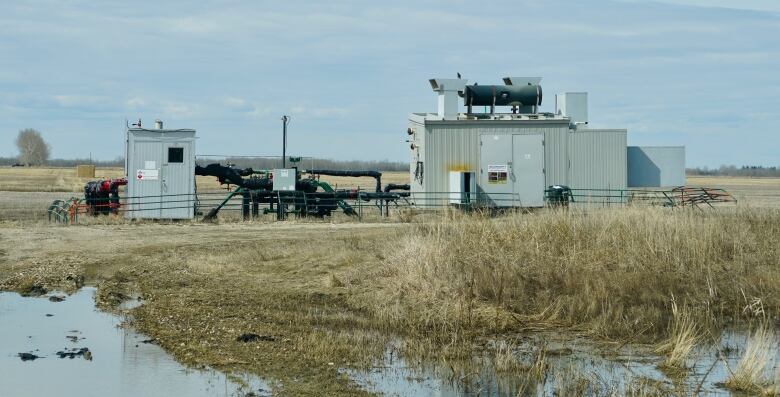
A Trident Exploration natural gas facility near Didsbury, Alta.

Landowners with oil and gas wells on their properties are still able to collect unpaid money from private companies, if they have the patience to go through a cumbersome process with the provincial government.

A farmer can apply to the province’s surface rights board to be paid. However, those landowners have to file individual paperwork for each oil and gas well on their property.

“I have some landowners with 50 or 60 leases, said Daryl Bennett, a landowner advocate in southern Alberta. “They have to make an application for every lease, every year. It’s just a headache.” 

A typical payment for one natural gas well can be about $4,000 a year.

‘Lengthy delays’

Under Alberta law, landowners can’t refuse companies wanting to develop oil and gas below the surface of their land.

Bennett said landowners have to wait more than a year right now to get paid — and the surface rights board has a backlog of 2,700 files that they are hoping to clear by next winter.

“A lot of landowners don’t even know they can apply to the board,” he said. “Due to the lengthy delays, most landowners aren’t even bothering.”

The fact companies are breaking their lease agreements in the first place is a growing frustration for landowners because the problem doesn’t seem to improve.

“A lot of them are just getting really ticked off,” said Bennett.

The Canadian Association of Petroleum Producers, which represents most oil and gas companies in the country, declined an interview request and said it was “unable to share any insight into this issue.”

Any Canadian Green New Deal must be more than free money: Don Pittis

Repeated extraordinary flooding in Canada is one of the factors convincing Canadians that something’s happening and that governments must take action.

Public spending can transform the economy but government handouts aren’t enough

Conservative politicians who think action on climate change is a left-wing project should look to Britain.

While not advertised under the Green New Deal banner, the U.K.’s climate plan, expected to be approved by Britain’s Conservative government, has many similarities, intending to boost the economy while fighting climate change.

Many Canadians, observing extraordinary levels of flooding, windstorms, forest fires and drought have come to accept that “something’s going on,” as Ontario Premier Doug Ford said during a visit last week to flooded Ottawa suburbs.

As Michael Morrice, an entrepreneur and activist who recently became the federal Green Party candidate in the southern Ontario riding of Kitchener Centre, repeatedly insists, fixing the climate can be good for business. And as Morrice has shown, business-friendly climate change success does not require handouts.

A decade ago Morrice set up Sustainable Waterloo Region, a non-profit group to support and publicly recognize businesses that cut their carbon footprint. Within five years, he told me, 14 per cent of the Waterloo workforce was working for an employer committed to the scheme.

Like winning a war or going to the moon, experts say, government investments in green projects can create radical new technology that the private sector could never afford on its own.

“And they were saving money while they did it,” said Morrice. 

As political parties and activists across the spectrum consider election-winning strategies that include climate action combined with a stronger and fairer economy, it is a message they will likely want to consider.

Transformational impact

But when they do commit to using their enormous spending power, governments can have a transformational impact, says British-based scholar Mariana Mazzucato using evidence from the most successful parts of the U.S. economy. 

In her 2015 book The Entrepreneurial State, the economist’s intent was, as the book’s subtitle suggests, “Debunking Public vs. Private Sector Myths.”

Mazzucato makes the strong case that, contrary to the stereotypical neo-liberal view that the private sector creates wealth while governments spend it foolishly, the most vibrant parts of the U.S. economy have been a direct result of government investment.

“From the internet to biotech and even shale gas, the U.S. state has been the key driver of innovation-led growth —willing to invest in the most uncertain phase of the innovation cycle and let business hop on for the easier ride down the way,” Mazzucato writes.

Private sector risk-takers might not call it easy, but as Mazzucato points out, Uber would not exist without government-funded GPS. The billions in the coffers of Google, Facebook, Amazon, Apple, Samsung, Tesla, SpaceX and many lesser companies would simply not have happened if taxpayers had not financed the technology they depend upon.

Even the earlier generation of computer technology credited to Bell Labs was based on a government deal forcing the telecom giant to divert a share of its windfall as a monopoly to R&D.

Otherwise the money would have simply disappeared into the pockets of shareholders — reinvested yes, but usually in financial endeavours that would show a short-term return, not in the highly risky original research that transforms economies.

And as governments consider how to reshape the economy to fight climate change Mazzucato has said perhaps the most wasteful way to spend is to simply hand out taxpayer money to companies to do what they were going to do anyway.

“You give them some sort of tax incentive to do it,” said Mazzucato, in a recent interview about her latest book, The Value of Everything.

In her book, economist Mariana Mazzucato demonstrates that rather than being a waste, government money spent on risky research is key to U.S. private sector wealth, a business-friendly lesson for the Green New Deal.

Instead, she says, governments must spend on green innovation the same way they spent on winning a war or launching a moon shot, with a goal firmly in mind. The modern green equivalent is ARPA-e, similar to defence research (DARPA) and space research (NASA), except directed at “high-impact energy technologies that are too early for private-sector investment.” One common argument against government-directed investment is that governments aren’t qualified to “pick winners,” but Kyla Tienhaara, Canada Research Chair in Economy and Environment at Ontario’s Queen’s University, says that seems to be forgotten when taxpayer money is directed into projects like pipelines.

Tienhaara conducted research on green stimulus spending following the 2008 credit crunch, and she discovered that in many cases taxpayer cash labelled green turned out to be handouts to the better-off or to corporations in ways that did not necessarily advance a climate agenda.

She cites a British Columbia transmission line funded under a green infrastructure project.

“The only people wanting to use that amount of electricity up there were actually mining companies,” said Tienhaara.

Canada can be a player

She also points to taxpayer-funded carbon capture and storage that she says was mainly a justification for the oil and gas industry to keep producing as normal.

Just because Canada is a small economy does not mean it cannot be a player. Artificial intelligence funding, for example, has demonstrated Mazzucato’s contention that unlike handouts, creating an area of radical expertise attracts a cluster of businesses that gather to feed off the groundbreaking ideas that result.

On the Green New Deal front, Tienhaara said there is plenty of room for Canada to compete by investing in appropriate specialities that might include such things as radical cold-weather construction or energy-storage technology.

Tienhaara says research investment need not be just in high technology, but in new ideas about “decoupling,” a term for thinking of ways to separate economic growth from climate destruction, and on how to stimulate climate action at the grassroots level.

Community involvement is exactly what Priyanka Lloyd’s organization, Green Economy Canada, is all about. A biochemist with an MBA, she heads a national organization that has grown up out of the Waterloo project that Mike Morrice founded a decade ago.

Lloyd’s group, now operating without government funding since the scrapping of Ontario’s cap-and-trade program, cancelled by the new provincial government, is working to support green business hubs like the original Sustainable Waterloo in cities across Canada.

Lloyd’s organization acts as a national hub for new regional hubs that share ways for small and medium enterprises to boost their bottom line with things such as improved lighting, keeping in the heat and advanced telecommunications systems to save money — and carbon — on unnecessary airline trips.

Lloyd says while the group continues to seek donors to supplement the small fees it collects from members, the loss of government support is not going stop the effort.

“We’re scrappy and resourceful, and the work is important.”