Archives for March 15, 2019

One-fifth of Americans say they have zero savings

About a fifth of Americans have no money tucked away for unexpected costs.

About 21% of working Americans said they aren’t saving any money at all, Bankrate found in a survey. Among those who are saving, a majority are putting away less than 10% of their income.

Over the past several decades, household savings in the US have been trending downward. By the Bureau of Labor Statistics’ measure, Americans were saving 7.6% of disposable income in December. Before the 1980s, that rate had mostly been in the double digits.

Widening inequality has been one potential reason the personal savings rate has remained low by historical standards and compared with other countries, said Brian Rose, the senior Americas economist at UBS Wealth Management.

“Among lower-income households, they’re mostly living paycheck to paycheck and even struggling to do that,” he said. “So, they have no leeway in their finances.”

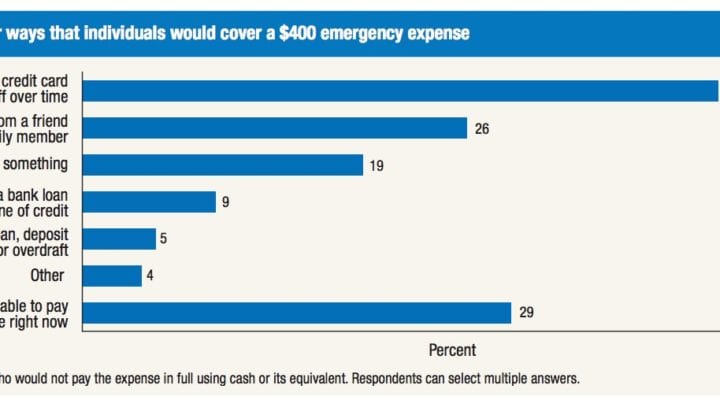
While households have become increasingly prepared for unexpected expenses in recent years, according to a recent Federal Reserve survey, four in 10 Americans say they would have trouble covering a $400 expense like a car repair or fixing a broken appliance.

That doesn’t mean Americans aren’t trying to save, according to Jonathan Morduch, an economist at New York University and a co-author of “The Financial Diaries,” a book detailing a study of the spending habits of 235 households over a year.

“The evidence we see is that households are often saving and then spending that down,” he said. “So, when a fifth of Americans say they don’t have any savings, it means they don’t have any long-term savings.”
That could be in part because Americans are struggling to pay off loans, with about 13% in the Bankrate survey citing debt as a reason they can’t save. From car loans to tuition, Americans have increasingly struggled to make payments on the country’s $4 trillion of consumer debt.

“How much does growing debt have to do with it?” Morduch said. “The answer is a lot.”

In coming months, a lack of savings could become more serious for Americans. Economists widely expect growth to slow over the next two years, while some even expect the US to enter a recession by 2020.

“It’s clear that not everyone has benefited from the economic expansion,” said Ryan Sweet, an economist at Moody’s Analytics, said of the Bankrate savings survey. “Also, it shows we are not ready for the next recession.”


Looking for a new job? Here’s what hiring managers want

Your greatest asset when applying for a job might be your social savvy.

Four out of 5 employers polled by CareerBuilder say that soft skills, including communication abilities and critical thinking, are equal to or more important than hard skills — or specific technical abilities — when they’re hiring candidates.

The employment website polled 1,021 hiring and human resource managers and 1,010 full-time employees in December and January.

“With technology changing the daily tasks of many jobs, hard skills are still important,” said Michelle Armer, chief people officer at CareerBuilder.

“But the results show that employers realize these skills can be taught through training or mentorship programs, whereas soft skills cannot be taught in that way,” she said.

More than 9 out of 10 survey participants said soft skills are important in determining whether they will hire someone.

The ability employers were most interested in was team orientation. “Attention to detail” and “customer service” rounded out the top three competencies companies seek.

Attributes that might give you an edge over other job applicants centered on being dependable, detail-oriented and self aware, said Maureen Hoersten, chief operating officer at LaSalle Network.

Having empathy and being team-oriented also matter, she said.

Job interviews give hiring managers insight into candidates’ soft skills, based on their behavior toward executive assistants and other staff members and their timeliness, said Hoersten.

In particular, what you say about your past employers and former coworkers can be telling.

For instance, hiring managers might be more inclined to look at you favorably if you ask them to respect your old employer’s policy of giving two weeks’ notice before switching jobs.

It shows that you have respect for your previous company’s investment in your career, Hoersten said.Where are the jobs?

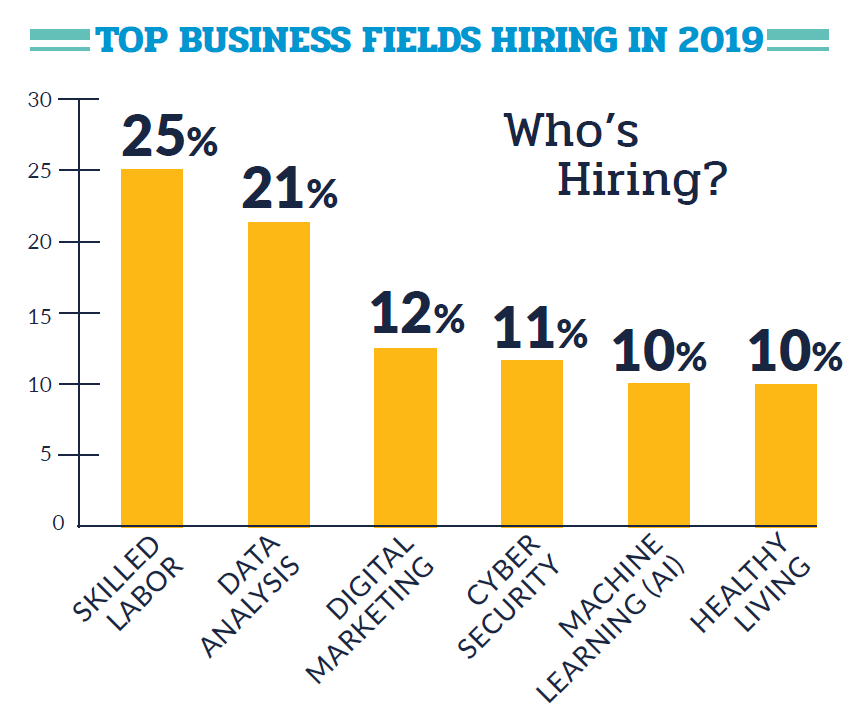
About 40 percent of the participating employers said they plan to bring more full-time workers on board next year.

Skilled labor, which includes engineering and technician jobs, are in high demand, as a quarter of the participating hiring managers said they’re hoping to add talent in those fields.

Data analysis candidates are also popular, as 2 out of 10 hiring professionals want to hire them this year.

“New technologies are constantly being introduced, causing legacy industries to be transformed, so the need for workers with specialized, high-tech capabilities is on the rise,” said Armer.

Sorry, but that $1,100 standing desk won’t make you thinner

You might want to sit down for this.

Standing desks won’t make you lose weight, and they also don’t make you significantly healthier or more productive, according to a new analysis of 53 sit-stand desk studies.

Dr. April Chambers, a bioengineer and assistant professor at the University of Pittsburgh, collaborated with Dr. Nancy A. Baker, an associate professor of occupational therapy at Tufts University, and Dr. Michelle M. Robertson, an executive director for the Office Ergonomics Research Committee, to determine how effective sit-stand desks (aka SSDs) are for workers. They wanted to know whether SSDs actually got workers to sit less and move more; whether they improved cardiovascular health and memory, while reducing fatigue and obesity; how they affected mood and confidence; if they eased musculoskeletal discomfort (like back and neck pain); and whether they helped improve workers’ postures at their computers.

The good news is, they found evidence that standing desks did modify workers’ behavior so that they were less sedentary; significant reductions in sitting time and increases in standing time were found 76% and 89% of the time, respectively. And standing desks were the most effective at making workers more comfortable; many subjects self-reported having less lower-back pain. There were slight improvements in users’ blood pressure, as well.

But overall, the desks weren’t making workers healthier or more productive in significant ways. There was almost no effect on obesity, as you don’t burn enough calories from just standing to have a huge impact on the scale. One study noted that workers who stood at their desks the entire day — not just for an hour here or there, but for six hours — burned only 54 more calories a day, on average. That’s less than half the calories in a slice of bread. Meanwhile, walking burns three times as many calories, even done at a leisurely pace.

“When they first hit the market, I think that certain areas of research just had higher expectations that they could use these [standing desk] devices for weight loss and things like that — and they haven’t lived up to that,” Chambers told MarketWatch. “But I don’t think that’s necessarily what they were made for, and I think there are other benefits that have been under-explored.”

Workers also weren’t noticeably more productive when they switched from sitting to standing desks; 77% of the 22 studies that looked at work performance had “no significant results,” and two of the studies actually found that sitting made workers more productive. (Newsweek also reported on an Australian study last year that found workers standing at computer desks for two hours reported physical and mental pain the longer they stood.)

“While we didn’t really see a detriment to mood or health or productivity, we didn’t see much improvement, either. But we also didn’t see any real consistency anywhere about how to use them, how long to use them, what position somebody should be in, and for how long,” Chambers added. “More research is needed to figure out how better to use them, and to get other benefits out of them other than weight loss.”

Still, more and more workplaces are adopting standing desks. While it’s nothing new — Charles Dickens, Thomas Jefferson, Winston Churchill and Ernest Hemingway all reportedly wrote while standing up — there’s been a rise in standing desks over the past decade. As workplaces have become more focused on employee wellness, and the dangers of sitting for long periods — even if you exercise — have become more widely recognized, companies like Microsoft MSFT, +0.17% , Facebook FB, -2.06% and Alphabet’s GOOGL, +0.20% GOOG, +0.30% Google have provided adjustable desks for workers to sit or stand at. In fact, Apple’s AAPL, +0.08% Tim Cook announced last year that all 12,000 employees at the iPhone maker’s new Apple Park headquarters would be given standing desks.

About 44% of the companies surveyed by the Society for Human Resource Management now either provide or subsidize standing desks for their employees, which is a three-fold increase since 2013. And the global standing-desk market is expected to reach $2.8 billion by 2025, according to Acute Market Reports, which notes that it’s not rising faster because the desks’ “additional cost hampers market growth.”

Indeed, Steve Robertson, the CEO of the small software company Eventective, Inc. in Maine, spent about $24,000 to replace his 20 employees’ traditional desks with standing LifeDesks, which ran about $1,100 apiece. They also required adding specialized standing mats ($20 apiece) at each station to make being on their feet more comfortable.

“One of the interesting side benefits is that collaborating with another person is actually easier and pleasant at a standing desk,” Robertson told MarketWatch. “As opposed to ‘pulling a chair up,’ it is much easier to simply walk up and work together while standing.” He also said that the boost in employee morale from his team appreciating that the company invests in their health (also offering them a half-price gym membership) has raised productivity.

Varidesk CEO and co-founder Jason McCann, who said his standing desks are in 98% of the Fortune 500 companies, told MarketWatch that his company’s products are meant to compliment overall wellness. “We believe a truly healthy lifestyle means you need to move throughout the day. The average working adult spends more than half of his waking life sitting, yet we know sitting for more than four hours per day can negatively affect health and life expectancy. Getting on your feet is the first step,” he said. “When standing, movement, which means calorie burn, is natural. You fidget. You walk to talk to a coworker. You stretch. All of this gets the blood flowing, making you more alert, engaged and focused.”

And the workers and workplaces that have already jumped on the standing desks bandwagon aren’t taking the mixed research reports sitting down. Several told MarketWatch that they’ve become healthier and happier while standing on the job, no matter what the science says.

Work-from-home writer Lydia Noyes, a 25-year-old health and wellness expert for HighYa.com, has been using a Fully Jarvis standing desk (which starts at $369) for the past four months.

“Almost immediately after switching to a standing desk, I started to feel less tension in my lower back, which had been bothering me for almost the whole time I worked as a writer,” she said. “I think that having the option to transition from sitting to standing makes me a more focused writer, because I don’t need to walk around the house to relieve my glute muscles after sitting too long; I can just transition to standing and continue working.”

But Noyes admitted that, “I don’t weigh any less since using one, and I’m not sure if my writing output has increased or improved because of it,” she said. “However, I know that having one has had psychological benefits for me. I feel a little less ‘trapped’ during the workday when I know I can transition to standing at any time.”

Michael Arnold, 49, an engineer from Anderson, S.C., stands 6-foot-4, and has long suffered back pain from hunching over the standard desks built for shorter workers. So when his previous employer installed adjustable desks that could be used for sitting and standing in 2012, he became a convert to working on his feet. “Sitting at a desk is miserable for me, but it took a standing desk for me to realize it,” he said. “I now only sit for conference calls and to really focus in on detailed project work.” He also said that standing up keeps him from getting drowsy in the late afternoon.

And freelance writer Julia Goldstein, 52, signed up for a communal workspace in the Seattle area that offers standing desks — and even bought one for her home office — because the runner and triathlete noticed that sitting all day was tightening her hips and giving her lower back pain.

“I find now that I generally prefer to stand. I have more energy and am less likely to get tired in the middle of the afternoon. If I’m at a networking event with limited seating, I no longer search out a seat,” she said. But she also admitted that simply standing isn’t enough to keep her in shape or maintain her weight. “You still need to do more,” she said.

Chambers suggested that the disconnect between what these satisfied customers say, and the subjects reported in the 50-plus studies, could be because there are limitations to what research is out there. For one thing, these studies mostly centered on younger adults at healthy weights; there could be more health benefits (or, detriments) for those who are overweight or obese, or who are older and less active. Also, none of the studies were conducted long enough to see what the long-term pros and cons of standing desks are; only a couple went as long as six months to a year.

The bottom line: Standing desks aren’t miracle workers on their own, but rather part of an overall healthier lifestyle. Sitting too much is dangerous — but then again, so is standing too much. Workers standing or walking for more than six hours a day are at a doubled or tripled risk of surgery for varicose veins; these veins are associated with higher risks of arterial disease and heart failure.

Chambers encourages workers to recognize just where standing desks can benefit them — in easing neck and back pain, or encouraging them to move more — and where they fall short. But don’t drop upwards of a thousand dollars expecting this to be a quick fix to an unhealthy lifestyle when you can periodically take a break for a few minutes to stand up, stretch and go for a walk — for free.

Are elite colleges really a ‘golden ticket’ to a successful life?

More than two dozen wealthy parents — among them high-powered CEOs and the actresses Felicity Huffman and Lori Loughlin — went to expensive and illegal lengths to secure attendance at elite colleges for their own children.

The drastic measures the parents took indicate how much they coveted that symbol of success. But the federal case alleging parents paid to inflate their children’s standardized test scores and bribed college coaches to guarantee their kids a spot also reveals the arbitrary nature of that symbol of success.

Though the allegations are illegal and extreme, they aren’t the first to illustrate that what it takes to get into many colleges often has little to do with merit.

Research suggests these schools reveal more about where students come from than what they learn while there. That may explain why these parents covet spots at these institutions for their children.

“While the elite colleges have kind of taken the credit for being the golden ticket it’s really about the golden ticket of getting in,” said Antoinette Flores, an associate director for post-secondary education at the Center for American Progress, a left-leaning think tank. “And wealthy students are significantly more likely to do that.”

For many fields, particularly those in science, technology, engineering and math, a degree from an elite college doesn’t translate to much higher earnings than a degree from a less-selective school. For students majoring in science-related fields, there’s no statistically significant difference in earnings between graduates of elite colleges and those from less-selective schools, according to research from Michael Hilmer, an economist at San Diego State University, and Eric Eide and Mark Showalter, economists at Brigham Young University.

But for students who major in business or liberal arts, where you go to school matters — business majors from top schools make 12% more than those from mid-tier schools and 18% more than their colleagues from bottom tier schools, for example.

Their study backs up a common refrain from financial aid experts, economists and researchers that in an environment of rising college costs and student debt, what you study may matter more than where you go.

But elite colleges’ reputations for offering the golden ticket has meant that parents and policymakers have always questioned elite schools’ admissions process. For years, pundits have suggested that top colleges simply use a lottery to form their classes.

On the one hand, affirmative action in college admissions has always been a source of skepticism among conservative groups. The angst around those policies seems particularly ironic to advocates for equity in higher education and students and graduates of color themselves, given the role of wealth in admissions.

How reliable is that golden ticket?

“This situation has exposed what everybody in college admissions has known for a long time,” said Eva Dodds, an independent college counselor based in the Detroit metro area and affiliated with Collegewise, a college counseling company with offices across the country.

“The expectation that if one gets into one of 150 brand name schools, that equals success, is based on trying to quantify success,” she added. “There is no quantitative formula.”

Indeed, many top colleges pride themselves on what they describe as a holistic approach to admissions that takes a variety of factors — in addition to grades and test scores — into account.

Some colleges have essentially argued that their admissions process is so complicated and unique that it’s essentially proprietary.

As part of a lawsuit accusing Harvard of discriminating against Asian-American applicants filed last year, the school asked the judge to keep a set of documents describing its admissions practices under seal.

It claimed that the way the school selects its incoming class is tantamount to a trade secret.

(Harvard isn’t one of the colleges caught up in the college bribery scandal and in response to claims in the lawsuit the school has said it is “committed to expanding opportunity to excellence , and to creating the diverse community essential to fulfilling its mission”).

The college admissions system is relatively unique in considering factors beyond GPA and test scores, said Anna Ivey, a college consultant and the former dean of admissions at the University of Chicago’s law school.

It’s difficult to tell if colleges exercise favoritism. “There’s so little transparency from the schools about how that works,” Ivey said. “This standard operating procedure was just ripe to be abused.”

Students have control over a finite number of factors. Andy Lockwood, an independent college and financial-aid counselor in Long Island, tells his clients to focus on their grades, test scores and the way they portray themselves in their application.

But even stellar credentials in those categories aren’t enough to guarantee a spot. Of the 26,000 domestic applications Harvard received for the 2019 incoming class, 3,500 had a perfect SAT math score, 2,700 had a perfect SAT verbal score, more than 8,000 had a perfect GPA.

If that doesn’t sound competitive enough, nearly 1,000 of those 26,000 domestic applications had received perfect composite scores on their standardized tests, according to documents in the lawsuit. They were competing for about 1,600 spots.

College requirements change from year to year

Applicants, however, have no power over who they are competing against, and that changes year to year. “The crafting of a class is a business,” Dodds said. That may explain why the parents embroiled in the college admissions scandal wanted to be certain that their children would get in.

A college may want someone who can play the cello or the piano. The next year, it may want students from the Midwest of the South. The following year, it may prefer students who can pay full-freight or those whose relatives attended the school.

The bribery scandal will likely raise questions about what’s fair for schools to consider, Dodds said. The allegations bring added scrutiny to the role athletics plays in the admissions process. Singer bribed athletic coaches to reserve spaces for his clients, even though they didn’t play the sport in question.

The FBI case showed that a small group of people allegedly “hacked” a vulnerability in the college recruitment for minor sports, said Jim Jump, the director of college counseling at St. Christopher’s School, a private boys school in Richmond, Va.

The ability to play a sport appears to carry a lot of weight at least at some colleges. Harvard rates applications on four categories — academic excellence, extracurricular activities, personal qualities and athletics — according to court documents in the affirmative action lawsuit.

In addition, the acceptance rate for recruited athletes is about 86% versus 6% for non-athletes, according to an analysis of applications by an economist hired by the organization suing Harvard.

Why do parents covet spots at these elite schools?

Colleges make the spots seem like a scarce resource, which only makes families covet them more, Jump said. These “are supposed to be metrics for quality, which I don’t think they are,” Jump said.

Schools go to great lengths to increase the number of applications they receive in part to push the share of students they admit down, allowing them to appear more selective — an important factor in college rankings.

Instead, the schools that fare the best on rankings and other metrics often have their pick of the best and wealthiest students who would likely be successful no matter where they went.

That means these colleges do little to transform the trajectory of the bulk of their students — that job is left up to many community colleges and less selective four-year schools.

Nonetheless, these schools do offer something not available at lesser-known colleges: Prestige. That can be very powerful, said Mark Huelsman, associate director of research and policy at Demos, a left-leaning think tank.

Graduating from a top college provides entry into a network that dominates the worlds of finance, politics, media and a slew of other industries. That can help certain résumés rise from the bottom to the top of a very large pile, he said.

For those whom the experience of attending an elite college might truly be transformative — less wealthy students — the cumulative advantage that wealth provides means that they’re much less likely to secure one of those coveted spots. Some top colleges have more students from families in the 1% than students from families in the bottom 60% of the income spectrum.

Huelsman said this story pulled back the curtain on something that many people were already aware of: An ecosystem of privileged institutions, wealthy families and knowledge of how to game the system. “It’s not based on a meritocracy,” he said.

Kia and Amazon team up to make charging EVs at home easier

You can now order the home charger and installation through Amazon.

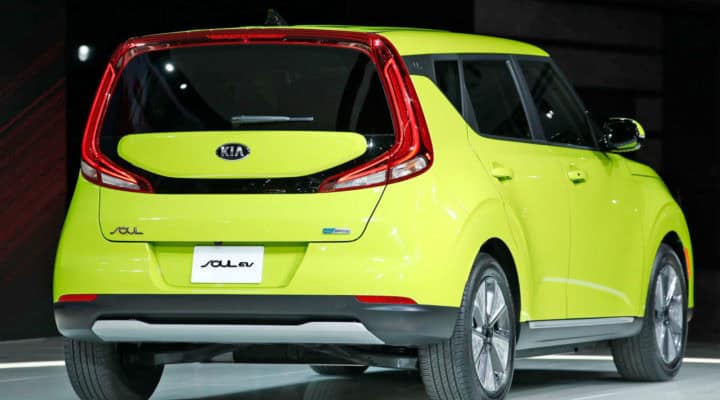
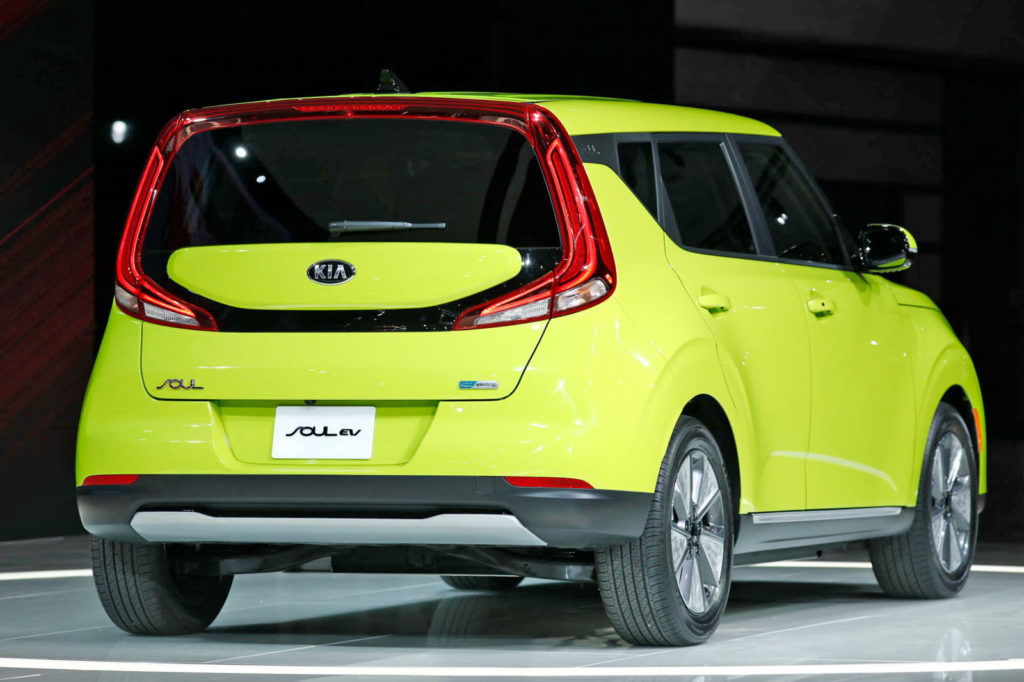
Amazon’s latest partnership with Kia could sway those weighing whether to take the plunge on an electric vehicle. Kia electric vehicle buyers can now order at-home charging units and schedule home installation through Amazon. The South Korean automaker becomes the second to partner with Amazon to sell electric charging stations, joining Audi which came onboard last year.

Customers can choose an at-home charging station and then schedule an installation with a licensed local electrician through Amazon Home Services. The partnership with Kia is strategic for Amazon, which can both leverage its Amazon Home Services unit as well as push buyers towards other brands of electric car chargers and accessories. Kia owners can choose between a $764 dollar charger from Bosch, the car’s official partner, or the slightly cheaper, Alexa-enabled Chargepoint ($699) or JuiceBox ($549). The latter brands are both WiFi-capable and rank as best-sellers on Amazon.

Expect even more automakers to join Amazon as the company makes its way in the electric vehicle market. There’s no word on which EV maker will join Audi and Kia to partner with Amazon, but chances are good it won’t be Tesla. Amazon early this year invested $700 million into Tesla competitor Rivian.

IKEA will officially reveal its first Sonos-powered speakers next month

Unlike the connected blinds, the speaker appears to be on target.

IKEA will reveal the first of its Sonos connected smart speakers at an exhibit in Milan next month. This isn’t the first we’ve seen or heard of the speaker, and we knew IKEA had plans to start selling it in the US and Europe this August. An unveiling next month seems to follow the original timeline, which is good considering IKEA just delayed the launch of its smart blinds.

The “bookshelf speaker” is the first in IKEA and Sonos’ SYMFONISK range, and a video released by the company suggests we might also see a wall-mounted version in the future. Speakers in the SYMFONISK line will be compatible with Sonos’ existing wireless speakers and with IKEA’s Home Smart lights and switches, as well as its connected blinds. The latter was delayed to allow for firmware updates that will make the blinds compatible with Alexa, Siri, and Google Assistant, so you might guess that the speakers will also work with those voice assistants. The blinds will sell for $113 and $136, but there’s no word yet on how much the speakers will cost.